





-
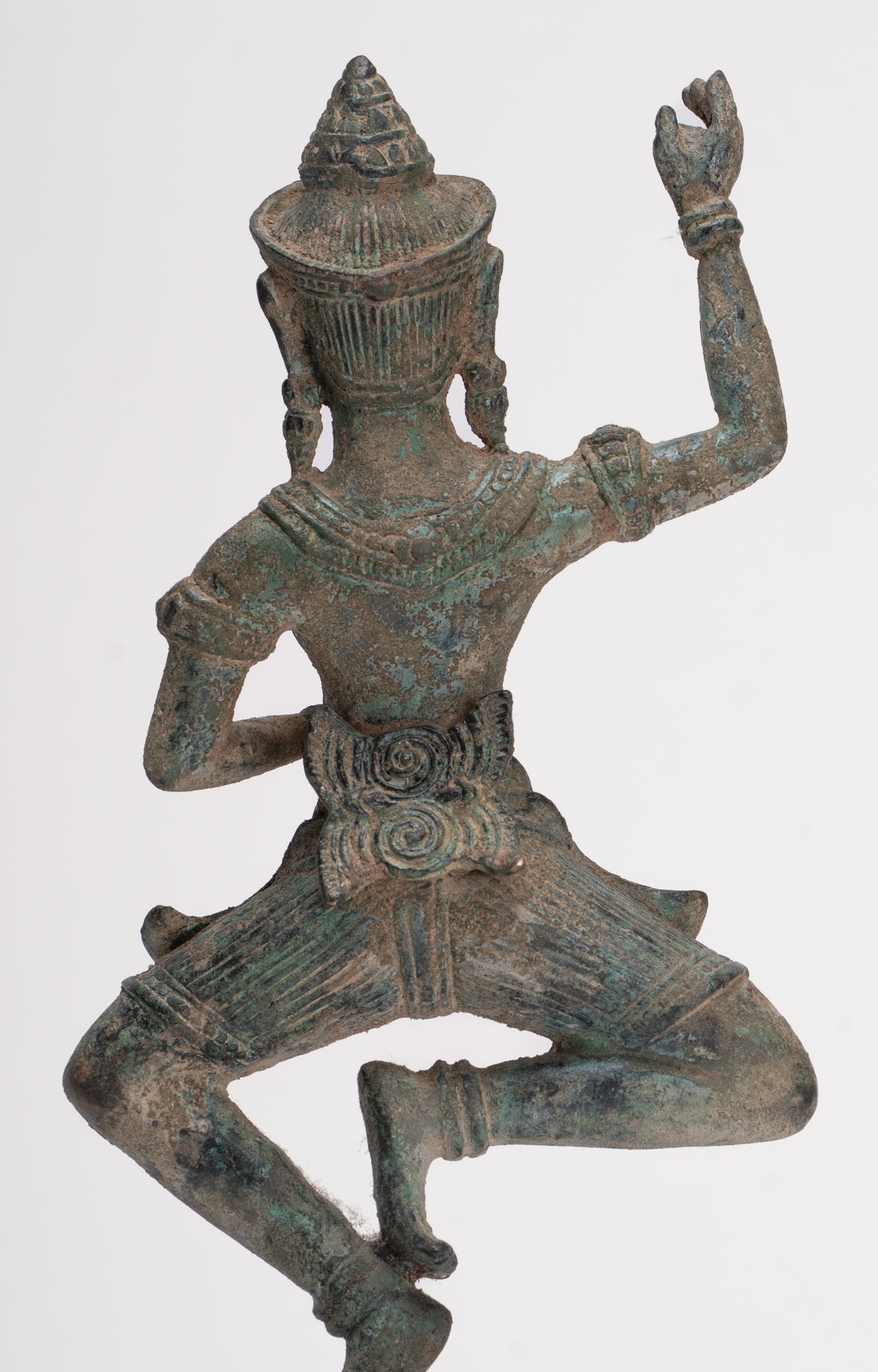
Antique Khmer Style Bronze Dancing Bayon Yoginī Statue - 26cm/10"
Standing on a Recumbent Human Figure
Measurements Height 26cm/10"
A compelling Khmer 12 century Bayon-style bronze of a dancing Yoginī, shown in an exceptionally animated and commanding ritual pose. The crowned female deity balances on one leg while the other is lifted across the body, creating a powerful sense of movement, poised control, and sacred dance. Her planted foot stands upon a recumbent human figure, an important element of tantric Buddhist imagery representing the overcoming of ignorance, attachment, and obstructive forces through awakened wisdom.
The Yoginī wears a tall tiered Khmer crown, elongated earrings, necklace, armlets, bracelets, and a finely modelled short sampot, in the Bayon style. Her sharply defined face, alert eyes, strong brows, and concentrated expression give the figure an unusual presence. One arm is raised above the shoulder in a gesture of dance or ritual power, while the other bends across the torso.
The bronze’s vigorous posture and complex spiritual symbolism are characteristic of the tantric visual culture associated with the late Angkor period and the Bayon style. Bayon sculpture is celebrated for its expressive movement, concentrated faces, richly ornamented figures, and imagery connected with Mahayana and tantric Buddhism during the reign of Jayavarman VII.
Measuring 26 cm / 10 inches high, this is a small-scale but highly dramatic work. It is particularly effective as part of a collection of Khmer, Cambodian, Buddhist, tantric, or Southeast Asian bronze sculpture.
The Yoginī
In tantric Buddhist tradition, a Yoginī is a female embodiment of awakened energy, spiritual insight, and transformative wisdom. She may appear graceful, fierce, playful, or commanding, often expressed through dance.
Here, the Yoginī’s raised-leg posture is not merely decorative. It conveys active spiritual power, balance, and the mastery of opposing forces. Her dance can be understood as the movement of wisdom: dynamic yet controlled, expressive yet centred.
The recumbent human figure beneath her foot should be read symbolically rather than literally. It represents spiritual obstacles such as ignorance, ego, attachment, fear, and negative mental states. By dancing above this figure, the Yoginī embodies the triumph of clarity and spiritual liberation over the limitations that bind ordinary consciousness.
Bayon Style
The Bayon style belongs to the late Angkor period, broadly associated with the reign of the Khmer king Jayavarman VII in the late 12th and early 13th centuries. It is closely connected with the Buddhist artistic world of Angkor Thom and the Bayon temple.
Bayon-style sculpture often differs from the more formal and restrained imagery associated with Angkor Wat. Figures can be more animated, expressive, and physically dynamic, with powerful gestures, richly articulated costume, and a heightened sense of sacred drama.
This sculpture’s dancing pose, commanding presence, Khmer crown, decorated sampot, and tantric base imagery all give it a strong Bayon-style character. Its precise date and original ritual context would require physical examination, provenance research, and specialist assessment.
Key features
-
Khmer Bayon-style bronze dancing Yoginī.
-
Depicts a female tantric Buddhist deity in a dramatic raised-leg dance pose.
-
The Yoginī stands upon a recumbent human figure.
-
Symbolic image of wisdom overcoming ignorance, attachment, fear, and spiritual obstruction.
-
Tall tiered Khmer crown with richly modelled surface detail.
-
Pendant earrings, necklace, armlets, bracelets, anklets, and waist ornament.
-
Short pleated Khmer sampot with incised decorative folds.
-
Two-armed figure with one hand raised and the other drawn across the body.
-
Expressive face with strong brows, alert eyes, and a concentrated ritual presence.
-
Rich dark bronze surface with areas of green and brown patination.
-
Strong stylistic affinity with late Angkor / Bayon tantric Buddhist imagery.
-
Measures approximately 26 cm / 10 inches high.
-
A striking addition to a collection of Khmer, Cambodian, Buddhist, tantric, or Southeast Asian art.
Frequently Asked Questions
What is a Yoginī?
A Yoginī is a female sacred being associated with spiritual practice, transformative energy, wisdom, and divine power. In tantric Buddhist traditions, Yoginīs can serve as protectors, guides, embodiments of enlightened awareness, or members of the retinue surrounding a principal tantric deity.
What does the human figure beneath her foot represent?
The figure is a recumbent human form that functions symbolically. In tantric imagery, a deity standing or dancing upon a human figure can represent the mastery of ignorance, ego, attachment, fear, and other forces that prevent spiritual awakening.
It does not necessarily refer to a particular historical person. Instead, it expresses the Yoginī’s spiritual authority and her ability to transform negative or obstructive energies.
Why is the Yoginī shown dancing?
Dance is an important expression of divine movement, spiritual energy, freedom, and transformation. The lifted leg, bent body, and raised arm create a sense of rhythmic balance and active power.
The figure is not simply performing a courtly dance. Her posture communicates a tantric form of sacred movement in which wisdom actively overcomes illusion and limitation.
Why is this not an apsara?
An apsara is a celestial dancer or heavenly female attendant. Khmer apsaras are generally shown as graceful, elegant, decorative figures associated with music, dance, paradise, and temple ornament.
Although this sculpture has a dance-like pose, its iconography is markedly different. The Yoginī’s intense expression, dramatic raised-leg stance, and position standing upon a recumbent human figure place it within a tantric and protective context rather than the courtly or celestial world of the apsara.
Why is this not Hevajra?
Hevajra is a major tantric Buddhist deity associated with late Angkor and Bayon-period religious culture. However, Hevajra is conventionally represented as a complex multi-headed and multi-armed figure, often with eight heads, sixteen arms, and four legs.
This sculpture has a single head and two arms. It is therefore not a complete image of Hevajra. Its dancing pose and tantric symbolism may nevertheless relate to the wider Hevajra tradition, in which Yoginīs appear as powerful female companions or attendants within a tantric sacred circle.
How should the Bronze be cared for?
Display the sculpture indoors on a stable surface away from direct sunlight, moisture, high humidity, and heat. Handle it from the base or the strongest central area, avoiding pressure on the raised arm, crown, lifted leg, fingers, and small human figure.
Dust gently with a soft dry brush or microfibre cloth. Avoid metal polish, wax, oil, water, abrasive cleaners, or household cleaning products, as these can alter the surface and damage the established patina.
SATISFACTION GUARANTEE - We have been offering Asian Art, through our website, for many years and are proud of the reputation we have developed for fair and honest listings. However, if for any reason, whatsoever, you are unhappy with your purchase please just let us know and we will provide a full refund. We want you to be 100% happy with your purchase.
-
-
The majority of orders will be shipped with DHL. This is a secure, express and fully tracked service.
Items less than 2Kg we typically ship using Royal Mail.
Once we receive your order we try to ship all orders the same or next working day.
Large and/or fragile pieces requiring palletising, specialist crating and/or extra packaging may take a little longer. Palletised shipments will be delivered curbside.
All orders over 35 GBP will be shipped free of charge.

-
We genuinely hope that all purchases delight.
However, if they do not, regardless of reason, we will refund all orders upon receipt of the unwanted item. Just notify us within 14 days of receiving your order that you wish to make a return and send the piece back to us with 30 days of delivery.


