



What Should an Antique Asian Sculpture Listing Include? a Collector’s Checklist
What Should an Antique Asian Sculpture Listing Include? a Collector’s Checklist
You're standing in front of a dealer's window, the piece looks right at a glance, and the card beside it tells you almost nothing useful. That's where bad purchases start.
If the sculpture is worth serious money, the listing has to do more than mention age and material, it has to prove what the object is, where it came from, what shape it's in, and whether it can legally move through the UK market.
Table of Contents
- The Twelve-Point Buyer's Checklist at a Glance
- Why Murugan and Valli Iconography Changes a Listing
- Provenance Documentation That Satisfies UK Buyers
- Condition Reports and Imaging Standards Collectors Should Expect
- Age and Origin Authentication Beyond a Date
- Material, Restoration and Reproduction Risks Most Checklists Miss
- Shipping, Import VAT and Export Licences for UK Buyers
- Red Flags That Should Stop a Purchase
The Twelve-Point Buyer's Checklist at a Glance
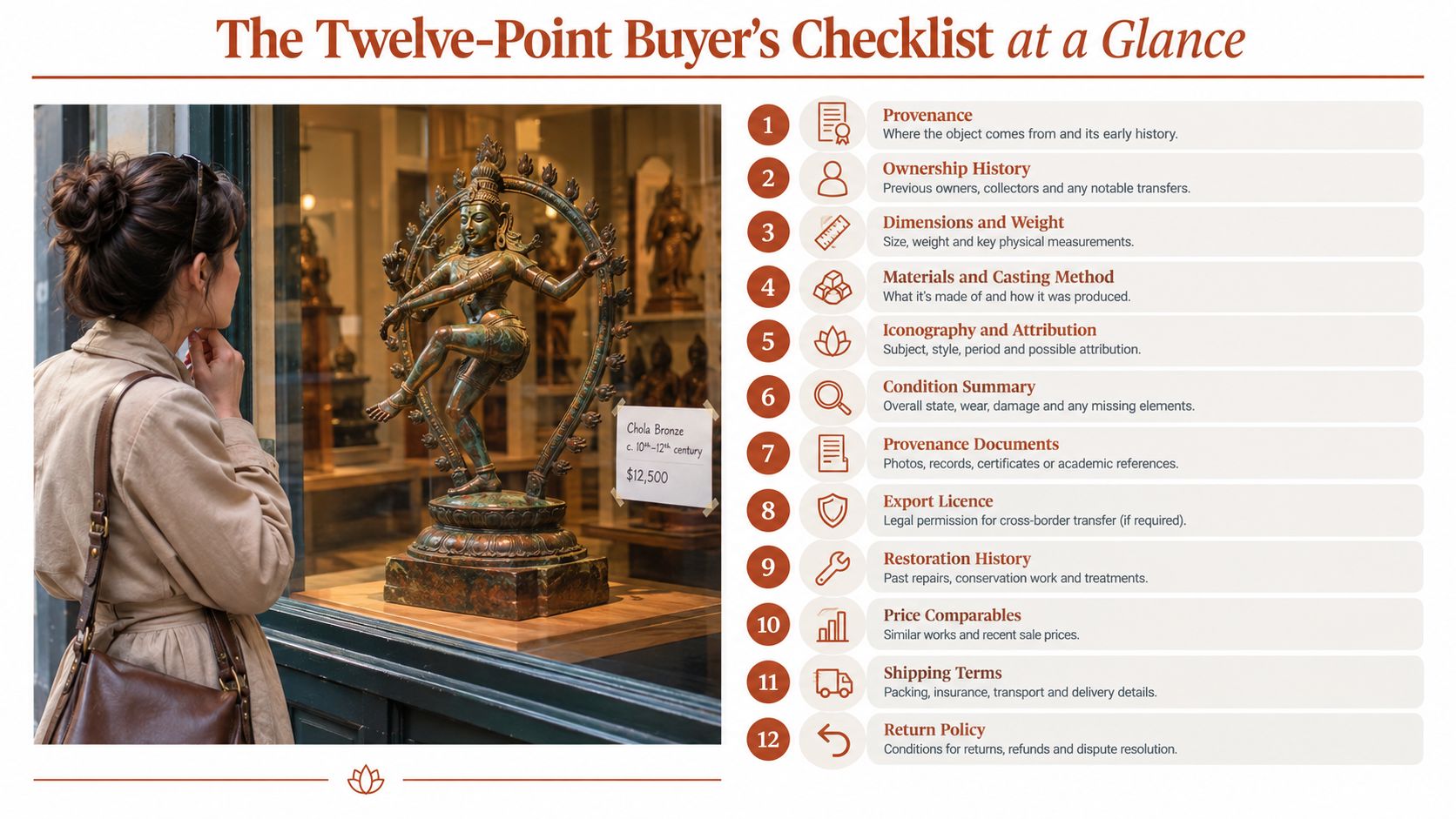
A collector looking at a Chola bronze, or any antique Asian sculpture, should not be guessing. The listing needs to answer twelve questions, in plain language and with evidence attached.
The twelve points you should insist on
- Provenance chain, who owned it, when, and with what paper trail.
- 1970 export-licence line, whether the object can be documented before the UNESCO threshold.
- Material identification, bronze, stone, wood, lacquer, mixed media, or a composite.
- Ivory status under the Ivory Act 2018, if any ivory is present, even in mounts or details.
- Condition report, cracks, losses, repairs, instability, and surface wear.
- Imaging standards, front, back, base, close-ups, and scale.
- Age authentication, stylistic, documentary, and scientific support, not just a seller's estimate.
- Iconographic specificity, the deity, pose, attributes, region, and school.
- Restoration history, what was altered, when, and by whom if known.
- Dimensions with a scale, so the object can be assessed and compared properly.
- Asking price rationale, why the figure sits where it does in relation to the object's quality and paperwork.
- Shipping terms, who insures it, who clears customs, and who carries the risk in transit.
Practical rule: if a listing can't answer at least half of those points before payment, it isn't ready for a serious buyer.
That is the shape of the whole checklist. The rest of this article breaks each item into the details that matter to a UK collector, because that's where deals get made, or fall apart.
Why Murugan and Valli Iconography Changes a Listing
Murugan isn't just “a Tamil figure” and Valli isn't decorative filler. In a serious listing, the iconography tells you whether you're looking at a devotional bronze, a paired consort figure, or a badly described object that has already been flattened into a generic label.
Read the figure, not just the silhouette
Murugan sits within the Tamil Shaiva tradition and is closely tied to the Arupadaiveedu, the six sacred abodes associated with his worship. His attributes matter. The vel weapon, the peacock mount, and related ritual markers are not optional details, they are the language of the sculpture itself. When Valli appears beside him, the sculpture reads differently again, because you're no longer dealing with a lone deity in isolation, but a paired composition with relationship, hierarchy, and balance built into the form.
A listing should name the visible markers, not hide behind a vague devotional label. The Valli on the left hip stance, a sugarcane bow, specific hand gestures, the crescent moon, and the third eye all affect attribution and collector confidence. Leave those out and the piece gets downgraded in the buyer's mind from a specific iconographic object to a generic Tamil figure, which weakens both value and confidence.
Why detail changes money
Collectors pay for accuracy. A correctly described Murugan and Valli group signals that the seller understands the tradition, the regional style, and the devotional context. An incomplete description does the opposite. It suggests the dealer hasn't looked closely enough, or doesn't want the buyer to look too closely.
A missing iconographic detail is not a minor gap. It can be the difference between a correctly identified bronze and an object the market treats with caution.
Regional schools also matter here. The same divine subject can be rendered in Chola, Vijayanagara, or Nayak idioms, and a good listing should say which visual cues support the attribution. That is the difference between scholarship and decoration, and serious collectors know it immediately.
Provenance Documentation That Satisfies UK Buyers
UK buyers do not need a charming ownership story. They need a chain of evidence. If the paperwork stops at “from a private collection”, the listing is weak and the risk sits with the buyer.
Treat provenance as a file, not a sentence
A credible provenance trail starts with dated ownership records and works backwards. UK cultural-object guidance treats provenance as a due-diligence issue, not a courtesy, and the 1970 line matters because it is the point at which export history becomes legally sensitive for many buyers and advisers. For items in the UK for less than 50 years, the expectation is clearer still, the listing should show when the object entered the UK and that it wasn't unlawfully exported from its source country or from the EU after 1 January 1993. For a collector, that means the file should contain dates, locations, and names, not just reassurance.
If the seller cannot show how the object moved, the buyer is being asked to absorb legal uncertainty as part of the price.
The documents a serious listing should carry
The object file should include dated invoices, gallery or auction receipts, any earlier catalogue entries, export licences from the country of origin where required, and customs or import paperwork where available. If the sculpture contains ivory, bone, or a restricted wood, CITES paperwork may also be relevant. The point is not to accumulate paper for its own sake, it is to show the object's legal and ownership history in a way a UK buyer can defend later.
| Document Type | What It Establishes | UK Compliance Link |
|---|---|---|
| Dated invoice | Who sold the object and when | Supports ownership chronology |
| Auction or gallery receipt | Prior market appearance and sale record | Helps reconstruct the chain of title |
| Earlier catalogue entry | Prior description and attribution | Useful for comparing identity over time |
| Export licence from origin country | Lawful exit from the source state | Critical where source-country controls apply |
| Customs or import record | Legal entry into the UK | Supports lawful movement and valuation history |
| Technical report | Material or age evidence | Strengthens due diligence when claims are contested |
For a deeper due-diligence framework, this provenance research guide for Asian antique sculpture is worth reading before funds move. The hard truth is simple, most UK transactions don't fail because the sculpture is ugly. They fail because the paper trail is thin.
Condition Reports and Imaging Standards Collectors Should Expect
A good condition report tells you what the object has survived. A bad one hides the damage in polite language. For an antique Asian sculpture, especially one headed for the UK, that's not good enough.
What the report must actually say
The report should cover structural integrity, surface condition, prior restoration, and stability concerns. That means cracks, joins, losses, abrasion, encrustation, patina consistency, repatination, overpaint, infills, replaced elements, and anything else that would change how the piece is handled, insured, conserved, or exported. The British Museum's acquisition policy makes the point clearly, objects in very poor condition, or objects liable to deterioration that can't be reliably stabilised, are not normally acquired. That's a useful benchmark for buyers too.
A seller who writes “good overall condition” and stops there hasn't done the job. Bronze may hide old joins, stone may show edge losses, and wood may carry movement, insect damage, or lacquer instability. Those are not cosmetic notes, they're structural facts.
Imaging that tells the truth
Photographs have to show the full object, not just the flattering side. Ask for front, reverse, base, both profiles, macro details, and a scale reference. Lighting should be neutral, with high-resolution images, raking light for texture, and a colour reference card if the surface matters. If there are repair lines, cast seams, tool marks, or areas of repatinated bronze, those details need close-ups.
If a dealer avoids the reverse, the base, or damaged angles, assume there's a reason.
The visual record should let you compare what you see against the written description. That is especially important where a sculpture might be collected, conserved, or exported, because a weak image set makes the whole file look thin. For a buyer, the right question isn't “Does it look good?” It's “Does the photographic set expose enough to make a decision?”
If you want a practical framework for judging what a proper report looks like, this guide to how Asian sculpture condition is assessed is the right kind of baseline.
Age and Origin Authentication Beyond a Date
A seller's date estimate is the weakest part of the file unless it sits beside other proof. Serious buyers want more than a style label and a confident tone.
Four lines of evidence, not one
The first line is stylistic attribution. Useful, yes, but weak on its own. The second is scientific testing, which can support the claimed period depending on the material. The third is documentary evidence, meaning ownership records, publication history, and earlier listings. The fourth is export-licence corroboration, because lawful movement often tells you more than a decorative description does.
For ceramics, thermoluminescence can help support age claims. For bronze, metallurgical analysis may reveal alloy composition and construction clues. For organic materials, carbon dating can assist when the object type makes it appropriate. For pigments, XRF can help identify the materials present. None of these methods is magic, but each carries evidentiary weight when a collector, insurer, or customs authority challenges the date.
How to read the strength of the claim
A listing based on style alone is a suggestion. A listing backed by one independent scientific line is stronger. A listing that combines a supported material analysis, a documented history, and export paperwork is the kind of file a serious buyer can rely on. That's the standard that matters, not the seller's confidence.
| Method | Best For | Strength of Evidence |
|---|---|---|
| Stylistic attribution | Preliminary dating and regional comparison | Weak unless backed by other evidence |
| Thermoluminescence | Ceramics | Strong for suitable ceramic objects |
| Metallurgical analysis | Bronze and other alloys | Strong for construction and material clues |
| Carbon dating | Organic materials | Strong where the material type allows it |
| XRF pigment analysis | Painted or decorated surfaces | Strong for materials, not a full date by itself |
Certificates older than ten years should be revalidated before purchase, because stale paperwork can't be treated as current assurance. Buyers who ignore that point usually discover it too late, after the object has already become a problem.
Material, Restoration and Reproduction Risks Most Checklists Miss
Most checklists stop at style, which is where careless buyers get caught. Material risk and reproduction risk are where the biggest errors happen.
Watch for hidden restricted materials
An antique sculpture can look harmless and still trigger serious legal trouble if it contains ivory, even inside mounts, trim, or small decorative sections. Under the Ivory Act 2018, dealing in ivory items requires an exemption, and the law allows only five exempt categories, including pre-1918 items of outstanding artistic, cultural or historical value, pre-1947 items with low ivory content, pre-1975 musical instruments, and acquisitions by qualifying museums. That is not background noise. It's a real compliance issue for collectors in the UK.
The same caution applies to mixed-media objects with coral, bone, or restricted hardwoods. If the listing does not say what the sculpture is made from, the buyer is left carrying the risk.
Reproduction signs you should not ignore
Modern lost-wax bronzes from Tamil Nadu and Chiang Mai are regularly passed off as older material. So are resin casts, plaster copies, and pieces with artificially aged patinas created through chemicals or burial techniques. A serious listing should answer five questions before the buyer even thinks about payment.
- Casting method: Is there evidence of lost-wax production, and does it match the claimed period?
- Weight and seams: Does the object behave like a hand-cast antique, or like a modern replica?
- Core material: What sits beneath the surface?
- Patina chemistry: Does the surface read naturally, or too uniformly?
- Repair history: What has been replaced, overpainted, or reworked?
A piece that fails those checks isn't a bargain, it's a liability. Once style, material, and restoration are all uncertain at the same time, the buyer should assume the object is not ready for purchase. That's not caution, that's basic self-protection.
Shipping, Import VAT and Export Licences for UK Buyers
Once the object is agreed, the logistics need to be clean. If the documents are sloppy at this stage, the deal can still unravel at the border.
The sequence that keeps a purchase moving
Start with a fine-art shipper that understands crating, climate control, and fragile surfaces. Appoint a customs broker who can handle the paperwork without improvising. Then make sure the invoice, packing list, export records, and insurance details travel together from the point of export to UK arrival.
For import treatment, the UK customs rule that matters is the 100-year antique test. Works of art, collectors' items, and antiques imported into mainland Great Britain from EU states have been subject to 5% import VAT since 1 January 2021, and the same treatment also applies to imports from the rest of the world, where the qualifying evidence is in place. UK customs guidance also distinguishes antiques from ordinary decorative objects by age and classification under heading 9706. If the object doesn't meet the age evidence test, don't assume the reduced treatment applies.
Documentary proof beats verbal assurance every time at the border.
What should travel with the consignment
A UK buyer should expect the commercial invoice, packing list, air-freight or sea-freight waybill, insurance valuation, and destination clearance agent details. If a source country requires an export permit, that belongs in the file too. If the piece contains protected organic material, a CITES permit may also be relevant. For a quick overview of the customs-declaration process, Matil's customs declaration guide is a useful reference point when you're checking the paperwork sequence.
For a Tamil bronze or sandstone Murugan group, the paperwork should be ready before shipment leaves. The buyer should not be improvising clearance after the fact. That is how delays, charges, and avoidable disputes begin.
Red Flags That Should Stop a Purchase
Some warning signs don't deserve debate. They deserve a hard stop.
The deal should die if you see any of these
- No pre-1970 provenance in writing, especially if the seller can only offer a story.
- Missing or inconsistent measurements, because sloppy dimensions usually mean sloppy identity.
- Condition photos that avoid specific areas, especially the base, reverse, hands, and joins.
- Suspiciously uniform patina on stone or bronze, which can signal artificial ageing.
- Valli poses that break traditional iconographic rules, because the subject may be misread or misdescribed.
- Export paperwork dated after the object supposedly left its source country, which makes the timeline collapse.
- Vague ownership language, such as “from a private European collection”.
- Resistance to thermoluminescence testing where the material type makes it relevant.
- Any indication of ivory, rhinoceros horn, or restricted hardwoods, because the legal exposure is too high.
The UK market is not forgiving when a buyer can't show lawful due diligence. An undocumented object can be seized under cultural-property rules, and ivory involvement can create criminal liability under the Ivory Act 2018. That is reputational damage, legal risk, and financial loss in one package.
For a fast screen, ask five questions before you wire funds. Can I see the provenance chain? Can I verify the material? Do the photos show the whole object? Is the age claim backed by more than style? Do the shipping and import documents make sense? If any answer is weak, walk away.
For a short list of warning signs collectors should already know, this red-flag guide for fake Buddha statues reinforces the same principle, weak paperwork is a reason to stop, not negotiate harder.
HD Asian Art curates Asian sculpture with object descriptions, provenance notes, and shipping information that collectors can review before committing. If you're comparing a listing against the standards in this checklist, visit HD Asian Art and ask for the object file before you buy.
