





-
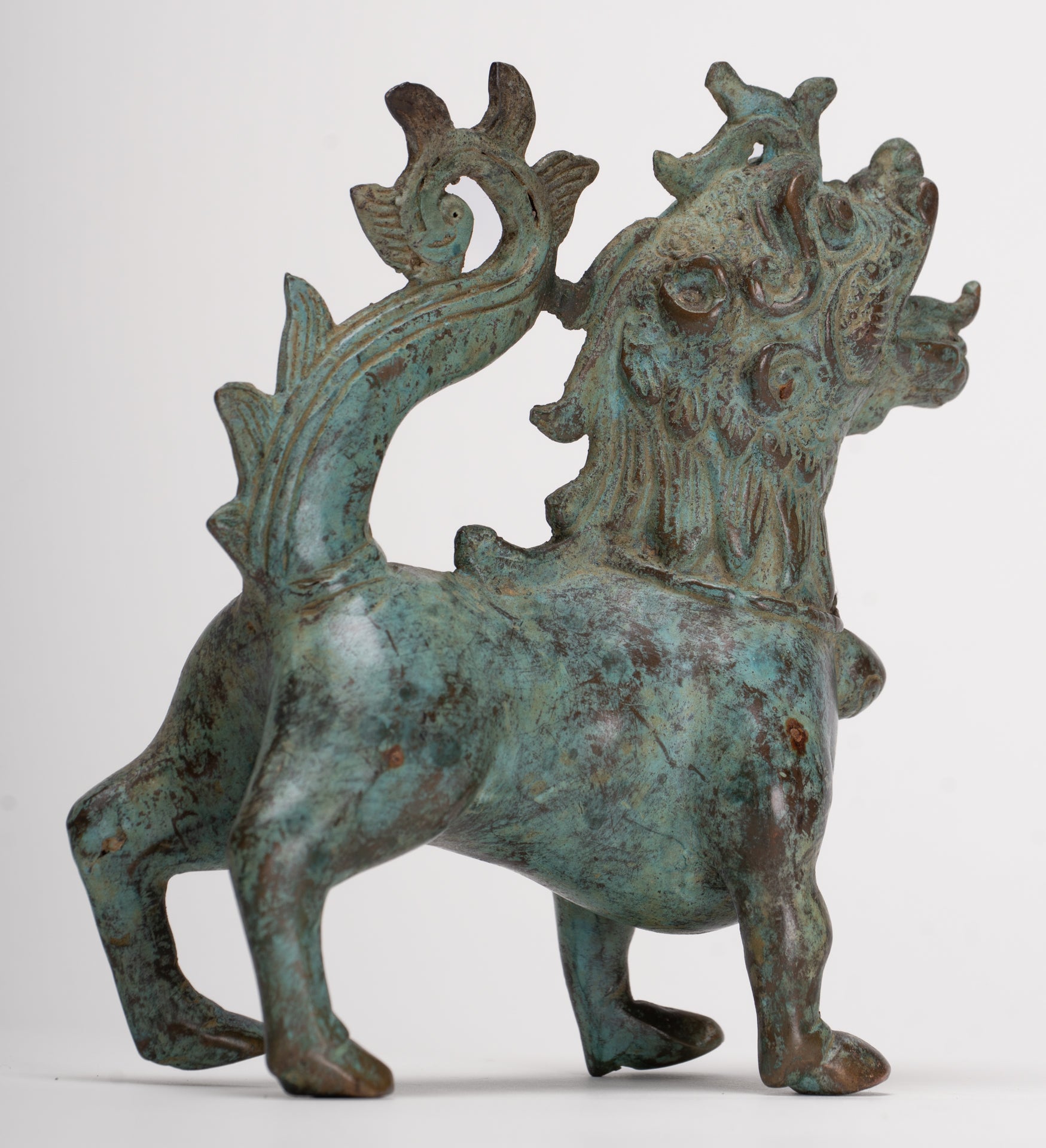
Antique Indonesian Style Bronze Singha Temple Guardian or Lion - 14cm/6"
Possibly an Architectural or Ritual Finial
Measures (Height) 14cm/6"
A striking Indonesian bronze Singa, or temple guardian lion, rendered in a highly expressive Javanese style. Compact in scale yet full of movement, the creature advances in a lively, prancing stance, with its head raised, mouth open in a protective roar, and elaborate openwork tail sweeping upward in a dramatic flourish.
At 14 cm / 6 inches high, this is not a conventional monumental temple lion of the type placed in pairs beside a gateway. Instead, its small scale, complex silhouette, and decorative openwork suggest that it may have served as an architectural or ritual finial—perhaps associated with a shrine, temple fitting, ceremonial object, or ornamental devotional element.
The bronze is richly modelled with curling mane details, flame-like scrollwork, upright ears, strong paws, and a powerful stylised head. Its body is deliberately imaginative rather than naturalistic. In Javanese Hindu-Buddhist art, the lion was not a direct observation of a local animal, but a sacred guardian created through Indian artistic influence, regional mythology, and the visual language of Java’s temples and ritual arts.
The surface displays a beautifully variegated patina of dark brown, turquoise, green, and blue-green tones. These colours bring depth to the creature’s mane, face, curving tail, and muscular body, while enhancing its sense of age and character.
The Singa as sacred guardian
The word Singa derives from the Sanskrit siṃha, meaning lion. Lions were important protective beings in Hindu-Buddhist art across South and Southeast Asia, despite the fact that lions were not native to the Javanese archipelago.
In Javanese sacred art, the lion became a powerful symbolic guardian of thresholds, temples, shrines, thrones, ritual objects, and sacred spaces. It was often combined with stylised vegetal forms, flame-like motifs, and hybrid features that make it appear more mythical than naturalistic.
This sculpture’s fierce yet animated appearance reflects that role. The open mouth, projecting tongue, curling mane, and raised tail do not represent aggression alone. They signal alertness, protection, authority, and the ability to repel harmful or chaotic forces.
Pairs of Singa sculptures traditionally guarded important temple entrances, while smaller lion forms could appear as architectural ornaments, support figures, throne decorations, finials, or ritual attachments. The present work’s scale and openwork construction make a finial or related decorative ritual function a particularly plausible interpretation. Comparable Central Javanese bronzes in museum collections combine lions and makaras in objects catalogued as architectural finials.
Javanese Hindu-Buddhist style
The sculpture belongs to the rich artistic tradition of Indonesia, where Hindu and Buddhist imagery was adapted into distinctive local forms. Java became one of Southeast Asia’s great centres of temple building, bronze casting, stone carving, and sacred ornament.
The Singa in Javanese art is rarely a realistic lion. Instead, artists created a powerful mythic being with a broad muzzle, exaggerated eyes, curling mane, prominent ears, and energetic tail. These forms often share visual affinities with makaras—hybrid aquatic guardians with crocodilian, elephantine, serpent, bird, fish, or lion-like elements.
Although the present creature has imaginative hybrid characteristics, it is best described as a guardian lion rather than a standard makara. A makara is generally more overtly aquatic and composite, whereas this figure’s strong body, mane, paws, and roaring head make the Singa identification more persuasive.
Surface and display
The bronze carries a compelling layered surface, with green and turquoise patina developing across a dark brown ground. The variation gives particular emphasis to the raised coils of the mane, the openwork tail, the face, and the paws.
This is an object best displayed indoors, on a secure and level surface. Its tail, ears, mouth, and other projecting details should be handled with care. Do not lift it by the tail or head; support it from the strongest central body area and lower legs.
Key Features
-
Indonesian bronze Singa or temple guardian lion.
-
Height: 14 cm / 6 inches.
-
Javanese-style Hindu-Buddhist guardian sculpture.
-
Possibly an architectural ornament, shrine fitting, ritual attachment, or finial.
-
Dynamic prancing or advancing stance.
-
Open roaring mouth with projecting tongue.
-
Strongly stylised head, curling mane, prominent ears, and expressive facial features.
-
Dramatic openwork tail formed with flame-like, vegetal, and scrolling ornament.
-
Mythic rather than naturalistic interpretation of the lion.
-
Associated with protective symbolism, sacred thresholds, temple guardianship, and spiritual authority.
-
Rich dark brown, turquoise, green, and blue-green patina.
-
An unusual addition to a collection of Indonesian, Javanese, Hindu-Buddhist, ritual, or Southeast Asian bronze art.
FAQs
What is a Singa?
A Singa is the Indonesian and Javanese term for a lion, derived from the Sanskrit word siṃha. In Javanese Hindu-Buddhist art, the Singa is a sacred guardian figure rather than a naturalistic depiction of a lion.
It is associated with protection, authority, strength, sacred thresholds, temples, and the defence of holy places.
Is this a temple guardian lion?
It is best described as a Javanese-style temple guardian lion. However, because of its compact 14 cm / 6 inch scale, it was probably not a large entrance guardian in the usual architectural sense.
The openwork tail and decorative profile suggest that it may have been an architectural ornament, ritual fitting, finial, or component of a shrine-related object.
Is it a makara?
Probably not in the strict iconographic sense. A makara is a hybrid aquatic creature, often combining crocodile, elephant, fish, serpent, bird, and other animal features.
This bronze shares the imaginative and hybrid energy found in Javanese makara ornament, but its body, mane, paws, and roaring lion-like head make Singa guardian lion the more appropriate primary identification.
Why does the lion look unlike a real lion?
Lions were not native to Java. Javanese artists developed their own sacred interpretation of the lion from Indian artistic models, temple symbolism, and local visual traditions. As a result, the Singa often has a broad stylised muzzle, exaggerated mane, curling scrolls, unusual ears, and an elaborate flame-like tail.
What does the openwork tail represent?
The tail is highly decorative, combining vegetal, flame-like, and scrolling forms. It enhances the creature’s supernatural appearance and may have helped the object function visually as a finial or ornamental attachment.
It should be viewed as part of the Javanese tradition of transforming animal forms into dynamic sacred ornament.
What does the green patina indicate?
The green and turquoise tones are part of the bronze’s present patina. They may reflect long-term oxidation, environmental exposure, handling, historic surface treatment, or a combination of these factors.
Patina alone cannot establish an exact date or archaeological origin, but it contributes greatly to the sculpture’s visual character.
How should I care for this bronze Singa?
Display the sculpture indoors on a stable, level surface, away from direct sunlight, high humidity, moisture, and heat sources. Handle it by the central body and lower legs, not by the tail, ears, head, mouth, or projecting ornament.
Dust gently with a soft, dry brush or microfibre cloth. Do not use metal polish, oils, waxes, solvents, abrasive cloths, or household cleaning products, as these may damage the patina and cast detail.
SATISFACTION GUARANTEE - We have been offering SE Asian Art for many years and are proud of the reputation we have developed for fair and honest listings. However, if for any reason, whatsoever, you are unhappy with your purchase please just let us know and we will provide a full refund. We want you to be 100% happy with your purchase.
-
-
The majority of orders will be shipped with DHL. This is a secure, express and fully tracked service.
Items less than 2Kg we typically ship using Royal Mail.
Once we receive your order we try to ship all orders the same or next working day.
Large and/or fragile pieces requiring palletising, specialist crating and/or extra packaging may take a little longer. Palletised shipments will be delivered curbside.
All orders over 35 GBP will be shipped free of charge.

-
We genuinely hope that all purchases delight.
However, if they do not, regardless of reason, we will refund all orders upon receipt of the unwanted item. Just notify us within 14 days of receiving your order that you wish to make a return and send the piece back to us with 30 days of delivery.


