


-
Antique Khmer Style Stone Sanskrit Inscribed Stele with Nandi - 54cm / 22"
Sacred Bull of Shiva on a Lotus Throne
Measures - (Height) 54cm/22" (Weight) 20.1kg/44.3 lbs
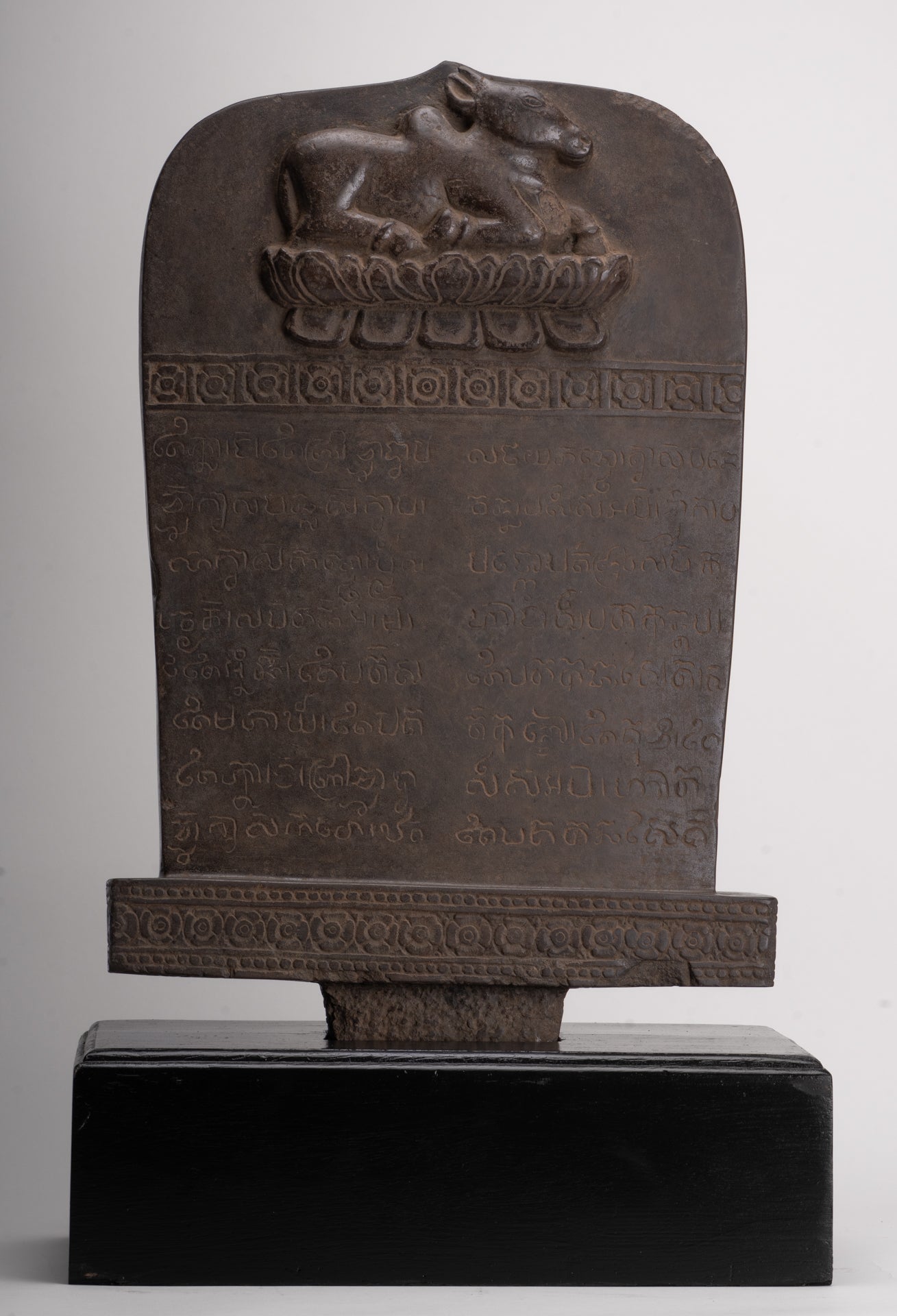
A handsome antique Khmer-style stone stele surmounted by a relief of Nandi, the sacred bull and devoted vehicle of Shiva. Measuring approximately 54 cm / 22 inches high, the stele is carved in a traditional arched format, with the recumbent bull placed prominently above a lengthy engraved inscription.
Nandi reclines calmly upon a stylised lotus throne, his body modelled with gently rounded volume and his head turned slightly outward. Beneath him, a decorative band of geometric floral motifs separates the sacred image from the inscription panel, whose lines of Khmer-style script form the principal body of the stele. A further patterned register runs along the lower edge, giving the composition a pleasing architectural balance.
The combination of devotional relief, lotus throne, ornamental borders, and formal inscription reflects the enduring Khmer tradition of religious stelae. The stone has a naturally varied dark brown-grey surface, with softened edges and an appealing sense of age. It is loosely mounted on a later black wooden display base for secure presentation.
The stele is similar in style to Catalogue Item 1760 in the National Museum of Cambodia, Phnom Penh. Comparable examples feature a rounded-top sandstone slab, a reclining Nandi on a lotus throne, and a substantial ancient Khmer inscription below.
Nandi: Sacred bull of Shiva
Nandi is Shiva’s sacred bull, vahana—or divine vehicle—and foremost devotee. His name is commonly translated as “joy,” “delight,” or “bliss,” and he is one of the most recognisable figures of Shaivite tradition. A Shiva temple commonly includes a seated Nandi placed on the central axis before the sanctuary, directing the worshipper’s attention toward Shiva’s presence within.
More than a companion animal, Nandi represents the ideal devotee: steady, patient, disciplined, devoted, and completely attentive to the divine. His reclining, alert posture conveys quiet strength rather than passivity. In symbolic terms, he embodies the individual soul oriented toward the highest reality.
As a bull, Nandi also carries associations of strength, virility, fertility, agricultural prosperity, and the vital forces that sustain life. His union with Shiva brings these natural powers into a spiritual framework of order, self-mastery, and devotion.
The lotus and inscription
Nandi is shown resting on a lotus throne. The lotus is one of Asia’s most enduring sacred symbols: it rises from muddy water yet flowers cleanly above it, and thus represents purity, renewal, compassion, spiritual awakening, and the possibility of transcendence amid worldly life.
The inscription is executed in a Khmer-style script. Its exact language, date, content, and historical purpose should not be asserted without formal epigraphic translation and examination. Khmer religious stelae may contain Sanskrit, Old Khmer, or a combination of both; across Cambodia, inscriptions in these languages were used over many centuries to record religious foundations, donations, temple obligations, land, ritual provisions, and acts of patronage.
Key features
-
Antique Khmer-style stone inscribed stele with Nandi relief.
-
Measures approximately 54 cm / 22 inches high.
-
Recumbent Nandi, the sacred bull and vahana of Shiva.
-
Nandi shown reclining on a stylised lotus throne.
-
Arched-top stele form with a harmonious, temple-inspired composition.
-
Substantial engraved Khmer-style inscription panel.
-
Decorative floral and geometric register beneath the Nandi relief.
-
Lower border with repeating foliate and rosette-like ornament.
-
Nandi symbolises devotion, loyalty, strength, discipline, fertility, and spiritual focus.
-
Lotus represents purity, compassion, renewal, and spiritual awakening.
-
Naturally varied dark grey-brown stone surface.
-
Loosely mounted on a later black wood base for display.
-
Similar in style to Catalogue Item 1760 at the National Museum of Cambodia, Phnom Penh.
-
Provenance: Ex-private Edinburgh, UK collection.
-
Certificate of Authenticity available on request.
Frequently Asked Questions
Who is Nandi?
Nandi is the sacred bull of Shiva, one of Hinduism’s principal deities. He is Shiva’s vahana, or divine vehicle, and is also revered as Shiva’s guardian, attendant, and ideal devotee.
Nandi’s name is associated with joy or bliss. In temple imagery, he represents unwavering devotion and the focused attention of the worshipper directed toward Shiva.
Why is Nandi shown lying down?
Nandi is traditionally represented as a calm, recumbent bull, often facing the main sanctuary or Shiva linga in a temple. His settled yet attentive posture symbolises discipline, patience, steadfastness, and continuous devotion.
The V&A notes that a seated Nandi occupies a central axial position in Shaiva temples, focusing the faithful toward the sanctum, while a standing Nandi is generally associated with his role as a processional vehicle.
What does the lotus beneath Nandi mean?
The lotus is a sacred symbol of purity, spiritual renewal, compassion, and awakening. Because it rises cleanly from muddy water, it signifies the possibility of inner clarity and transcendence within the conditions of ordinary life.
As Nandi’s throne, it elevates him from an animal companion to a sacred attendant of Shiva and reinforces the devotional purpose of the stele.
Is the inscription Sanskrit?
The inscription is described as Sanskrit, but a confident reading of its exact language, date, and content would require expert epigraphic translation. The script visible on the stele is Khmer-style, and historic Cambodian inscriptions can be written in Sanskrit, Old Khmer, or in a mixture of the two.
For careful cataloguing, it is best to describe it as an inscribed Khmer-style stele, traditionally described as Sanskrit, unless a published translation or specialist report accompanies the object.
What might the inscription record?
Inscribed stelae in Khmer religious settings can commemorate the foundation or endowment of a temple, a dedication to a deity, donations of land or goods, ritual duties, the appointment of temple personnel, or the religious merit of a patron.
Without a translation, it is not possible to identify this stele’s specific message. Its visual combination of Nandi and inscription does, however, strongly suggest a Shaivite devotional context.
Is the wood base original?
No. The black wood base is a later display mount. It is intended to provide stability and enable secure presentation of the stone stele.
How should this stele be cared for?
Display the stele indoors on a secure, level surface, well away from direct sunlight, high humidity, fireplaces, radiators, and abrupt changes in temperature. Ensure that the base is properly supported, as stone is heavy and the mounted form should not be moved by lifting the upper slab alone.
Dust gently with a soft, dry natural-bristle brush. Avoid water, oils, wax, polish, abrasive materials, or household cleaners, as these may stain porous stone, alter the surface, or fill fine inscription lines.
SATISFACTION GUARANTEE - We have been offering SE Asian Art for many years and are proud of the reputation we have developed for fair and honest listings. However, if for any reason, whatsoever, you are unhappy with your purchase please just let us know and we will provide a full refund. We want you to be 100% happy with your purchase.
-
-
The majority of orders will be shipped with DHL. This is a secure, express and fully tracked service.
Items less than 2Kg we typically ship using Royal Mail.
Once we receive your order we try to ship all orders the same or next working day.
Large and/or fragile pieces requiring palletising, specialist crating and/or extra packaging may take a little longer. Palletised shipments will be delivered curbside.
All orders over 35 GBP will be shipped free of charge.

-
We genuinely hope that all purchases delight.
However, if they do not, regardless of reason, we will refund all orders upon receipt of the unwanted item. Just notify us within 14 days of receiving your order that you wish to make a return and send the piece back to us with 30 days of delivery.


