



Hindu Deity Attributes and Symbols List
Hindu Deity Attributes and Symbols List
Table of Contents
The Trimurti: Brahma, Vishnu, and Shiva
The Trimurti represents the three primary manifestations of the divine in Hindu philosophy: Brahma the creator, Vishnu the preserver, and Shiva the destroyer and transformer. Each god embodies distinct cosmic functions and carries symbolic representations consistent across centuries of Hindu tradition.
Brahma, the creator, is depicted with four heads and four arms, symbolizing omniscience. He holds a Vedas manuscript representing knowledge and a rosary symbolizing time and cycles. His swan vehicle represents wisdom, though he receives far fewer temples and worshippers than Vishnu or Shiva.
Vishnu, the preserver, maintains universal order and harmony. Depicted in blue skin, he holds a conch shell, discus, mace, and lotus flower. His eagle mount Garuda symbolizes courage and strength. Vishnu is believed to incarnate on Earth whenever cosmic balance is threatened, with Krishna and Rama among his celebrated avatars.
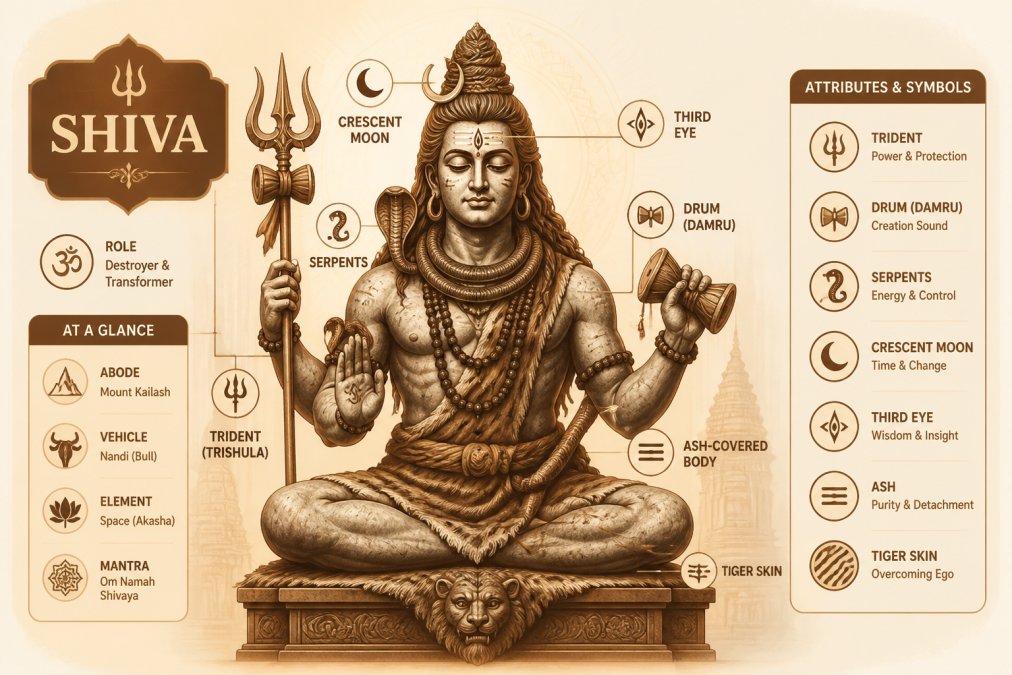
Shiva completes the triad as the destroyer and transformer. Depicted with a crescent moon on his forehead and a third eye between his brows, he represents both destruction and regeneration. His attributes include the trident, drum, and serpents coiled around his neck. The ash on his body symbolizes purification through destruction.
Meaning of Hindu God Symbols Across the Pantheon
Hindu iconography operates as a visual language where each object, gesture, and characteristic conveys spiritual meaning. The symbols associated with deities communicate their roles, powers, and philosophical principles.
Sacred Weapons and Objects
Sacred weapons and objects represent divine power and cosmic principles. The chakra (discus) symbolizes the wheel of time and righteousness, representing Vishnu's power to maintain cosmic order. The trishula (trident), Shiva's primary weapon, embodies the three aspects of consciousness: creation, maintenance, and destruction.
The shankha (conch shell) produces the sacred sound "Om" and symbolizes purity and cosmic vibration. The padma (lotus flower) symbolizes spiritual awakening and purity emerging from worldly ignorance. The gada (mace) represents divine strength and protection. The damaru (two-headed drum) held by Shiva represents the sound of creation and cosmic rhythm. Serpents, particularly the cobra, symbolize kundalini energy and divine power.
| Sacred Object | Meaning | Primary Deity Association |
|---|---|---|
| Chakra | Wheel of time, cosmic order | Vishnu, Krishna |
| Trishula | Trinity of consciousness, destruction | Shiva |
| Shankha | Cosmic sound, purity | Vishnu, Krishna |
| Padma | Spiritual awakening, purity | Lakshmi, Saraswati, Brahma |
| Gada | Divine strength, protection | Hanuman, Krishna |
| Serpent | Kundalini, divine power | Shiva, Kali |
Vahana (Vehicle) Symbolism
Each major deity's vahana (vehicle or mount) carries profound symbolic meaning, reflecting the deity's essential nature and cosmic function. Garuda, the eagle who serves as Vishnu's mount, symbolizes courage, swiftness, and the triumph of good over evil. Nandi, the bull who serves Shiva, represents strength, fertility, and steadfast devotion. The lion ridden by Durga and Kali symbolizes fierce divine power and the destruction of ego and ignorance.
Saraswati rides the swan, symbolizing the goddess's power to distinguish knowledge from ignorance. The peacock, Murugan's mount, represents beauty, grace, and transformation. The mouse that serves as Ganesha's vehicle symbolizes humility and the ability to navigate through obstacles.
Color Symbolism in Iconography
Colors in Hindu deity iconography carry specific spiritual meanings. Blue represents infinity, the cosmic void, and transcendence. Krishna and Vishnu are depicted with blue skin, symbolizing their connection to the infinite. Red signifies courage, strength, and divine energy. Goddesses like Durga and Kali often wear red, representing their fierce protective power. White symbolizes purity, peace, and knowledge. Saraswati typically appears in white, representing the clarity of knowledge. Yellow or gold represents prosperity, auspiciousness, and divine light. Black or dark blue in Kali's depiction represents the formless, infinite nature of consciousness. Green represents fertility, growth, and renewal.
Why Do Hindu Gods Have Multiple Arms
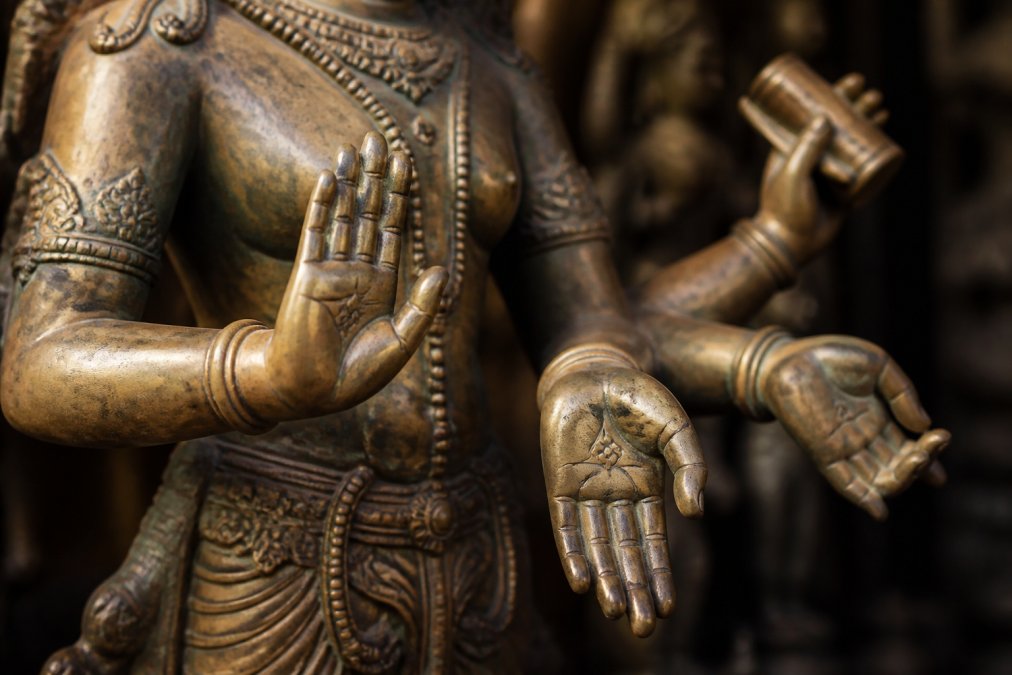
Hindu deities frequently appear with multiple arms, sometimes four, six, eight, or more. This artistic convention represents divine omnipotence and the simultaneous expression of multiple cosmic functions. Multiple arms allow a deity to hold several sacred objects simultaneously, each representing different aspects of their divine power.
Durga, depicted with ten arms, holds weapons in some hands and gestures of blessing in others, representing her capacity to both destroy evil and protect her devotees simultaneously. Four arms commonly appear on major deities like Vishnu and Brahma, representing the four directions or four Vedas. Eight arms frequently appear on warrior goddesses, representing the eight directions and infinite cosmic power.
Multiple arms serve a practical narrative function in Hindu art, allowing artists to depict a deity's various attributes, weapons, and gestures within a single composition. The concept reflects Hindu philosophy's understanding that divine consciousness is not limited by the constraints of physical form.
Hindu Deity Mudras and Meanings
Mudras are sacred hand gestures that carry specific spiritual meanings in Hindu tradition. The Abhaya mudra (gesture of fearlessness) shows an open palm raised at shoulder height, conveying protection and reassurance. The Varada mudra (gesture of blessing) shows an open palm facing outward at waist level, representing the granting of wishes and divine grace.
The Gyan mudra (gesture of knowledge) involves touching the thumb and index finger together while the other three fingers extend upward, representing wisdom and enlightenment. The Dhyana mudra (meditation gesture) shows both hands in the lap, palms facing upward, representing deep meditation and inner peace. The Anjali mudra (prayer gesture) brings both palms together at chest level, representing the unity of individual consciousness with divine consciousness. The Bhairavasana mudra shows a fierce gesture associated with Shiva and Kali, representing the destruction of ignorance and ego. The Kartari mudra (scissor gesture) represents the cutting through of illusion and duality.
Major Deities and Their Iconic Attributes
Understanding the specific attributes associated with major deities provides insight into their cosmic roles and the spiritual principles they embody.
Lord Shiva: The Destroyer and Transformer
Shiva represents consciousness itself and the power of transformation through destruction. The crescent moon adorning his forehead represents the mind, while his third eye symbolizes higher consciousness and the power to see beyond ordinary perception. When Shiva opens his third eye, it releases cosmic fire capable of destroying entire universes.
Shiva's hair is typically depicted as matted locks adorned with the Ganges River, which he caught in his hair to prevent its destructive descent to Earth. Serpents coil around his body, representing kundalini energy and mastery over primal forces. His ash-colored skin symbolizes purification through destruction and transcendence of material concerns.
His primary attributes include the trishula (trident), representing the three aspects of consciousness. The damaru (drum) symbolizes creation through cosmic vibration. The gada (mace) represents divine power and protection. The pashupash (noose) signifies his capacity to bind and control cosmic forces. Shiva's bull mount, Nandi, represents strength and steadfast devotion. In his form as Nataraja (the cosmic dancer), Shiva performs the dance of creation and destruction, with one foot raised in a dancing motion while the other stamps on the demon of ignorance.
Lord Vishnu: The Preserver
Vishnu maintains cosmic order and harmony, intervening whenever dharma (righteous law) is threatened. Depicted with blue skin representing infinity and the cosmic void, Vishnu embodies transcendence while remaining intimately involved in worldly affairs. His four arms hold the four primary attributes that define his cosmic function.
The chakra (discus) in his upper right hand represents his power to maintain order and cut through ignorance. The shankha (conch) in his upper left hand produces the sacred sound that calls all beings to righteousness. The padma (lotus) in his lower left hand symbolizes purity and spiritual awakening. His lower right hand displays the Varada mudra, the gesture of blessing and boon-granting. Vishnu wears a crown symbolizing his sovereignty and divine authority. His mount, Garuda the eagle, represents courage and the triumph of good over evil.
Vishnu's significance extends through his ten major avatars, or incarnations, in which he takes physical form to restore cosmic balance. Krishna and Rama embody different aspects of Vishnu's nature. Krishna represents divine love and the complexity of dharma in human relationships, while Rama exemplifies the perfect adherence to duty and righteous conduct.
Goddess Devi: The Divine Feminine
Devi represents the supreme feminine principle in Hinduism, manifesting in countless forms ranging from gentle and nurturing to fierce and destructive. As Shakti, she is the creative energy that animates all existence. Without Shakti, even Shiva remains inert and powerless.
Devi's manifestations include Saraswati, the goddess of knowledge and the arts, typically depicted in white with a swan mount and a stringed instrument called the veena. Lakshmi, the goddess of prosperity and abundance, appears in gold and red, holding lotus flowers and showering coins. Parvati, Shiva's consort, represents the gentle, nurturing aspect of the feminine principle. Durga, the warrior goddess, rides a lion and carries multiple weapons, representing the fierce protection of dharma. Kali, the most fearsome manifestation, appears dark-skinned with a garland of severed heads, representing the destruction of ego and ignorance.
The common thread connecting all Devi manifestations is their role as both creators and destroyers, nurturers and warriors. Devi's multiple arms in her fierce forms hold weapons and symbolic objects representing her capacity to protect devotees, destroy demonic forces, and maintain cosmic order.
The Role of Goddesses (Devi) in Hinduism
The divine feminine principle, known as Devi or Shakti, occupies a central position in Hindu theology and practice. Far from being subordinate to male deities, Devi represents the creative and destructive power through which all existence manifests. In many Hindu traditions, particularly Shaktism, Devi is understood as the supreme reality.
Shakti literally means "power" or "energy," and in Hindu philosophy, this principle is fundamental to creation itself. The cosmic dance of Shiva cannot occur without Shakti; she is the dynamic force that animates consciousness and brings potential into manifestation. This philosophical framework places the feminine principle at the very heart of existence.
The goddess appears in Hindu scripture and practice as protector, destroyer of demons, granter of blessings, and guide to spiritual liberation. Her fierce forms demonstrate that divine feminine power includes the capacity for destruction when necessary to restore cosmic order. Her gentle forms reveal the nurturing, creative, and wisdom-bestowing aspects of the same fundamental energy.
Temples dedicated to the goddess attract millions of devotees who seek her protection, blessings, and guidance. Major festivals like Navratri celebrate the goddess in her various forms, with devotees fasting, performing rituals, and engaging in worship that acknowledges her supreme cosmic role. The Devi Upanishad and other sacred texts explicitly identify the goddess as Brahman, the ultimate reality underlying all existence.
Deities and the Three Gunas
Hindu philosophy identifies three fundamental qualities or modes of nature called the gunas: Sattva, Rajas, and Tamas. These three gunas interpenetrate all of creation and determine the nature of consciousness, matter, and action. Different deities are associated with different gunas, reflecting their cosmic functions and the spiritual qualities they represent.
Sattva represents purity, harmony, knowledge, and spiritual elevation. Saraswati, the goddess of knowledge and wisdom, embodies Sattva through her association with learning, arts, and spiritual development. Vishnu, the preserver, also carries strong Sattvic qualities through his role in maintaining cosmic order and righteousness.
Rajas represents activity, passion, desire, and dynamic energy. This guna drives creation, action, and transformation. Krishna, in his role as a warrior and lover, demonstrates how Rajas can be channeled toward dharma and spiritual growth.
Tamas represents inertia, darkness, ignorance, and destruction. While often portrayed negatively, Tamas is essential to the cosmic cycle; without destruction, creation cannot occur. Shiva embodies Tamas through his role as destroyer. Kali, in her fierce form, represents the Tamasic destruction of ignorance and ego.
Understanding the gunas and their association with different deities helps practitioners recognize that all qualities have their place in the cosmic order. Spiritual development involves balancing these three gunas rather than attempting to eliminate any single one.
| Guna | Quality | Associated Deities | Spiritual Significance |
|---|---|---|---|
| Sattva | Purity, knowledge, harmony | Saraswati, Vishnu | Spiritual elevation, wisdom |
| Rajas | Activity, passion, energy | Krishna, Indra | Transformation, courage |
| Tamas | Inertia, destruction, darkness | Shiva, Kali | Dissolution, ego transcendence |
The study of Hindu deity attributes and symbols reveals a sophisticated spiritual system where every visual element communicates profound theological meaning. From the multiple arms representing divine omnipotence to the sacred weapons symbolizing cosmic principles, Hindu iconography offers practitioners a visual language for understanding the nature of divinity and consciousness.
At HD Asian Art, we recognize that authentic representations of these deities serve not merely as decoration but as focal points for spiritual practice and contemplation. Our carefully curated collection of Hindu statues and sculptures captures the essential attributes and symbolic meanings that have guided practitioners for centuries. Each piece in our selection, whether antique or contemporary, honors the spiritual significance these divine forms represent, making them perfect centerpieces for meditation spaces and refined home altars. Browse our collection to find the deity representation that resonates with your spiritual journey and aesthetic vision.
Frequently Asked Questions
What do the different items held by Hindu gods represent?
Hindu deity attributes and symbols serve as visual language for their divine functions and powers. The trident (trishula) represents control over the three dimensions of existence; the lotus symbolizes purity and spiritual awakening; the chakra embodies cosmic order and time; the conch (shankha) represents cosmic sound and creation. Each weapon, object, and attribute tells a story about that deity's role in Hindu cosmology and their relationship to devotees seeking their blessings.
Why do Hindu gods have multiple arms?
Multiple arms represent a deity's multitasking divine nature and their ability to simultaneously manage different aspects of creation and cosmic order. Each arm typically holds a symbolic object or gesture that conveys a specific power or blessing. For example, Shiva's four arms represent his roles as creator, preserver, destroyer, and concealer. This visual representation helps devotees understand that gods transcend human limitations and can manifest multiple forms of divine power at once.
How do I identify Hindu deities by their attributes?
Each major deity has a distinctive combination of attributes that make them recognizable. Shiva wears a crescent moon and serpent, carries a trident, and sits on a tiger skin. Vishnu holds a conch and chakra, wears a yellow garment, and rides the eagle Garuda. Ganesha has an elephant head and carries a modaka (sweet). Learning these primary symbols, their vahana (vehicle), weapons, colors, and hand gestures (mudras), allows you to identify deities in statues, paintings, and temple iconography across different artistic traditions and regions.
What is the significance of the lotus flower in Hindu iconography?
The lotus (padma) symbolizes spiritual purity, enlightenment, and divine beauty in Hindu tradition. It represents the soul's journey from ignorance to knowledge, emerging pristine from muddy water. Nearly all major deities are depicted holding or sitting on a lotus, signifying their transcendent nature. The lotus also represents the unfolding of consciousness and is deeply connected to the chakra system in spiritual practice, making it one of the most sacred and universally recognized symbols across Hindu, Buddhist, and other Eastern spiritual traditions.
