



Thai Buddha Statues: The Ultimate Collector's Guide
Thai Buddha Statues: The Ultimate Collector's Guide
Is a Thai Buddha statue in a UK home merely an attractive object, or does its history, ritual status and placement change what responsible ownership means?
That question matters because Thai Buddhist sculpture has never been a single decorative style. It is a layered tradition shaped by regional kingdoms, religious practice and political relationships, with examples held in British museums that span more than 1,300 years. A serious collector therefore looks beyond a serene face or a convincing patina. Material, iconography, provenance, lawful export and intended use all belong to the same investigation.
For British buyers, the distinction is especially important. A statue may be a museum object, a consecrated devotional image, a contemplative presence in a private room, or a contemporary sculpture inspired by historical forms. Those categories overlap visually, but they carry different responsibilities.
Table of Contents
- What Makes Thai Buddha Statues Unique
- Historical Periods and Royal Styles
- Regional Styles and Iconographic Features
- Authentication and Condition Assessment
- Collecting and Purchasing Considerations
- Legal Requirements and Export Compliance
- Placement, Meaning, and Cultural Context
- Building a Meaningful Collection
What Makes Thai Buddha Statues Unique
What makes a Thai Buddha statue more than a familiar image of serenity to a collector in Britain?
Its distinctiveness begins in history, but it becomes clear through close looking. Thai Buddhist sculpture developed through changing courts, regional exchanges, temple use, and devotional practice. The result is a tradition in which form carries evidence. A face, a hand gesture, a stone surface, or a bronze silhouette can tell you where an image belongs, how it may have been used, and what questions a careful buyer in the UK should ask before bringing it home.
The Victoria and Albert Museum records a sandstone Buddha head from the Dvaravati kingdom of central Thailand, dated to the seventh to eighth century (Victoria and Albert Museum collection record). That early date matters, but so does the material. Sandstone reminds collectors that Thai Buddha sculpture was not confined to the portable bronze figures often seen on the market. The museum also notes that images of similar scale may have functioned as architectural ornaments in temple niches, so even a fragment can preserve part of a larger sacred setting.
By the time we reach Lopburi, the visual language has shifted. The crown-like uṣṇīṣa and firmer facial modelling associated with the style point to contact with Angkor and the Khmer world. For a UK collector, that is a useful reminder that “Thai” is not a single fixed look. It is a historical category shaped by movement across borders, changing power, and local adaptation.
Curator's principle: Treat a Thai Buddha as a historical argument in sculptural form, not as a generic symbol of calm.
Ayutthaya brings another layer. A standing Buddha with the abhaya mudra, the raised hand associated with reassurance or freedom from fear, shows how meaning depends on the relationship between gesture, posture, period, and place. That is why provenance and lawful export matter so much in Britain. The object is never only decorative. It is also a cultural and religious work whose significance survives its journey into a private collection.
Historical Periods and Royal Styles
How do you test a dealer's period label when a figure has travelled far from the temple world that gave it meaning? For a UK collector, the historical sequence is more than background reading. It is a working tool for checking attribution, spotting composite descriptions, and deciding what provenance questions to ask before a purchase.
Use the sequence as you would use a timeline in a picture gallery. Start with the broad dynasty or kingdom named in the catalogue, then ask whether the sculpture's material, modelling, posture, and base all belong comfortably within that claim. If one feature points earlier and another much later, record the tension instead of smoothing it away with a convenient label such as “Thai style.”
From early central Thai traditions to Lopburi
Early central Thai Buddhist sculpture gives you a baseline. In practical terms, that baseline matters because it reminds British buyers that age alone does not produce one standard “antique Thai” appearance. Stone images, fragmentary heads, and architectural pieces can all be legitimate survivals from sacred contexts, but they require sharper provenance work than a decorative bronze with a vague market history.
Lopburi then shows why period names are never purely local. Khmer court culture shaped parts of central Thailand, so a dealer's attribution should explain cross regional influence rather than treat “Thai” as a sealed category. A useful test is consistency. If the head type suggests Lopburi but the seller cannot explain the body, base, or find history, caution is sensible.
For UK buyers, this is also the point where collecting practice meets compliance. An object described loosely as “Khmer or Thai, possibly Lopburi” may still be worth studying, but it should not move into a collection on confidence alone. Provenance paperwork, import records, and any earlier publication history matter because they help separate honest uncertainty from weak attribution.
Ayutthaya and recognisable royal idioms
Ayutthaya is where many collectors begin to recognise forms they instinctively call Thai. That instinct needs discipline. Royal style is not a mood. It is a cluster of formal choices shaped by court patronage, workshop habits, and devotional use.
A museum comparison can help. The British Museum's Thai bronze seated Buddha shows how cataloguers build an attribution from observable features rather than atmosphere alone (British Museum object record).
This matters with modern reproductions. Workshops can combine a flame finial associated with one period and a posture associated with another, producing a persuasive object that reads as old without being a period piece. Accurate cataloguing protects the buyer, and it shows proper respect for the sculpture's religious and historical identity.
Regional Styles and Iconographic Features
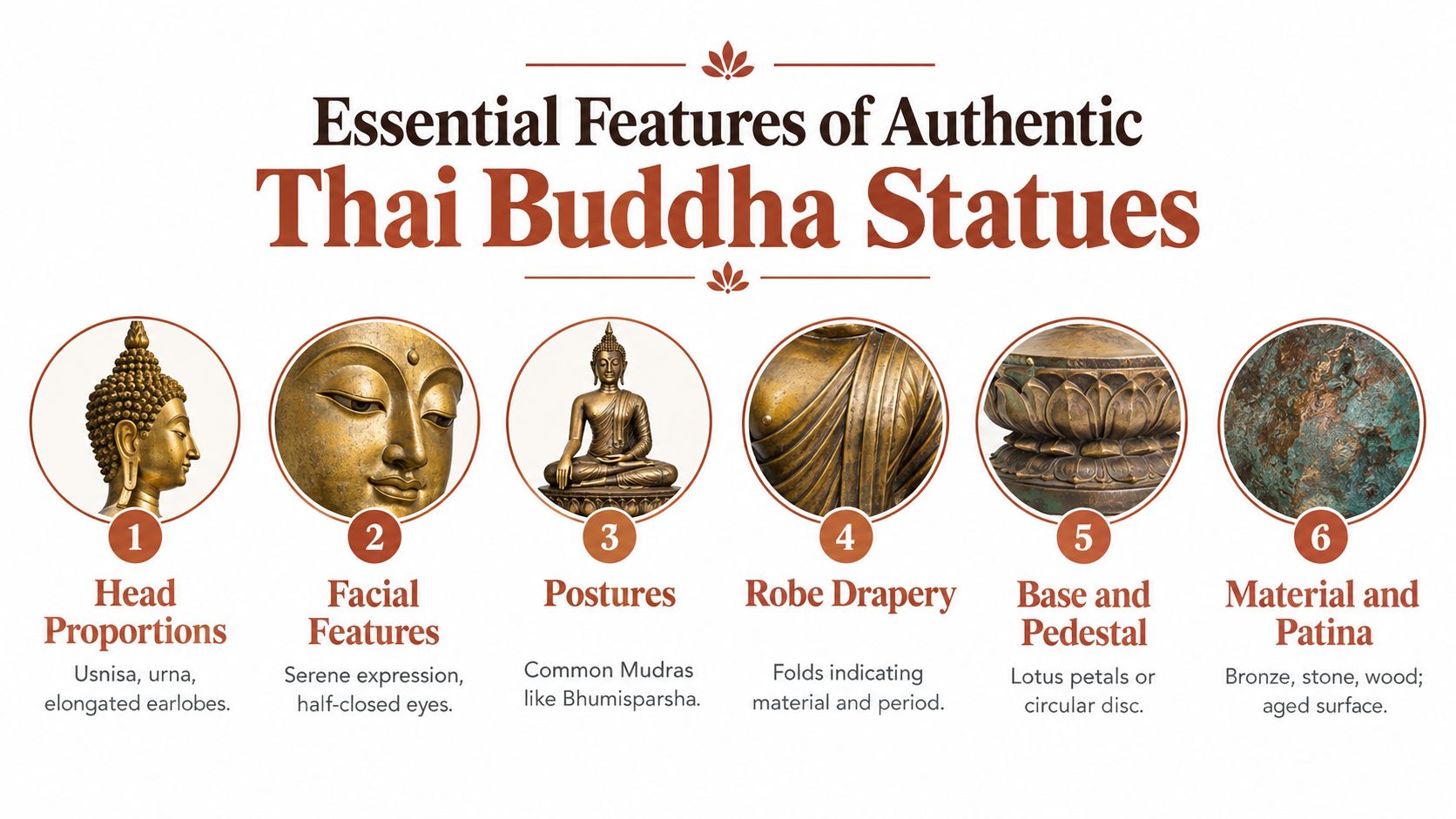
Visual identification begins with morphology, not atmosphere. A serene expression may suit many periods, while a boat-shaped throne, a particular robe treatment or a high uṣṇīṣa can provide more useful evidence when considered alongside construction and provenance.
The British Museum documents a Thai cast-bronze Buddha seated in bhūmisparśa mudrā, the earth-touching gesture. Its recorded features include a virāsana posture, boat-shaped throne, lotus-form support, tiered hexagonal plinth, elongated ears, plain robe and high uṣṇīṣa ending in a flame finial (British Museum object record). No single feature proves a date. Together, however, these details create a disciplined vocabulary for comparison.
Reading the figure from head to base
Start with the head. Examine the shape and termination of the uṣṇīṣa, the treatment of the urna where visible, the length of the ears and the modelling of the face. The Lopburi head's crown-like uṣṇīṣa reflects Khmer influence, while later Thai traditions developed other approaches to the cranial finial (V&A documentation).
Then move downwards. Record the posture, hand gesture, robe folds, throne geometry and base design. The lotus support can be as informative as the face, particularly when its petals, profile and connection to the plinth are preserved.
| Style period | Typical posture | Hand gesture | Cranial features | Regional association |
|---|---|---|---|---|
| Dvaravati | Seated or standing forms vary | Buddhist gestures vary | Early uṣṇīṣa treatments | Central Thailand |
| Khmer-influenced Lopburi | Seated and other regional forms | Gesture depends on image | Crown-like uṣṇīṣa | Lopburi and Angkor connections |
| Ayutthaya | Standing and seated images | Abhaya and other established mudras | More recognisable Thai developments | Ayutthaya |
| Northern Thai traditions | Seated devotional forms are common | Often earth-touching or meditation gestures | High uṣṇīṣa and flame finial may appear | Chiang Mai and Northern Thailand |
A collector comparing a statue with modern interiors should also distinguish historical analysis from styling. For broader visual context on combining period objects with furniture, styling mid-century modern furniture can help explain why proportion, negative space and material contrast matter without turning a religious image into a prop.
The guide to recognising different styles of Thai Buddha statues offers a further vocabulary for regional comparison. Use such resources as starting points, then test impressions against museum records and the object's physical evidence.
Authentication and Condition Assessment
Authentication begins with separating what you can observe from what a seller claims. A convincing surface, old-looking colour or familiar gesture may support an attribution, but none proves age alone. Modern reproductions can imitate individual motifs, so collectors need to evaluate the combination as a pattern.
Build a repeatable examination
Request high-resolution photographs before travelling to view an object. The underside, joins, back of the head, hands, throne and any repaired area deserve the same attention as the front.
- Record construction. Note whether the object is cast, carved, assembled or made from brick covered with stucco and gilding. The British Museum records Thai ritual objects made from brick, stucco and gilding, demonstrating why “Thai Buddha” isn't a material category (British Museum object record).
- Inspect casting evidence. Look for seams, core openings and areas of hand finishing. Photograph them with a scale and describe their location precisely.
- Assess the surface. Distinguish original patina from later gilding, over-cleaning, paint or wax. Surface appearance should support, not replace, structural analysis.
- Compare proportions and details. Check the posture, mudra, robe, ears, uṣṇīṣa, throne and plinth against documented museum examples.
- Separate condition from authenticity. A repaired old object may still be historically important, while a pristine surface may belong to a modern reproduction.
Practical rule: Ask for evidence of the underside and joins before discussing certainty about age.
A condition report should include measurements, photographs, old repairs, replaced elements, cracks, losses, stabilisation and any uncertainty. Keep it with invoices and provenance records rather than treating paperwork as an afterthought.
Care also depends on the material. Bronze, stone, wood and gilded stucco respond differently to humidity, abrasion and cleaning. For related principles on preserving aged surfaces, an antique rug cleaning guide illustrates why historic materials should be assessed before a routine cleaning method is applied.
For bronze-specific questions, compare your notes with what specialists assess beyond patina when dating a bronze Buddha. The aim isn't a quick verdict. It is a transparent record that another qualified person can review.
Collecting and Purchasing Considerations
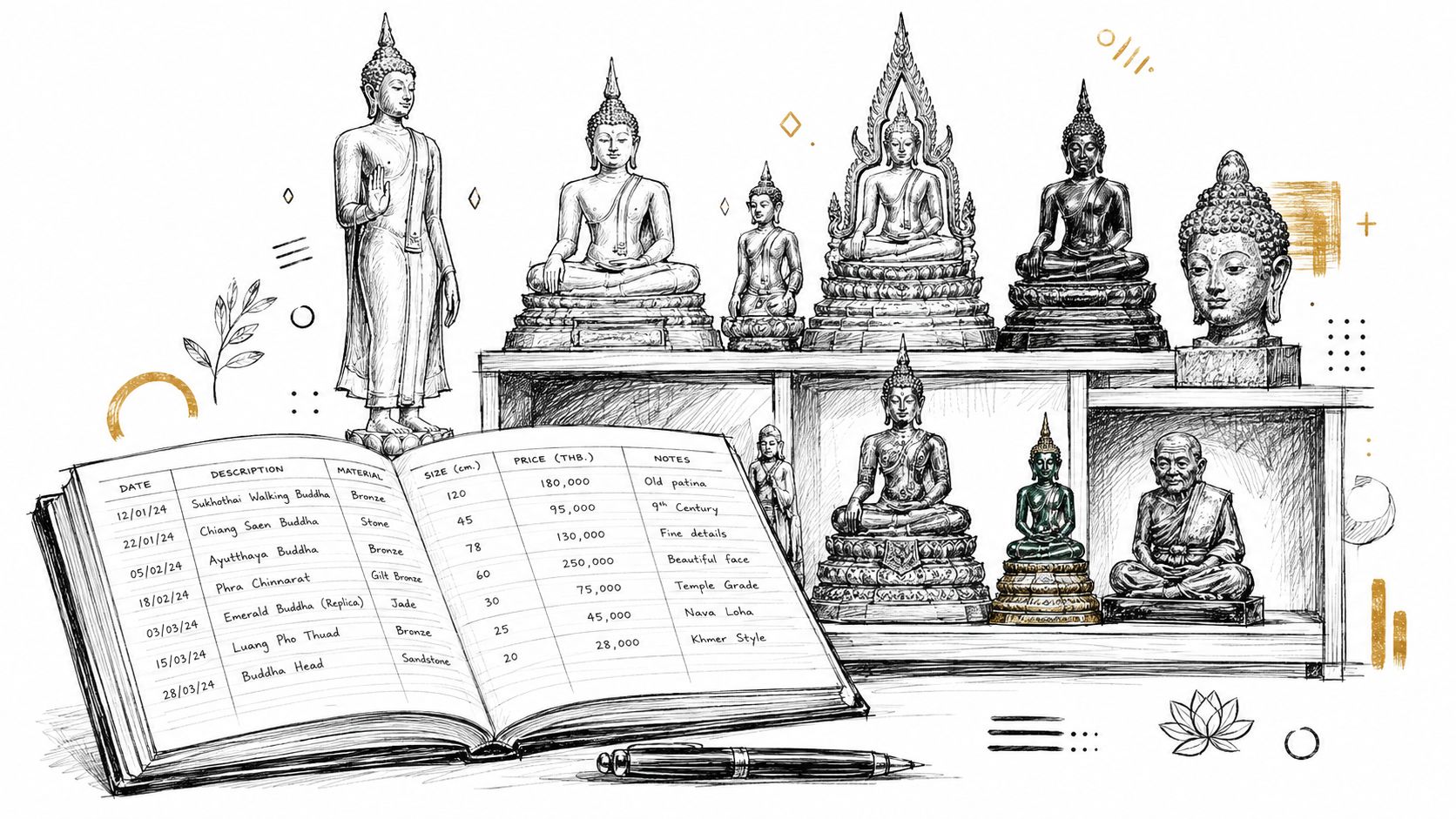
The right buying route depends on what you want the object to be. A museum-quality antique, a contemporary devotional image and an interior sculpture may all be described as Thai Buddha statues, but they require different questions and different levels of documentation.
A specialist dealer can usually provide a curated description, condition information and a clearer conversation about material and provenance. An auction house offers access to varied consignments, but catalogue language may be cautious and inspection time limited. A private sale may produce a meaningful object at a reasonable cost, yet the buyer often carries greater responsibility for attribution, title and transport.
Match the object to your purpose
Ask yourself whether you need:
- A historical object: Prioritise provenance, condition reporting, comparative records and lawful export documentation.
- A devotional image: Establish whether the image has ritual history, and consider how it will be handled in the home.
- A contemporary interior piece: Focus on craftsmanship, scale, stability and honest labelling rather than an unsupported antique claim.
- An institutional acquisition: Require records that can be retained, audited and shared with future custodians.
HD Asian Art is one UK-based option for comparing Thai Buddha statues by regional style and form, including Sukhothai, Chiang Saen, Ayutthaya, Dvaravati, Rattanakosin and Lopburi-inspired examples. Its catalogue also places Thai works alongside broader Buddhist and Hindu sculpture, which can help a buyer compare materials and iconography before making a decision.
Shipping deserves its own checklist. Ask how the statue will be immobilised, whether vulnerable projections are protected, who carries transit risk and what happens if the object arrives with damage. A serious seller should be able to explain packaging, insurance, returns and the condition at dispatch.
Legal Requirements and Export Compliance
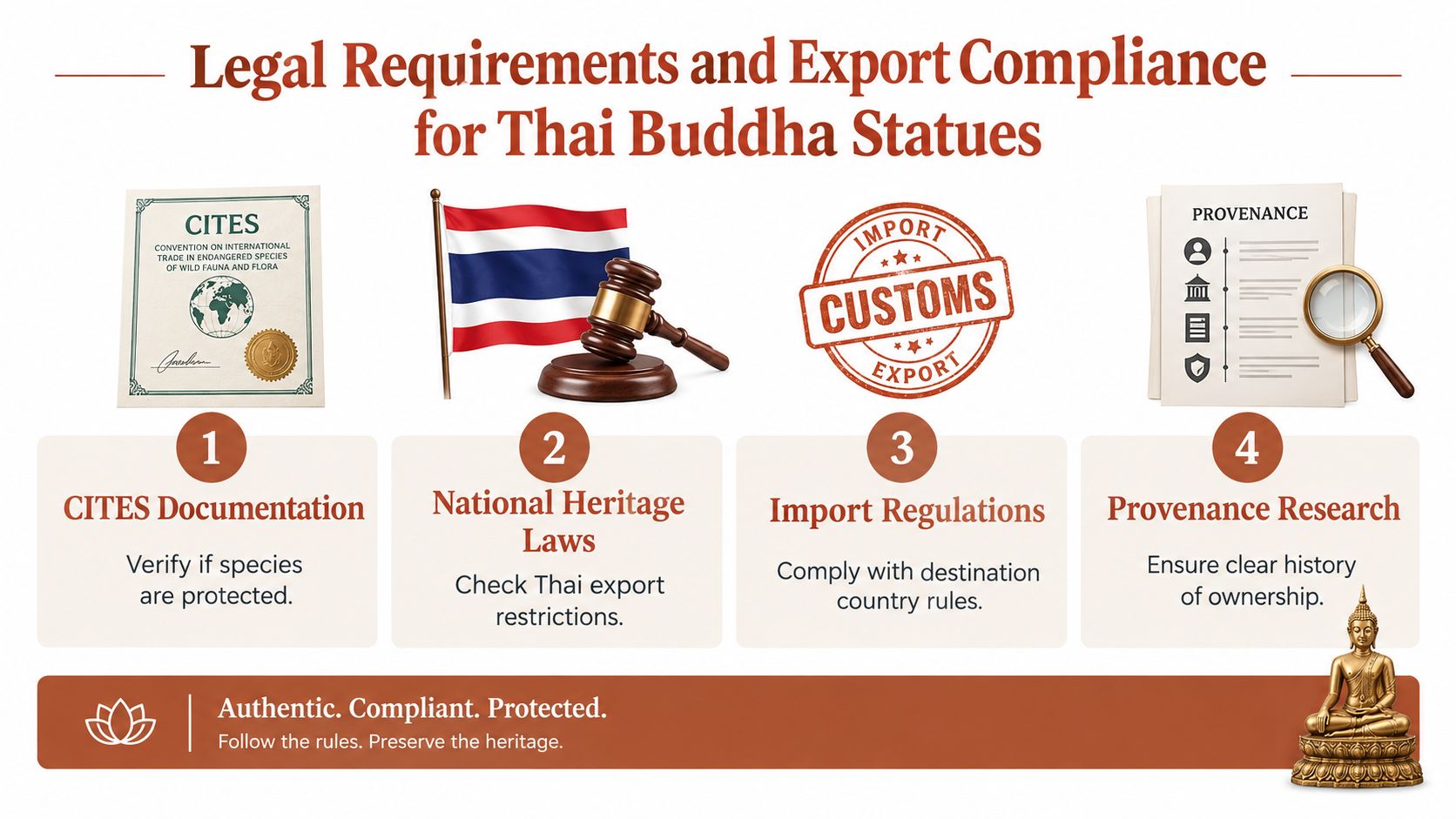
The most dangerous assumption in collecting is that an old Thai Buddha is just another decorative import. For UK buyers, provenance and lawful export are technical acquisition requirements. They affect title, seizure risk, reputation and the possibility of transporting the object again.
GOV.UK states that importing cultural objects into Great Britain generally has no UK import-licence requirement, but imports from non-EU countries must comply with the exporting country's licensing regime. Buyers should verify requirements with the relevant export-country authorities through the GOV.UK guidance on exporting or importing objects of cultural interest.
Build the file before payment
A practical due-diligence file should contain:
- Ownership history: Request the seller's full chain of ownership, with dates and supporting documents.
- Object identity: Keep photographs that match the statue, including distinctive damage, repairs and joins.
- Export evidence: Obtain Thai export documentation where applicable, and confirm that the paperwork describes the actual object.
- Condition and restoration: Require written declarations about gilding, repairs, replacement parts and structural work.
- Specialist advice: Escalate uncertain cases to a provenance specialist or customs adviser before purchase or onward export.
The British Museum records a Northern Thai Buddha made in 1540 to 1541, associated with Chiang Mai Province and probably Fang. Its collector, Carl Alfred Bock, visited Siam and northern areas between June or July 1881 and August 1882, and museum records state that he apparently obtained the statue at Muang Fang after spending time in 1882 digging for Buddha images in ruined stupas (British Museum provenance record). That history shows why the word “antique” tells you far less than a documented findspot and acquisition chain.
Regulation (EU) 2019/880 also identifies cultural goods removed from their country of creation or discovery in breach of local law as goods that may not be introduced. Its categories include liturgical icons and statues, including free-standing examples. For original statuary art more than 200 years old and valued at EUR 18,000 or more per item, the relevant framework requires an importer statement for the applicable category (Regulation (EU) 2019/880). This EU instrument shouldn't be treated as a complete statement of every current UK customs procedure, but its categories and thresholds are important compliance issues.
For any cross-border cultural transaction, clarity matters as much as it does in newer fields such as voice cloning laws. Keep legal research separate from informal assurances, and use the legal and ethical guide to collecting Southeast Asian art as a further framework for responsible decision-making.
Placement, Meaning, and Cultural Context
Should a Thai Buddha statue face a particular direction in a UK home? There isn't one universal answer. Placement depends on whether the image is used devotionally, contemplatively or as non-devotional art, and on the household's relationship with Buddhist practice.
Three contexts, three responsibilities
A home altar gives the statue a devotional role. Keep it raised, clean and away from floor-level storage or casual handling. A meditation space may use the image as a focus for stillness, but the owner should still distinguish respectful contemplation from an improvised decorative prop. A non-devotional display can be treated as art, while remaining sensitive to the fact that visitors may read the figure as religious.
The National Museum of Scotland has documented a Thai Buddha used in an Edinburgh temple's garden meditation room, showing that Thai Buddhist images remain part of active religious practice in Scotland, not only museum collections. The example matters because it places the object within a living community rather than an abstract design vocabulary.
Before buying, ask: Who will use the image? Is it being consecrated or simply displayed? Will visitors interpret it as religious?
A further London example makes the distinction clearer. A British Museum exhibition guide describes a golden Buddha made for the royal opening of a temple in Ayutthaya Province, where Buddhist monks blessed the devotional figure. It was later installed at Buddhapadipa temple in London, where members of the local Thai-Buddhist community and other visitors have venerated it (British Museum exhibition guide).
That ritual history would affect how a conscientious owner describes, handles and displays the image. If a statue will function ritually, consult a local Thai Buddhist community rather than relying on a universal internet rule about direction, eye level or room choice.
Building a Meaningful Collection
A meaningful collection begins with a question more precise than “Which statue looks most impressive?” Decide whether you're collecting a period, a region, a material, a gesture or a record of Buddhist practice in Thailand and Britain. That decision gives every later purchase a place within an intelligible whole.
One collector might begin with a contemporary standing Buddha because the abhaya mudra expresses reassurance and the form suits a quiet entrance. Another might choose a historically documented bronze, accepting visible repairs because the object's provenance is stronger than its surface. A third may focus on sandstone and stucco examples to understand how Thai religious sculpture functioned architecturally, beginning with the Dvaravati evidence preserved by the V&A.
Let documentation shape the collection
Keep a file for every object. Include the invoice, measurements, photographs, condition report, attribution, provenance, export papers and conservation history. If the statue changes hands, the file should travel with it.
Care also means accepting limits. Don't polish aged surfaces just to make them brighter, don't remove attached elements without specialist advice, and don't describe a modern interpretation as an antique because its style feels convincing. Honest classification protects both the object and the people who encounter it.
UK interest in Buddhist visual culture has a measurable demographic context, although official figures don't count Thai statue ownership. The 2021 Census for England and Wales recorded 213,015 people identifying as Buddhist (Office for National Statistics census data), while an ONS table for Great Britain reported 281,580 Buddhists in its available religious-affiliation dataset (ONS religious affiliation table). These figures aren't counts of Thai Buddhists specifically, but they help explain why British collections and communities encounter Buddhist images in more than one context.
The V&A records Thai objects acquired as early as 1927, including a seventeenth-century Ayutthaya Buddha head purchased from collector E. G. Sebastian, and also holds a sixteenth-century gilt-bronze Buddha made in Bangkok (V&A collection record). Those acquisitions show that Thai Buddha statues have been collected and preserved in Britain for nearly a century.
Collect with curiosity, restraint and a willingness to ask difficult questions. The strongest collection isn't the one with the boldest claims. It's the one whose objects can be understood, cared for and passed on without losing their history.
If you're looking for Thai Buddha statues with documented regional context, detailed descriptions and options ranging from historical works to contemporary pieces, explore HD Asian Art. Use its collections and educational resources to compare styles, clarify iconography and choose an object that suits your collecting, devotional or interior purpose.
