


Nataraja Statue Symbolism: Gestures, Flames and Meaning
Nataraja Statue Symbolism: Gestures, Flames and Meaning
Almost everyone who meets a Nataraja statue for the first time asks a version of the same question. Is he dancing, or is he fighting? The limbs say motion, the face says calm, and the ring of fire says something is ending.
The answer commonly given, that the drum means creation and the flame means destruction, is accurate as far as it goes. It just isn't the whole argument, and it says nothing about whose argument it is. A Chola bronze made for a South Indian temple, a copper-alloy figure catalogued by a national museum and a contemporary cast bought for a meditation room can share one visual vocabulary without carrying one single meaning.
The useful question, then, isn't only what each symbol means. It's whose reading you're looking at, from which period, and for what use. Build the image up element by element and that question answers itself.
Table of Contents
- Nataraja Symbols at a Glance
- The Five Cosmic Acts Behind the Pose
- The Drum, the Fire and the Flaming Ring
- The Foot on Apasmara and the Hands of Refuge
- What the Hair, Moon and Earrings Add
- Whose Meaning? Chola, Khmer and Modern Statues
- Checking a Nataraja Statue Before You Buy
Nataraja Symbols at a Glance
What makes Nataraja's many gestures read as one image rather than a collection of separate symbols? The answer lies in how the details work together. Shiva holds creation and dissolution in one body, while the four arms allow distinct gestures to appear at once. The British Museum describes its copper-alloy Nataraja as a visual account of Shiva's five cosmic activities, assigning theological meaning to its gestures and attributes (British Museum collection record).
The museum dates this sculpture to approximately AD 930 to 940. That range identifies the dating of this particular object, not a universal date for Nataraja images.
| Element | Position | Meaning |
|---|---|---|
| Drum (damaru) | Upper right hand | Creation through sound |
| Flame | Upper left hand | Destruction and dissolution |
| Raised palm (abhaya mudra) | Lower right hand | Protection and fearlessness |
| Gajahasta hand | Lower left hand | Points to the raised foot as refuge |
| Raised foot | Lifted leg | Salvation and release |
| Planted foot on Apasmara | Standing leg | Ignorance overcome by divine order |
| Flaming ring (prabhamandala) | Around the whole figure | Cycle of cosmic time |
| Crescent moon | Matted hair | Time |
| Contrasting earrings | Both ears | Androgynous nature of Shiva |
| Matted hair with Ganga | Head | Shiva's discipline and sacred descent of water |
A Reading Method You Can Use in Ten Seconds
Read the figure from top to bottom. The upper hands establish the opposing forces: the drum begins creation, while the flame signals dissolution. The lower hands shape how the viewer responds, offering protection and directing attention towards refuge.
Then follow the feet. One presses Apasmara, the figure associated with ignorance; the other rises as a sign of release. The flaming ring contains the dance within a cycle of cosmic time, while the moon, earrings and flowing hair add further layers to the image.
This sequence gives you a practical way to describe a Nataraja, whether you encounter a museum bronze or a modern casting. The table gathers common interpretations in one place; the meanings are best read together, not as isolated labels. A raised hand, for example, does more than identify a gesture: it balances the movement and tension carried by the rest of the figure.
The Five Cosmic Acts Behind the Pose
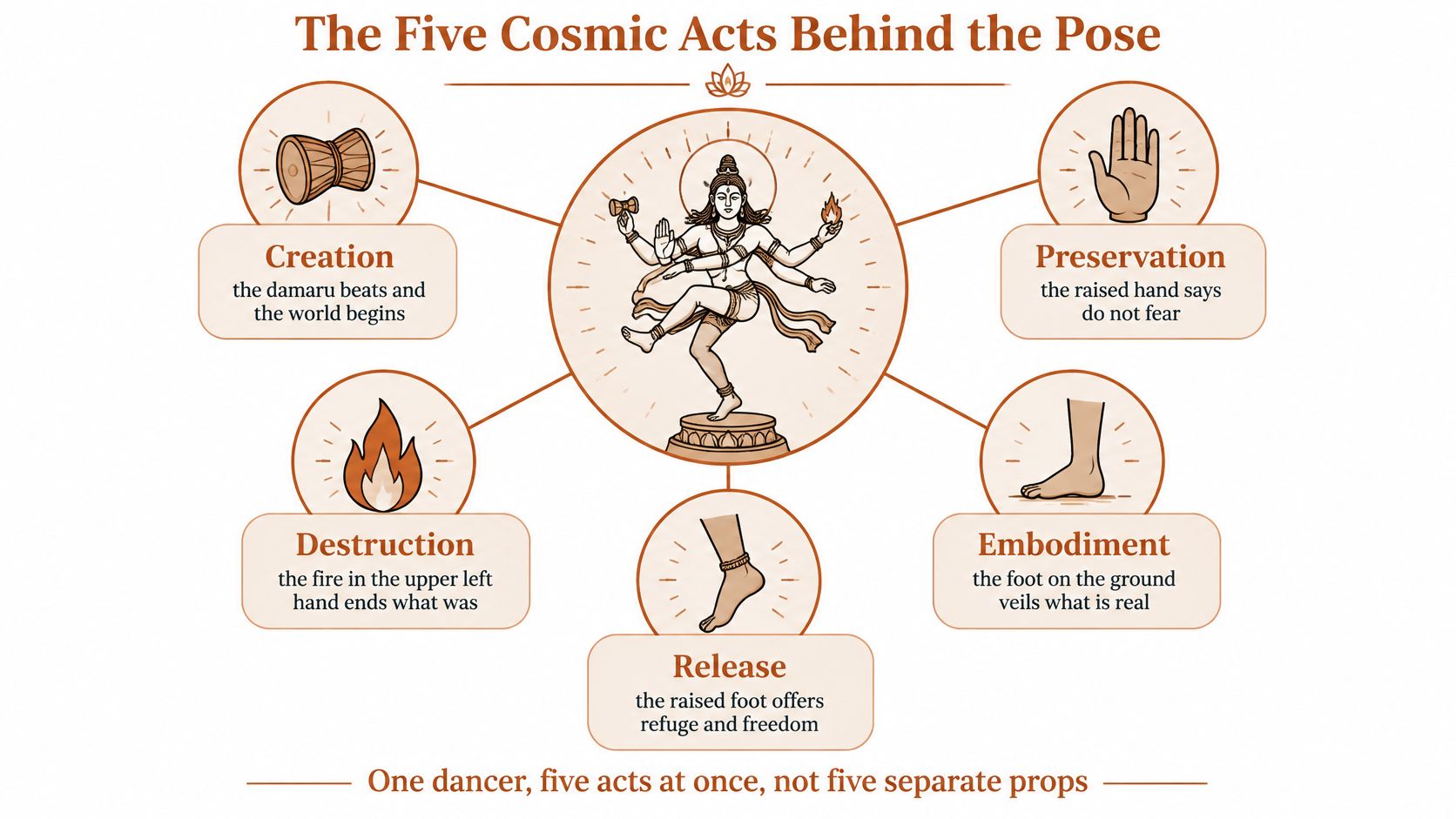
Think of a theatre production. Lighting, costume and props each do a small job, but they serve one script, and the audience reads them together. The Nataraja works the same way, with five cosmic acts as the script: creation, preservation, destruction, embodiment and release. Nataraja statue symbolism is usually taught as a list of props with one meaning each, yet the props only make sense as a company of players serving one plot.
The core idea: the dance doesn't alternate between making and unmaking. It holds both at once, which is why the drum and the flame are carried by the same pair of hands.
Map the acts onto the body and the pose stops looking busy. The drum in the upper right hand sounds creation into being. The raised lower right palm preserves, holding the world in a gesture of protection. The flame in the upper left hand dissolves what has run its course. The two feet carry embodiment and release, one binding the dancer to the ground and one pointing away from it.
Why Destruction Is the Most Misread Word in the Pose
English gives the word a nihilistic ring that the theology doesn't carry. Destruction here means the removal of ignorance, ego and illusion, the clearing of what blocks sight. A statue with a flame in its hand isn't a monument to endings. It's a monument to the space endings make.
The dance is also continuous. Nothing in the figure suggests a single frozen instant, because the pose shows a process repeating rather than a moment captured. That's what the four arms are for: one body performs several acts at once without contradiction, so the viewer takes in the whole cycle in a single glance.
One Test for Any Statue
Look at the arms. If each one does a different job, with a drum, a flame, a protective palm and a pointing gesture, the piece follows the five-act system and can be read against the table.
If two arms repeat the same gesture, or an attribute is missing, you're most likely looking at a looser decorative version. The symbolism should then be described with more caution, because the argument has lost a clause.
The Drum, the Fire and the Flaming Ring
Start with the two objects the upper hands carry, because everything else in the figure answers to them.
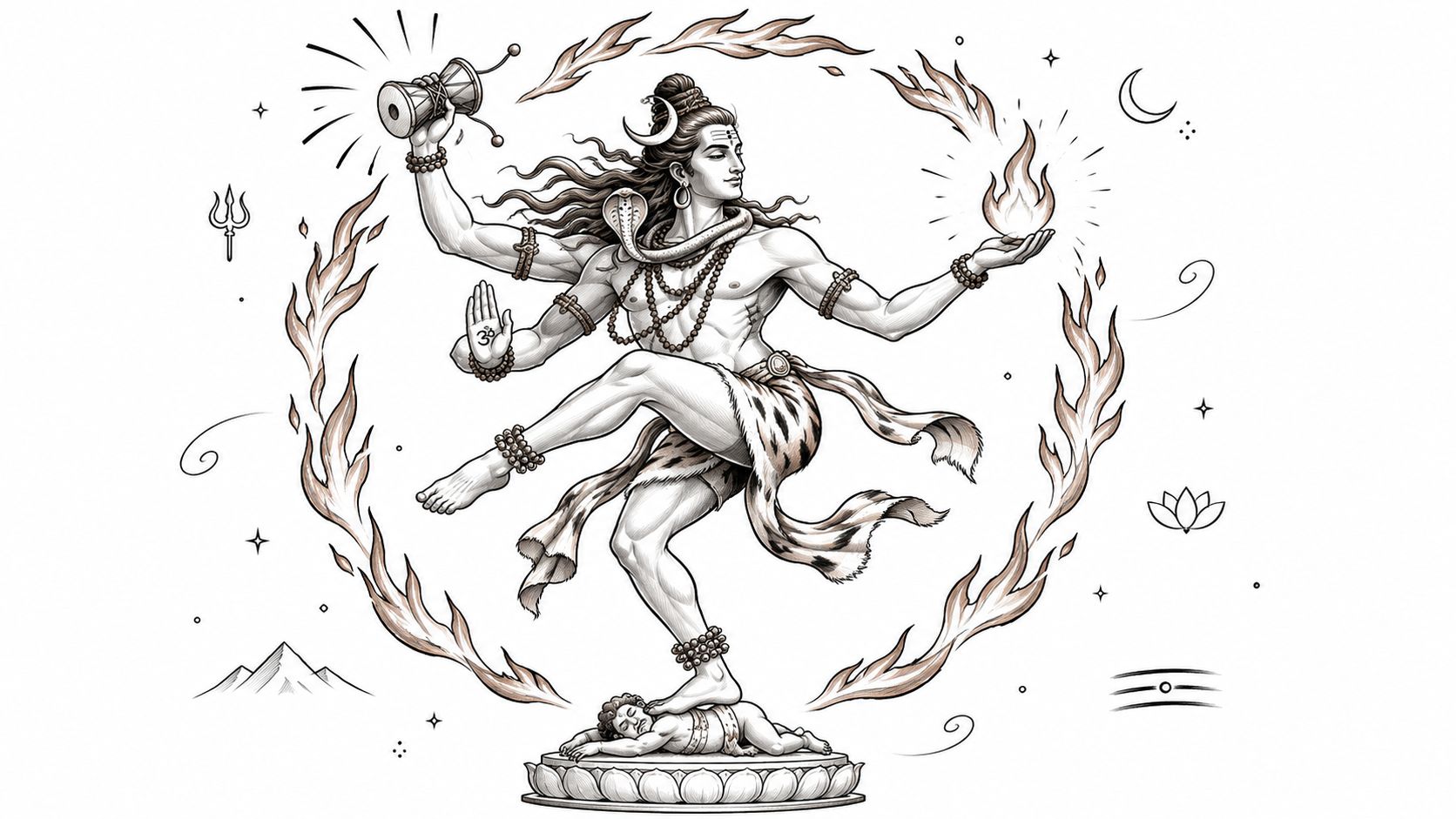
The damaru is a small hourglass drum, and its beat is the first sound, the vibration from which the world unfolds. That's why creation sits in the upper right hand and is described as creation through sound rather than through craft or labour. Opposite it, the flame in the upper left hand is destruction, the dissolving of what has been made. The two are held apart deliberately, so neither force wins.
The Ring Is a Clock Face, Not a Halo
The British Museum's Chola-period Nataraja, dated to approximately AD 1100 and associated with Tamil Nadu, shows Shiva dancing in the anandatandava mode inside a continuous ring of flame, with Apasmara underfoot. The museum reads the image as the end of one cosmic cycle and the beginning of another, and its commentary links the flaming ring to the recurring structure of cosmic time (British Museum, a journey through South Asia in eight objects).
Think of the rim of a clock face. It doesn't tell you what time it is. It tells you that time is measured, that the hands come round again, and that no position on the dial is final. The ring of flames does that job for cosmology, and it does a second job for the sculptor. A figure with lifted limbs, flying hair and four outstretched arms needs a boundary to hold it together, and the circle supplies one.
Where the Ring Meets the Metal
That bronze was cast by the lost-wax method, a process honed to exceptional refinement during the Chola period, which the museum dates broadly from the 8th to the 13th century AD. The approximately 1100 statue therefore sits near the middle of a roughly 500-year stretch of major South Indian bronze production. Lost-wax casting is what makes raised limbs and flowing hair possible in metal at all, because the wax model can be shaped freely before the bronze replaces it.
The technique explains a detail collectors often miss. Thin flame tongues, open space between arm and torso, and hair that fans out without snapping are foundry decisions as much as design decisions. When you look at a Nataraja, you're reading a cast, not a drawing.
The Foot on Apasmara and the Hands of Refuge
Begin at the ground and move upwards. Under the planted foot lies Apasmara, the dwarf who stands for ignorance. The British Museum's image shows the foot resting on this figure rather than crushing him in fury. Apasmara isn't a monster to be feared. He is ignorance held down by divine order, kept where he can do no harm.
The other leg lifts, and the raised foot signifies salvation and release. It points the viewer past the cycle of rebirth rather than deeper into it.
Read the feet as one sentence: the planted foot refuses ignorance, and the lifted foot offers the way out. Neither gesture carries much on its own.
Then the hands take over the argument. The raised right palm is abhaya mudra, the gesture of protection and fearlessness, the visual equivalent of "do not be afraid". The lower left hand curves across the body in gajahasta, the elephant-trunk gesture, and its fingertips indicate the lifted foot. A guide to mudra hand gestures is worth keeping open while you compare pieces, because the same hand shape can carry different meanings across traditions.
Following One Viewer's Eye
Say someone stands in front of a Nataraja for the first time, in a museum gallery or a friend's hallway. Their eye goes to the face, then to the ring, then down. If they see the lifted foot and the pointing hand together, they read the dance as a route to liberation.
If the pointing hand is missing, or the fingers curl away from the foot, the same figure reads as a display of power, which is a different claim about the deity altogether. One gesture changes the sentence.
Hand positions vary between periods and workshops. Some bronzes hold the lower left arm further out from the body, some bring it closer, and later reproductions often simplify the fingers. Read the combination rather than a single gesture, and treat a deviation as a question about the workshop before treating it as a fault.
Three Questions to Ask of Any Statue
- Where is the planted foot? It should sit on Apasmara, not beside him or hovering above the base.
- What does the pointing hand indicate? The fingers should lead the eye towards the lifted foot.
- What does the lifted leg balance against? The raised foot should feel supported by the planted leg and the ring, not floating free of them.
What the Hair, Moon and Earrings Add
Small details refine the big gestures, and three of them repay a closer look once you're comfortable with the drum, the flame and the feet.
The Moon and the Second Clock
The crescent moon sits in the matted hair and stands for time, which puts a second clock inside the image. The ring measures cosmic cycles on the outside; the moon marks time on the body itself. Two clocks, one argument about duration.
The hair around it is the jata, matted locks that flare outward with the motion of the dance. They're often shown holding the river Ganga, which stands for the descent of sacred water and grace. The locks themselves signal the ascetic's discipline, a god who carries the world's water in hair he never combs.
A useful comparison: the earrings work like a balance with two different weights in one frame. Each side carries something distinct, and the whole is held level.
The contrasting earrings differ from each other, one on each side of the face, and they're read as Shiva's androgynous nature, masculine and feminine held in one body. That's a philosophical position rather than an ornamental quirk, and it belongs to the same logic as the four arms: the divine contains what looks contradictory.
These details vary by workshop and period, so check them against the larger gestures rather than deciding a statue's meaning from its earrings alone. The body is a map, and these are its place names. They tell you where you are, not what the journey is for.
Whose Meaning? Chola, Khmer and Modern Statues
Does every Nataraja statue carry the same meaning? The familiar shorthand, drum for creation, fire for destruction, Apasmara for ignorance, is a useful starting point. It does not explain every historical setting or modern use. Read the symbols as a connected argument about cosmic order, then ask who made the image, when, and for what purpose.
The V&A describes Nataraja through Shiva's five cosmic acts: creation, preservation, destruction, embodiment and release. The same museum record notes interpretations connecting the image with Shiva's cremation-ground associations and Chola dynastic power (V&A collection record). These readings can coexist, though they draw attention to different aspects of the image.
| Version | Typical date | Setting | Reading to check |
|---|---|---|---|
| British Museum copper-alloy Nataraja | AD 930 to 940 (lead-isotope proposal around AD 800) | Museum collection | Five cosmic acts and the four-armed system |
| Chola-period Tamil Nadu bronze | Approximately AD 1100 | Southern India, lost-wax cast | Anandatandava dance inside the cycle-of-time flame ring |
| V&A Nataraja record | AD 12th century | Museum collection | Five cosmic acts, with possible cremation-ground and Chola power readings |
| Modern contemporary statue | Contemporary, made now | Home, shrine or collection | Visual vocabulary; ritual use depends on the owner |
Where the Formula Holds and Where It Breaks
The symbols provide a shared visual vocabulary. The drum signals creation, the flame destruction, and Apasmara beneath Shiva's foot ignorance overcome. Together, they connect the act of dancing with cosmic change. Yet a familiar symbol does not make every statue identical in meaning.
A bronze made for a Tamil Nadu temple had a devotional role and could also carry dynastic significance. A contemporary statue in a living room may use the same symbols for contemplation, decoration, or both. The imagery travels across time; its ritual and political setting does not automatically follow.
Regional Styles Need a Name, Not a Guess
Khmer and Angkor-style statues often feature strong, calm faces, refined crowns and a sense of stillness associated with classical Cambodian sculpture. Those qualities alone cannot establish where a Nataraja was made. A crown or serene expression is a clue to examine, not proof of a statue's regional origin.
HD Asian Art's product descriptions identify a statue's stylistic origin, such as Khmer, Thai or Indian school, and state whether it is antique, vintage or a contemporary piece inspired by historic temple art. That information gives readers a clearer basis for comparison with Chola bronzes. For context on their craftsmanship, this account of Chola bronze sculpture as a South Indian masterwork explains the tradition behind that benchmark.
The key questions are whose interpretation a statue reflects, which period or style it belongs to, and how it is used. A careful description keeps the widely shared cosmic reading distinct from period-specific, regional and modern meanings.
Checking a Nataraja Statue Before You Buy
A checklist turns a beautiful object into a known one. Work through these on the product photographs rather than the marketing copy.
Run the Checks in This Order
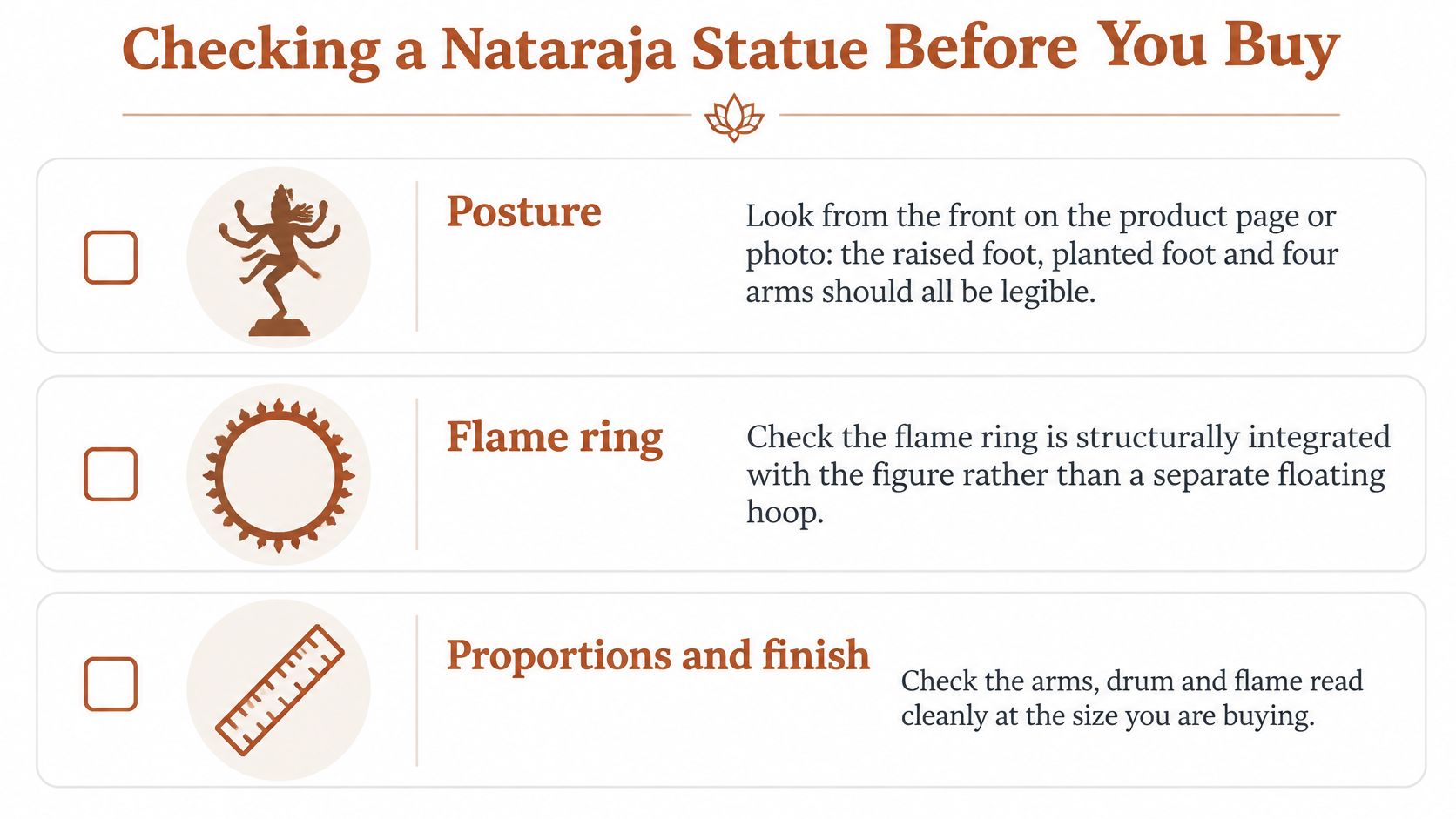
- Posture from the front. The raised foot, the planted foot and all four arms should stay legible from the intended frontal viewpoint. If an arm disappears behind the ring in the main photograph, ask for a straight-on shot.
- The flame ring. The British Museum's record of its Tamil Nataraja treats the prabhamandala as both a cosmological boundary and a compositional device, with the figure's asymmetrical limbs creating tension inside a stable circle (British Museum collection record). Check whether the flames are structurally integrated with the body. A separate floating hoop and a ring cast with the figure are different objects.
- Condition of the ring. A broken or heavily reconstructed circle affects physical stability and theological meaning at the same time, because the ring is what carries the cycle-of-time reading.
- The hierarchy underfoot. Apasmara and the raised foot should keep their relationship, ignorance beneath the planted foot and release in the lifted one. If the dwarf has been reduced to a decorative lump, the lower half of the argument is gone.
- Symbols against the table. Compare drum, flame, palm, pointing hand and both feet with the vocabulary near the start of this piece. Two or more missing elements point to a decorative figure rather than an iconographic one.
- Provenance and description. Look for a stated period, school and condition. Our guide to authenticating Asian religious sculptures covers the questions worth asking about casting, patina and old repairs.
Match the Piece to the Room
Size and finish decide more than most buyers expect. Our statues are suitable for home shrines, meditation rooms and puja spaces, and for decor and collections, so the intended setting should drive the scale you choose. Shiva also sits within a wider Hindu range that includes Ganesha, Durga, Lakshmi, Murugan and Vishnu, which lets you place a dancing figure against quieter, seated forms rather than choosing it in isolation.
Keep a shortlist of pieces whose descriptions name a period and a style, and whose photographs confirm each symbol you care about. Buy after that, not before.
HD Asian Art is a UK-based specialist in Hindu and Buddhist sculpture, with a Shiva range that includes the dancing Nataraja as well as calmer, seated depictions of the deity. Every piece is described by stylistic origin and condition, so you can check the drum, the flame, the ring and the figure underfoot before you decide. Browse the HD Asian Art collection to compare a dancing bronze with a meditative Shiva and see how the same iconography shifts with the pose.
