


Khmer Linga: Sacred Symbols of Khmer Kingship
Khmer Linga: Sacred Symbols of Khmer Kingship
Why does a plain stone cylinder keep showing up in conversations about kingship, temple architecture, and sacred territory? Because a Khmer Linga was never just a phallic symbol. In Khmer religious art, it worked like a royal seal that also marked out holy ground, tying Śiva, the ruler, and the land together in one object.
The Khmer world gives that object depth. Historical accounts place the most influential Khmer state between the 11th and 13th centuries across much of mainland Southeast Asia, including present-day Cambodia, southern Vietnam, Laos, and eastern Thailand (Britannica). In that setting, Hinduism and Buddhism coexisted for more than 1,000 years, while Sanskrit and Khmer inscriptions from the 7th through 9th centuries recorded local kingdoms and religious foundations (Britannica). A Khmer linga belongs to that long, syncretic conversation, not to a single neat doctrine.
For a quick visual analogue, think of a serious interior sculpture, such as limestone link indoor outdoor sculptures, where form, material, and placement all shape meaning. A Khmer linga works in a similar way, except the meaning is religious, political, and territorial at once.
Table of Contents
- What a Khmer Linga Actually Represents
- The Linga and Yoni as a Sacred Ensemble
- Khmer Linga as Royal and Sacred Authority
- Reading Khmer Linga Forms and Iconography
- Authenticity and Provenance Questions for UK Buyers
- Caring for a Khmer Linga in a UK Home
- Choosing How to Live With a Khmer Linga
What a Khmer Linga Actually Represents
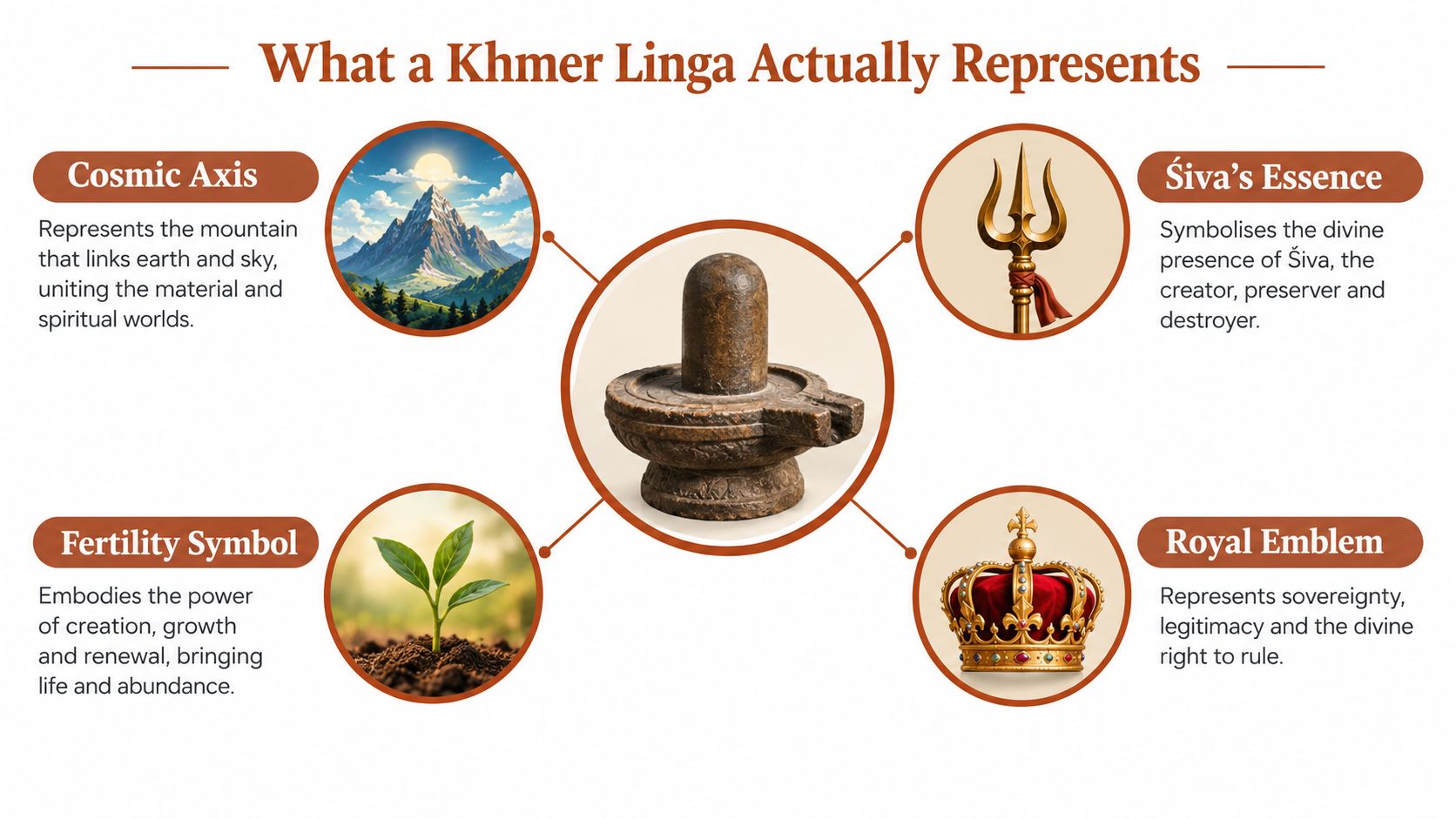
A Khmer Linga is best understood as a layered emblem, not a single-purpose sign. It stands for Śaiva presence, yet it also carries ideas of authority, because Khmer readers often understood divine power and royal power together.
A sacred sign with local meaning
The Sanskrit word liṅga can mean sign or characteristic, and in Khmer usage that meaning took on a local shape. Middle Khmer texts use bralịṅ, from braḥ, meaning sacred, and liṅga, to refer to souls or vital spirits, which shows that linga symbolism entered ideas of personhood rather than staying inside temple ritual (Oxford Art Journal). That matters, because it shows the object was adapted, not copied into Cambodia unchanged.
Cambodian art history also points to older local ideas of sacred stones and ancestor presence. A number of scholars have suggested that the Khmer linga may have absorbed those older ways of thinking, rather than replacing them outright. For a collector, that helps explain why the object can feel at once doctrinal and local, where South Asian Shaivism meets Khmer sacred thinking.
Why this matters to a collector
Practical rule: if an object is described only as a fertility symbol, the description is already too narrow.
That narrow reading misses the larger meaning. A Khmer linga could mark consecrated place, signal sacred authority, and act as a visual shorthand for sovereignty. A useful working definition is this: a Khmer linga is a sacred stone sign of Shiva that also carries Khmer ideas of kingship, territory, and vital spirit.
For collectors, the most helpful diagnostic clue is how the seller explains its meaning. Record whether the description stresses soul or vital-spirit language, or only fertility, and prefer accounts that mention kingship and territory. A boundary marker that also serves as a devotional focus gives the right comparison. It is not decorative in the modern sense, and it is not only ritual equipment. It does both.
The Linga and Yoni as a Sacred Ensemble
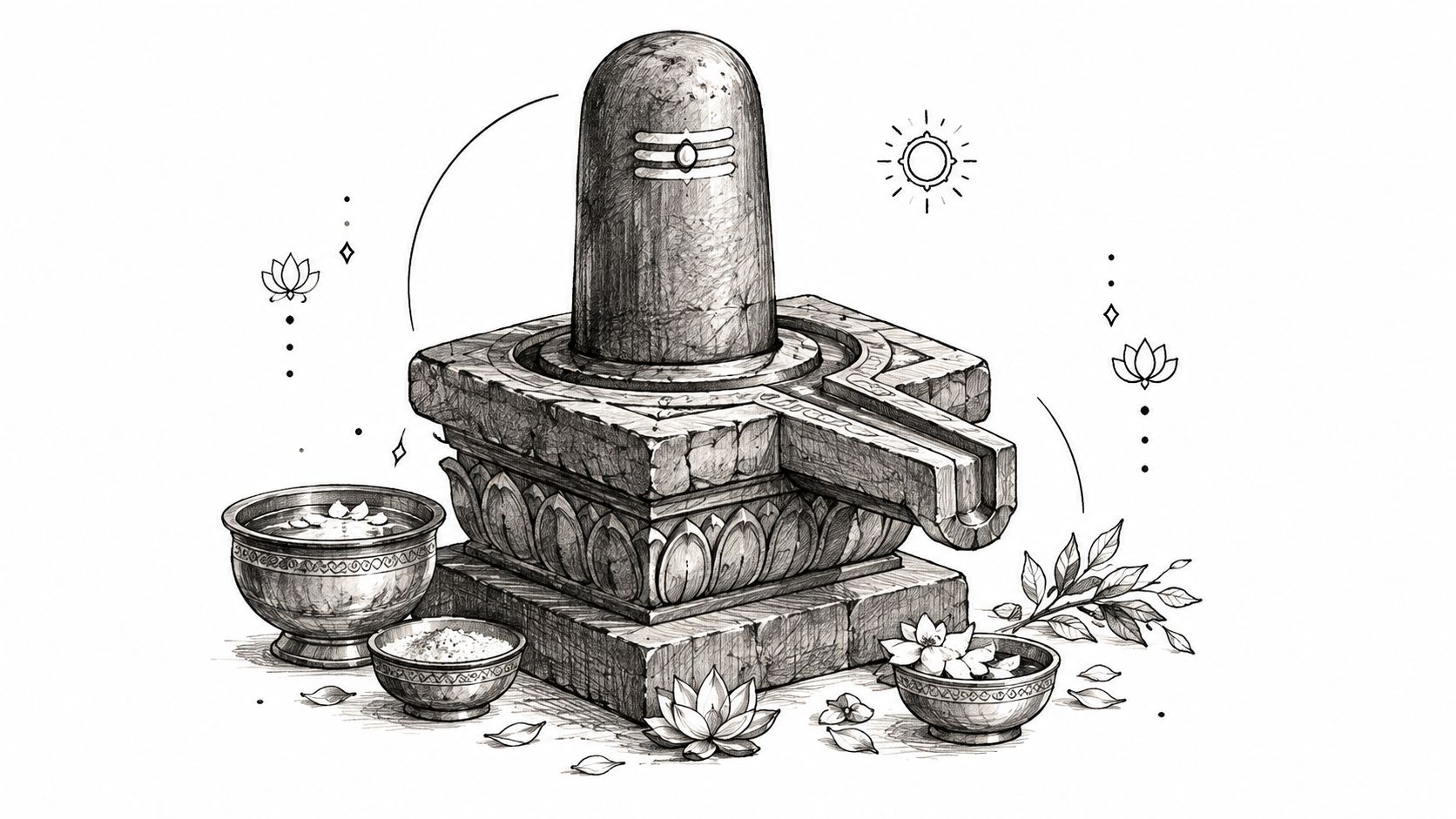
A Khmer linga rarely makes full sense by itself. The stronger reading comes from the linga-yoni ensemble, where the base is part of the meaning, not an accessory.
Reading the base as part of the object
The yoni is generally a quadrangular base with a central socket and a drainage channel, so ritual liquids poured over the linga flow outward in a controlled path (Wonders of Cambodia). That design turns a simple ablution into a directed spatial act. The liquid does not just wash the stone, it moves through a defined channel, and the rite writes sacred order into space.
A baptismal font joined to a property line gives a useful comparison. One part creates the liturgical action, the other marks its boundary. The ensemble frames the linga as both a ritual apparatus and a consecrated zone.
The yoni does more than support the shaft, it tells you where sacred space begins and where it flows outward.
Why context changes meaning
Many casual descriptions go wrong here. The same shaft can mean very different things depending on whether it sits in a temple, near a summit, or in a private collection. Khmer interpretation also sits inside the wider Sanskrit cosmopolis, the cultural sphere in which Sanskrit language, religious vocabulary, and political models travelled across South and Southeast Asia. A useful overview of that shared world appears in scholarship on the cosmopolis and related temple cultures, including the broader art-historical discussion in the Oxford Art Journal (Oxford Art Journal).
That scholarship also warns against a simple “Indianisation” story. The form took root in Khmer settings shaped by local sacred practice as well as imported Shaiva ideas. So a Khmer linga is not a floating symbol. Its meaning depends on place, base, and ritual setting.
For collectors, that means a presentation without base, findspot, or associated records is incomplete. The ensemble is the clue. Photograph the socket, channel outlet, and underside, and note channel orientation and wear, rather than repeating a general syncretism point.
Khmer Linga as Royal and Sacred Authority
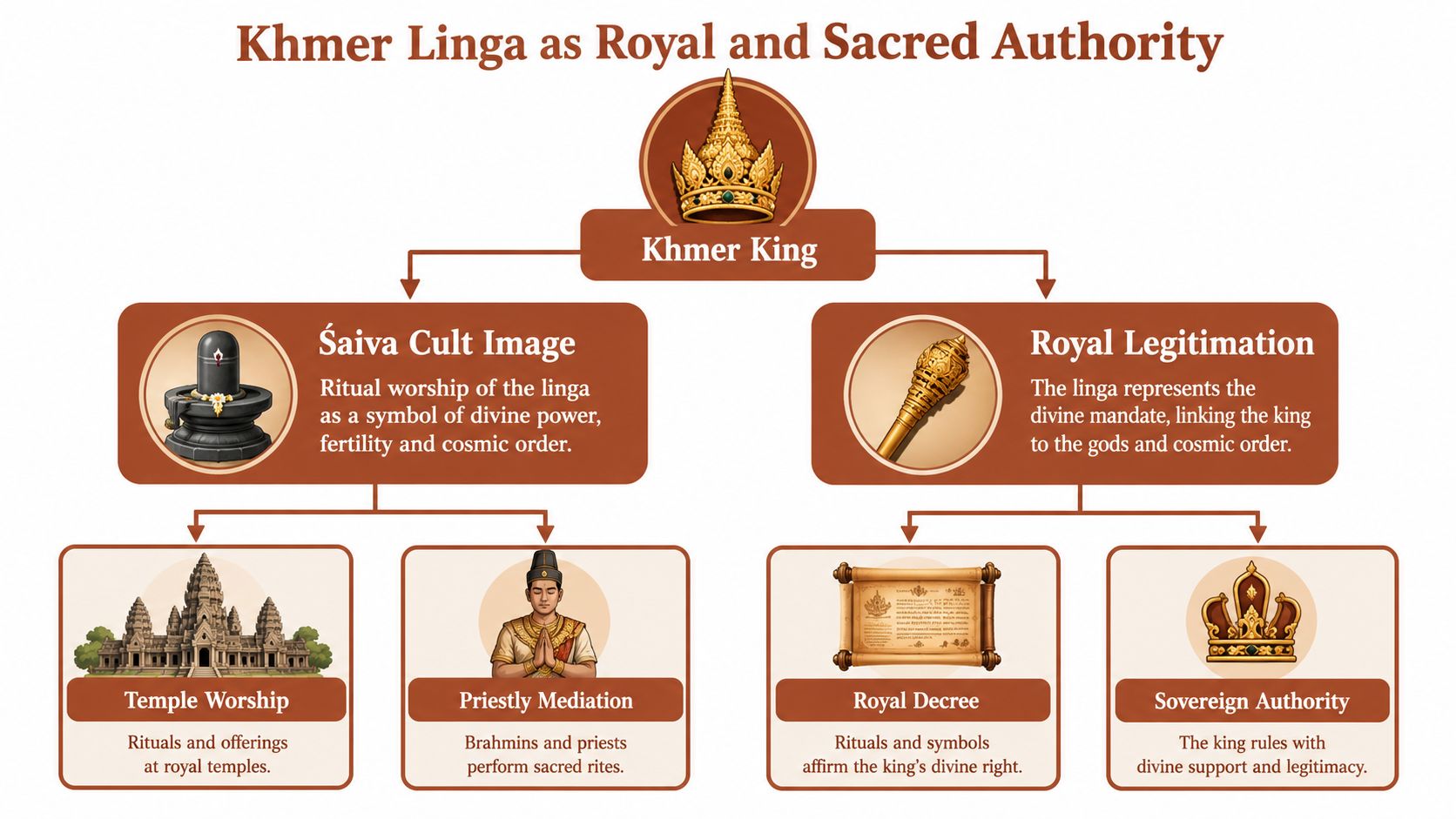
The Khmer linga becomes easier to read once you see it as an object of power as well as devotion. It worked as a Śaiva cult image and as a means of royal legitimation, so its placement inside a temple mattered.
Temple height and political meaning
The Metropolitan Museum notes that Khmer rulers placed lingas at or near the summits of major temples because some identified themselves with Śiva, which turned the object into a link between deity, temple architecture, royal authority, and the cosmos (Metropolitan Museum of Art). That vertical placement is not a small detail. It makes the theology visible.
The uppermost point of the temple works like a royal seal placed on a document. It marks where sacred force and kingship meet. In that setting, the linga does not stand apart from power, it helps represent how power is claimed and renewed.
The V&A records the same pattern in Cambodia's early religious monuments, where Shiva's cult was paramount and the cult image in temple-mountains was Shiva in the form of a linga (Victoria and Albert Museum). That matters because the temple mountain is not just an architectural form. It is a political and sacred statement set into stone.
The linga also fits a broader Shaiva visual system. The Metropolitan Museum identifies it as one of the most widespread symbols of Shiva in the region, alongside the Shiva footprint, sacred bull, trident, and the one-faced linga cover known as a lingakosha (Metropolitan Museum of Art). Each symbol speaks the same religious language, but from a different angle.
That wider language helps explain why Khmer political theology is discussed in scholarship on divine kingship and Shiva in ancient Southeast Asia (Divine kingship and Shiva in ancient Southeast Asia). The linga was not a side symbol. It sat at the point where sacred authority and kingship were made legible together.
Reading Khmer Linga Forms and Iconography
If you want to identify a Khmer linga properly, start by describing what you can see. Do not begin with “it's a lingam,” because that skips the useful details. Start with shaft shape, face count, sectioning, and base arrangement.
A simple typology to use at eye level
The Metropolitan Museum states that a Khmer linga may be uncarved or display one to four faces of Shiva, each representing different powers of the deity (Metropolitan Museum of Art). That gives you a basic typology: aniconic, ekamukha, caturmukha, and more developed tripartite forms. In practical terms, this is the difference between a plain sacred shaft and a shaft that starts to present divine identity more explicitly.
A useful comparison is moving from an abstract logo to a branded icon. The underlying object stays recognisably the same, but added features narrow the ritual reading. The Met's teaching material also notes that a Khmer artist could represent Shiva through a mid-seventh-century sandstone image from southern Cambodia measuring 61 cm by 19.7 cm by 10.2 cm, while still conceptualising Shiva more commonly through the aniconic linga form (Metropolitan Museum of Art).
What to record, not just what to name
For serious observation, record the following separately:
- Shaft geometry, whether cylindrical, squared, or sectioned.
- Face count, from plain to one, four, or more carved faces.
- Yoni channel orientation, because drainage direction matters.
- Libation wear, which can show repeated ritual use.
- Surface condition, including smoothing, breaks, or later reworking.
Observation rule: if the catalogue entry doesn't separate form from condition, it's not giving you enough to judge the piece.
| Khmer Linga Diagnostic Features | Distinctive features | Implied cult context |
|---|---|---|
| Aniconic linga | Plain shaft, no face carving | Strongly associated with Shiva in abstract sacred form |
| Ekamukha linga | One face of Shiva carved on the shaft | More explicit personalisation of the deity |
| Caturmukha linga | Four faces of Shiva on the shaft | Full directional presence, often read as more elaborate worship |
| Tripartite form | Differentiated sections or cosmic levels | Layered sacred structure rather than a single undivided shaft |
The easiest mistake is to confuse all linga forms as interchangeable. They aren't. A plain shaft and a four-faced example can belong to very different moments of ritual language and date.
Reading mukha-linga forms in Hindu worship
Authenticity and Provenance Questions for UK Buyers
A convincing appearance doesn't prove age. That's the first rule a UK buyer should remember. A Khmer linga can look ancient and still be later, recut, restored, or assembled from mixed parts.
What evidence should travel with the object
Treat the purchase like a period house survey. You wouldn't buy on façade alone, and the same logic applies here. A serious buyer should ask for photographs of all surfaces, full dimensions, material identification, condition notes, ownership history, and, where relevant, export documentation.
The practical reason is straightforward. The UK Department for Culture, Media and Sport published a 2025 report addressing export licensing and provenance, which shows that paperwork is not a box-ticking exercise. It can affect ethical acceptability, museum lending, insurance, valuation, and possible repatriation questions.
Four categories that often get blurred
A knowledgeable buyer should separate:
- Devotional object, made for worship and still understood ritually.
- Archaeological artefact, recovered from an older context.
- Later ritual object, made for use but not necessarily ancient.
- Contemporary decorative sculpture, made for display rather than cult.
These categories matter because they affect how the object should be described, insured, and handled. Iconography can suggest Khmer character, but it cannot by itself confirm date or authenticity.
Practical warning: if the ownership history has gaps, the object may still be beautiful, but its acquisition risk is higher.
That is also why museums can hesitate even when an object looks right. A gap in provenance can raise questions about legality, ethics, and future lending. If you're buying in the UK, the safest habit is to ask for documents before you ask for admiration.
Provenance guidance for antique Khmer sculptures
Caring for a Khmer Linga in a UK Home
Domestic care should be simple, but not casual. A Khmer linga, especially in stone or metal, reacts to its environment, and a home can be surprisingly harsh on old material.
What harms it most
Humidity, salts, corrosion, structural joins, and unstable stone all matter. Museum conservation records on Cambodian metal sculpture note that active powdery corrosion can develop and may require specialist treatment (bronzes of Angkor conservation record). In a house, the risks are often less dramatic but more constant, direct radiators, damp rooms, and repeated handling slowly wear the object down.
Liquids need special caution. Oil, water, and incense can all leave residues, and repeated ritual handling can stress joins or weaken a surface. If the object has visible damage, loose fragments, or a compromised base, don't try to “clean it up” yourself.
Care choices that make sense
- Keep it stable: use a secure plinth or shelf that won't wobble.
- Avoid damp: bathrooms, cellars, and unventilated corners are poor choices.
- Limit liquids: unless a conservator has approved ritual use, keep water and oil away.
- Watch temperature: radiators and strong heat dry and stress material.
- Call a conservator: if corrosion, cracking, or flaking appears.
For general display principles, the handling advice used for carved furnishings can be a useful reference point, especially when you're thinking about support, contact surfaces, and avoiding preventable damage. A practical overview is available through Stahl Home Center furniture advice, which is helpful for understanding why stable placement matters.
A conservator, not a general cleaner, should be the first call when a sacred object starts shedding material.
There's also an ethical question here that owners sometimes avoid. Should the piece be ritually activated, shown as décor, or left materially untouched? The answer depends on provenance, condition, cultural context, and your relationship to the object, not on appearance alone.
Choosing How to Live With a Khmer Linga
How should you live with a Khmer linga once it is in your care? The answer depends on whether you treat it as an object of veneration, a historical artefact, or a work to be studied and preserved for what it reveals about Khmer religious art.
Three honest ways to hold the object
If you choose veneration, you accept ritual responsibility. If you choose stewardship, you put condition, provenance, and safe handling first. If you choose study, you treat the piece as evidence of religious history. Each choice can be respectful, but each calls for different conduct.
The better comparison is a family library than a decorative purchase. You are not claiming the meaning for yourself, you are holding it for the next reader. Khmer rulers sought grace from Indic gods through Shaiva emblems, so keep that wider symbolic world in view when deciding how to care for the object. The linga belonged to a larger sacred vocabulary that also included the Shiva footprint, the sacred bull, the trident, and the one-faced linga cover known as a lingakosha (Metropolitan Museum of Art).
For a room-setting reference, Groen's Fine Furniture on 3D sculptures shows how three-dimensional works sit in a space and why stable support matters. If you are comparing acquisition options or building a reference collection, HD Asian Art offers Khmer and wider Southeast Asian sculptures with educational context, which helps when you want to compare form, provenance, and display choices without losing sight of the object's religious setting.
If you want to identify a Khmer linga, compare forms, or review provenance and display questions, start with careful observation and keep the object's sacred history in view. That approach suits serious collecting, responsible stewardship, and home display alike.
