



Brahma Statue: The Four-Faced Creator in Asian Art
Brahma Statue: The Four-Faced Creator in Asian Art
Collectors who encounter a Brahma statue for the first time often mistake the four faces for a stylistic flourish. They are not. Each face is a precise theological statement, and understanding what those faces mean is the difference between acquiring a decorative object and bringing home a sculpture with a thousand years of iconographic intention behind it.
Brahma, the Hindu god of creation, sits at the apex of the Trimurti alongside Vishnu and Shiva, yet his sculptural form remains one of the least understood among Western collectors and spiritual practitioners alike. This guide corrects that.
Table of Contents
- Quick Takeaways
- Who Is Brahma? The Creator Within the Hindu Trinity
- Reading a Brahma Statue: What Every Attribute Means
- Indian vs. Southeast Asian Brahma Sculpture: Key Differences
- Khmer Brahma Statues: Cambodia's Defining Contribution
- Phra Phrom: How Thailand Transformed Brahma
- Brahma Sculpture Traditions Compared
- Choosing a Brahma Statue: What Collectors and Practitioners Should Know
- Frequently Asked Questions
- References
Quick Takeaways
|
Key Insight |
Explanation |
|---|---|
|
Four faces = omniscience, not decoration |
Each face points to one of the four cardinal directions, representing Brahma's ability to witness and oversee the entire universe simultaneously. |
|
Each face also represents a Veda |
The Rig, Sama, Yajur, and Atharva Vedas are embodied in Brahma's four faces, linking his form directly to the sacred texts of Hinduism. |
|
The hamsa (swan) is his vehicle |
Brahma's vahana, the swan, symbolises grace, discernment, and the ability to separate the real from the illusory, much like separating milk from water. |
|
Khmer sculpture often adds extra arms |
Cambodian Brahma statues frequently depict eight or ten arms rather than the standard four, each arm holding a sacred attribute tied to creation and cosmic order. |
|
Phra Phrom is Brahma in Thai form |
In Thailand, Brahma is worshipped as Phra Phrom, a deity of protection and good fortune whose four faces represent kindness, grace, compassion, and fairness. |
|
Red is his canonical colour |
Brahma is traditionally depicted in red, signifying the active creative power of the sun and the generative force of the universe's first act. |
|
Brahma statues are rare in standalone temple worship |
Despite his supreme cosmological role, dedicated Brahma temples are uncommon. His sculptural presence is often found in paired or Trimurti groupings, making standalone Brahma statues especially significant as collector pieces. |
Who Is Brahma? The Creator Within the Hindu Trinity
Brahma holds the role of creator within the Trimurti, the Hindu concept of three supreme cosmic functions embodied in three deities. Vishnu preserves creation, Shiva dissolves and transforms it, and Brahma brings it into existence. This is not a hierarchy of power but a division of cosmic responsibility, and all three are considered equally necessary for the universe to function.
Hindu scriptures describe Brahma as born from a lotus that emerges from the navel of Vishnu, a detail that places creation itself as an act arising from preservation. This origin myth appears repeatedly in sculptural programmes across India, Nepal, and Southeast Asia, where Brahma figures are often shown seated on a lotus as a direct reference to that primordial moment.
Brahma's consort is Sarasvati, the goddess of knowledge, music, and the arts. This pairing is not incidental. Creation without wisdom produces chaos, so the god of creation and the goddess of learning are theologically inseparable. In practice, many collectors who are drawn to a Brahma statue find themselves exploring Sarasvati sculpture soon after, since the two figures form a natural altar pairing.
Understanding Brahma's sculptural form is inseparable from understanding his theology. Every attribute on his body is a readable text, not an artistic choice.
Reading a Brahma Statue: What Every Attribute Means
A well-crafted Brahma statue functions like a visual scripture. Every element has been fixed by centuries of iconographic convention, and once you understand the grammar, any Brahma figure becomes readable, regardless of whether it originates from a Bengal workshop, a Khmer atelier, or a Thai foundry.
The Four Faces (Chaturmukha)
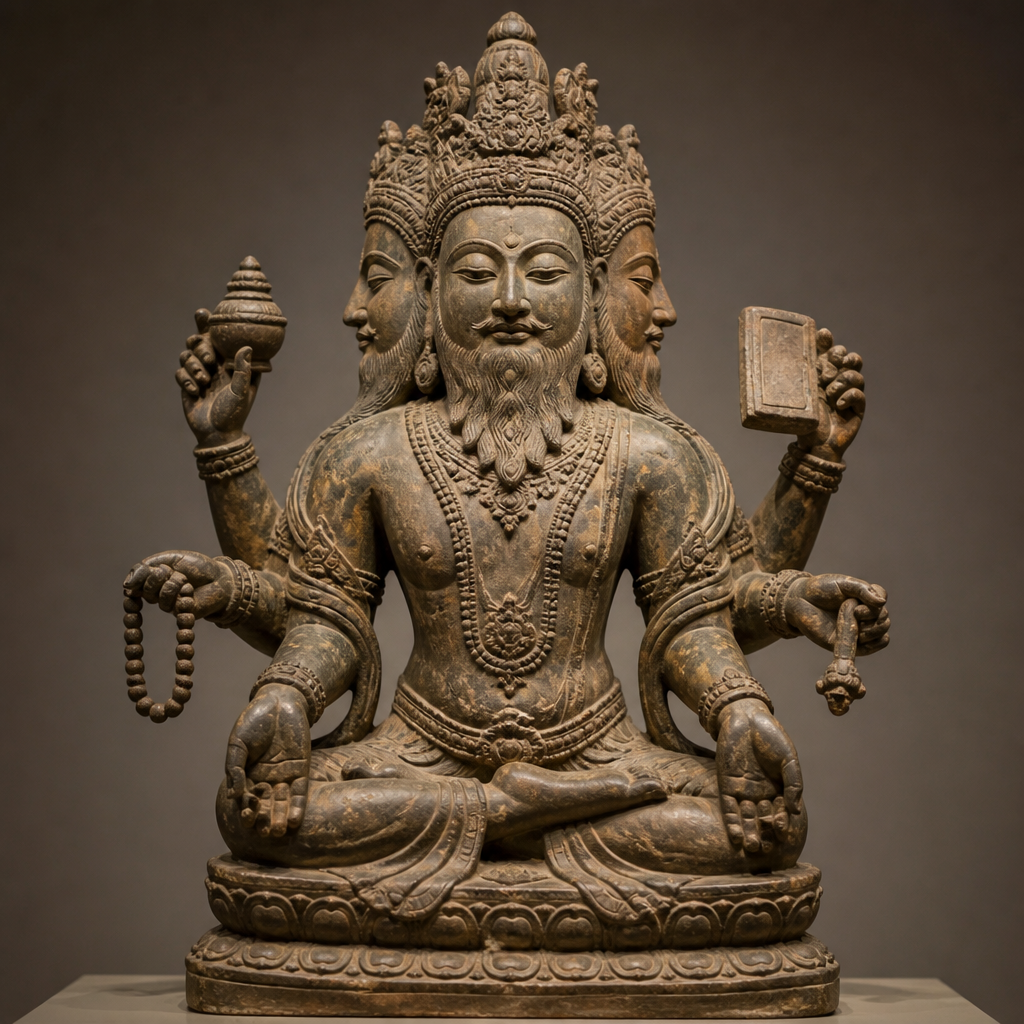
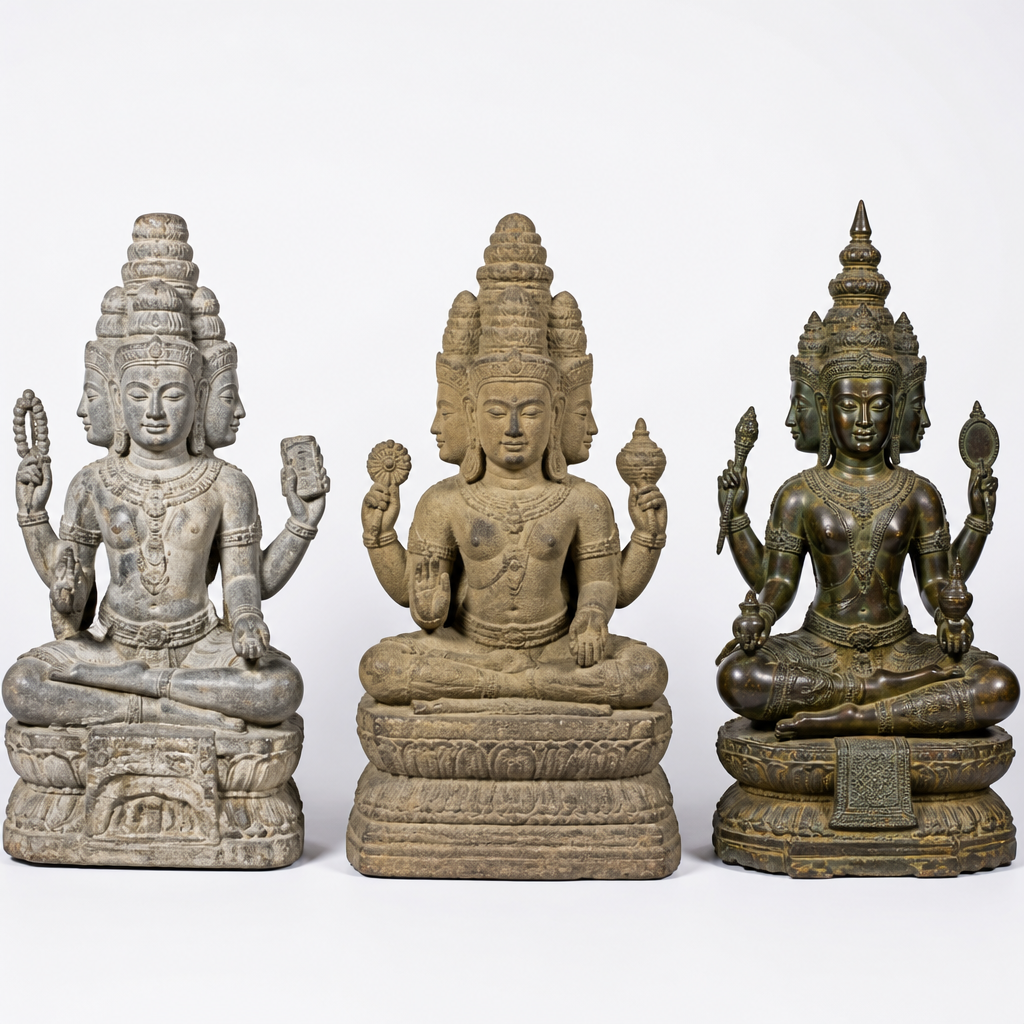
The defining feature of any Brahma sculpture is the Chaturmukha form, the four-faced configuration in which each face points to one of the four cardinal directions: north, south, east, and west. This arrangement makes a precise theological claim: Brahma sees everything and is present in all directions simultaneously. The four faces also correspond to the four Vedas, with each face associated with one of the sacred texts, the Rig, Sama, Yajur, and Atharva Vedas. According to Hindu myth, Brahma originally possessed five heads, but the fifth was removed, leaving the canonical four faces found in virtually every sculptural tradition from India to Indonesia.
The Four Hands and Their Attributes
A standard Brahma statue shows four arms, one for each face. The hands typically hold the following attributes, though their arrangement varies by regional tradition. The kamandalu (a water pot) represents the primordial waters from which creation emerged. A book or manuscript refers to the Vedas themselves. A rosary, or japamala, signifies time, since counting beads marks the passage of cosmic cycles. The fourth hand often holds a lotus, the symbol of purity and the seat from which Brahma himself was born. Notably, unlike most Hindu deity statues, Brahma's hands do not hold weapons. This absence is meaningful: creation is an act of generation, not destruction.
Colour, Vehicle, and Seated Position
Brahma is traditionally depicted in red or red-gold tones, symbolising the active creative power of the sun. His vahana (divine vehicle) is the hamsa, the swan, an animal associated with discernment and grace. In seated sculptures, Brahma is typically shown in a lotus position or seated on a lotus throne, reinforcing his origin from the primordial lotus of Vishnu. In standing forms, the posture tends to be frontal and serene, emphasising creative authority rather than dynamic action.
Pro tip: When evaluating a Brahma statue, check that each of the four faces is rendered with equal care and detail. In lower-quality castings, the faces that are not visible from the front are often finished poorly. Museum-quality pieces treat all four faces as primary, since all four are equally significant theologically.
Indian vs. Southeast Asian Brahma Sculpture: Key Differences
The Brahma sculptural tradition split into distinct regional schools as Hinduism spread from the Indian subcontinent into Southeast Asia during the first millennium CE. Understanding these differences helps both collectors and practitioners choose pieces that are authentic to a specific tradition rather than a homogenised blend.
Indian Brahma statues, particularly those from South India, tend to emphasise the Trimurti context. Brahma appears in relief carvings alongside Vishnu and Shiva, especially in the temple traditions of the Chola and Pallava periods. Stone and bronze pieces from this tradition often show a dignified, frontal Brahma with four arms clearly differentiated by their attributes. The sculptural programme is dense with meaning, and the figure is rarely isolated from its cosmological context.
Southeast Asian traditions, by contrast, show a more syncretic approach. As Hinduism blended with local animist beliefs and, later, with Theravada Buddhism in mainland Southeast Asia, Brahma's iconography adapted. In Cambodia, the Khmer kingdom produced some of the finest free-standing Brahma sculptures ever made. In Thailand, Brahma evolved into Phra Phrom, a figure that absorbed local protective deity roles alongside his Hindu creative function.
Pro tip: A Brahma statue's origin is often readable in the treatment of the skirt cloth (called a sampot in Khmer tradition) and the crown style. Khmer pieces from the Bakheng period (early tenth century) feature a knee-length sampot drawn up between the legs with distinctive pleated "fishtail" pendants at the front, a detail documented in examples held by major museum collections. Indian pieces typically show a dhoti treatment with different draping conventions.
Khmer Brahma Statues: Cambodia's Defining Contribution
The Khmer empire, which dominated much of mainland Southeast Asia between the ninth and fifteenth centuries, produced Brahma sculptures of extraordinary sophistication. The Angkor period temples were dedicated simultaneously to Shiva, Vishnu, and Brahma, and the three deities appeared together in temple programmes across the empire. Prasat Phnom Krom, an Angkorian temple built by Yasovarman I on a hill approximately ten kilometres southwest of Siem Reap, is one of the clearest surviving examples of this triple-deity dedication, with separate towers for Shiva, Vishnu, and Brahma.
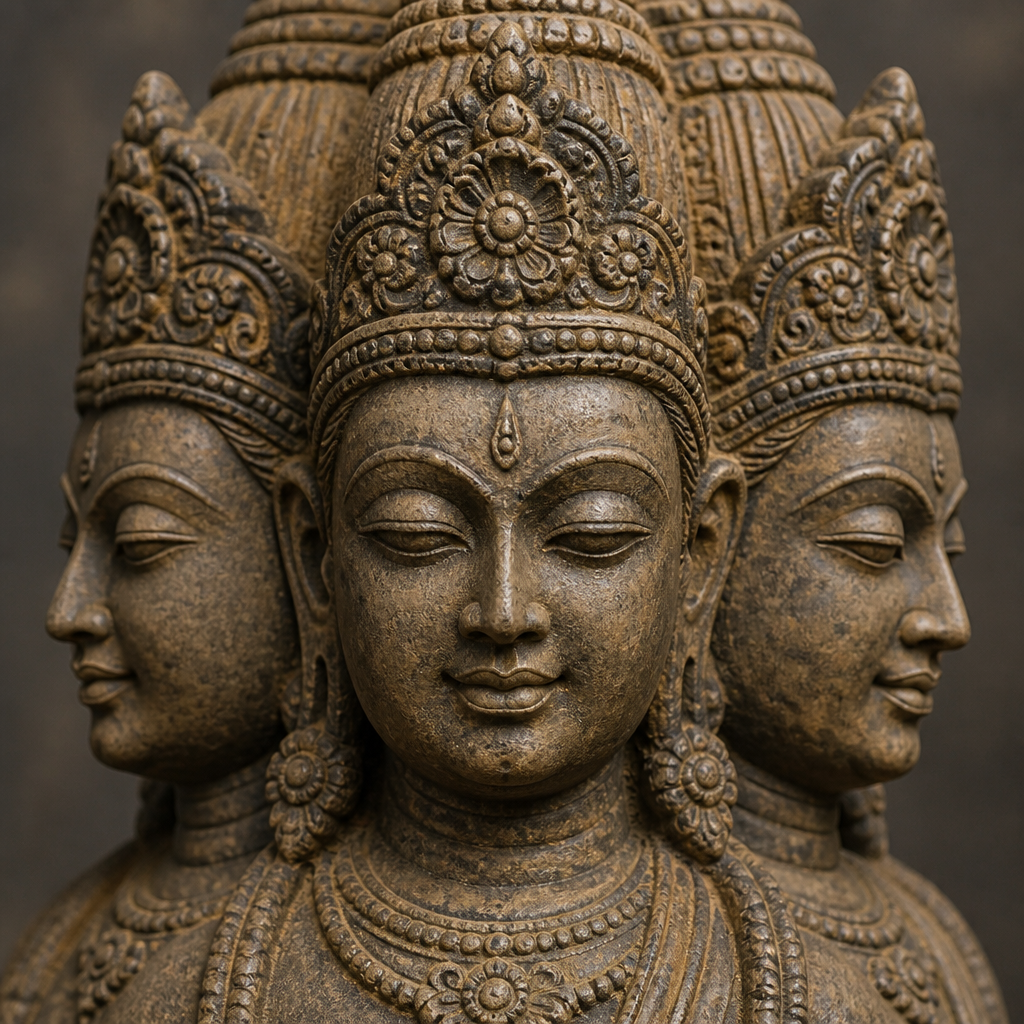
Khmer Brahma statues are distinguished by several features that set them apart from Indian prototypes. The multiple-arm configuration is more common in Khmer work, with eight-arm and even ten-arm versions appearing. A ten-armed Khmer Brahma in the Angkor style depicts the god holding a full range of attributes across each arm, turning the figure into a comprehensive visual catalogue of creative power. The Bakheng style, named after carvings associated with the Bakheng temple and widely used in the early tenth century, features a distinctive sampot treatment that art historians and collectors use to date and authenticate pieces.
Post-Angkor Brahma statues from the Bayon period show a stylistic shift toward softer features and a more meditative quality, which many collectors find particularly compelling. The Bayon style developed after the Khmer empire's conversion toward Mahayana Buddhism and then Theravada Buddhism, and the blending of Hindu and Buddhist aesthetic sensibilities in this period produced some of the most nuanced sculptures in the region's history.
In practice, a Khmer-style Brahma statue is one of the most versatile pieces a collector can acquire. Its formal authority works in a dedicated altar setting, but its sculptural refinement also commands attention as a standalone art object. The bronze casting traditions of Cambodia, which continue in workshops today producing works in the antique Khmer style, maintain the technical standards that made the originals so remarkable.
Phra Phrom: How Thailand Transformed Brahma
Thailand's relationship with Brahma is one of the most fascinating case studies in how Hindu iconography adapts to new cultural environments. Known in Thailand as Phra Phrom, the four-faced creator deity is worshipped outside of strictly Hindu contexts by regular Buddhists and is regarded as a deity of good fortune and protection. This is a significant departure from his pan-Hindu role as cosmic creator, though the visual form remains closely related.
The Erawan Shrine in Bangkok's Pathum Wan district is the most famous Phra Phrom site in the world. The shrine, completed in 1956, was constructed to address misfortunes that occurred during the construction of the adjacent hotel, and the golden Phra Phrom statue at its centre became one of Thailand's most visited religious sites. In Thai iconographic convention, the four faces of Phra Phrom represent four virtues: kindness, grace, compassion, and fairness, a set of meanings that differs subtly from the directional and Vedic symbolism of the Indian tradition but serves an equivalent function of communicating the deity's all-encompassing benevolent presence.
Phra Phrom is also known colloquially outside Thailand as the "Four-Faced Buddha" among Chinese folk religious worshippers, though this designation is iconographically incorrect. Brahma is a Hindu deity who also appears in Buddhist cosmology as Mahabrahma, the lord of the highest heavenly realm. This cosmological overlap explains why his veneration sits so comfortably alongside Buddhist practice in Thailand and why Thai-style Brahma statues are found on Buddhist altars without contradiction.
For collectors based in the United Kingdom, a Thai-style Phra Phrom statue makes an excellent entry point into Southeast Asian Hindu deity sculpture. The tradition is well-documented, the iconography is clear, and the combination of Hindu origin and Buddhist cultural context resonates equally well for spiritual practitioners and art enthusiasts.
Brahma Sculpture Traditions Compared
|
Tradition |
Distinctive Features |
Best Suited For |
|---|---|---|
|
Indian (South Indian / Chola-Pallava) |
Four arms, standard attributes (kamandalu, book, rosary, lotus), often in Trimurti groupings, stone or bronze, frontal and authoritative posture |
Collectors focused on classical Hinduism, Trimurti altar arrangements, academic study of Hindu iconography |
|
Khmer (Cambodian) |
Four to ten arms, elaborate sampot drapery, distinctive crown, Bakheng or Bayon period styling, bronze or sandstone, free-standing forms common |
Collectors of Southeast Asian antiquities, those seeking statement sculptures with strong sculptural presence, serious altars with Angkor-period aesthetic |
|
Thai (Phra Phrom) |
Four faces emphasising protective virtues, golden colouring, often standing or enthroned, Buddhist-Hindu syncretic context, accessible for non-specialist practitioners |
Spiritual practitioners, home altar use, those who want a deity of protection and good fortune, collectors of Thai religious art |
Choosing a Brahma Statue: What Collectors and Practitioners Should Know
The first decision any buyer of a Hindu deity statue should make is whether the piece is for devotional use, display, or both. This distinction matters because it affects which sculptural tradition to prioritise. A piece intended for daily devotional use benefits from having all four faces clearly rendered and accessible. A piece intended primarily as a display object may prioritise the sculptural quality of the front face and overall form.
Material Choices and What They Signal
Bronze is the dominant material in both Indian and Southeast Asian Brahma sculpture traditions, and for good reason. Bronze captures fine detail, ages with character, and conveys the weight and presence appropriate to a figure of Brahma's cosmological significance. Stone Brahma statues, particularly those in the Khmer sandstone tradition, carry an archaeological gravitas that bronze cannot replicate, but stone figures are considerably heavier and less suited to domestic altar settings. For most collectors and practitioners, a well-cast bronze in the antique Khmer or Indian style offers the best balance of detail, durability, and presence.
What Scale Communicates
Scale is one of the most underestimated decisions in acquiring a Hindu deity statue. A small Brahma figure on a desk reads as a personal devotional object. A thirty-centimetre-plus bronze on an altar commands an entirely different energy in a room. In practice, collectors who underestimate scale and purchase pieces that are too small often return to acquire a larger version. If in doubt, choose one size larger than your instinct suggests, particularly for a deity like Brahma whose four-faced form only fully reveals itself when the piece has enough scale to render all four faces with clarity.
Connecting Brahma to Your Existing Collection
Brahma statue collectors often find natural extension points within Hindu deity sculpture more broadly. Sarasvati, his consort, makes an obvious pairing. Vishnu and Shiva complete the Trimurti and create a thematically coherent altar or display grouping. For those approaching from a Buddhist background, the overlap between Brahma and Mahabrahma in Buddhist cosmology means that a Brahma figure can sit authentically alongside Buddha statues from the same Southeast Asian traditions, particularly Thai, Khmer, or Sri Lankan pieces.
HD Asian Art's collection of Hindu deity statues includes pieces from several of the traditions discussed in this article, with a particular strength in Cambodian and Indian works. Exploring the full range of available sculptures gives collectors and practitioners a clear sense of how different regional traditions handle the same iconographic subject.
Frequently Asked Questions
Why does Brahma have four faces?
Brahma's four faces point to the four cardinal directions: north, south, east, and west. This configuration, known as Chaturmukha, represents his omniscience and his ability to observe and preside over the entire universe simultaneously. Each face also corresponds to one of the four Vedas, making the form both a cosmological and a scriptural symbol. According to Hindu mythology, Brahma originally had five faces, but the fifth was removed, leaving the canonical four found in sculpture across India and Southeast Asia.
What do the objects in Brahma's hands represent?
The standard attributes held in Brahma's four hands are the kamandalu (a water pot symbolising the primordial waters of creation), a manuscript representing the Vedas, a rosary or japamala marking the passage of cosmic time, and a lotus referencing the primordial seat of creation. Crucially, none of Brahma's hands hold weapons, which distinguishes him from most other major Hindu deities and reflects his role as creator rather than warrior or protector.
What is the difference between a Brahma statue and a Phra Phrom statue?
Phra Phrom is the Thai interpretation of Brahma. Iconographically they share the four-faced form, but the Thai tradition emphasises four virtues associated with the faces: kindness, grace, compassion, and fairness. Phra Phrom has also been absorbed into Thai Buddhist practice as a deity of good fortune and protection, giving him a devotional role that goes beyond the purely creative function of Brahma in pan-Hindu theology. A Phra Phrom statue tends to have a golden colouring and a more accessible, protective expression, while Brahma statues in the Indian tradition are typically rendered in red or red-bronze tones with a more austere, authoritative presence.
How does Khmer Brahma sculpture differ from Indian Brahma sculpture?
Khmer (Cambodian) Brahma sculptures often feature more arms than the standard four found in Indian tradition, with eight-arm and ten-arm configurations common. The Khmer tradition also has a highly distinctive approach to the deity's garment, the sampot, which in the Bakheng style features knee-length draping with characteristic pleated pendants at the front. Khmer pieces tend to have a more introspective quality in the facial expression compared to the frontal authority of many South Indian Brahma figures. Both traditions produce exceptional work, but they are aesthetically distinct enough that a knowledgeable collector can identify regional origin from the sculptural style alone.
Is it appropriate to have a Brahma statue in a home with no Hindu practice?
Yes. Brahma statues are collected and displayed by art collectors, interior designers, and spiritual practitioners from a wide range of backgrounds without any requirement for formal Hindu devotional practice. In Buddhist Southeast Asia, Brahma figures appear on Buddhist altars and in Buddhist cosmological contexts without contradiction. In a home setting, a Brahma statue functions as a powerful object of contemplation, a symbol of creative intelligence, and a work of art with a documented iconographic history. Respectful display, which means giving the piece appropriate positioning and not treating it as mere decor, is the only meaningful standard to apply regardless of the owner's religious background.
What should I look for when buying a museum-quality Brahma statue?
First, examine all four faces with equal scrutiny: a quality piece renders each face with care since all four are iconographically significant. Second, check that the hand attributes are correctly depicted and clearly formed. Third, assess the casting quality of smaller details such as the crown, the drapery folds, and the base. Fourth, consider the weight and finish of the bronze, since antique-style castings should have a depth of patina and a solidity that distinguishes them from lightweight decorative reproductions. Finally, confirm the stated regional tradition against the sculptural evidence. An authentic Khmer-style piece will show the sampot treatment and crown type associated with that tradition, not a generic four-faced figure that could be from anywhere.
If you have a Brahma statue in your collection or have visited a significant Brahma shrine anywhere in Asia, share your experience in the comments below. We would like to hear what drew you to this particular deity and how the piece sits in your space.
References
-
Brahma: overview of iconography, mythology, and attributes on Wikipedia
-
Phra Phrom: Thailand's four-faced deity of fortune and its relationship to Hindu Brahma
-
Khmer Brahma sculpture from the Bakheng period in the Metropolitan Museum of Art collection
-
The Trimurti in Hindu theology: Brahma, Vishnu, and Shiva explained
-
Prasat Phnom Krom: Angkorian temple dedicated to Brahma, Vishnu, and Shiva near Siem Reap
