



Estatua de Buda reclinado: significado, estilos y cómo elegir
Estatua de Buda reclinado: significado, estilos y cómo elegir
La mayoría de las personas que compran un estatua de buda reclinado Piensan que están comprando una pieza decorativa de una figura dormida. Están equivocados. El Buda reclinado no representa el sueño. Representa uno de los momentos más significativos de todo el pensamiento budista: el paso final al parinirvana.
Entender bien ese significado y comprender cómo cambia a través de regiones y siglos es la diferencia entre elegir una pieza con resonancia genuina y elegir algo que parece vagamente asiático en un estante. Esta guía cubre la iconografía, las principales tradiciones regionales y las decisiones prácticas que separan una compra reflexiva de una lamentable.
Tabla de contenidos
Conclusiones rápidas
|
Información clave |
Explicación |
|---|---|
|
El Buda reclinado representa el parinirvana, no el sueño. |
La postura marca los momentos finales del Buda histórico antes de la liberación completa del ciclo de nacimiento y muerte, el samsara. Es un momento de profunda paz, no de descanso. |
|
El lado derecho hacia abajo es la posición canónica. |
Casi todas las tradiciones autenticadas sitúan al Buda acostado sobre su lado derecho. Una postura del lado izquierdo, como la del Buda monolítico en Phnom Kulen en Camboya, es una desviación notable e intencional, no un estilo estándar. |
|
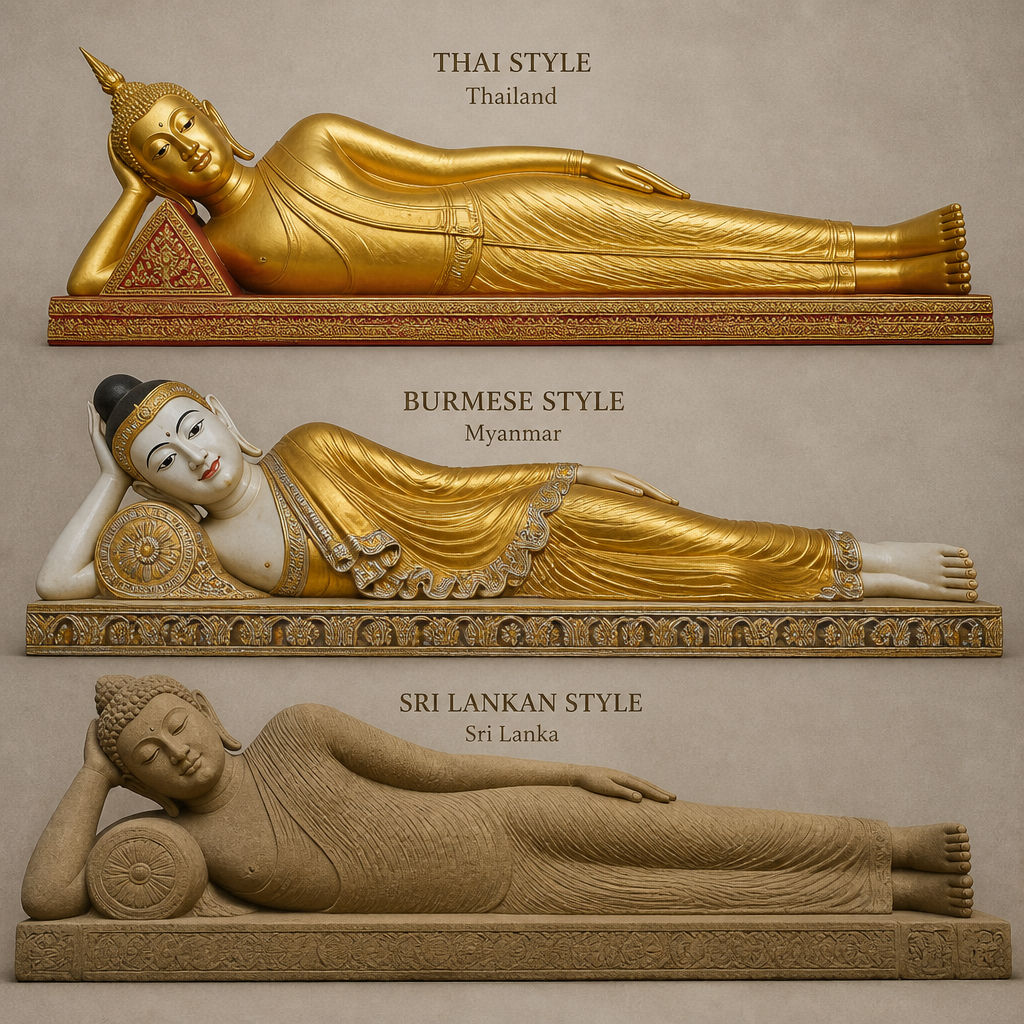
Los estilos tailandés, birmano y de Sri Lanka difieren visiblemente |
Las estatuas tailandesas tienden hacia superficies doradas y formas alargadas. Los ejemplos birmanos suelen presentar ornamentación con joyas. Los estilos de Sri Lanka, como el Gal Vihara en Polonnaruwa, están tallados directamente en la roca con austera sencillez. |
|
El Buda reclinado más antiguo conocido es de Pakistán. |
La estupa de Bhamala contiene una estatua de Buda reclinado datada con carbono en aproximadamente 1.800 años de antigüedad, lo que sitúa firmemente la tradición iconográfica en el arte de Gandhara. |
|
Las decoraciones para los pies tienen significado |
En las tradiciones tailandesa y birmana, las plantas de los pies suelen estar decoradas con las 108 marcas auspiciosas de Buda. Este detalle señala una pieza iconográficamente seria y de alta calidad. |
|
La escala afecta el significado en un entorno doméstico. |
Un Buda reclinado lee de manera diferente a 15 cm que a 90 cm. Las proporciones más largas y bajas enfatizan la calma horizontal del parinirvana. Las piezas compactas sobre un altar elevado todavía llevan la iconografía pero con menos impacto visual. |
|
El material y el acabado indican el origen regional. |
La laca dorada sobre madera es característica de Birmania y Tailandia. La fundición de bronce está muy extendida en Camboya y China. La talla de piedra domina Sri Lanka y la India. |
Lo que realmente significa el Buda reclinado
El Buda reclinado representa al Buda histórico durante su última enfermedad, en el umbral de parinirvana, la liberación completa y final del ciclo de renacimiento. Los textos budistas describen este momento que tuvo lugar bajo los árboles de sal en Kushinagar, en lo que hoy es el estado indio de Uttar Pradesh, donde Buda dijo a sus seguidores que miraran hacia el Dharma después de su fallecimiento. La postura no es casual. Es una de las imágenes con mayor carga doctrinal de todo el vocabulario visual budista.
La expresión tranquila que define a todo Buda reclinado bien hecho es deliberada. Comunica la ausencia de sufrimiento, la disolución del apego y la paz que llega con la liberación final. La imagen también sirve como recordatorio de anica, la enseñanza budista de la impermanencia. Incluso el Buda, el despierto, estaba sujeto al fin del cuerpo. La postura reclinada hace que esa enseñanza sea visible y tangible.
Esta tradición iconográfica parece haber surgido junto con otras representaciones de Buda en el arte greco-budista de Gandhara, en la región que abarca el Pakistán y el Afganistán modernos. La estupa de Bhamala contiene un Buda reclinado cuya antigüedad es de unos 1.800 años, lo que la convierte en el ejemplo confirmado más antiguo del mundo. A partir de ese origen, la imagen se extendió hacia el este y el sur de Asia, adquiriendo características regionales distintas y conservando su significado central.
La postura reclinada no es una representación de descanso. Es la imagen más precisa que jamás haya producido el arte budista de la liberación total. Cada elección técnica, la dirección de la figura, la posición de la mano, la decoración de los pies, codifica ese significado.
Para los coleccionistas y practicantes espirituales, esto es de importancia práctica. Un Buda reclinado no es intercambiable con otras posturas de Buda. Tiene un peso narrativo específico que los budas que enseñan sentados y los budas que bendicen de pie no tienen. Elegirlo es un acto considerado, no un defecto estilístico.
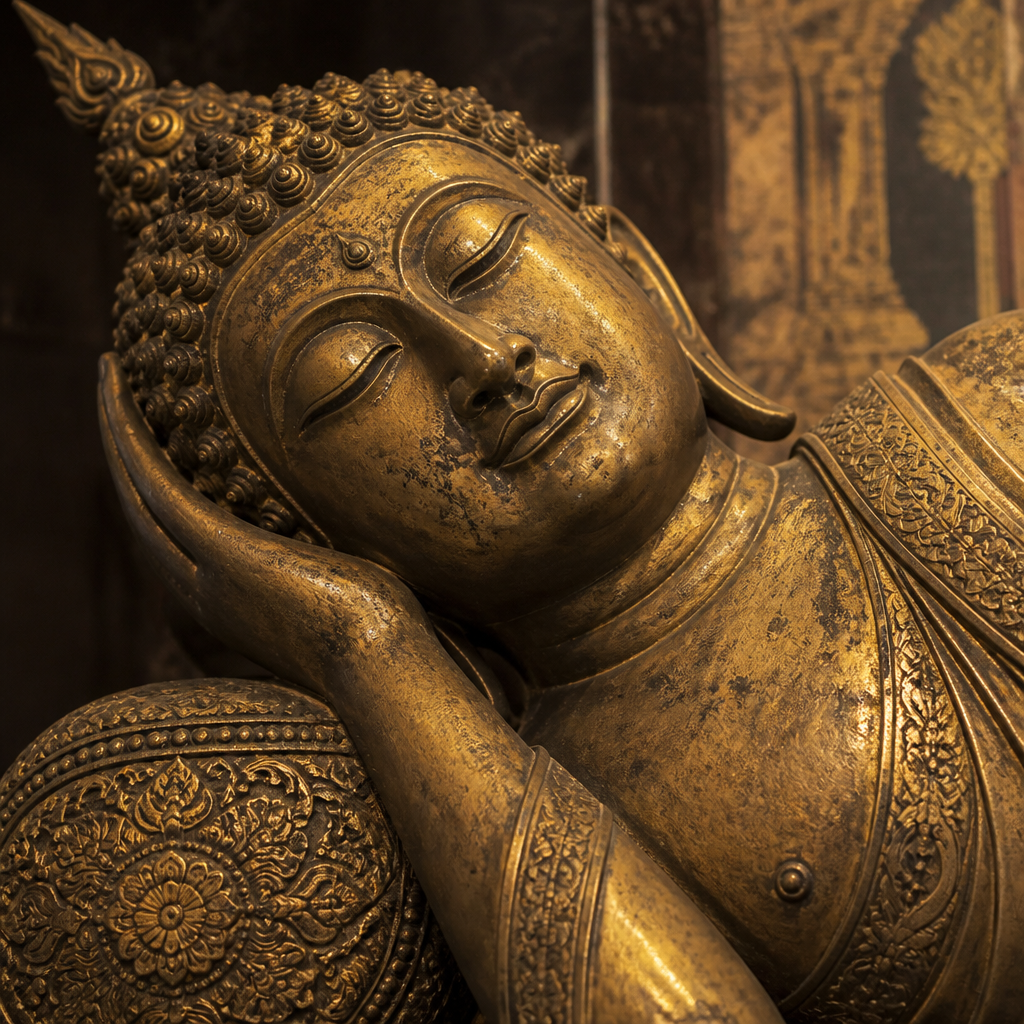
Variaciones regionales en las estatuas de Buda reclinado
Las diferencias regionales en las estatuas de Buda reclinado no son superficiales. Reflejan siglos de distintas tradiciones artísticas, diferentes escuelas budistas y distintos patrocinios reales. Conocer las convenciones regionales te ayuda a identificar lo que estás mirando y a juzgar si una pieza es iconográficamente coherente.
Tailandia
Budas reclinados tailandeses, conocidos en tailandés como Phra Buddhasaiyas, se encuentran entre las imágenes más reconocibles de todo el arte budista. El ejemplo de Wat Pho en Bangkok, encargado por el rey Rama III en 1832 durante el período Rattanakosin, estableció el estándar visual del estilo real tailandés: superficies doradas, proporciones alargadas y plantas de los pies con incrustaciones de nácar que representan las 108 marcas auspiciosas de Buda. Otros ejemplos tailandeses importantes incluyen Wat Lokayasutharam en Ayutthaya y Wat Khun Inthapramun en Ang Thong. Las piezas tailandesas a escala doméstica suelen seguir esta tradición decorativa dorada, con la cabeza sostenida por un cojín elevado o la mano derecha.
Birmania (Myanmar)
Los budas reclinados birmanos se encuentran entre los más grandes del mundo. El Buda Win Sein Tawya cerca de Mawlamyaing alcanza aproximadamente 183 metros de longitud. El Buda Shwethalyaung de Bago, de unos 55 metros de altura, es uno de los más venerados. Para los coleccionistas, las piezas birmanas a escala doméstica suelen presentar una elaborada laca dorada sobre un núcleo de teca u otra madera dura, a menudo con coronas ornamentales con joyas e insignias que reflejan la tradición birmana de representar a Buda con atuendo real. El templo Manuha en Bagan contiene un ejemplo temprano particularmente importante.
Srilanka
El Gal Vihara en Polonnaruwa, tallado en el siglo XII, representa el enfoque de Sri Lanka en su forma más poderosa: una figura masiva tallada directamente de una sola cara de granito, sin dorado y con una ornamentación mínima. La expresividad proviene enteramente de la propia talla, del rostro sereno, de la precisión de los pliegues de las cortinas. Los Budas reclinados de Sri Lanka en esta tradición enfatizan la austeridad y la calidad formal directa sobre el tratamiento superficial decorativo.
Camboya y China
En Camboya, el lado oeste del templo Baphuon en Angkor presenta un gran Buda reclinado, y el Buda monolítico de Phnom Kulen se destaca por yacer en el lado izquierdo en lugar de en el derecho, una desviación que tiene su propio significado local. Los ejemplos chinos, como el Buda reclinado del templo Dafo en Zhangye, a menudo muestran la influencia de las convenciones artísticas locales mezcladas con iconografía budista importada.
Consejo profesional: Al evaluar una pieza descrita como tailandesa o birmana, fíjese en el tratamiento de la base y el soporte para la cabeza. Las piezas tailandesas casi siempre muestran un almohadón o almohada de varios niveles con bandas decorativas. Las piezas birmanas suelen mostrar un soporte curvo simple integrado en el bloque escultórico general. Estos detalles estructurales son difíciles de falsificar de manera convincente y dicen más sobre el origen que el acabado superficial por sí solo.
Los detalles iconográficos que lo cambian todo
Una estatua de Buda reclinado no es sólo una figura acostada. Los detalles específicos de su ejecución determinan si tiene significado iconográfico o meramente decorativo. Para coleccionistas y profesionales, saber qué detalles importan es esencial.
La dirección de la postura acostada
El canónico Buda reclinado yace sobre su lado derecho, con la cabeza apoyada en la mano derecha o en un cojín. Ésta es la posición descrita en las fuentes textuales budistas. En algunas tradiciones regionales, sobre todo en Phnom Kulen en Camboya, existe una pieza situada en el lado izquierdo, pero es una excepción. Si encuentra una pieza del lado izquierdo presentada como estándar, vale la pena señalarla y cuestionarla.
La posición de los ojos
Los ojos importan enormemente. Los ojos completamente cerrados sugieren una profunda absorción meditativa o sueño, lo cual es iconográficamente incorrecto para el parinirvana. La representación correcta muestra ojos casi cerrados pero no completamente cerrados, lo que transmite más el estado de transición que el de inconsciencia. Ésta es una sutil distinción que separa las piezas cuidadosamente producidas de las reproducciones del mercado masivo.
La decoración de los pies
En particular, en las tradiciones tailandesas y birmanas, las plantas de los pies están decoradas con las 108 marcas auspiciosas de Buda. En las piezas tailandesas de alta calidad, esto se realiza con incrustaciones de nácar. En las piezas birmanas suele estar pintado o lacado. Una pieza con suelas lisas y sin decoración no es necesariamente incorrecta, particularmente en las tradiciones de Sri Lanka o China, pero en una pieza de estilo tailandés indica un nivel más bajo de artesanía o atención al detalle iconográfico.
La expresión
El rostro debe proyectar calma absoluta, no inexpresividad. Hay una diferencia. El vacío es la ausencia de expresión. La expresión parinirvana es serenidad activa, un rostro que comunica la paz alcanzada. Cualquier pieza donde el rostro parezca vacío o inexpresivo ha fallado en el elemento más importante de la composición.
Consejo profesional: Mire fotografías de la pieza desde múltiples ángulos antes de comprarla, específicamente la cara en vista de tres cuartos, los pies rectos y el perfil horizontal general. Estas tres vistas revelan la calidad de la artesanía y la fidelidad a la convención iconográfica más claramente que cualquier toma frontal.
Comparación de las tradiciones del Buda reclinado de un vistazo
La siguiente tabla compara las tres tradiciones más comúnmente representadas en estatuas de Buda reclinadas coleccionables y con calidad de altar disponibles en el mercado occidental. Comprender estas distinciones le ayuda a hacer coincidir una pieza con su intención espiritual, estética o de coleccionismo específica.
|
Tradición |
Materiales y acabados típicos |
Características iconográficas clave |
|---|---|---|
|
Tailandés (Rattanakosin y anteriores) |
Superficie dorada sobre yeso, madera o bronce; incrustaciones de nácar en los pies; bandas de laca en la base |
Proporciones alargadas, almohada decorativa, 108 marcas en las plantas, ojos serenos casi cerrados, ushnisha de llama ornamental |
|
Birmano (Myanmar) |
Laca dorada sobre teca o madera dura; insignias enjoyadas; decoración de pies pintada o lacada |
Estilo ornamental real, a veces representado con corona y joyas, base ricamente decorada, modelado facial más suave que los ejemplos tailandeses. |
|
Sri Lanka (cingalés) |
Piedra (granito o caliza), sin dorar; a veces encalado o pintado en períodos posteriores |
Superficies austeras, calidad de tallado directo, ornamentación mínima, énfasis en la masa escultórica y la precisión de las cortinas. |
Cómo elegir la estatua de Buda reclinada adecuada
La elección de una estatua de Buda reclinado implica tres decisiones superpuestas: fidelidad iconográfica, estilo regional y adecuación práctica al espacio y propósito. Acertar con los tres al mismo tiempo es lo que hace que la mayoría de los compradores tengan éxito o se conformen con la pieza equivocada.
Haga coincidir el estilo con su colección o espacio existente
Si ya posee piezas de una tradición regional específica, un Buda reclinado de la misma tradición crea coherencia visual y espiritual. Un altar de laca birmana no se beneficia de una pieza dorada de estilo tailandés con diferentes convenciones proporcionales. En HD Asian Art, la gama abarca Birmania, Tailandia, Sri Lanka, Camboya y otras tradiciones asiáticas importantes, lo que significa que puede encontrar una pieza que complemente, en lugar de contradecir, lo que ya tiene.
Considere la escala en serio
Los budas reclinados son inherentemente horizontales. Requieren más espacio lateral que una figura sentada o de pie de altura comparable. Una pieza reclinable de 60 cm necesita una superficie de al menos 65 cm de largo y debe quedar lo suficientemente baja como para que el espectador pueda ver la cara con claridad. Una pieza colocada demasiado alta en un estante ocultará la cara y pondrá en primer plano la base, lo que invierte la jerarquía visual que pretendía el escultor.
Prioriza el rostro sobre todo lo demás
En un Buda reclinado, el rostro es el punto central. El cuerpo lleva el significado de la postura, pero el rostro lleva su peso emocional. Una pieza con un cuerpo bellamente detallado y una cara mediocre es una pieza fallida. En la práctica, al evaluar un Buda reclinado a cualquier precio, dedique más tiempo a evaluar la cara que cualquier otro elemento. La expresión, el modelado de los rasgos, la calidad de los ojos: estos determinan si la pieza tiene presencia genuina o simplemente llena el espacio.
Comprenda lo que está comprando en términos de edad y procedencia
Las piezas con calidad de museo y procedencia confirmada tienen precios significativamente más altos que las piezas artesanales contemporáneas elaboradas con métodos tradicionales. Ambos tienen un valor genuino, pero tienen propósitos diferentes. Un coleccionista que construye una colección seria necesita documentación. Un practicante que crea un altar casero necesita una pieza con una integridad iconográfica auténtica, que las piezas contemporáneas hechas por artesanos capacitados en talleres tradicionales pueden proporcionar absolutamente.
Colocación y cuidado de un Buda reclinado en casa
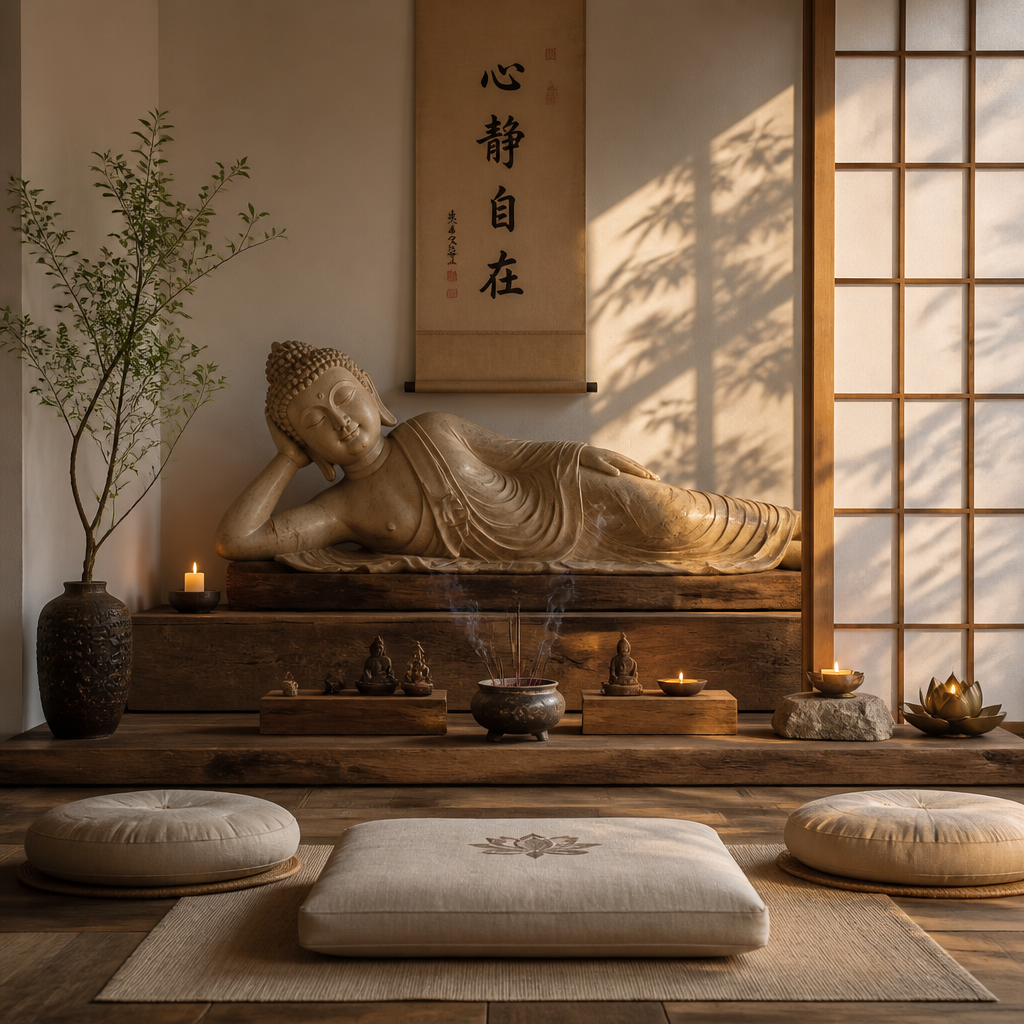
La colocación de un estatua de buda reclinado en casa no es sólo una decisión estética. En la convención budista, las imágenes de Buda deben colocarse a una altura donde no se las mire desde arriba, idealmente al nivel de los ojos o por encima de ellos cuando se está sentado. Para una figura reclinada, esto crea un desafío práctico porque la pieza es horizontal. Una mesa de altar baja o un estante exclusivo a la altura de los ojos de los sentados funcionan bien. La figura debe mirar hacia la habitación y no hacia la pared.
En la práctica budista tailandesa, la cabeza de la figura tradicionalmente mira en una dirección específica dependiendo del propósito de su colocación, pero en un contexto doméstico occidental, la convención más importante es simplemente tratar la pieza con respeto: no colocarla en el suelo, no almacenar objetos encima de ella y no colocarla en un baño o espacio de servicio.
El cuidado depende enteramente del material. Las piezas de bronce necesitan una limpieza ocasional con un paño suave y seco y, en ambientes húmedos, una ligera aplicación de cera para evitar que la pátina se acelere más allá del acabado deseado. Las piezas de laca dorada, habituales en el trabajo birmano y tailandés, nunca deben limpiarse con agua ni ningún disolvente. Quitar el polvo en seco con un cepillo suave es el enfoque correcto. Las piezas de piedra son las más robustas pero conviene protegerlas de las heladas si se colocan al aire libre.
Un error común es colocar un Buda reclinado sobre una superficie demasiado pequeña para ello. La figura completa, incluida la base, debe asentarse cómodamente dentro de la superficie sin sobresalir. El voladizo crea tanto un riesgo físico como una inestabilidad visual que socava la calidad misma de calma que la pieza debe proyectar.
Preguntas frecuentes
¿En qué se diferencia el significado del Buda reclinado de otras posturas de Buda?
El Buda reclinado representa específicamente al Buda histórico en el momento del parinirvana, su salida final del ciclo de nacimiento y muerte. Los budas sentados suelen representar la enseñanza o la meditación. Los Budas de pie representan la bendición o el caminar. La postura reclinada es la única ligada a este momento biográfico y doctrinal específico, lo que le confiere un peso espiritual distinto en la práctica y la iconografía budista.
¿Es apropiado el Buda reclinado para un altar doméstico?
Sí, y se utiliza ampliamente en hogares budistas de Tailandia, Birmania, Sri Lanka y más allá. La consideración clave es la ubicación. La figura debe estar a una altura respetuosa, no en el suelo, y tratada con el mismo cuidado que cualquier imagen sagrada. No existe ninguna prohibición sobre el uso de un Buda reclinado como imagen principal del altar, aunque en algunas tradiciones se usa más comúnmente como figura central un Buda sentado meditando o enseñando.
¿Por qué Buda se acuesta sobre su lado derecho?
La posición del lado derecho se describe en fuentes textuales budistas como la postura que asumió el Buda en el momento del parinirvana. En el contexto cultural indio más amplio, acostarse sobre el lado derecho se asocia con auspiciosidad y un estado de alerta reparador. Es la posición canónica e iconográficamente correcta. Las figuras reclinadas del lado izquierdo existen en ciertas tradiciones regionales, pero son excepciones y no la norma.
¿Qué es el Buda parinirvana y en qué se diferencia del nirvana?
Nirvana, en la enseñanza budista, se refiere a la extinción del anhelo y la liberación del sufrimiento que se logra mediante el despertar. El Buda histórico alcanzó el nirvana bajo el árbol Bodhi. Parinirvana, a veces llamado mahaparinirvana, se refiere al nirvana final que ocurre en la muerte física, cuando incluso la existencia física residual mantenida después del despertar llega a su fin. El Buda reclinado representa específicamente esta segunda liberación final, razón por la cual es la forma iconográfica asociada con el fallecimiento del Buda más que con su iluminación.
¿Cómo puedo saber si una estatua de Buda reclinado es iconográficamente auténtica?
Verifique cuatro cosas: la figura yace sobre su lado derecho; los ojos están casi cerrados, pero no completamente; la expresión es de serenidad activa más que de vacío o sueño; y, en piezas tailandesas o birmanas, las plantas de los pies muestran marcas decorativas. Una pieza que supera los cuatro controles parte de una auténtica tradición iconográfica. Una pieza que no cumpla con ninguno de ellos puede seguir siendo hermosa, pero no es iconográficamente precisa.
¿El tamaño de una estatua de Buda reclinado afecta su significado o uso?
El significado es consistente independientemente de la escala. Sin embargo, las implicaciones prácticas difieren significativamente. Una pieza pequeña funciona bien en un altar personal o como parte de una colección más amplia. Una pieza más grande, de 60 cm o más de longitud, crea un punto focal que funciona más como la pieza central de un santuario. La naturaleza horizontal de la forma significa que la escala afecta la lectura espacial de la pieza de manera más dramática que en el caso de las figuras sentadas o de pie, que trabajan en una gama más amplia de tamaños sin reorganizar el espacio a su alrededor.
¿Qué materiales son más comunes en las estatuas de Buda reclinado de Asia?
El bronce está muy extendido en Camboya, China y partes de Tailandia y la India. La laca dorada sobre madera o un material central es característica de las piezas birmanas y tailandesas. La piedra, particularmente el granito y la piedra caliza, domina los ejemplos de Sri Lanka y algunos de la India. En la producción artesanal contemporánea, la resina y los materiales compuestos se utilizan cada vez más en piezas del mercado masivo, aunque los minoristas con calidad de museo trabajan con materiales y métodos tradicionales. Al comprar, pídale siempre al vendedor que confirme el material, ya que el acabado de una pieza de resina puede imitar mucho el bronce o la laca dorada de un vistazo.
Si tiene un Buda reclinado en su casa o colección, realmente nos gustaría conocer la tradición de la que proviene y cómo lo ha colocado. Comparte tu experiencia en los comentarios.
Referencias
