



Lord Ganesha Antique Statue: A Collector's Guide
Lord Ganesha Antique Statue: A Collector's Guide
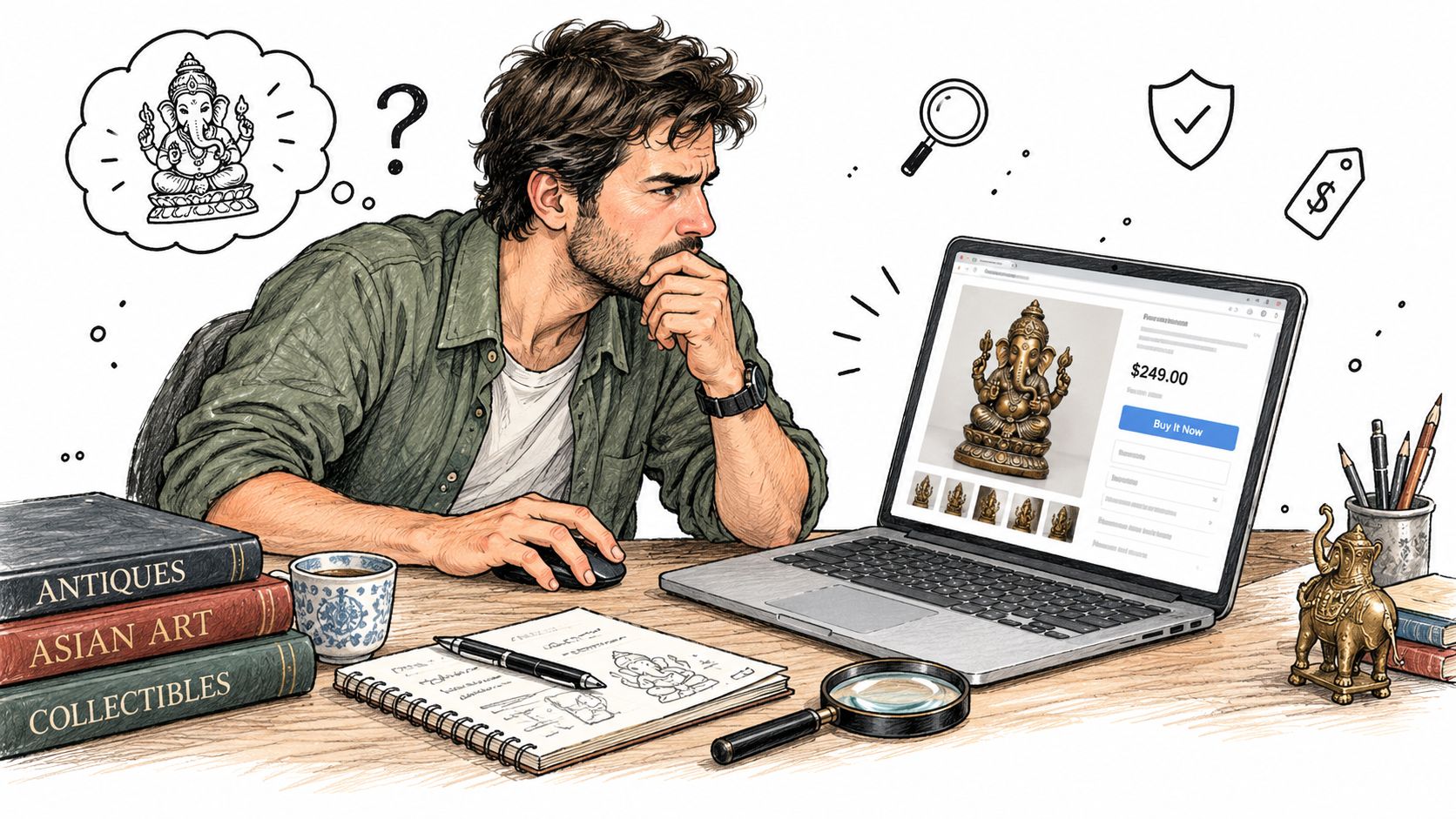
A promising listing appears on your screen. The photograph shows a seated Ganesha with a darkened surface, carefully carved ornaments and a description that calls it “antique”. The price looks tempting, but the seller gives little information about age, origin or previous ownership. Before you decide whether it belongs in your home, collection or institution, you need to establish what you're looking at.
A genuine Lord Ganesha antique statue should withstand questions about iconography, material, manufacture, condition and provenance. A modern decorative object may still be attractive and spiritually meaningful, but it shouldn't be priced or represented as a historic sculpture. UK museum examples, careful comparison and HMRC's guidance on imported antiques and works of art provide a useful framework for making that distinction.
Table of Contents
- Why Identifying an Antique Lord Ganesha Statue Matters
- Core Iconographic Features of Lord Ganesha Statues
- How to Date and Authenticate Lord Ganesha Antique Statues
- Regional Styles and Temporal Markers in Ganesha Sculpture
- Provenance, Condition and UK Import Considerations
- Recommended Placement, Care and Display Practices
- Buying Tips for Collectors and Institutions
- Building a Thoughtful Lord Ganesha Collection
Why Identifying an Antique Lord Ganesha Statue Matters
A collector may find two statues with the same elephant-headed subject, dark surface and seated pose, yet only one may have the age, workmanship and documentation expected of an antique. A dark bronze finish, worn base or traditional ornament can result from deliberate finishing, workshop methods or ordinary decorative treatment on a recent object. The word “antique” therefore needs evidence, not visual atmosphere.
The distinction affects both the purchase and the object's meaning. Ganesha represents wisdom, auspicious beginnings and the removal of obstacles for many devotees. Other buyers value the sculpture as historical or artistic material. A modern devotional statue can fulfil its purpose without pretending to be rare. A piece sold as an antique carries expectations about craftsmanship, ownership history, conservation and responsible stewardship.
Start with evidence the object can provide
Read the sculpture before accepting the seller's adjectives. Record the head, trunk, arms, attributes, posture and base, then examine whether the material and surface are consistent with the claimed age. Request photographs of the underside, reverse and damaged areas. Their absence does not prove deception, but it limits what you can assess.
Online retail results create a poor benchmark for historic work. The marketplace results mix inexpensive contemporary pieces with objects described using broad terms such as “vintage” or “antique”. A low-cost resin or cast-metal Ganesh may resemble an older bronze at a glance, while its manufacture, cultural context and value are entirely different.
Practical rule: Treat age, origin and attribution as separate questions. A statue can be old but poorly documented, well documented but heavily restored, or beautifully made but modern.
A UK museum record gives a more disciplined comparison. The British Museum describes a sandstone Ganesha made around AD 750, measuring 96 centimetres high and 36 centimetres wide. It was purchased from Spink & Son Ltd and entered the collection in 1974 through its collection record. Material, dimensions, date and acquisition history together provide usable reference points, even though one museum object cannot authenticate another.
Identification also affects practical costs. Before committing to a purchase, separate the object's likely age from its condition, packing needs, transport risk and UK import requirements. Check the relevant HMRC treatment for antiques and works of art, and retain invoices, descriptions and provenance records. Good paperwork supports the object's history and helps expose claims that cannot withstand scrutiny.
Core Iconographic Features of Lord Ganesha Statues
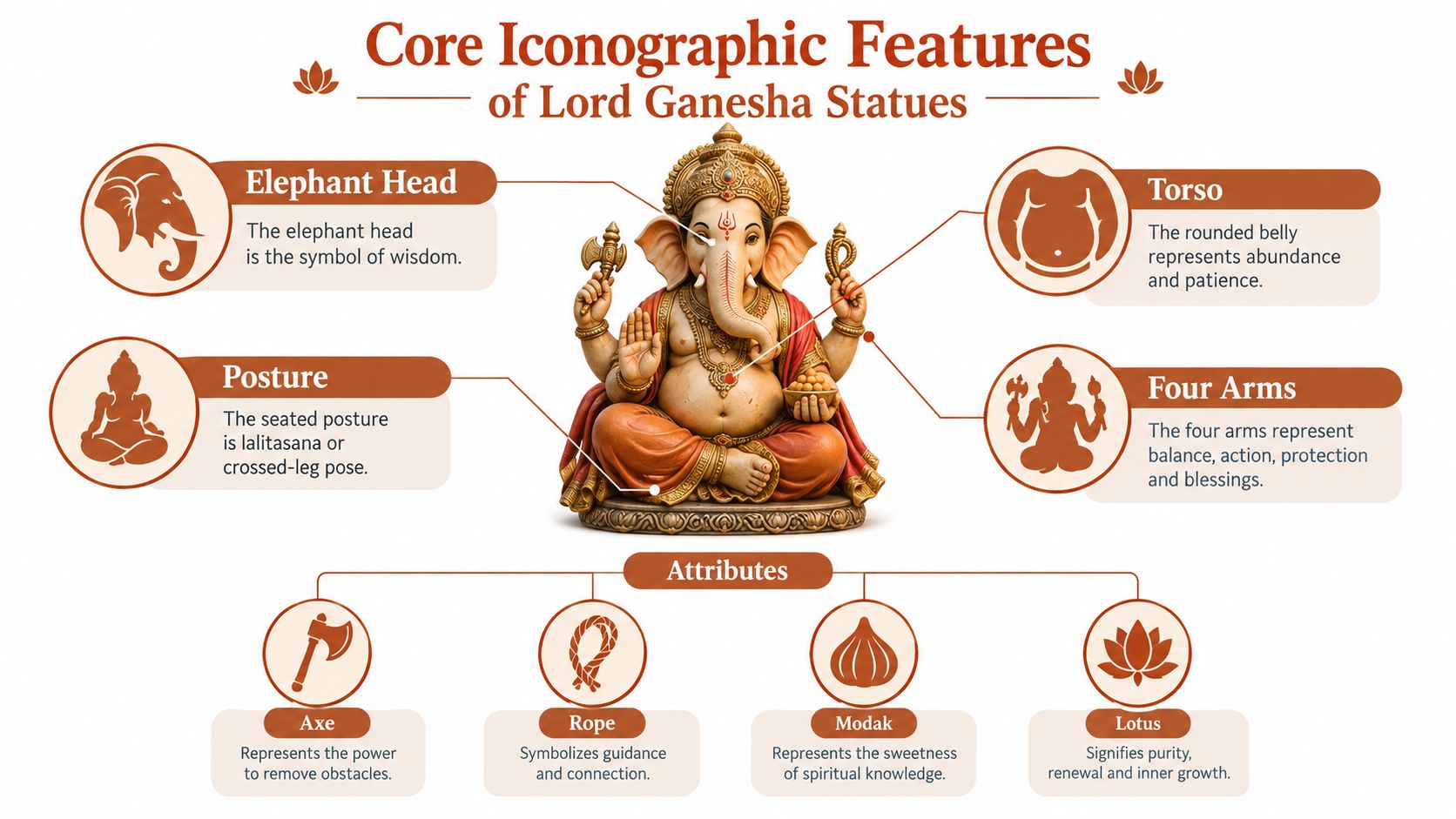
A specialist begins with the figure's structure, not its patina. Ganesha is generally recognisable through the elephant head, human body, prominent belly and distinctive combination of arms, attributes and posture. These features establish whether the sculptor understood the religious image and can also help distinguish a carefully made devotional sculpture from a generic elephant-headed decoration.
Read the figure from head to base
Start at the face. Look at the relationship between the elephant head and human torso, the direction and curve of the trunk, the treatment of the eyes, the tusks and the ears. A convincing traditional image usually has an internally coherent anatomy. The head shouldn't appear mechanically attached to the torso, and the ornaments should follow the body rather than sit as unrelated surface decoration.
The rounded belly is a major visual feature, but its treatment varies. Some sculptures emphasise a soft, generous torso, while others use a more controlled, formal shape. Examine whether the belly, chest and shoulders were carved or modelled as a unified volume. Abrupt transitions can indicate a weak reproduction, although a simple workshop style isn't automatically evidence of modern manufacture.
Posture helps identify function and style. A seated Ganesha may appear cross-legged or in a relaxed seated pose often described as lalitasana, while standing and dancing forms create a different sense of movement and ceremonial purpose. Look at the weight distribution. On an older sculpture, the posture should make structural sense, particularly where one leg, arm or attribute projects beyond the main body.
Count arms and identify attributes
Four arms are common, but Ganesha appears in many iconographic forms. The hands may hold a modak, axe, noose, goad, lotus, conch or discus, while another hand may offer protection or blessing. Don't assume that every statue must contain the same objects. Regional traditions and specific forms change the selection, arrangement and number of attributes.
A missing attribute is both an iconographic and condition issue. A broken goad or empty hand may reflect age, transport damage or deliberate alteration. Ask whether the object is original, replaced or newly made. Freshly bright metal on one hand, sharp edges against a softened body and an inconsistent fit can reveal a later replacement.
For a useful visual explanation of these symbols, compare Ganesha's iconography and the meanings of his attributes. Use such references to form a vocabulary, then return to the physical object. Symbolism helps with identification, but it doesn't authenticate age on its own.
Separate devotional purpose from decoration
A devotional sculpture may show handling wear around the base, softened edges on frequently touched areas or residue associated with offerings. A purely decorative object may have a cleaner finish, a contemporary plinth or deliberately uniform colouring. Neither category is automatically superior, but the distinction affects how you should interpret wear and how you'll display the piece.
Scale offers another clue. A temple sculpture, household image and modern interior object can all use related iconography, yet their proportions, finishing and structural demands differ. A large stone Ganesha should have a convincing base and evidence of appropriate tool work. A small bronze should show a plausible casting method rather than a generic moulded outline.
How to Date and Authenticate Lord Ganesha Antique Statues
Authentication begins with manufacture. The central question isn't whether the surface looks old. It's whether the material, technique, wear and documentation tell the same story.
Compare material with production method
Bronze statues may retain casting seams, filed areas, chased details and traces of tool finishing. Inspect the underside and difficult recesses. A genuine casting can show variations in thickness and finishing, while a modern reproduction may reveal repetitive mould marks, unusually clean cavities or a seam that runs through details a skilled maker would have refined.
Stone requires a different reading. Look for hand-tool marks, changes in grain, old breaks and the way raised details have softened. Machine carving can produce regular parallel marks, overly consistent depth or corners that appear mechanically sharp. Those signs need interpretation because some later workshops use both hand and powered tools.
Wood can develop splits, insect damage, shrinkage and changes in surface colour. Terracotta may show firing variation, small losses and a surface that differs between exposed and protected areas. Alabaster is comparatively soft and can show abrasions, repairs and handling wear that should be assessed against its translucency and carving quality.
Treat patina as evidence, not proof
Patina should develop in relation to handling, exposure and the material beneath it. On bronze, inspect recessed areas, contact points and the underside rather than judging only the most visible face. Artificial ageing may produce an even dark coating, bright colour in cracks or a surface that looks old from a distance but lacks layered variation under magnification.
Resin and composite reproductions often reveal themselves through light weight, mould lines, air bubbles, powdery edges or a surface that continues into the base without the expected structural logic. A seller's claim that an object is “bronze” should be tested with detailed photographs and, where appropriate, professional examination. Weight alone isn't conclusive because hollow casting, repairs and mixed materials complicate the comparison.
For a focused discussion of surface reading, use this guide to distinguishing genuine patina from artificial ageing. The principles apply beyond Buddhist sculpture, but they still need to be applied to the particular alloy, stone or finish in front of you.
A dark surface can support an attribution. It can't create one.
Build an evidence file
Request high-resolution images of the front, back, sides, underside, base, attributes and every repair. Ask for dimensions and weight, but don't treat either as a substitute for examination. A condition report should state what is missing, detached, restored, filled, stabilised or replaced.
Useful documentation may include an old invoice, collection label, exhibition record, export paperwork, family history or a published reference. None of these documents should be accepted uncritically. Check whether the names, dates, measurements and photographs correspond to the object being offered.
For a high-value purchase, commission an independent specialist before paying in full. A professional may recommend magnification, material analysis or comparison with documented objects. The cost and inconvenience of verification are usually easier to absorb than discovering that an expensive “antique” is a recent cast with an applied finish.
Regional Styles and Temporal Markers in Ganesha Sculpture
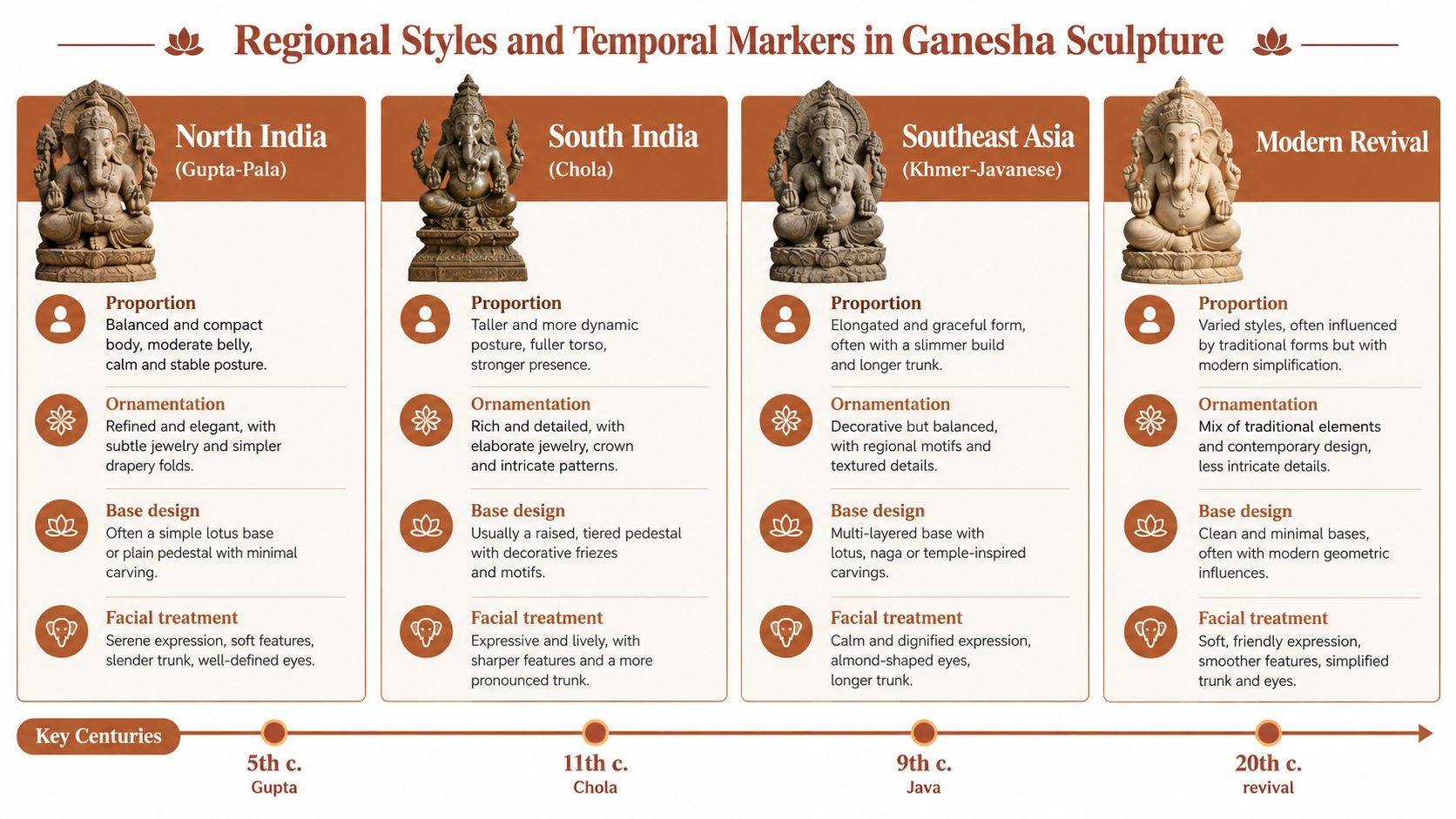
Regional attribution should come from comparison, not a single visual impression. Examine proportion, ornament, facial treatment, base design and the relationship between the figure and its attributes. “Indian style” is often too broad to support authentication, especially when a dealer has not identified the material, workshop tradition or likely period.
Use a visual map, not a single clue
North Indian traditions may favour controlled proportions, formal ornament and facial details that reward close inspection. South Indian bronzes often place greater emphasis on balance, movement, casting quality and the relationship between the body and its attributes. Southeast Asian examples may reflect Khmer, Javanese or Cham visual languages, with distinctive approaches to crowns, jewellery, torso shape and base construction.
These categories overlap. Workshops exchanged ideas, artists travelled, and later objects sometimes reproduce older forms. Test style against material and claimed history. A bronze with distinctly South Indian balance, for example, requires closer investigation if its provenance places it in a Southeast Asian temple context. The mismatch may indicate movement, later interpretation or an inaccurate attribution.
The British Museum's sandstone Ganesha provides a useful UK reference because its date, dimensions and material are documented. The object was made around AD 750, stands 96 centimetres high and is 36 centimetres wide, as documented in the British Museum collection record for object 1974,0225.1. Its scale, carved density, handling of the body and treatment of the base show how an early stone image can differ from a later domestic bronze. Use those features for comparison, not as a template for every antique Ganesha statue.
Read the UK collection context carefully
The Royal Albert Memorial Museum in Exeter holds a Ganesha carved from alabaster more than 150 years ago in what was then Ceylon, now Sri Lanka. Museum records connect its arrival in Devon with a British judge who served in India during the 1860s and 1870s. The museum also included Ganesh Chaturthi events in 2024 in its account of looking after Ganesh.
This object differs sharply from the early sandstone example. Its alabaster, colonial-era movement, documented history and continuing cultural presence all affect its interpretation. For a buyer, the practical point is clear: provenance can explain how a statue reached Britain, but it does not by itself prove a regional attribution or settle the ethical questions surrounding its removal and ownership.
A touring Ganesha from the British Museum offers another useful UK precedent. Cultural reporting describes an 800-year-old statue loaned to seven museums across the country. A museum account gives its height as 119 centimetres, dates it to the 13th century and places its likely original setting in a niche on the exterior of a Hindu temple in Odisha as reported by the BBC. The example shows that large Hindu sculpture can travel safely and be interpreted responsibly when provenance, condition assessment and handling arrangements receive proper attention.
Provenance, Condition and UK Import Considerations
A seller may offer a convincing antique Ganesha, yet unclear history or hidden restoration can turn a visually attractive purchase into an expensive problem. Provenance does not require an unbroken ownership chain. Each document should, however, relate to the specific statue. Exhibition records, old collection numbers, invoices and published references carry more weight when they match the object's material, dimensions and appearance.
Condition affects both market value and the care the sculpture will require. A repaired trunk, arm, crown or projecting attribute may be stable and transparently disclosed, but the work is no longer entirely original. Inspect filled cracks, solder joins, replacement elements, over-cleaned surfaces, stress around the ankles and repairs at the base. Ask whether the restoration is visible, reversible and recorded in writing. For a significant purchase, obtain an independent condition report before payment.
Use a three-part buying test
Before committing funds, answer three questions:
- Can the object be identified? Its iconography, material and regional style should support one coherent attribution.
- Can the history be supported? Documentation should match the price and the importance claimed by the seller.
- Can the object be safely owned? Condition, packing, insurance, display requirements and import charges all belong in the budget.
UK customs treatment follows classification, age and authorship, not only the fact that the image represents Ganesha. HMRC states that antiques must be more than 100 years old to qualify for the reduced import valuation. Original sculptures and statuary may fall under heading 9703 when executed entirely by the artist in its valuation guidance. A devotional subject does not automatically make a modern statue an antique or a qualifying work of art.
For eligible works of art and antiques entering Great Britain, HMRC guidance provides an effective import VAT rate of 5%, while customs duty is listed at 0% for antiques and works of art under the simplified rates guidance. Ask the importer or customs adviser to confirm the classification before relying on those rates. The VAT calculation can include customs value, packing, transport, insurance and any duty, so the purchase price is only part of the landed cost.
Budget for mass and fragility
A small hollow bronze and a heavy stone figure require different handling plans. The UK imported US$19.16 million of antique sculptures and statuary in the latest twelve-month period ending August 2025, representing 25.73 tons, according to the referenced trade data available through the National Museums Scotland collection information. That market figure does not value an individual Ganesha. It does show why transport, insurance and valuation should reflect the statue's material, dimensions and weight. A specialist packer can also identify lifting points and weaknesses before collection.
Recommended Placement, Care and Display Practices
An antique Ganesha statue needs a stable environment before it needs elaborate decoration. Choose a secure surface that can support the object's weight without vibration, and keep the sculpture away from doors, narrow walkways and shelves where a projecting arm or attribute could catch on clothing.
Light, humidity and temperature changes affect materials differently. Bronze generally tolerates a domestic interior well when kept dry and handled carefully, while stone can suffer from staining, salts or unstable mounting. Wood and other organic materials respond more visibly to fluctuations in humidity. Avoid placing any antique beside a radiator, in direct sunlight or in a damp room.
Display with respect and restraint
Many owners treat Ganesha as both a sacred image and an artwork. A home altar, meditation room or quiet interior setting can provide an appropriate location, provided the statue is stable and the surrounding activity won't expose it to oil, water, incense residue or accidental knocks. If the piece is used devotionally, decide in advance which offerings are compatible with its material and condition.
Dust with a soft, dry brush or clean cloth, using a light touch around fingers, attributes and jewellery. Don't apply commercial metal polish, wax, household cleaner or abrasive paste. These products can remove historic surface, fill recesses with residue or create a modern sheen that obscures evidence of age.
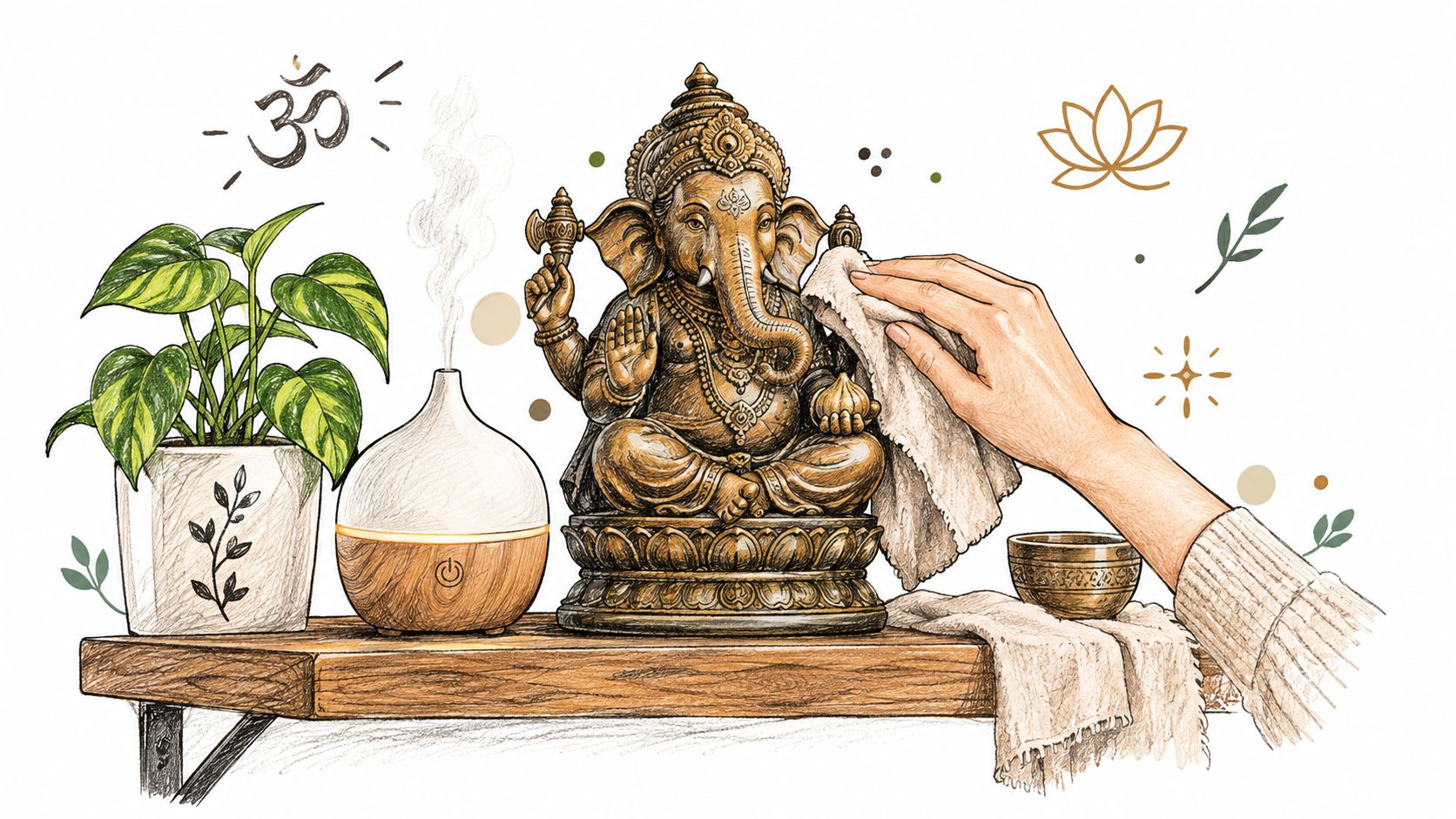
For broader guidance, consult this care guide for bronze and stone Asian sculptures. Handle the statue with both hands from its strongest body areas, never by the trunk, crown, arms or other projecting details. Photograph the object periodically so you can identify new cracks, movement or surface changes.
Professional conservation advice is appropriate when a piece has a loose attribute, active corrosion, a structural crack, flaking pigment or an uncertain previous treatment. Stabilisation is preferable to cosmetic intervention. The best conservation work preserves evidence and function without making an old sculpture look artificially new.
Buying Tips for Collectors and Institutions
A seller's willingness to answer precise questions tells you more than an impressive description. Ask for the material, manufacturing method, dimensions, weight, estimated date, regional attribution, condition history and reason for the attribution. Request photographs in natural light, including the underside and any labels or collection marks.
Apply a buyer's checklist
- Inspect the complete object: Require views of the front, back, sides, base and all attributes, not just the most flattering angle.
- Match documents to the statue: Check that measurements, repairs, material and photographs correspond to the offered piece.
- Clarify returns: Make sure the return period allows time for independent examination and that the policy covers material or age misdescription.
- Price the risk: Include packing, transport, insurance, conservation and possible import charges before comparing offers.
- Record the purchase: Keep invoices, correspondence, photographs and condition reports with the object's permanent file.
Red flags include a vague claim that a statue is “from an old collection”, a refusal to show the underside, inconsistent statements about bronze and weight, or pressure to pay quickly without authentication. A seller who cannot explain whether an attribute is original or replaced may not have carried out the level of examination the object requires.
Institutions should add acquisition policy, cultural sensitivity, legal compliance and collection care to the checklist. A museum-quality standard isn't defined by a high price. It comes from a defensible attribution, transparent condition, documented ownership and a plan for long-term care. Specialist dealers who work with museums, galleries and private collectors may offer better documentation, but their claims still deserve independent review.
Building a Thoughtful Lord Ganesha Collection
A strong collection doesn't depend on acquiring the oldest or largest statue available. It develops through coherent choices. One collector may focus on South Indian bronze casting, another on regional stone images, and another on the movement of Hindu sculpture into British collections. Each approach can work when the objects are accurately identified and properly documented.
Start a record for every acquisition. Note the iconography, material, dimensions, weight, condition, stated date, regional attribution, provenance, purchase terms and conservation history. Add your own photographs after arrival. Over time, this file becomes more valuable than memory and helps future caretakers understand what they hold.
Compare objects by questions rather than appearance alone:
- Does the form make iconographic sense?
- Does the technique suit the material?
- Does the surface show coherent age and handling?
- Does the provenance support the attribution?
- Can the piece be displayed safely and respectfully?
A modest statue benefits from the same discipline as a museum-level acquisition. Patience, documentation and education consistently outperform impulse buying, particularly in a market where contemporary decorative Ganesha items sit beside historic sculptures. The most rewarding collection brings together aesthetic pleasure, historical awareness and responsible ownership.
If you're assessing a potential purchase, HD Asian Art offers a curated selection of antique and contemporary Hindu and Southeast Asian sculpture, including Ganesha pieces in bronze and stone, with information for collectors and private interiors. Visit HD Asian Art to compare available works and begin your research with the material, style and provenance questions outlined above.
