



Gran Buda de piedra para santuario de jardín: guía de diseño completa
Por qué un gran Buda de piedra crea el santuario de jardín perfecto
Tabla de contenidos
un Gran Buda de piedra para el santuario del jardín. transforma los espacios al aire libre en retiros profundamente pacíficos donde los visitantes naturalmente reducen el ritmo y se reconectan consigo mismos. Las investigaciones muestran que los elementos de piedra natural en espacios al aire libre reducen los niveles de cortisol y aumentan la sensación de calma a los pocos minutos de exposición. un grande estatua de buda se convierte en un ancla visual para su intención, un recordatorio físico de que este rincón de su propiedad existe para la serenidad.
Lo que diferencia a una estatua de Buda de otros adornos de jardín es su simbolismo inherente. A diferencia de las esculturas decorativas que celebran únicamente la belleza, una figura de Buda representa el despertar espiritual y la paz interior. La escala importa enormemente, un gran buda de piedra llama la atención, crea juegos de sombras a lo largo del día y se convierte en el principio organizador en torno al cual gira todo el diseño de su jardín zen.
A continuación, lo guiaremos a través de la selección de materiales, los principios de ubicación, las estrategias de mantenimiento y la decisión crítica entre piezas artesanales talladas a mano y alternativas producidas en masa. Al final, comprenderá exactamente cómo elegir y colocar un gran buda de piedra para el santuario del jardín que transforma su espacio al aire libre en el santuario de meditación que ha estado imaginando.
Materiales de la estatua de Buda al aire libre: elección de piedra duradera para la longevidad
Su elección de piedra determina si su gran buda de piedra para santuario de jardín se vuelve más hermoso con el tiempo o se deteriora hasta convertirse en una reliquia desgastada.
Granito: fuerza y atractivo atemporal
El granito se erige como el estándar de oro para exteriores estatua de budas por su estructura cristalina y resistencia a la intemperie. Cuando se talla a mano, el granito revela estrías naturales y variaciones de color que crean interés visual sin necesidad de pintura ni tintes. La densidad del granito resiste la penetración del agua, un factor crítico en climas de hielo y deshielo. Una estatua de Buda de granito desarrollará una sutil pátina gris a lo largo de décadas, volviéndose más refinada en lugar de deteriorarse. La principal limitación es el costo, ya que el granito tallado a mano requiere mucha mano de obra y herramientas especializadas. Sin embargo, la inversión paga dividendos durante más de 30 años de exposición. El granito requiere un mantenimiento mínimo; una limpieza suave ocasional con un cepillo suave y agua es suficiente.
Mármol: elegancia con exigencias de cuidado
El mármol ofrece una elegancia visual inigualable y detalles excepcionales porque la piedra es más suave y responde mejor a las herramientas de tallado que el granito. Sin embargo, el mármol es carbonato de calcio, que reacciona en condiciones ácidas. El agua de lluvia disuelve gradualmente la superficie del mármol y, con el tiempo, los finos detalles tallados se difuminan y suavizan. El mármol también absorbe agua más fácilmente que el granito, lo que lo hace susceptible a sufrir daños por congelación y descongelación en climas fríos.
Las estatuas de mármol se benefician de un sellado periódico, generalmente cada 2 o 3 años, para protegerlas contra la humedad y los daños químicos. En climas secos o regiones mediterráneas, el mármol envejece maravillosamente y requiere una mínima intervención. Una estatua de Buda de mármol capta la luz de la mañana y del atardecer de una manera que el granito no puede, creando una cualidad brillante que realza la atmósfera meditativa.
Piedra de lava: textura natural y resistencia a la intemperie
La piedra de lava, roca volcánica formada a partir de antiguos flujos de lava, ofrece una estética distintiva que cierra la brecha entre la durabilidad del granito y el atractivo visual del mármol. Esta piedra oscura y porosa desarrolla rápidamente una rica pátina y se integra naturalmente en los diseños de paisajes. Los líquenes y musgos crecen fácilmente en la superficie, creando la apariencia de envejecimiento en unas pocas temporadas.
La porosidad de la piedra de lava hace que los ciclos de congelación y descongelación sean una preocupación en los climas fríos. Sin embargo, en climas moderados, la piedra de lava resiste con gracia. Las estatuas de piedra de lava talladas a mano son menos comunes porque la piedra es más frágil, pero los escultores a menudo adoptan la textura natural de la piedra de lava, creando estatuas que parecen tener una forma orgánica. La piedra de lava cuesta menos que el granito o el mármol, lo que la hace accesible para jardineros con presupuestos más ajustados. El mantenimiento es mínimo, limpieza suave ocasional para eliminar el exceso de musgo si se desea.
| Materiales | Durabilidad | Mantenimiento | Costo | Mejor clima | Envejecimiento visual |
|---|---|---|---|---|---|
| granito | Excelente (más de 30 años) | mínimo | Alto | Todos los climas | Pátina gris sutil |
| mármol | Bueno (15-25 años) | Sellado moderado | Alto | Seco/Mediterráneo | Se suaviza, se vuelve luminoso. |
| Piedra de lava | Bueno (15-20 años) | mínimo | moderado | Cálido/moderado | Crecimiento rápido de líquenes |
Significado de la ubicación de la estatua de Buda: Feng Shui y posicionamiento espiritual
El lugar donde coloques tu gran buda de piedra como santuario del jardín es tan importante como la estatua misma. La ubicación afecta tanto a la composición visual de su paisaje como a la calidad energética del espacio.
Direcciones cardinales y flujo de energía
En la tradición del feng shui, cada dirección cardinal conlleva distintas cualidades energéticas. Este representa nuevos comienzos y crecimiento, lo que lo hace ideal para estatuas de Buda destinadas a inspirar nuevos comienzos. El Sur representa reconocimiento y visibilidad. West se conecta con la plenitud y el descanso, adaptándose a un Buda colocado para la reflexión vespertina. El norte representa la quietud y la introspección, lo que lo hace perfecto para una estatua en un rincón tranquilo dedicado a la meditación.
Sin embargo, el principio más importante son las líneas de visión. Su estatua de Buda debe ser visible desde su ubicación principal de observación, ya sea un patio, una ventana o un banco de meditación. Coloque su gran buda de piedra como santuario en el jardín donde los caminos naturales a través de su jardín conduzcan hacia él. El Feng Shui también enfatiza la dirección del Buda; tradicionalmente, las estatuas de Buda miran hacia afuera, bendiciendo y protegiendo el espacio que dominan.
Elevación y líneas de visión en su jardín
Un gran buda de piedra para un santuario en el jardín normalmente debe estar ligeramente elevado sobre el nivel del suelo. Esta elevación, ya sea que se logre a través de un montículo sutil, una plataforma de piedra o una ligera elevación, crea prominencia visual y evita que el agua se acumule alrededor de la base. Cuando te sientas en tu espacio de meditación, el nivel de tus ojos debe alinearse aproximadamente con la sección media o la parte inferior de la cara de la estatua, creando una relación visual íntima.
Considere las líneas de visión desde múltiples puntos de vista. Su Buda debe ser visible desde las ventanas de su casa, su área principal para sentarse al aire libre y a lo largo de los senderos del jardín. Colocar un Buda cerca de una pequeña fuente, arroyo o estanque crea un punto de reunión natural para la energía y combina dos elementos esenciales en el diseño de jardines zen.
Diseño de jardín zen con Buda: creación de su espacio de meditación
Una estatua de Buda se vuelve verdaderamente poderosa cuando se integra en un diseño de jardín zen completo en lugar de estar sola.
Elementos paisajísticos e integración del paisajismo nativo
El paisaje duro, los caminos, las plataformas y las superficies del suelo crean el marco físico alrededor de su gran buda de piedra para el santuario del jardín. La grava rastrillada o los escalones cuidadosamente colocados atraen a los visitantes hacia la estatua mientras crean interés visual a través de la textura y las líneas. El paisaje nativo alrededor de su Buda integra la estatua en la ecología más amplia del jardín. Elija especies nativas que prosperen en su clima y atraigan la vida silvestre local en lugar de plantas exóticas que requieran un mantenimiento constante.
El principio clave es la moderación. Un jardín zen no es un jardín de flores. Las plantaciones deben ser mínimas, cuidadosamente compuestas y elegidas por la textura del follaje en lugar de flores vistosas. Las especies de hoja perenne proporcionan estructura durante todo el año. El objetivo es crear un espacio negativo que haga que la estatua de Buda y las plantas clave sean más poderosas a través del contraste.
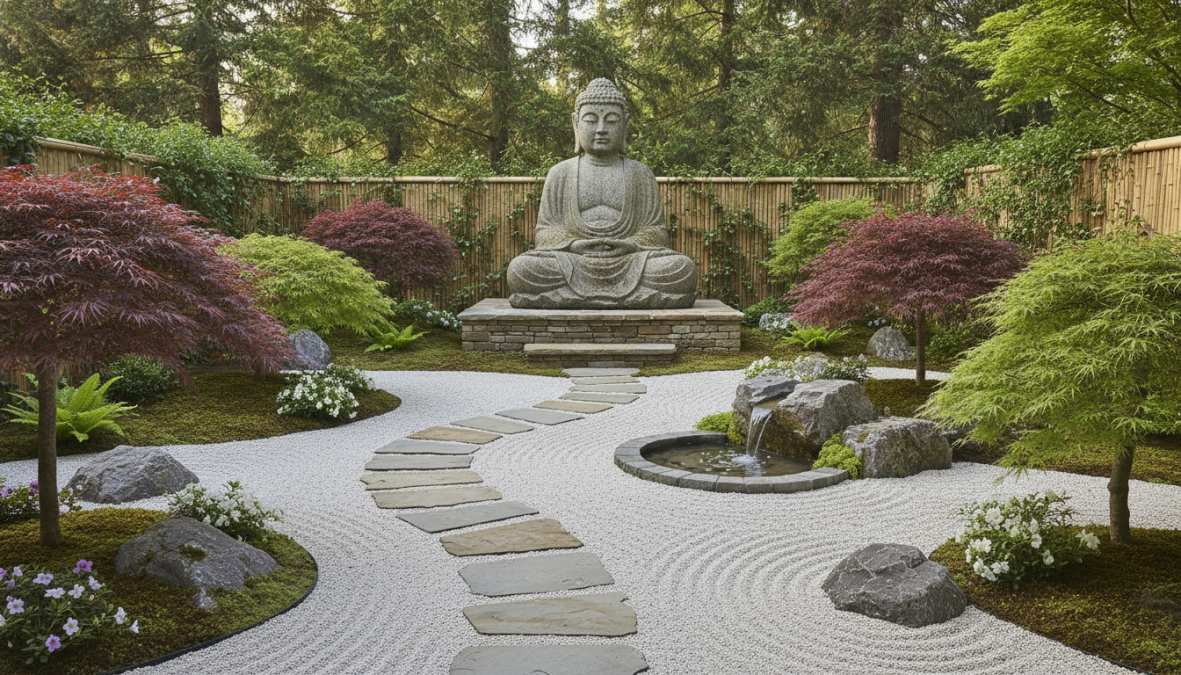
Los materiales resistentes deben complementar el material de tu estatua. Un Buda de granito combina maravillosamente con caminos de piedra y grava en tonos neutros. Un Buda de mármol se beneficia de un paisaje duro de colores más claros que refleja la luz.
Características del agua y composición del punto focal
El agua amplifica la calidad meditativa de cualquier santuario. Una pequeña fuente situada cerca de tu Buda crea un sonido suave que enmascara el ruido urbano y proporciona un punto focal para la meditación auditiva. Tu Buda debe seguir siendo el punto focal principal, con elementos de agua como elementos de apoyo. Coloque los elementos de agua ligeramente desplazados para que Buda siga siendo el ancla visual principal mientras que el agua agrega riqueza sensorial. Un pequeño estanque reflectante con la imagen de Buda reflejada en aguas tranquilas crea una poderosa composición meditativa.
La escala de las fuentes de agua es muy importante. Una gran y espectacular cascada abruma un pequeño jardín y hace imposible la meditación tranquila. Un suave burbujeador o un pequeño chorro de recirculación crea el sonido suficiente para resultar relajante sin exigir atención.
Estatuas de Buda resistentes a la intemperie: fundamento, apoyo y cuidado del clima
Un gran buda de piedra para un santuario en el jardín debe resistir décadas de exposición a la intemperie. Esto requiere tanto una instalación inicial adecuada como un mantenimiento continuo específico para su clima.
Cimentación estructural y estabilidad
Una estatua de piedra pesada requiere una base sólida que evite que se asiente, se incline o se agriete. Los cimientos deben extenderse por debajo de la línea de heladas de su región, la profundidad a la que el suelo se congela en invierno. En climas fríos, las heladas (la expansión hacia arriba del suelo helado) pueden desplazar una estatua varios centímetros durante un solo invierno, agrietando tanto la estatua como su base.
La base ideal es una plataforma de hormigón armado de al menos 12 pulgadas de espesor, que se extienda por debajo de la profundidad de la línea de congelación (4 a 6 pies en las regiones del norte, 1 a 2 pies en climas moderados, mínimo en regiones cálidas). Esta plataforma debe estar ligeramente elevada para alejar el agua de la base de la estatua. La estatua en sí debe asentarse sobre una plataforma secundaria que cree un espacio de aire que permita que el agua drene debajo de la estatua en lugar de acumularse.
Para estatuas particularmente grandes, considere la instalación profesional. El peso de un Buda de granito de 6 pies puede exceder las 10,000 libras. Una estatua pesada colocada incorrectamente puede moverse con el tiempo, creando fracturas por tensión o peligros de derrumbe.
Mantenimiento e impermeabilización específicos para el clima
Su clima determina su programa de mantenimiento y su enfoque de impermeabilización. Los climas fríos con ciclos de congelación y descongelación exigen medidas preventivas. Antes de la primera helada, inspecciona tu estatua en busca de grietas o daños que puedan permitir la penetración de agua. Aplique un sellador de piedra transpirable en otoño para crear una barrera resistente al agua y al mismo tiempo permitir que la piedra respire. Evite el uso de descongeladores a base de sal cerca de su estatua; use cloruro de calcio en su lugar si es necesario.
En climas cálidos y secos, el mantenimiento es mínimo. Una limpieza suave ocasional con un cepillo suave y agua elimina el polvo y mantiene la estatua visualmente fresca. Los climas húmedos con mucha humedad fomentan el crecimiento de líquenes y musgos. A algunos jardineros les encanta esta apariencia desgastada, ya que hace que las nuevas estatuas parezcan antiguas al cabo de unas pocas temporadas.
Tallado a mano versus producción en masa: artesanía y abastecimiento ético
La decisión entre una estatua de Buda artesanal tallada a mano y una pieza producida en masa afecta no sólo la calidad visual y la longevidad de su gran buda de piedra para el santuario del jardín, sino también las implicaciones éticas de su compra.
Las estatuas talladas a mano son creadas por hábiles artesanos, a menudo en regiones con siglos de tradición en el tallado de piedra. Cada pieza requiere semanas o meses de trabajo, en el que el artesano responde a las características naturales de la piedra y toma innumerables microdecisiones sobre proporción, expresión y detalle. El resultado es una escultura única donde sutiles variaciones hacen que cada estatua sea distinta. Estas piezas desarrollan carácter con el tiempo, la pátina y el desgaste realzan su belleza en lugar de disminuirla.
Las estatuas producidas en masa se crean utilizando moldes y acabados mecanizados. De las fábricas surgen miles de piezas idénticas, cada una uniforme e intercambiable. La mano de obra es mínima, el costo es bajo y el plazo es corto. Sin embargo, un Buda producido en masa carece de las sutiles variaciones que hacen que las piezas talladas a mano sean atractivas. Después de algunos años de desgaste, piezas producidas en masa A menudo parecen cansados en lugar de envejecer con gracia.
La dimensión ética es importante si te preocupas por apoyar a los artesanos y las prácticas laborales justas. Las estatuas talladas a mano suelen provenir de talleres familiares o pequeños estudios donde los talladores ganan salarios razonables y mantienen el control artístico. La diferencia de precio entre las estatuas talladas a mano y las producidas en masa es significativa, pero la longevidad y la recompensa estética justifican la inversión. Un Buda de granito tallado a mano por un hábil artesano le sobrevivirá y mejorará con el tiempo.
Seleccionar el Buda Mudra y la pose adecuados para su santuario
el mudra (gesto con la mano) y la pose de tu estatua de Buda tienen significados espirituales específicos que afectan la energía y la intención de tu santuario.
El Abhaya mudra (mano derecha levantada, palma hacia adelante) representa protección y valentía. El Dhyana mudra (ambas manos cruzadas sobre el regazo, con las palmas hacia arriba) representa la meditación y la contemplación interior. El mudra Bhumisparsha (mano derecha tocando la tierra) representa la iluminación y la conexión a tierra, lo que lo hace especialmente adecuado para instalaciones de jardín. El Varada mudra (mano derecha extendida hacia abajo, palma abierta) representa generosidad y compasión.
Su elección debe reflejar su inclinación espiritual personal. Si practicas la meditación, el Dhyana mudra crea un ancla visual natural. Si buscas protección y coraje, Abhaya resuena. La postura del cuerpo importa igualmente. Un Buda sentado crea una energía introspectiva y tranquila. Un Buda de pie parece más activo y comprometido. La mayoría de los santuarios de jardín se benefician de un Buda sentado o de pie.
Construyendo su gran santuario de jardín de Buda de piedra: un enfoque paso a paso
La creación de un santuario completo alrededor de su gran buda de piedra para el santuario del jardín sigue una secuencia lógica.
Paso 1: Evalúe su espacio y clima (semana 1) Camine por su propiedad a diferentes horas del día y observe dónde cae la luz y dónde existen espacios naturales de reunión. Identifique la línea de heladas, la precipitación promedio y el nivel de humedad de su región.
Paso 2: elige tu estatua (semanas 2 a 4) Seleccione el material según sus preferencias climáticas y de mantenimiento. Busca artesanos si quieres trabajos tallados a mano. Considere mudra y pose según sus intenciones espirituales.
Paso 3: preparar la base (semanas 5-6) Contrate a un contratista si su estatua supera las 5000 libras o si su clima requiere cimientos por debajo de la línea de congelación. Excave hasta la profundidad adecuada, instale drenaje, vierta hormigón armado y deje que cure por completo.
Paso 4: instale la estatua (semana 7) Coloque su estatua sobre su base, asegurándose de que esté nivelada y correctamente centrada. Verifique las líneas de visión desde sus ubicaciones de visualización principales.
Paso 5: Diseño del paisaje circundante (semanas 8-9) Crea caminos, plataformas y superficies de suelo alrededor de tu estatua. Elija materiales que complementen el material de su estatua y el estilo arquitectónico de su hogar.
Paso 6: Seleccionar y plantar vegetación (semanas 10 a 12) Elija plantas nativas adecuadas a su clima que proporcionen estructura sin abrumar la composición. Plante en racimos en lugar de esparcidos.
Paso 7: Integrar las características del agua (semanas 13-14) Si lo desea, instale una pequeña fuente o elemento de agua colocado para sostener su estatua en lugar de competir con ella. Asegúrese de que el drenaje y las conexiones eléctricas sean adecuados.
Paso 8: Establecer un programa de mantenimiento (continuo) Cree una rutina de mantenimiento estacional específica para su clima. Primavera: inspeccionar si hay daños invernales. Verano: controle el crecimiento excesivo. Otoño: aplique sellador si es necesario. Invierno: proteger de los daños causados por la sal y el hielo en climas fríos.
| paso | Línea de tiempo | Acciones clave | Consideraciones climáticas |
|---|---|---|---|
| Evaluación del espacio | Semana 1 | Luz de documentos, vistas, espacios de reunión. | Tenga en cuenta la línea de escarcha y los patrones de lluvia. |
| Selección de estatuas | Semanas 2-4 | Elige material, mudra, artesano. | Adaptarse a las necesidades de durabilidad climática |
| Preparación de la base | Semanas 5-6 | Excavar, instalar drenaje, verter hormigón. | La profundidad varía según la línea de escarcha. |
| Instalación | Semana 7 | Colocar la estatua, verificar la alineación. | Verifique el nivel y las líneas de visión |
| Diseño de paisaje | Semanas 8-9 | Crear caminos y superficies de suelo. | Utiliza materiales complementarios |
| Vegetación | Semanas 10-12 | Plantar especies nativas estratégicamente | Elija plantas apropiadas para el clima |
| Características del agua | Semanas 13-14 | Instale una fuente o arroyo si lo desea | Asegurar un drenaje adecuado |
| Plan de mantenimiento | en curso | Inspección y cuidado estacional. | Ajustar horario por clima |
Crear un santuario centrado en un gran buda de piedra como santuario en el jardín es una inversión en su propia paz y práctica espiritual. Las estatuas más hermosas son aquellas que se alinean con tu intención y clima, instaladas en lugares donde realmente pasarás tiempo meditando y reflexionando. HD Asian Art ofrece estatuas talladas a mano cuidadosamente seleccionadas de artesanos expertos que entienden que cada pieza conlleva intención y presencia. Explore nuestra selección y encuentre la estatua que se adapte a su visión del santuario.
Preguntas frecuentes
¿Qué tipo de piedra es mejor para una gran estatua de Buda al aire libre?
El granito, el mármol y la piedra de lava ofrecen distintas ventajas. El granito proporciona una durabilidad excepcional y resistencia a la intemperie con un mantenimiento mínimo, ideal para la mayoría de los climas. El mármol ofrece una elegancia refinada pero requiere un sellado regular en ambientes húmedos. La piedra de lava ofrece una textura natural y excelentes propiedades de drenaje, perfectas para crear una estética zen. Su elección depende del clima, la apariencia deseada y el compromiso de mantenimiento. Cada material desarrolla una hermosa pátina con el tiempo, mejorando la conexión espiritual con el santuario de su jardín.
¿Cómo puedo asegurarme de que una gran estatua de Buda de piedra se mantenga estable y con el soporte adecuado?
Una base sólida es esencial para cualquier gran Buda de piedra. Instale una base de concreto reforzado de al menos 12 pulgadas de profundidad, asegurando un drenaje adecuado para evitar que el agua se acumule. La base debe extenderse más allá de la huella de la estatua para distribuir el peso de manera uniforme. Utilice un nivel durante la instalación y considere la posibilidad de utilizar almohadillas antidesplazamiento para mayor estabilidad. En climas de congelación y deshielo, asegúrese de que la base se extienda por debajo de la línea de congelación. Se recomienda la instalación profesional para piezas monolíticas de más de 200 libras para garantizar la integridad estructural y evitar que se asienten o vuelquen.
¿Dónde debería colocar un gran Buda de piedra en mi jardín para obtener feng shui y beneficio espiritual?
La ubicación depende del diseño de su jardín y del flujo de energía deseado. En la tradición del feng shui, mirar al Buda hacia la entrada principal invita a que entre energía positiva en su espacio. Colóquelo en un punto elevado para que sirva como punto focal, creando un área de reunión natural para la meditación. Asegúrese de que la estatua tenga una línea de visión clara desde su área de visualización principal, ya sea un patio, una ventana o un rincón de meditación. Evite colocarlo en zonas muertas con sombra o áreas desordenadas. Considere la exposición a la luz del sol por la mañana, que simboliza el despertar espiritual y mejora la tranquilidad del santuario de su jardín.
¿Cómo mantengo una gran estatua de Buda de piedra en diferentes climas?
El cuidado específico del clima prolonga la vida de su estatua y preserva su belleza. En climas húmedos, aplique anualmente un sellador resistente a la intemperie para evitar el crecimiento de musgo y líquenes, especialmente en mármol. Las regiones frías requieren protección durante los ciclos de congelación y descongelación, garantizar un drenaje adecuado y considerar una cubierta protectora durante los duros inviernos. En climas áridos, una limpieza suave ocasional con cepillos suaves mantiene la pátina. Independientemente del clima, inspeccione anualmente si hay grietas o problemas estructurales. Las estatuas talladas a mano pueden necesitar más atención que las piezas producidas en masa debido a los detalles intrincados que atrapan la humedad. El mantenimiento adecuado preserva tanto la integridad física como la presencia espiritual de su espacio de meditación.
