



Jayavarman VII: Reign, Monuments and How to Verify Statues
Jayavarman VII: Reign, Monuments and How to Verify Statues
The most popular advice about Jayavarman VII is also the least reliable. You're often told that if a face has semi-closed eyes and a calm smile, you've found the king himself. That shortcut blurs four separate claims, material, style, provenance and date, into one confident label. A stronger approach keeps those claims apart and asks what evidence supports each one.
Table of Contents
- Jayavarman VII at a Glance
- The Bayon, Ta Prohm and the Building Programme
- Attribution Labels That Stand Up to Scrutiny
- How to Check a Statue's Material and Provenance
- Kingship, Hospitals and Hindu Imagery in the Record
- Documenting Your Piece Before You Buy or Display It
Jayavarman VII at a Glance
Jayavarman VII ruled the Khmer Empire from approximately 1181 to 1218 CE, following the kingdom's conflict with Champa, according to the University of Toronto lecture material on Angkor. That same material estimates Greater Angkor supported approximately 700,000 to 900,000 people across roughly 3,000 square kilometres, with a wider territory exceeding approximately 70,000 square kilometres during his period. Those aren't decorative background figures. They're the first test for any story you're told about a statue.
What the numbers let you check
| Item | Value | Why it matters |
|---|---|---|
| Reign | About 1181 to 1218 CE | Every attribution must fit this window |
| Length of reign | Roughly 37 years | Narrows what counts as early or late in his reign |
| Greater Angkor population | 700,000 to 900,000 at its height | Shows the labour and economy behind the art |
| Urban landscape | Roughly 3,000 square kilometres | Shows settlement beyond the monuments alone |
| Wider territory | More than 70,000 square kilometres during his period | Shows the reach of royal administration |
Don't picture that population packed inside temple walls. People lived across a dispersed network of settlements, farmland, reservoirs, roads, temples and smaller infrastructure. That's why sculpture from this reign can't be understood as an isolated temple tradition. It came from a highly urbanised imperial system with quarries, transport, food supply and organised labour behind it.
The monuments that anchor comparisons are the Bayon, Ta Prohm, Preah Khan and Banteay Chhmar, alongside roads, bridges, reservoirs and provincial foundations. If someone dates a piece to Jayavarman VII, the carving, iconography and history should sit comfortably within that world. If the date drifts well beyond the reign window, you're no longer discussing his period, however Khmer the object looks.
Working rule: A claim about a sculpture is only as strong as its fit with these dates and this scale.
That rule sounds strict, but it protects you from the commonest confusion. Bayon style describes a visual language linked to the period. It doesn't automatically prove that Jayavarman VII commissioned the piece, that it portrays him, or that it was carved during his lifetime.
The Bayon, Ta Prohm and the Building Programme
Walk into Angkor Thom as a visitor and the programme reveals itself in stages. After consolidating power following warfare, Jayavarman VII built across the whole kingdom. Britannica's account of Jayavarman VII notes that inscriptions associated with his reign state hundreds of thousands of people participated in projects including temples, reservoirs, roads, bridges and statues. Coordinated rebuilding and reorganisation drove that effort, and the scale matters whenever a seller ties a statue to this reign.
The Bayon at the centre
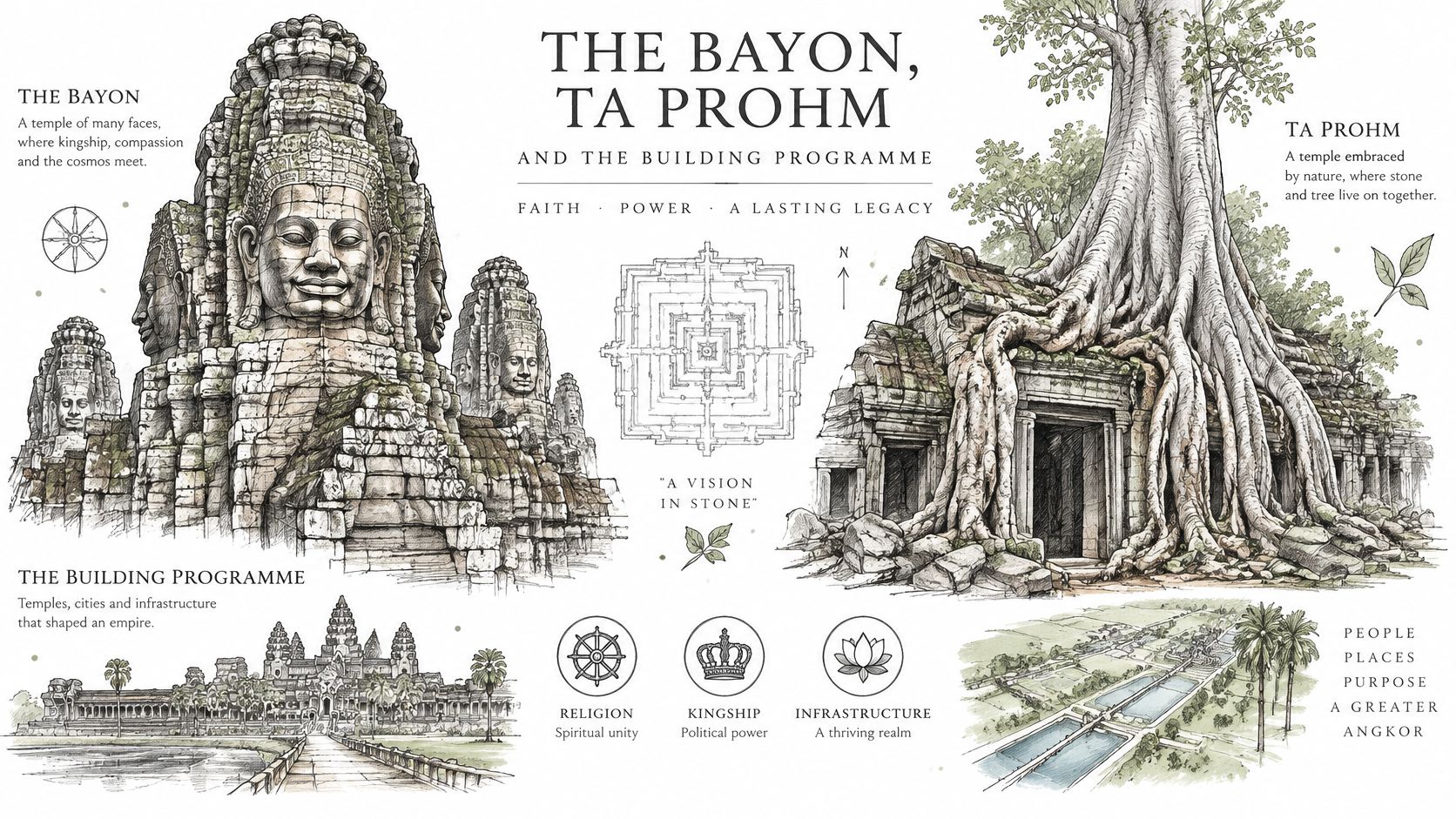
The Bayon served as the state temple at the centre of Angkor Thom. Cultural Heritage Online's Angkor guide describes 54 towers and four faces per tower, a traditional total of 216 faces, though damage and loss mean fewer survive today. Stand below them and the faces look outward toward the cardinal directions, so the temple addresses the whole capital in every direction.
Look down as well as up. The bas-reliefs show warfare, courtly activity, markets and domestic scenes, and the imagery combines Mahayana Buddhist themes with Hindu deities. Reading the Bayon as a shrine to a single icon misses what its carvings record. Our guide to the Bayon Temple in Cambodia and its place in Khmer architecture explores that setting in more depth.
Ta Prohm as a working institution
Ta Prohm reads differently because it functioned as an institution, a monastery people lived and worked in. The Peek guide to Angkor's UNESCO heritage sites records that Jayavarman VII founded it in 1186 CE as Rajavihara, meaning royal monastery, dedicated to his mother, with 260 statues of gods, 39 towers with pinnacles, 566 groups of residences and an enclosure of approximately 600 by 1,000 metres. Read them as the inventory of a staffed monastic campus: accommodation, ritual staff, storage and services. An empty stone shell could never account for numbers like these.
| Monument | Role and date | Figures to check |
|---|---|---|
| Bayon | State temple at the centre of Angkor Thom | 54 towers and 216 faces traditionally counted; fewer survive |
| Ta Prohm | Founded 1186 as Rajavihara, dedicated to the king's mother | 260 statues, 39 towers, 566 residence groups, enclosure about 600 by 1,000 m |
| Preah Khan | Major monument of the reign | Inscriptions and carved galleries useful for comparison |
| Banteay Chhmar | Major monument of the reign | Reliefs often cited in attribution comparisons |
The table gives you a comparison set, and each row tests a different thing. When you hold a statue against photographs of these sites, check face proportions, crown form, the restraint of the smile and how the head sits on the neck and shoulders. What you are looking for is a family resemblance in carving decisions.
A tower face and a palm-sized bronze differ in scale, material and function, so a match on one feature establishes a stylistic link at most. Where the stone came from, where the piece was found and when it was carved remain separate questions, and each needs its own evidence.
Attribution Labels That Stand Up to Scrutiny
A catalogue entry earns trust when its claims sit in separate columns. Material records what a statue is made of, style records which period's carving language it speaks, provenance records where it surfaced, and date records when it was made. Sellers compress all four into one confident phrase, and identity, the question of who the figure actually shows, is where that compression does most damage. Resemblance to a Bayon face answers the style question alone.
The National Museum of Cambodia's record for its Jayavarman VII statue shows what a careful entry looks like: a sandstone statue attributed to the king from Krol Romeas in Angkor Thom, measuring 137.5 cm, dated to the late 12th to early 13th century, with semi-closed eyes, a restrained smile, long earlobes and a distinctive Khmer physiognomy. Each observation is checkable. None of them proves who sat for the carving, which is why the record says "attributed".
A five step attribution sequence
- Establish the findspot: Secure the archaeological findspot and excavation record before discussing identity.
- Compare the carving: Set facial morphology and body treatment against securely documented Bayon-period images.
- Cross-reference the site evidence: Check temple bas-reliefs and inscriptions that could support or weaken the comparison.
- Test the joins: Head and body are sometimes found separately and joined later, so check the join against the excavation record and comparative reliefs before identity is discussed.
- Separate portrait from devotion: Distinguish royal portraiture from an image of a king presented as a Buddhist practitioner.
Step four is where honest entries and hopeful ones part company. A convincing face on a plausible torso can still be a later reconstruction. If the head and body were not found together, the label has to carry that caveat.
Buddha images carry a further uncertainty. The V&A record for a related figure notes that a distinctive Buddha iconography became especially popular during his reign and that the king may have associated himself with the Buddha in that form. "May have" is interpretation, and a sound label keeps it that way. Our discussion of Khmer style, period attribution and honest catalogue language shows what that discipline looks like in listings.
| Label | Use when | Evidence needed |
|---|---|---|
| Identified as | Findspot, head and torso fit and comparison all support it | Full excavation and reconstruction record |
| Traditionally attributed to | A long-standing museum or scholarly attribution exists | The source of the tradition, named |
| Possibly representing | Facial features match Bayon-period images but the findspot is uncertain | Comparative images and a stated caveat |
| Bayon style | Carving and iconography match Bayon-period work | Stylistic comparison dated to the late 12th to early 13th century |
| Jayavarman VII style | Loose stylistic term only, never a claim of identity | Stylistic similarity alone, which can extend across both centuries |
| Later Khmer-style Buddha | A later work borrowing the visual language | The period, plus a note that the form is borrowed |
Read the table as a ladder of confidence and choose the lowest rung the evidence can defend. Use identified as, traditionally attributed to or possibly representing in place of flat certainty, and keep object identity, period, workshop and provenance in separate fields so a resemblance cannot slowly grow into a biography.
How to Check a Statue's Material and Provenance
Start with material because it answers a narrower question than style. Stone analysis can tell you whether the material is compatible with known Bayon-period sculpture. It cannot tell you who the figure represents, who carved it, or when the surface was worked. Keep that boundary clear from the first photograph you take.
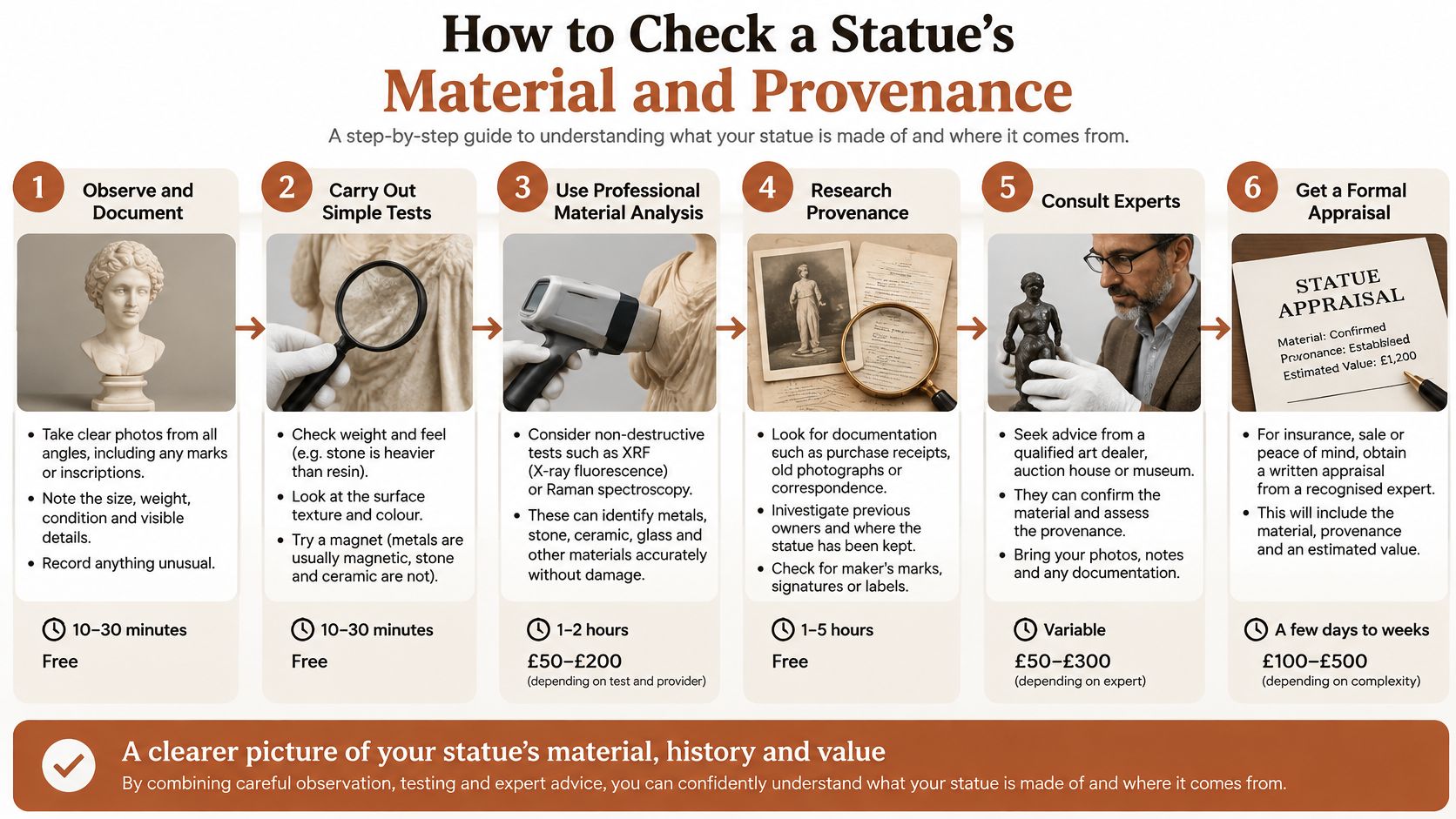
Treat a statue file like four separate witnesses rather than one verdict. Material speaks to geology. Style speaks to period conventions. Provenance speaks to ownership and movement. Dating speaks to the strongest claim you can defend after the first three agree or conflict. Sellers often compress those four into a single phrase such as "Bayon period Jayavarman Buddha," so your job is to pull them apart again.
The four step petrographic workflow
- Document before sampling: Record dimensions, carving technique, iconography, weathering and provenance. Photograph the face, hands, base, breaks and tool marks in raking light so shallow cuts, later repairs and changed contours show clearly.
- Sample only with approval: Obtain minimally invasive samples only where conservation approval permits. For most private owners this step will not be available, so do not promise a laboratory result you cannot obtain.
- Compare the thin section: A specialist compares mineralogy, grain texture, volcanic inclusions and cement with reference quarry samples. The reason is that two sandstones can look alike on a shelf yet still separate under magnification.
- Test against published reference sources: Ask whether the sample is compatible with the sandstone sources described in the study below. Record the answer as compatible or incompatible, not as authentic or fake.
The ScienceDirect study of Bayon-style sculpture sandstone examined 57 Bayon-style sculptures and found most used sandstone rich in volcanic material associated with a localised source roughly 100 km east of Angkor, where quarrying evidence also exists. That gives collectors and lending museums a reproducible check for acquisition files, rather than relying only on the eye.
A petrographic match shows compatible stone. It does not prove the carving date, because the same regional stone could have been reused, left unfinished or carved later.
That pitfall is easy to miss in a sales description. Say a seller offers a seated figure as Bayon style and supplies a stone report. The report may support the material claim while remaining silent on tool marks, stylistic chronology, conservation history and archaeological provenance. You still need all four lines of evidence.
Score each claim separately in your file: compatible material, compatible carving style, credible provenance and secure dating. If provenance consists only of a recent invoice, write exactly that. If dating rests only on the smile, write that down too. A gap stays useful when it is named plainly.
Before you travel to view a piece, ask for clear images and written history. HD Asian Art can provide high-resolution images of a statue's surface, face, hand, base, casting detail or area of patina upon request, which helps you inspect wear and repairs before committing time. For the archival side, the collector's guide to the provenance of antique Khmer sculptures sets out what a credible ownership chain should contain.
Technical language should not decide the purchase by itself. Petrography means studying rock composition and texture, often from a very thin slice under a microscope. You are not expected to perform it yourself. Your job is to ask whether it was done, who did it, what it was compared with and which conclusion it actually supports.
Kingship, Hospitals and Hindu Imagery in the Record
Jayavarman VII strongly promoted Mahayana Buddhism, but he didn't erase Hindu traditions from Khmer art. The Peek guide to Preah Khan, Ta Prohm and the Bayon notes that the Bayon contains imagery of both Hindu gods and the Buddha. Read that mixture as coexistence and adaptation, not as one religion replacing another overnight.
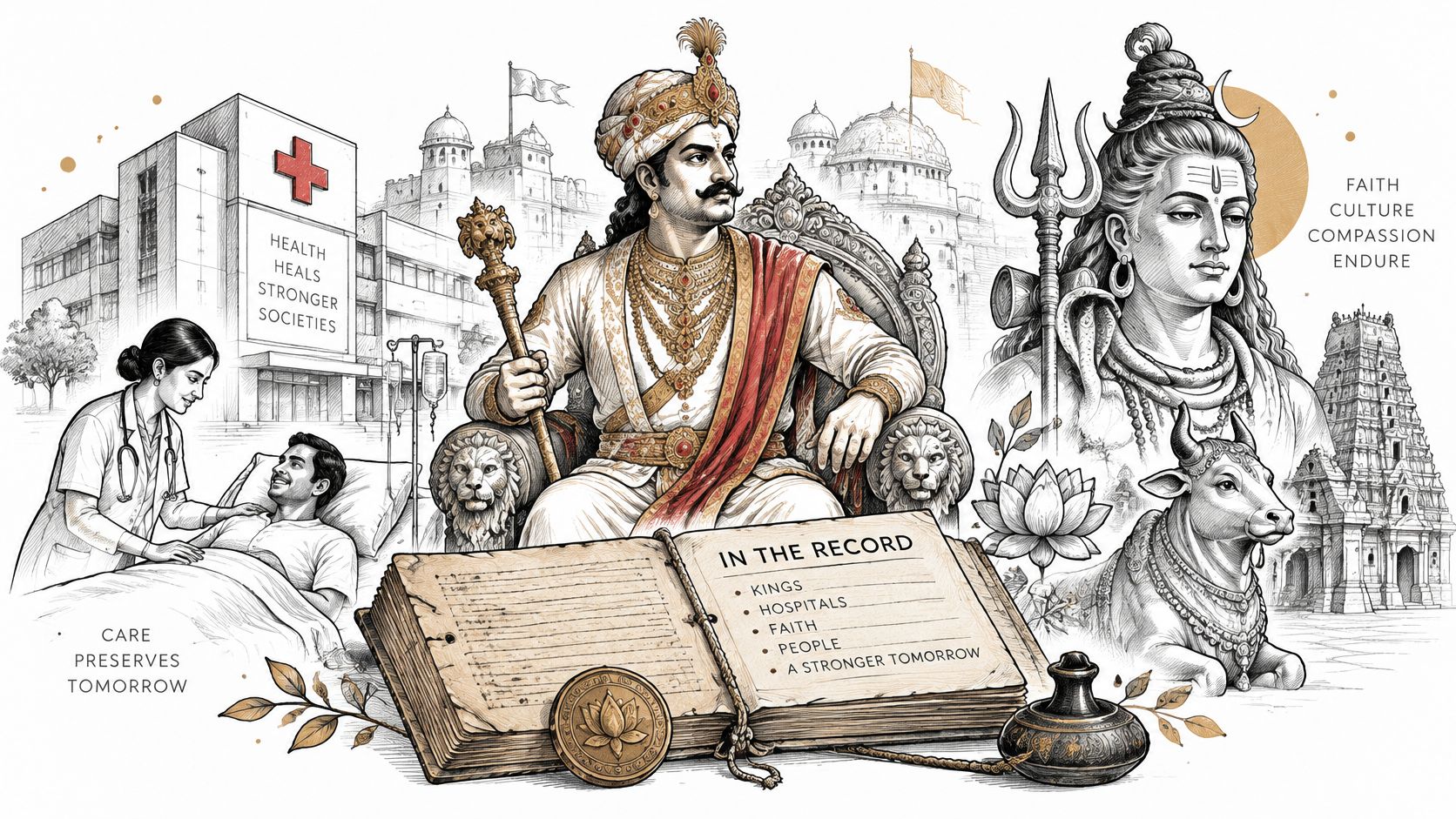
That distinction helps when you meet a sculpture with mixed signals. A Buddhist figure carved within an older Khmer visual convention isn't necessarily confused or incorrectly labelled. Royal patronage, family commemoration and administration could sit inside one foundation, as they did at Ta Prohm.
What the hospital inscriptions prove
The hospital network is where modern readers most often project modern ideas backwards. The Phalikan account of the hospital inscriptions discusses 102 hospitals and describes roughly 200 workers per institution, including doctors, pharmacists, astrologers and other specialists, while the Say Fong inscription records staffing and pharmacy inventories. Those details are unusually specific, covering personnel, medicines, supplies, funding and admission policy.
They still don't prove that every institution functioned as a permanent hospital in the modern clinical sense. Many sites are known primarily through inscriptions, so the archaeological evidence is uneven. Inscriptions also communicated compassionate kingship to the public. They recorded merit and royal intention as well as administration.
Don't call the network a medieval national health service. That comparison flatters modern expectations but obscures the central question, which is what an Angkorian hospital did in practice. It may have combined treatment, pharmacy, ritual, astrology and charitable support in proportions that varied by place and period.
The geography matters for collectors because hospital inscriptions have been found beyond present-day Cambodia, including in Thailand and Laos. Jayavarman VII's ideological and administrative reach was regional, so an object connected with his religious programme shouldn't automatically be described as coming from Angkor itself. Place of manufacture, place of dedication and findspot are separate facts.
Two test questions: Is the claim confirmed by archaeology or only recorded in an inscription, and does it describe a royal ideal or a working institution?
Apply the same questions to sculpture labels. A healing Buddha or compassionate bodhisattva may reflect the values promoted by the king's foundations without having stood in a hospital. Iconography suggests a religious context. It doesn't supply an address.
The most accurate summary is therefore double sided. The hospitals formed a practical institutional network and a political and religious performance of merit at the same time. Holding both ideas together gives you a better reading of Jayavarman VII than either cynical dismissal or uncritical praise.
Documenting Your Piece Before You Buy or Display It
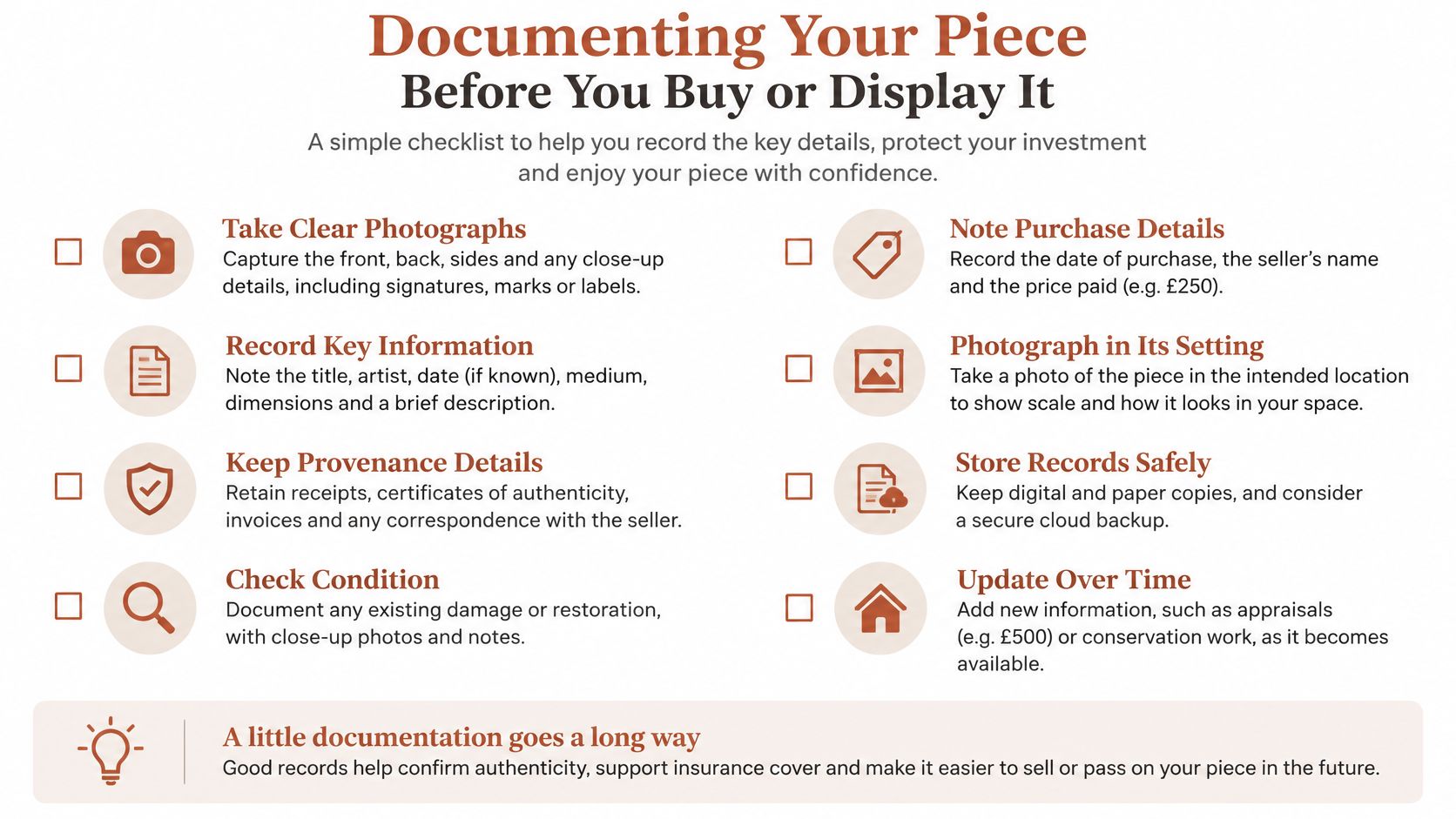
The blank field to avoid is provenance. Without it, even a careful style label can't be tested properly. Build one file for the object and complete it before you pay, insure or write a display label.
Buyer's documentation checklist
- Object identity: Use one calibrated label, such as possibly representing or Bayon style.
- Period: State the dating rationale and how it relates to the reign window.
- Workshop or style: Record this separately from period, because style can continue after a reign ends.
- Provenance: Note the findspot or earliest documented owner, plus each later transfer you can evidence.
- Material report: Include it only if approved sampling took place. Otherwise write not done, rather than leaving a suggestive blank.
- Dimensions and weight: Measure height, width and depth yourself, including any modern mount.
- Condition and reconstruction: State whether head and torso were found together and list fills, pins, breaks and recarving.
- Conservation history: Keep treatment reports with dates and the conservator's name.
- Seller images: File high-resolution views of the face, hand, base and tool marks with the purchase documents.
Photographs can carry useful file information as well as visual evidence, so preserve originals rather than screenshots. Where you need to check camera dates or file history, you can find embedded photo details before renaming or editing your copies. That won't authenticate a statue, but it can help you organise when an image was taken and whether you're comparing the same object across listings.
Our collection includes statues of deities such as Apsara, Avalokitesvara, Buddha, Jayavarman, Lokeshvara, Naga, Shiva, Tara and Vishnu, among many others. Whatever subject you're considering, use the same file structure. A documented reconstruction changes how a face may be described, and a clear dating rationale shows whether a label is stylistic or historical.
For display, keep stone and bronze away from damp walls and direct sunlight. Give the piece enough space for its scale to read correctly, rather than crowding it against larger furniture. Verify which checklist fields you can complete before paying, and treat any blank provenance field as a reason to pause.
Browse Jayavarman, Buddha, Lokeshvara, Shiva and other Southeast Asian sculptures with HD Asian Art, and ask us for detailed images when you're comparing surface, base or patina. Visit HD Asian Art to explore the collection and choose a piece you can document with confidence.
