



Indian Buddhist Sculpture: Gandhara, Mathura, and Gupta
Indian Buddhist Sculpture: Gandhara, Mathura, and Gupta
Most collectors who approach Indian Buddhist sculpture for the first time treat it as a single tradition. They see a seated figure with a halo, a meditative expression, and a lotus base, and they stop there. That is a costly mistake.
The three great schools of Indian Buddhist sculpture, Gandhara, Mathura, and Gupta, differ from each other in origin, material, iconographic logic, and aesthetic intention so profoundly that a trained eye can place a figure within seconds. Understanding those differences is not an academic exercise. It is the practical foundation for buying intelligently, authenticating confidently, and building a collection that has genuine depth.
Table of Contents
- Quick Takeaways
- Gandhara Art: The Greco-Buddhist Synthesis
- Mathura Sculpture: India's Indigenous Voice
- The Gupta Period: Spiritual Perfection in Stone
- Comparing the Three Schools Side by Side
- What Collectors Should Actually Look For
- Frequently Asked Questions
- References
Quick Takeaways
|
Key Insight |
Explanation |
|---|---|
|
Gandhara used grey schist or stucco |
The Hellenistic influence in Gandhara art is visible in the stone itself. Grey schist, sourced from the region covering modern-day northwestern Pakistan and eastern Afghanistan, gives Gandhara figures a cool, classical tone distinct from anything produced in the Indian interior. |
|
Mathura's red spotted sandstone is a signature marker |
Mathura sculptures were carved almost exclusively from locally sourced red spotted sandstone from the Sikri quarries. The warm reddish hue is not decoration but identification. If you see it, you are almost certainly looking at something from the Mathura tradition. |
|
Gupta drapery is translucent, not structural |
The Gupta sculptors made robes appear wet or skin-thin, clinging to the body without obscuring anatomy. This "diaphanous drapery" technique marks Gupta work instantly and was never replicated with the same refinement in earlier schools. |
|
Before Gandhara and Mathura, Buddha was not shown in human form |
Both schools introduced anthropomorphic images of the Buddha. Before this period, sculptors used symbols: the Bodhi tree, footprints, and the Dharma wheel. Understanding this shift is essential for reading any early Indian Buddhist sculpture correctly. |
|
Gandhara transmitted Buddhist imagery along the Silk Route |
Gandhara art was the primary vehicle for carrying Buddhist iconography into Central Asia, China, and Japan. Many conventions still visible in East Asian Buddhist sculpture trace directly back to Gandharan prototypes. |
|
Mathura is purely indigenous; Gandhara is a fusion tradition |
Mathura art evolved from existing Indian sculptural traditions with no significant foreign intervention. Gandhara was explicitly hybrid, combining Greco-Roman figural conventions with Indian Buddhist iconographic content. |
|
The Gupta period synthesised both earlier schools |
Gupta sculptors drew on the Mathura tradition's indigenous energy and refined it into an idealized spiritual type. The result became the canonical model for Buddhist sculpture across Southeast Asia for over a millennium. |
Gandhara Art: The Greco-Buddhist Synthesis
Gandhara art emerged from one of the most consequential cultural intersections in ancient history. The region, encompassing modern-day northwestern Pakistan and eastern Afghanistan, sat at the crossroads of Hellenistic, Persian, Indian, and Central Asian influence. From roughly the 1st century BCE through the 7th century CE, workshops in this region produced a body of Buddhist sculpture unlike anything created elsewhere in the ancient world.
The defining characteristic of Gandhara art is its direct borrowing of Greco-Roman figural conventions applied to Indian Buddhist subject matter. This was not accidental. After Alexander's campaigns and the subsequent Indo-Greek kingdoms, Hellenistic artistic culture had deep roots in the northwest. When Buddhist patronage under the Kushan rulers began commissioning monumental sculpture, local craftsmen applied the only technical vocabulary they possessed: the classical Mediterranean one.
The Visual Language of Gandhara
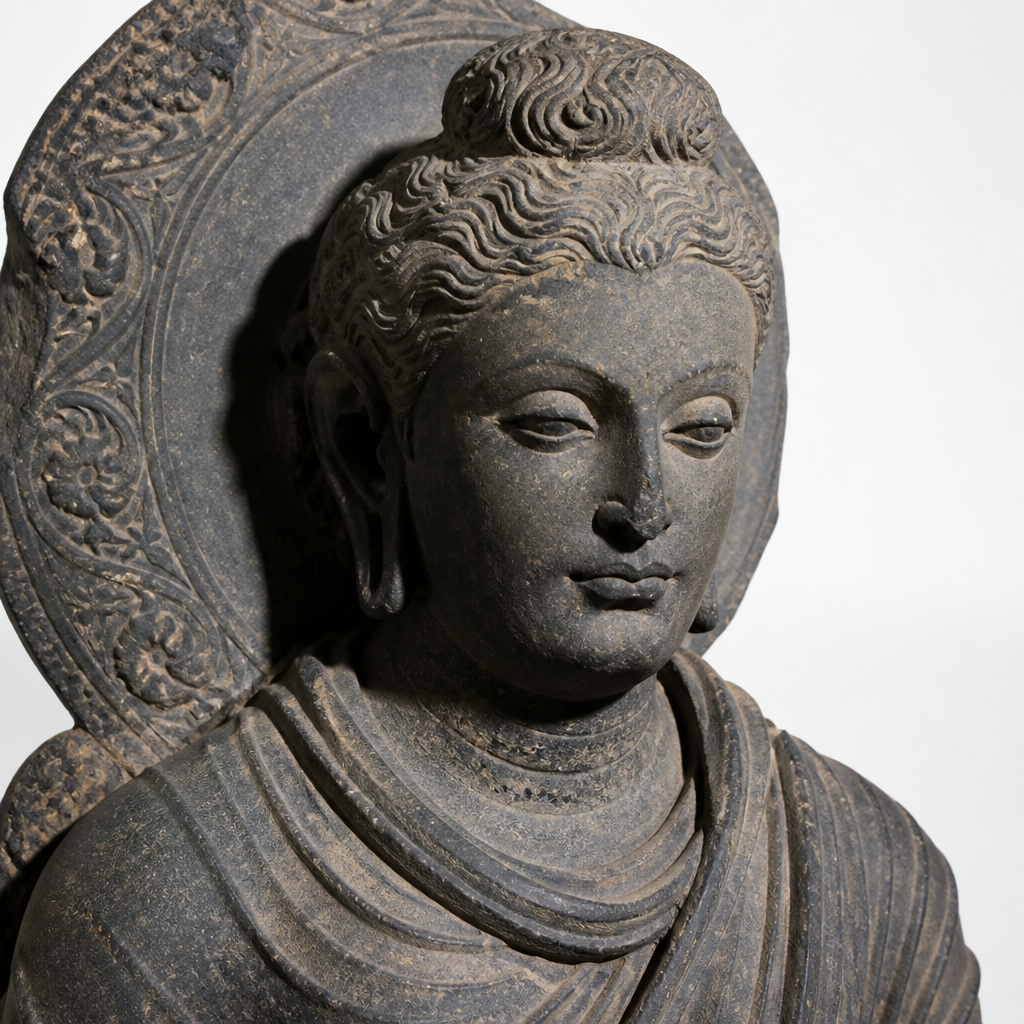
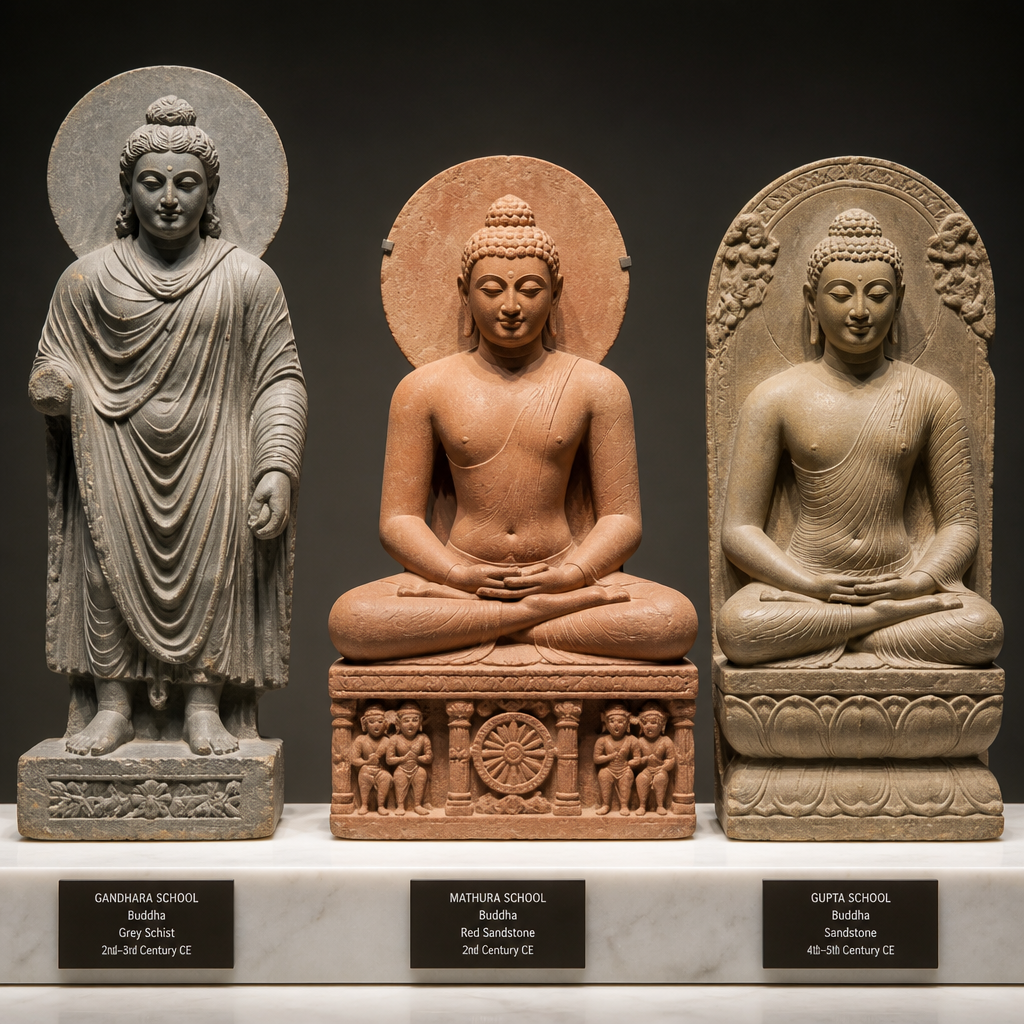
A Gandhara Buddha is immediately recognisable by several features. The hair falls in wavy, Apollonian curls rather than the tight snail-shell curls that would later become canonical. Facial features are sharp and realistic, with a straight nose, deep-set eyes, and defined musculature that owes more to a Roman portrait bust than to any Indian sculptural precedent. Drapery folds across the robe are heavy and structural, rendered in the same tradition as a Roman toga.
The primary material is grey schist, a fine-grained stone that takes detail well and gives finished figures a cool, silvery surface. Stucco was also widely used, particularly for larger decorative programmes. Both materials are compositionally alien to the red sandstone tradition of the Indian interior, which makes Gandhara attribution relatively straightforward for any collector who has handled examples from both regions.
Pro tip: When examining a Gandharan figure, look at the treatment of the ushnisha (the cranial protuberance indicating the Buddha's enlightenment). In Gandhara work, it is often covered by the wavy hair and can read as a simple topknot rather than the clearly delineated cranial bump found in later Indian schools. This detail alone distinguishes many Gandharan Buddhas from Gupta-period work at a glance.
Gandhara's Lasting Influence
The Gandhara school was the primary vehicle through which Buddhist iconography entered Central Asia, China, Korea, and Japan. Merchants and missionaries travelling the Silk Route carried Gandharan images and copies of them eastward. The long robes, meditative seated posture, and halo conventions that define East Asian Buddhist sculpture today were transmitted through Gandharan prototypes. For any collector interested in the broader Asian Buddhist art tradition, Gandhara is the starting point, not a side note.
Mathura Sculpture: India's Indigenous Voice
While Gandhara was producing its hybrid classical work in the northwest, a completely different sculptural tradition was developing at Mathura, in the Gangetic plains of what is now Uttar Pradesh. The Mathura school is arguably the more important of the two for understanding the internal logic of Indian Buddhist sculpture, because it evolved from existing Indian artistic conventions without significant foreign intervention. It is, to use the obvious term, authentically Indian.
The Mathura school flourished between the 1st century BCE and the 5th century CE, spanning both the Kushan and early Gupta periods. It was not exclusively Buddhist. The same workshops and the same craftsmen produced sculpture for Brahmanical Hindu and Jain patrons simultaneously, which is a critical point for collectors: Mathura is a regional style, not a sectarian one.
What Makes Mathura Sculpture Distinctive
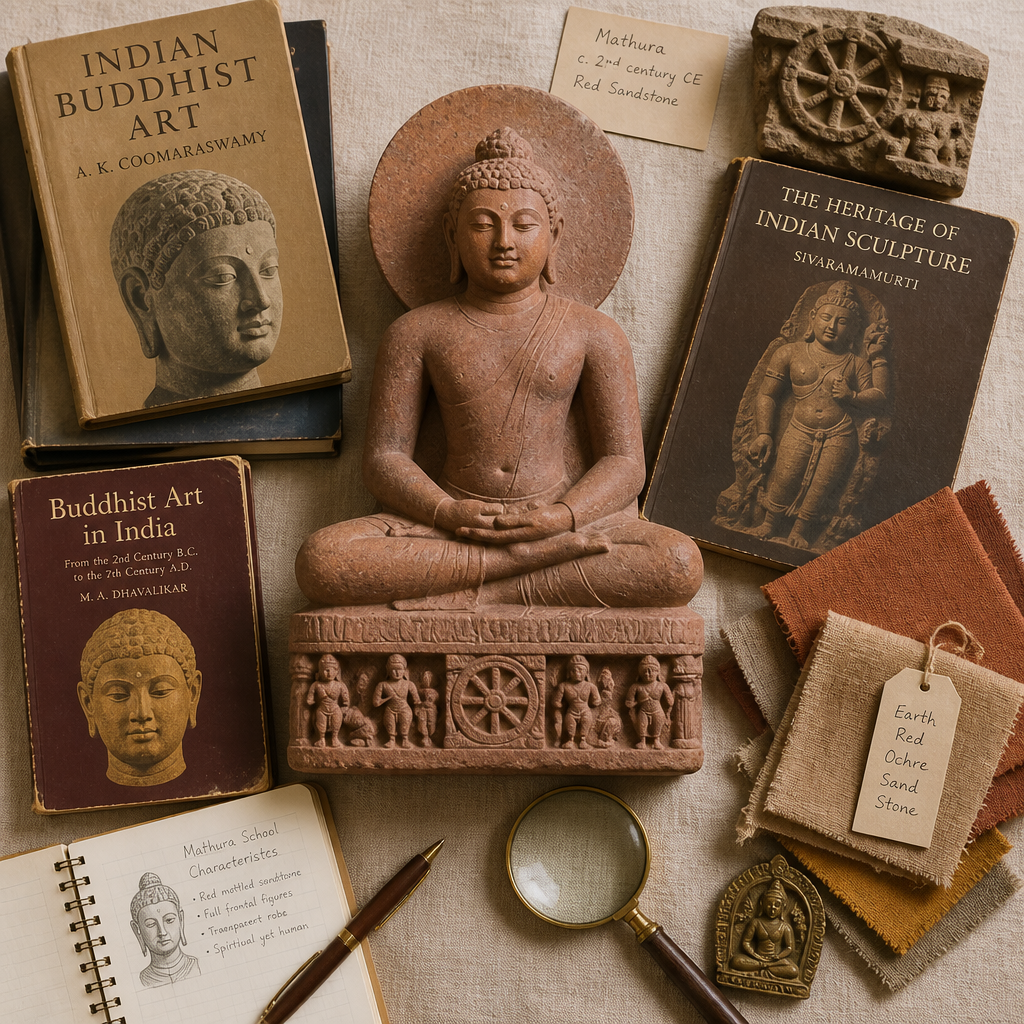
The signature material is the locally quarried red spotted sandstone from the Sikri quarries near Mathura. This warm reddish stone with its characteristic mottled surface is one of the most reliable attribution markers in all of Indian art history. The colour is not uniform: veins and spots of deeper red and cream run through it, and experienced collectors learn to recognise it by sight within seconds.
The figural style is equally distinctive. Mathura Buddhas are broad-shouldered, energetically posed, and often depicted with the right shoulder bare. Early examples sometimes show the robe clinging to the body so closely that the chest is left uncovered, a convention closer to the yaksha figurative tradition of early Indian art than to anything in the Mediterranean world. Faces are rounded and full, with thick lips and a wide smile that projects vitality rather than the cool detachment of Gandhara work.
The Mathura tradition introduced something no other school could claim at the time: a fully indigenous Indian image of the Buddha. It drew on existing sculptural knowledge, on forms perfected for Yaksha and Yakshini figures, and redirected them toward Buddhist devotional ends without apology or compromise.
Mathura was also the first school to produce sculptures of Hindu deities like Vishnu and Shiva in the round, and its craftsmen were instrumental in developing the visual language of Jain sacred imagery. A collector building a serious collection of Indian religious sculpture cannot focus on Mathura Buddhas alone and ignore this broader output: the cross-fertilisation between Buddhist, Hindu, and Jain iconography in Mathura work is precisely what makes it historically significant.
Pro tip: Mathura Buddhas from the Kushan period frequently show the halo (prabhamandala) as a plain flat disc with minimal ornamentation. By the time Gupta influence arrived, that same halo became elaborately decorated with lotus and flame motifs. The halo's complexity is a rough chronological indicator that many collectors find useful when dating Mathura-region pieces.
The Gupta Period: Spiritual Perfection in Stone
The Gupta period, spanning roughly 320 to 550 CE, represents the high point of Indian Buddhist sculpture. Scholars have called it the golden age of Indian art, and the description is not hyperbole. The Gupta style synthesised the technical refinement of Mathura's indigenous tradition, resolved the tensions that had existed between naturalistic and symbolic representation, and produced a canonical image of the Buddha that would influence sculptors from Sri Lanka to Japan for the next thousand years.
The political stability of the Gupta empire provided the conditions for this achievement. Sustained royal and merchant patronage funded workshops at Mathura, Sarnath near Varanasi, and Nalanda. Each centre developed its own regional variant of the Gupta style, identifiable in part by the different stones used. For collectors, knowing which centre a piece comes from adds significant specificity to attribution.
The Defining Features of Gupta Buddhist Sculpture
The Gupta period Buddha is defined by a cluster of visual features that appear together and rarely separately. The robe is rendered in diaphanous drapery, a translucent thin fabric that clings to the body and reveals the underlying anatomy without obscuring it. This is technically demanding: the sculptor must suggest cloth without losing the figure beneath it. Gupta craftsmen solved this problem definitively, and their solution became the standard.
The ushnisha is covered by tight snail-shell curls that extend right over the cranial bump. The halo is ornately carved with floral and gem motifs, far more elaborate than the plain Mathura disc. The earlobes are elongated. The eyes are meditative, cast slightly downward. The lips are relatively thick. Three horizontal lines often appear across the neck, a detail that appears consistently in Gupta work and rarely elsewhere. These features, taken together, constitute what Wikipedia's entry on Gupta art accurately describes as a cluster of "formative traits" that distinguish Gupta sculpture from all that preceded it.
Sarnath and the Perfection of the Type
The Sarnath workshop, near Varanasi, produced some of the most refined Gupta Buddhas known. The Sarnath figures are notable for robes with almost no visible fold lines by the late 5th century, pushing the diaphanous convention to its logical extreme. The stone used at Sarnath is a creamy buff-coloured sandstone distinct from the red Mathura material, which allows collectors to separate Sarnath Gupta pieces from Mathura Gupta ones even at a distance.
The seated Buddha from Sarnath in the dharmachakra mudra (the gesture of setting the Dharma wheel in motion) is widely considered among the canonical achievements of Indian art. Its influence was not merely aesthetic. This specific iconographic type, a seated Buddha with hands in a teaching gesture, thin transparent robe, elaborate halo, and meditative downcast gaze, became the template for Buddhist sculpture production across Southeast Asia, including Thailand, Cambodia, and Sri Lanka, for centuries after the Gupta period ended.
Comparing the Three Schools Side by Side
The table below draws together the most practically useful distinguishing features for collectors. These are the details that allow attribution in the field, before any archival research or technical analysis begins.
|
Feature |
Gandhara (1st century BCE to 7th century CE) |
Mathura (1st century BCE to 5th century CE) |
Gupta (circa 320 to 550 CE) |
|---|---|---|---|
|
Primary material |
Grey schist or stucco |
Red spotted sandstone (Sikri quarries) |
Buff sandstone (Sarnath) or red sandstone (Mathura centre) |
|
Hair treatment |
Wavy Apollonian curls, often covering ushnisha |
Flat cap or early snail-shell curls; ushnisha clearly marked |
Tight snail-shell curls covering ushnisha; highly formalised |
|
Drapery style |
Heavy, structural folds; Greco-Roman toga convention |
Thin clinging robe, often bare right shoulder; yaksha tradition |
Diaphanous, translucent; body anatomy visible beneath fabric |
|
Facial type |
Sharp, realistic, Hellenistic; straight nose, deep-set eyes |
Rounded, full-cheeked, wide smile; energetic and vital |
Serene, idealised; meditative downcast eyes; thick lower lip |
|
Halo treatment |
Present but often simple; flame or plain disc |
Plain flat disc, minimal decoration in early examples |
Elaborate floral and gem motifs; highly carved |
|
Geographic origin |
Northwestern Pakistan and eastern Afghanistan |
Mathura, Uttar Pradesh, India |
Mathura, Sarnath (Varanasi), and Nalanda |
|
Artistic influence |
Hellenistic, Greco-Roman, Central Asian |
Indigenous Indian; Yaksha and Yakshini tradition |
Synthesis of Mathura tradition; became canonical across Asia |
What Collectors Should Actually Look For
Academic classifications are useful, but collectors need to translate them into practical visual skills. The three schools described above are not museum abstractions. They represent real, identifiable differences that a trained eye can apply to any piece, whether it is a museum-quality original, a later regional work in the Gupta style, or a modern production piece attempting to replicate the tradition.
Reading Iconography Before Reading Style
Before you analyse artistic school, read the iconography. As experienced Buddhist art specialists know, authentic Buddhist iconography follows strict rules that changed little across centuries. The mudra (hand gesture) must match the figure's doctrinal role. The ushnisha and urna (the dot between the eyebrows) appear on Buddha figures but generally not on bodhisattvas. The number of lotus petals on a base often follows regional conventions.
A common mistake collectors make is focusing on style and patina while ignoring iconographic coherence. A figure with a Gupta-style diaphanous robe but incorrect mudra placement is either a later regional work that did not follow the iconographic programme carefully, or something produced for a market that did not prioritise doctrinal accuracy. Either way, that iconographic inconsistency is information that affects both attribution and value.
Material as the First Filter
If you have access to the piece, material is your first and most reliable filter. Grey schist narrows you to the Gandhara tradition immediately. Red spotted sandstone points directly to Mathura. Creamy buff sandstone suggests Sarnath. These are not infallible, because later regional workshops sometimes imported stone, and later sculptures often replicated earlier styles in different materials. But as a first-pass filter, material is fast and often decisive.
For collectors working from photographs, the material read comes from colour and texture. The warm red of Mathura sandstone, the cool grey of Gandhara schist, and the pale cream of Sarnath stone each have a characteristic visual tone that becomes recognisable with exposure to documented examples.
The Drapery Test
Drapery is the most school-specific visual feature and the hardest to fake convincingly. Heavy toga-style folds with clear ridges: Gandhara. A thin robe that clings but still reads as fabric: Mathura. A translucent skin-thin robe where the body is fully visible beneath: Gupta. Later regional traditions in Southeast Asia adapted the Gupta diaphanous convention, so seeing thin drapery does not automatically confirm Indian origin. But the specific quality of Gupta diaphanous drapery, with the three neck lines, the elongated earlobes, and the formalised snail-shell curls all present simultaneously, is distinctive enough to make attribution credible even from photographs.
The museum-quality Indian Buddhist sculptures at HD Asian Art reflect this tradition, bringing the iconographic rigour of these three schools into pieces selected for collectors and spiritual practitioners who understand the difference between generic Asian figurines and works that genuinely embody a sculptural lineage.
Frequently Asked Questions
What is the main difference between Gandhara and Mathura Buddhist sculpture?
The fundamental difference is origin and influence. Gandhara art is a hybrid tradition that combined Greco-Roman artistic techniques with Indian Buddhist iconographic content. It emerged from northwestern Pakistan and eastern Afghanistan under Kushan patronage. Mathura art is purely indigenous, evolving from existing Indian sculptural traditions without significant foreign influence. The materials confirm this: Gandhara uses grey schist or stucco, while Mathura uses the locally quarried red spotted sandstone of the Sikri quarries near Mathura in Uttar Pradesh. Stylistically, Gandhara figures have sharp Hellenistic features and heavy structural drapery, while Mathura figures are rounded, energetic, and often have a bare right shoulder.
Why is the Gupta period considered the golden age of Indian Buddhist sculpture?
The Gupta period, roughly 320 to 550 CE, synthesised everything that had been developed by the Gandhara and Mathura schools and resolved their competing approaches into a single, highly refined canonical type. The Gupta Buddha, with its diaphanous drapery, formalised snail-shell curls, elaborately carved halo, and serene meditative expression, became the template for Buddhist sculpture production across South and Southeast Asia for the next thousand years. The Gupta workshops at Mathura, Sarnath, and Nalanda produced figures of exceptional technical quality under sustained royal and merchant patronage. That combination of artistic synthesis, technical refinement, and institutional support is what justifies the "golden age" designation.
How can a collector identify Gupta-period Buddhist sculpture?
Look for a cluster of features that appear together: diaphanous drapery that makes the robe appear translucent or skin-thin; tight snail-shell curls covering the ushnisha; an elaborate halo with floral and gem motifs; elongated earlobes; meditative downcast eyes; relatively thick lower lips; and often three horizontal lines across the neck. Sarnath-centre Gupta pieces will show buff-cream sandstone and increasingly simplified drapery folds moving toward the late 5th century. Mathura-centre Gupta pieces use the same red spotted sandstone as earlier Mathura work but with the updated Gupta iconographic programme applied.
Did any Buddhist sculpture traditions outside India directly derive from these three schools?
Yes, significantly. The Gandhara school was the primary vehicle for transmitting Buddhist iconography along the Silk Route into Central Asia, China, Korea, and Japan. Many conventions in East Asian Buddhist sculpture trace directly to Gandharan prototypes. The Gupta style had an even broader impact on South and Southeast Asia. The canonical seated Buddha type produced at Sarnath became the model for sculptors in Sri Lanka, Thailand, Cambodia, Laos, and Indonesia. When you encounter a Thai bronze Buddha or a Cambodian Khmer stone figure, you are looking at a tradition whose ultimate source lies in Gupta period workshops of the 4th and 5th centuries CE.
Is it possible to build a meaningful collection around one of these three schools without studying all three?
In practice, no. The three schools are in constant dialogue with each other, and understanding any one of them in isolation produces systematic blind spots. A collector focused exclusively on Gupta-period Buddhas who does not understand Mathura conventions will misread pieces that belong to the transitional period between the two. Someone specialising in Gandhara work who ignores the Mathura tradition will miss the contrast that makes Gandhara's Hellenistic influence legible. The three schools are best understood as a sequence: Gandhara and Mathura represent the two competing approaches to imaging the Buddha in human form, and the Gupta period represents the synthesis that resolved that competition into the canonical Asian Buddhist image.
What role does material play in authenticating Indian Buddhist sculpture?
Material is the first and most reliable attribution filter for any collector. The specific stones used in each school, grey schist for Gandhara, red spotted sandstone from the Sikri quarries for Mathura, and buff-cream sandstone for Sarnath, are geologically tied to their regions of origin. This makes material analysis one of the strongest tools in the attribution process, alongside iconographic reading and stylistic analysis. Authentic Buddhist iconography also follows strict internal rules that have changed little across centuries, and mismatches between material, style, and iconography are among the clearest warning signs that a piece is either misattributed or not what it appears to be.
If you are building a collection in this space, or deepening one you already have, we would genuinely like to know which of these three schools you find most compelling and why: share your perspective in the comments below.
We would love your feedback and any insights you would share with others. What perspective would you add?
References
-
Overview of Gupta art sculpture characteristics, schools, and stylistic features
-
Smarthistory guide to Gupta period Buddhist art and its defining visual features
-
Guide to Gandhara art history, Greco-Roman influence, and Buddhist iconographic development
-
How collectors read Buddhist statue iconography: mudras, postures, and identification markers
