



5 Photos Collectors Use to Verify an Antique Buddha
5 Photos Collectors Use to Verify an Antique Buddha
An antique Buddha statue reveals itself through a combination of signs, not any single clue: a regional style that matches its claimed origin, layered patina that follows logical wear patterns, hand-finishing marks from lost-wax casting, and provenance you can actually trace.
If any of these signals contradicts another, or a seller can’t produce documentation, stop and request more photos or a specialist opinion before you buy.
Key Features:
- Authentic antique Buddha statues should show consistent patina, surface wear, and craftsmanship that align with their material, region, and age, not just internal verification.
- Provenance documentation, like labels, receipts, or scholarly references, significantly reduces risk and should match the stylistic and material signals of the piece.
- Metallic sculptures typically exhibit uneven corrosion and unique casting marks, which differ between traditional lost-wax processes and modern reproductions.
- High-resolution photography of all angles and scientific tests like XRF or microscopy can confirm alloy composition and surface authenticity, especially for high-value pieces.
- Buyers should request detailed photos, ask about provenance and restorations, and exercise caution with uniform surfaces, inconsistent aging signs, or evasive seller responses.
Table of Contents
- Understanding antique Buddha statues: materials, regional styles, and iconography
- Key physical characteristics to inspect: patina, surface wear, craftsmanship, and construction
- Verification techniques: from high-resolution photography to scientific testing
- Provenance, markings, and documentation: what counts and how to verify it
- How experts and the market value antique Buddha statues
- Practical buying checklist: what photos to request, questions to ask sellers, and red flags
- Care, storage, and conservation basics for antique Buddhist sculpture
- When to get professional help: appraisal, conservation, and specialist authentication
- Final considerations: a compact decision flow for collectors
- Collector’s perspective: why restraint and documentation preserve value
- An alternative for buyers: how a specialist gallery can help
- Sources
Understanding antique Buddha statues: materials, regional styles, and iconography
Material tells you what era and region are even possible before you look at anything else. Bronze dominates Southeast Asian and Himalayan production because it survives burial, humidity, and centuries of handling. Stone, mostly sandstone or schist, was the material of choice for Khmer and Indian sculptors working at monumental scale. Wood shows up heavily in Burmese and Thai temple carving, and lacquer, especially Burmese dry-lacquer figures, adds a decorative layer that ages in its own distinct way. Terracotta is rarer but turns up in early South and Southeast Asian contexts, where it tends to be more fragile and more easily faked with modern clay.
Each material preserves age differently:
- Bronze develops layered oxidation and a patina that builds unevenly over decades.
- Stone shows erosion at edges and mineral staining that penetrates rather than sits on the surface.
- Wood cracks along the grain and shrinks asymmetrically as it dries out over time.
- Lacquer crazes and flakes in a pattern that follows the underlying wood or bamboo armature.
- Terracotta chips at exposed edges and absorbs soil discoloration unevenly.
Regional style narrows things further. A Cambodian Angkor-period figure carries different bodily proportions and base treatment than a Thai Sukhothai piece or an Indonesian Majapahit bronze. Base types matter too: lotus pedestals, tiered plinths, and integral versus separately cast bases each point toward specific workshops and periods, a detail covered in more depth in HDAsianArt’s dynasty identification guide.
Iconography does the rest of the work. The ushnisha (the cranial protrusion symbolizing enlightenment), the urna (the dot or mark between the brows), elongated earlobes, and specific mudras (hand gestures) all map onto established Buddhist taxonomy and help pinpoint deity and tradition. The Education About Asia guide to identifying enlightened figures breaks down how these markers shift across schools of Buddhist art, and robe type (open versus closed, draped over one or both shoulders) adds another layer of regional specificity.
Key physical characteristics to inspect: patina, surface wear, craftsmanship, and construction
Genuine bronze patina builds in layers, not in a single uniform coat. Look for darker, denser buildup in recesses, folds of drapery, and the underside of the base, where handling and dust naturally accumulate over generations. High points like the nose, knees, and hands should show lighter wear from repeated touching, a pattern that’s almost impossible to fake convincingly because it requires decades of actual handling to produce.

Casting method leaves its own fingerprint. Lost-wax bronzes, the traditional method across Southeast Asia and the Himalayas, tend to show subtle asymmetry, small shrinkage cavities, and individualized chasing marks left by a craftsman working freehand. Modern sand-cast or mold-replicated pieces, by contrast, display granular surface textures and seams that repeat identically from piece to piece, according to the Appraisily guide to authenticating antique Buddha statues. If you’re evaluating a bronze specifically, HDAsianArt’s authentication guide for bronze Buddha statues walks through casting seams and surface texture in more detail.

Wood ages through cracking along the grain and uneven shrinkage, especially near joints or where separate pieces were doweled together. Lacquer crazes in a network pattern that thickens with age and often reveals a different color underneath where it has chipped. Stone develops mineral staining and edge erosion that looks organic rather than applied.
The real test is what lies beneath the surface age. Chip a small area, carefully, or examine one that’s already damaged, and check whether the patina or oxidation continues underneath at the same depth and color, or whether it’s just a thin surface treatment sitting on fresh material. Uniformly perfect surfaces or overly cleaned finishes often signal recent manufacture or aggressive restoration, both of which reduce value regardless of the object’s actual age.
Pro Tip: Bring a jeweler’s loupe or a cheap 10x magnification lens when viewing pieces in person. Genuine corrosion under old engravings or base plates should look continuous and irregular; modern insertions or re-gilding tend to disrupt that layering and look suspiciously even under magnification.
Verification techniques: from high-resolution photography to scientific testing
Photography is your first and cheapest verification tool, and it’s more revealing than most buyers expect. Museum and auction-house guides consistently note that forgers reproduce the front view shown in a published photo but fail badly on the back or underside, according to Christie’s collecting guide to Buddhist sculpture. Always request images of every angle before committing to anything.
For pieces where the stakes justify it, three technical methods each answer a different question:
- Microscopy examines surface texture, tool marks, and patina layering at high magnification, useful for spotting casting artifacts and inconsistent corrosion.
- X-ray fluorescence (XRF) is a non-destructive scan that reveals a bronze’s alloy composition, which can flag modern high-zinc brasses that no traditional workshop would have used.
- Thermoluminescence (TL) or radiocarbon (C14) testing applies mainly to ceramic or organic materials and requires a physical sample, which raises both ethical and practical constraints on when it’s appropriate.
No single test proves authenticity on its own for a metal sculpture. Forensic checks like XRF and microscopy are most informative when paired with stylistic analysis and a documented history, not used as a standalone verdict.
If you commission lab testing, a credible report will state the equipment used, the exact sampling location, calibration standards, and a plain-language interpretation, not just a raw data printout. Ask the lab or appraiser for images of exactly where any sample was taken, since sampling location on a bronze can affect how representative the alloy reading is of the whole piece.

Provenance, markings, and documentation: what counts and how to verify it
Meaningful provenance is anything that can be checked against an independent record, not just a story attached to a listing. That includes:
- Old collection labels or inventory numbers affixed to the base
- Original receipts, invoices, or shipping manifests
- Citations in an exhibition catalog or a published scholarly work
- Prior auction records showing the same piece with matching photographs
Inscriptions and seals deserve close inspection under magnification. Patina should run continuously inside the letterforms of an engraving, matching the surrounding surface in color and depth. If the inscription looks crisper or cleaner than the metal around it, that’s a strong sign it was added later.
Cross-checking claims against published sources takes real effort but pays off. Auction archives and museum catalog references are practical comparables for both pricing and stylistic attribution, and they can confirm within minutes whether a claimed attribution has ever actually appeared in the literature. HDAsianArt’s guide to provenance research covers how to search archives and publications methodically.
How experts and the market value antique Buddha statues
Age alone doesn’t set price. Valuation depends on type, period, condition, workmanship quality, and provenance together, and a later piece with exceptional artistry regularly outsells an older, cruder one, according to Catawiki’s expert guidance on Buddhist statue valuation. Facial expression and modeling quality carry more weight in that equation than most new collectors assume, a point HDAsianArt explores in its piece on facial expression in Buddhist statues.
To build a working estimate:
- Pull recent comparable sales of similar period, size, and material from auction records.
- Adjust down for restoration, missing elements, or structural damage.
- Adjust up for exceptional casting quality, rare iconography, or a documented exhibition history.
- Factor in size, since monumental pieces command different markets than tabletop figures.
Commission a formal market appraisal when a piece’s estimated value justifies the cost, when you need documentation for insurance, or ahead of a sale. Expect different outputs depending on purpose: an insurance appraisal, a fair-market-value appraisal, and an auction estimate can all produce different numbers for the same object.
Practical buying checklist: what photos to request, questions to ask sellers, and red flags
Before you commit to any piece, work through this sequence:
- Request front, back, base, and underside photographs, plus close-ups of the face, hands, and drapery folds.
- Ask specifically for a shot of the interior casting if the base is open or removable.
- Ask the seller directly about provenance history, any restorations performed, prior testing, and export documentation.
- Compare the back and underside against the front view. Forgers commonly copy a published front-facing photo but produce a back or underside that doesn’t match the piece’s claimed age or origin.
- Watch for red flags: uniformly clean surfaces, mismatched wear between front and back, inscriptions that look sharper than the surrounding patina, or a seller who can’t answer basic provenance questions.
If any answer feels evasive or the photos raise more questions than they resolve, walk away or ask for a specialist review before paying.
Care, storage, and conservation basics for antique Buddhist sculpture
Keep humidity stable, roughly 45 to 55 percent, and avoid direct sunlight or heat sources that dry out wood and lacquer. Transport bronze and stone pieces padded and upright when possible; wood and lacquer travel best cushioned and flat.
Never attempt home cleaning with household chemicals, polish, or abrasive cloths. These strip patina and destroy value instantly.
For temporary stabilization, a soft brush to remove loose dust and a stable, vibration-free shelf are the only steps you should take yourself. Anything beyond that belongs with a conservator.
When to get professional help: appraisal, conservation, and specialist authentication
High-value pieces, conflicting stylistic signals, or any question about legal export history all justify a lab test or a formal auction-house opinion. Expert verification is standard practice for serious acquisitions, and appraisers typically request high-quality photos showing the face, hands, base, and any interior casting marks, per Mearto’s appraisal guidance.
Look for these credentials and report elements:
- Appraisers affiliated with recognized professional appraisal organizations
- Conservators with documented museum or institutional experience
- Lab reports that specify equipment, sampling method, and a written interpretation
Some specialist galleries support collectors through curated inventory, individually researched descriptions, and detailed photography on each listed piece, which can serve as useful reference points when comparing a private acquisition against museum-standard material.
Final considerations: a compact decision flow for collectors
Match style to material, check patina logic, verify provenance, then test if value warrants it. Document every step. When signals conflict, pause and consult a specialist rather than guessing.

Collector’s perspective: why restraint and documentation preserve value
Careful records and conservative conservation protect both cultural heritage and resale value. Keep every seller email, receipt, and test report. Documentation is worth more than confidence.
— James, HDAsianArt.com
An alternative for buyers: how a specialist gallery can help
Sorting patina from paint and provenance from guesswork takes hours most collectors don’t have to spare. A specialist gallery can serve as an alternative to solo research: pieces may arrive individually researched, photographed from multiple angles, and described with careful attention to materials and stylistic details, helping buyers avoid starting from a blank listing.
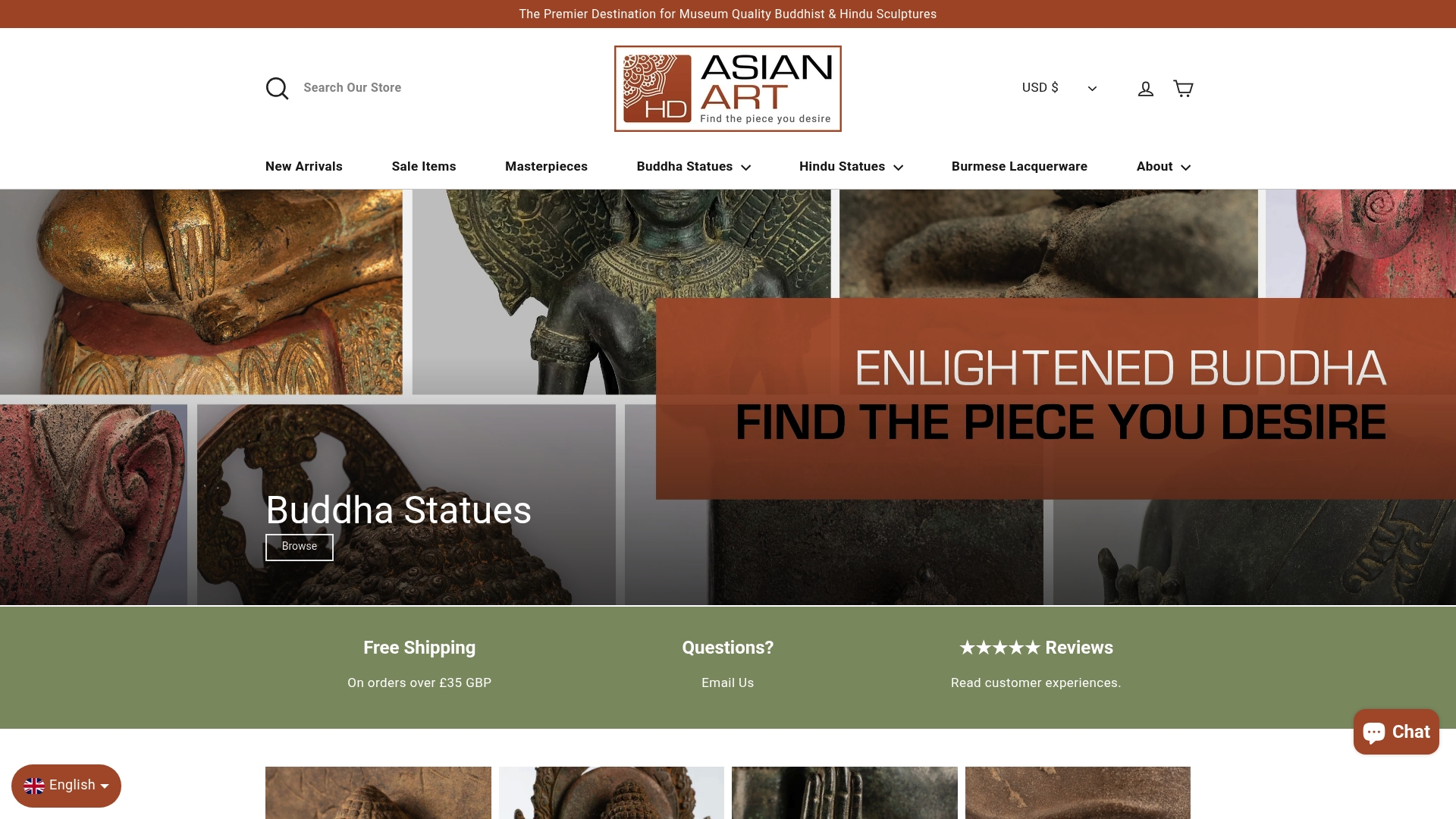
Careful curation can extend beyond descriptions. Shipping with insured courier services matters greatly for bronze and stone works that have survived centuries and risk damage in transit. If you’re weighing a private purchase against a curated one, browse the current antique Buddhist and Hindu statue collection at HDAsianArt and reach out to the team directly with questions about provenance or a specific piece’s casting history before you buy.
Sources
- Christie’s — Collecting guide to Buddhist sculpture
- Mastering Antiquity — Appraisily guide to identifying authentic antique Buddha statues
- Mearto — Buddha category & appraisal services
- Education About Asia — Notes on identifying the enlightened ones
