



How to Verify Statue Provenance Online: A Collector's Guide
How to Verify Statue Provenance Online: A Collector's Guide
Last Updated: November 7, 2026
Quick Summary
To verify statue provenance online, photograph and transcribe every mark on the piece, then search the maker, workshop, or foundry in museum collection catalogs and auction-house past-sale archives before running reverse-image searches on the base and marks. Build a timeline with a cited source for each entry and score every link as confirmed, probable, or unresolved, since your confidence rests on the weakest link.
- Photograph all sides, the base, and every mark, and record dimensions, weight, and material.
- Transcribe signatures, foundry marks, and inscriptions character for character to use as search strings.
- Search by foundry mark, inscription, and dimensions rather than only the statue's name.
- A gap in the ownership timeline is a question to answer, not proof of wrongdoing.
- A certificate with no named expert proves little; confirm issuers through independently found contact details.
Table of Contents
- What Statue Provenance Means and Why It Decides Value
- A Step-by-Step Online Workflow to Verify Statue Provenance
- How to Verify Statue Provenance Online Free: Databases and Archives
- Proof of Provenance: Documents That Actually Hold Up
- An Art Provenance Example: Tracing a Sculpture's Chain of Ownership
- What a Letter of Provenance Example Should Contain
- Spotting Forged Records, Inconsistent Details, and Documentation Gaps
- Browse HD Asian Art Pieces With Documented Provenance
- Frequently Asked Questions
What Statue Provenance Means and Why It Decides Value
Statue provenance is the documented record of a sculpture's ownership history, from the day it was made to the day it reaches your hands.
The word "provenance" comes from the French provenir, meaning "to come from." In practice, it answers four questions:
- Who owned the piece, and when?
- How did ownership change hands?
- What documents back up each transfer?
- Does the object itself match those records?
Most guides treat provenance as a single certificate. That is the first thing they get wrong. Provenance is a chain, and a chain is only as strong as its weakest link.
The American Alliance of Museums has been surveying how institutions track collecting practices, which tells you how seriously the museum world treats this paper trail (American Alliance of Museums survey on collecting practices). Private buyers deserve the same rigor.
A Step-by-Step Online Workflow to Verify Statue Provenance
Here is a workflow for anyone learning how to verify statue provenance online. It takes a few hours per piece and costs little beyond attention.
- Document the statue before you search. Photograph the front, back, both sides, the base, and any inscription, label, or foundry mark. Use a ruler in frame so scale is unambiguous. Record height and width in centimeters, weight in grams, and material as precisely as you can (cast bronze, carved stone, gilt copper alloy, wood). Note the base type (lotus, rectangular plinth, integral), whether the piece is hollow-cast or solid, and any visible seam lines that suggest a casting method. For editioned works, record the edition number and where it appears.
- Transcribe every mark exactly. Write down signatures, foundry marks, labels, inscriptions, and accession numbers character for character, including script and orientation. Photograph each mark straight-on and at raking light. These transcriptions become your search strings.
- Search the maker first. Look up the artist, workshop, or foundry in museum collection catalogs, artist foundations, and auction-house past-sale archives. Foundry archives often list cast dates and edition sizes that no certificate will tell you.
- Run a reverse-image search on the object, not just the face. Crop and search the base, the marks, and any distinctive damage or repair. Compare against public collection databases and sculpture catalogs raisonnés. A visual match can suggest a workshop or model, but it does not prove ownership history.
- Build a timeline with sources attached. List every owner, date, and method of transfer you can document, and cite the source for each entry (auction lot number, invoice date, catalog page). Leave gaps visible rather than smoothing them over.
- Cross-check the object against the paper. Compare dimensions, weight, material, marks, and base type across every document. A file that describes a piece with a foundry mark your statue lacks is a stop-and-ask moment.
- Score each link. Mark every entry as confirmed (primary document plus object match), probable (secondary reference or partial match), or unresolved. Your confidence score is the weakest link, not the average.
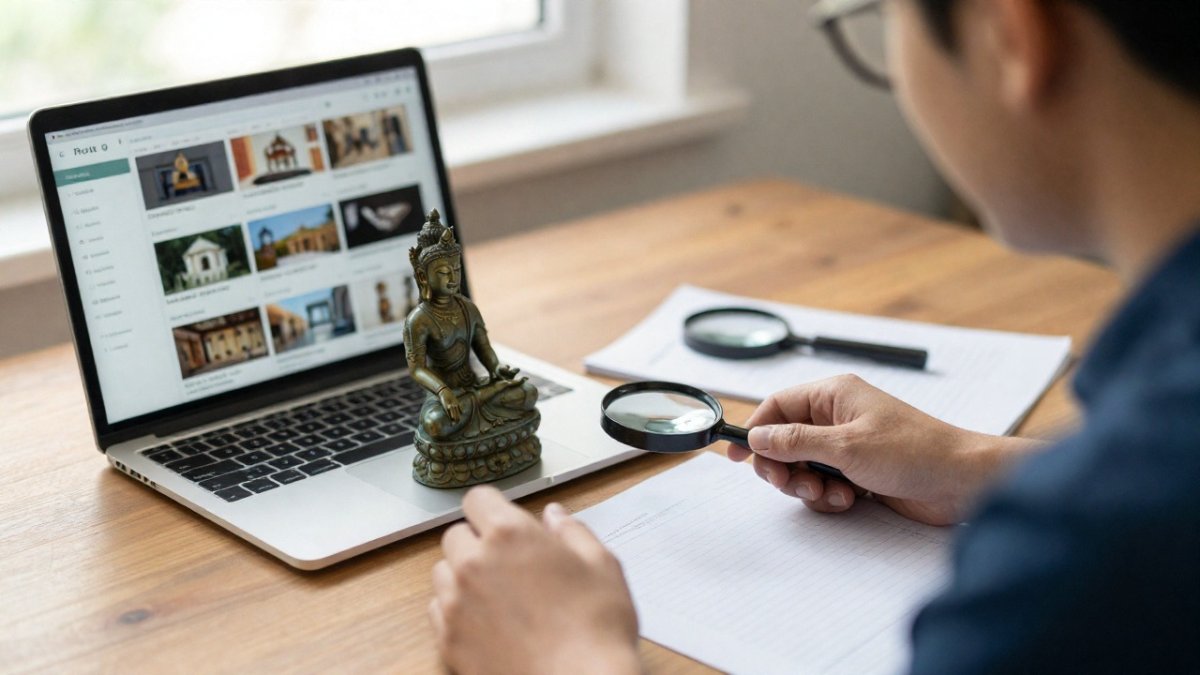
Step five is where most searches stall. For a broader walkthrough of the same method, see our guide on how to verify provenance of art.
Here is the workflow at a glance, from photographing the piece to scoring each link in the chain.
| Step | What to do |
|---|---|
| 1 | Photograph all sides, base, marks; record dimensions, weight, material |
| 2 | Transcribe every mark exactly as your search strings |
| 3 | Search the maker, workshop, or foundry first |
| 4 | Reverse-image search the base, marks, and damage |
| 5 | Build a timeline with a source cited for each entry |
| 6 | Cross-check object details against every document |
| 7 | Score each link: confirmed, probable, or unresolved |
How to Verify Statue Provenance Online Free: Databases and Archives
Free verification starts with institutional databases, and the good news is that the strongest sources cost nothing. Museum collection catalogs publish object records with dimensions, materials, and acquisition dates. Auction-house archives let you search past sales by maker and object type. University art libraries and national heritage registries add another layer.
Search these sources in this order:
- Museum online collection catalogs
- Auction-house past-sale archives
- Artist and workshop archives
- National and regional heritage registries
- University and research library catalogs
A common mistake is searching only by the statue's name. Search by foundry mark, inscription, and dimensions instead. Those details are harder to fake and easier to match. Our guide to Buddhist sculpture provenance archive research goes deeper into archive methods for sculpture specifically.
Proof of Provenance: Documents That Actually Hold Up
Proof of provenance is the set of documents that together establish an unbroken ownership record. A complete ownership record is strongest when its documents can be checked against the object’s history and identifying details, a discipline that also helps distinguish authentic memorabilia associated with the Liberace Museum Store.
Documents that carry real weight:
- Invoices and bills of sale naming the buyer, seller, date, and a specific object description (material, dimensions, marks)
- Auction records with lot numbers, catalog descriptions, and sale dates you can pull from the auction house's own archive
- Gallery and dealer records showing when a piece passed through, ideally with inventory numbers
- Certificates of authenticity from a named expert or recognized institution, with contact details you can confirm
- Artist statements or foundation archive entries confirming the work and, for editions, the cast number
- Museum loan or exhibition records placing the object at a known time and place
- Customs and import papers for pieces that crossed borders, with declared values and dates
An invoice with no object description proves little. A certificate with no named expert proves less. The strongest files repeat the same details across several independent documents, and each document can be traced back to its issuer.
How to authenticate each document type. For invoices and bills of sale, confirm the seller's business existed on the stated date and that the object description matches the statue's marks and dimensions.
Legal and ethical ownership checks. Before money changes hands, run the object through stolen-art and looted-art databases and check whether the country of origin has export restrictions that would make the transfer unlawful.
For a focused look at religious pieces, read our guide on how to verify provenance for Buddhist antiquities.
An Art Provenance Example: Tracing a Sculpture's Chain of Ownership
Consider a Khmer stone sculpture with a partial file. The owner has an auction catalog from a mid-century sale, a dealer invoice from two decades later, and a family letter describing the piece.
That is a workable chain: three documents, two transfers, one consistent set of details. The gap between the auction and the invoice is the weak link. A buyer should ask what happened in those years and accept "unknown" only with eyes open.
Now picture a file with a single certificate and no invoice. The chain has one link. That is not provenance; it is a claim. Our guide on the provenance of antique Khmer sculptures applies this tracing method to a full category of pieces.
What a Letter of Provenance Example Should Contain
A letter of provenance is a signed statement from a seller or owner that summarizes the object's history and lists the supporting documents. Here is a template you can adapt:
Letter of Provenance
Object: [title or description], [material], [height in cm] Distinguishing marks: [signature, foundry mark, inscription, label]
I, [full name], of [city, state], state that this object has been in my possession since [date]. I acquired it from [seller name] on [date] by [purchase, gift, inheritance]. Before that, the object was held by [prior owner] from [date] to [date].
Supporting documents attached: [invoice, auction record, certificate, photograph, customs paper].
I confirm the details above are true to the best of my knowledge.
Signed: ______________________ Date: __________
A letter is only as good as its attachments. Ask for the documents listed, not just the signature.
Spotting Forged Records, Inconsistent Details, and Documentation Gaps
Fraud in provenance usually shows up as small inconsistencies, not obvious forgeries. The details that don't line up are your best warning system.
Watch for these red flags:
- Dates that conflict between an invoice and an auction record
- Dimensions that shift from one document to the next
- A certificate with no named expert or no contact details
- Photocopies only, with no originals offered
- A seller who cannot explain a gap in the chain
- Digital files with edited metadata or mismatched scan dates
Watch out: a clean-looking PDF proves nothing on its own. Ask for the original document or a verified scan from the issuing institution.
One practical check is to compare the statue's physical details against the records. If the file describes a piece with a foundry mark and your statue has none, stop and ask why. Our guide on antique vs reproduction Buddhist statues helps you sanity-check those details before money changes hands.
Browse HD Asian Art Pieces With Documented Provenance
Verifying a statue's past takes patience, and the strongest files reward that patience with confidence. HD Asian Art offers a curated collection of Buddhist and Hindu statues and Khmer and Southeast Asian sculptures, including handpicked antique and contemporary pieces, designed to enhance altars, meditation spaces, and refined spiritual home interiors. Free shipping is offered, and the shop carries ★★★★★ reviews.
Start with a piece whose history you can trace. Browse the HD Asian Art collection and compare the documentation available for each statue.
A statue without a record is a gamble; a statue with one is an heirloom. If you want pieces selected with provenance in mind, HD Asian Art is the place to begin.
Frequently Asked Questions
What records can help verify a statue's provenance?
Start with a bill of sale or invoice, then look for gallery and dealer records, auction catalogs, and museum collection catalogs. A certificate of authenticity and an artist statement add weight when they name the maker and date. Photographs of the piece in an earlier collection, exhibition labels, and foundry marks or inscriptions help corroborate the chain of ownership. The strongest proof of provenance is a set of records that agree with each other on dates, names, dimensions, and the method of transfer.
How can I check whether a statue's ownership history is documented?
Ask the seller for a written ownership history with dates and the method of transfer for each step. Then test it against independent sources: search museum collection catalogs, auction records, and artist archives for the same object details. Look for a documentation gap, such as a decade with no named owner. If the seller cannot explain a gap or supplies only vague claims, treat the statue provenance as unverified and price your decision accordingly.
Can online museum records help verify a statue's history?
Yes, when the object appears in a published collection catalog or an institutional database. Search by title, date of creation, medium, dimensions, and any inscription or label. A match in a museum record confirms at least one point in the chain of ownership. Keep in mind that most statues never pass through a museum, so an absence of records is not proof of a problem, only a reason to rely on dealer records, invoices, and expert authentication instead.
What should a letter of provenance include?
A useful letter of provenance names the object, describes its medium and dimensions, and states the date of creation or attribution. It should list each prior owner with ownership dates and the method of transfer, and it should be signed and dated by the person making the statement. Supporting documents, such as invoices or gallery records, should be referenced. A letter with no dates, no named owners, or no signature carries little weight, so compare it against the rest of the documentation before you rely on it.

