



Buddha Mudra: lo que realmente significa cada gesto de la mano
Buddha Mudra: lo que realmente significa cada gesto de la mano
La mayoría de las personas que poseen una estatua de Buda pueden decir que es hermosa. Son muchos menos los que pueden decirle lo que realmente dice. La posición de las manos, llamada Buda mudra, no es decorativo.
Es un vocabulario simbólico preciso desarrollado durante más de dos milenios, y cada configuración de los dedos, cada dirección de la palma, cada ángulo de la muñeca conlleva un significado específico arraigado en un momento específico de la vida o las enseñanzas del Buda. Si no puedes leer el mudra, te estás perdiendo toda la conversación que el escultor pretendía iniciar.
Tabla de contenidos
- Conclusiones rápidas
- ¿Qué es un mudra y por qué es importante?
- Los cinco mudras básicos que todo coleccionista debe conocer
- Mudras secundarios que vale la pena reconocer
- Cómo las tradiciones regionales cambian el mismo mudra
- Comparación de Mudra: elegir la estatua adecuada para su intención
- Errores comunes al leer los gestos de las manos en las estatuas de Buda
- Preguntas frecuentes
- Referencias
Conclusiones rápidas
|
Información clave |
Explicación |
|---|---|
|
Mudra significa "sello" o "signo" en sánscrito |
Cada gesto de la mano sella una intención, cualidad o momento biográfico específico asociado con el Buda. La palabra misma indica que se trata de un lenguaje fijo y codificado, no de una postura improvisada. |
|
El mudra Bhumisparsha marca el momento preciso de la iluminación. |
La mano derecha que toca la tierra llama al suelo como testigo del despertar del Buda bajo el árbol Bodhi. Es el mudra más emblemático del arte budista del sudeste asiático. |
|
El Dhyana mudra indica meditación, no sueño |
Las manos apoyadas en el regazo, de derecha a izquierda, con los pulgares ligeramente tocándose, forman un cuenco. Esto comunica una profunda absorción meditativa, no descanso. La distinción es muy importante a la hora de colocar una estatua para practicar. |
|
Las escuelas regionales utilizan el mismo mudra de forma diferente |
Un mudra Abhaya tailandés y un mudra Abhaya Gandharan comparten el mismo gesto con la palma hacia afuera, pero difieren en el ángulo del brazo, la posición de los dedos y la postura que los acompaña. El contexto regional da forma a la lectura. |
|
El Varada mudra casi nunca se usa solo |
La palma de la donación abierta y orientada hacia abajo suele aparecer combinada con el Abhaya mudra en la mano opuesta. Una estatua que muestre únicamente a Varada es rara y vale la pena examinarla de cerca. |
|
El Dharmachakra mudra está vinculado exclusivamente al primer sermón. |
Ambas manos a la altura del pecho, con los dedos formando círculos, representan al Buda "haciendo girar la rueda del Dharma" en Sarnath. Ningún otro hecho biográfico utiliza este gesto. |
|
Los mudras fueron codificados aproximadamente en el siglo III d.C. |
Las primeras apariciones de mudras en escultura provienen de Gandhara en el siglo I d.C. En el siglo III, la gramática simbólica estaba en gran medida fijada, lo que permitió que la tradición se extendiera de manera confiable por toda Asia. |
¿Qué es un mudra y por qué es importante?
La palabra sánscrita mudra se traduce como "sello" o "signo". En la iconografía budista, los mudras son gestos con las manos codificados que se utilizan en escultura y pintura para comunicar los roles, estados mentales y momentos biográficos del Buda. No son elecciones decorativas dejadas a la imaginación del escultor. Son una gramática simbólica fija que se desarrolló junto con la difusión del propio budismo, permitiendo leer el mismo significado en una estatua de Birmania, una pintura de Japón o un bronce de Camboya.
Los mudras aparecieron por primera vez en la escultura budista en la región de Gandhara, probablemente en el siglo I d.C., y parecen haber sido codificados en un sistema estable alrededor del siglo III d.C. Se entendía que los dedos de la mano representaban diferentes niveles de conciencia necesarios para alcanzar el despertar total, lo que significa que cada configuración gestual sintetizaba una combinación específica de esas cualidades.
Para coleccionistas y practicantes, poder leer un mudra transforma por completo la experiencia de una estatua. Ya no estás mirando un objeto bello. Estás leyendo una declaración sobre protección, generosidad, enseñanza o iluminación que ha sido realizada en bronce o piedra con extraordinaria precisión. Una estatua colocada en el altar de una casa sin conocer su mudra es como colgar una carta en la pared sin leerla.
Los mudras son a menudo la clave para identificar las deidades retratadas en esculturas y pinturas budistas, y con frecuencia ilustran un aspecto importante de la propia historia de la deidad o la forma particular en que la figura puede ayudar a los devotos a alcanzar su propia iluminación.
Los cinco mudras básicos que todo coleccionista debe conocer
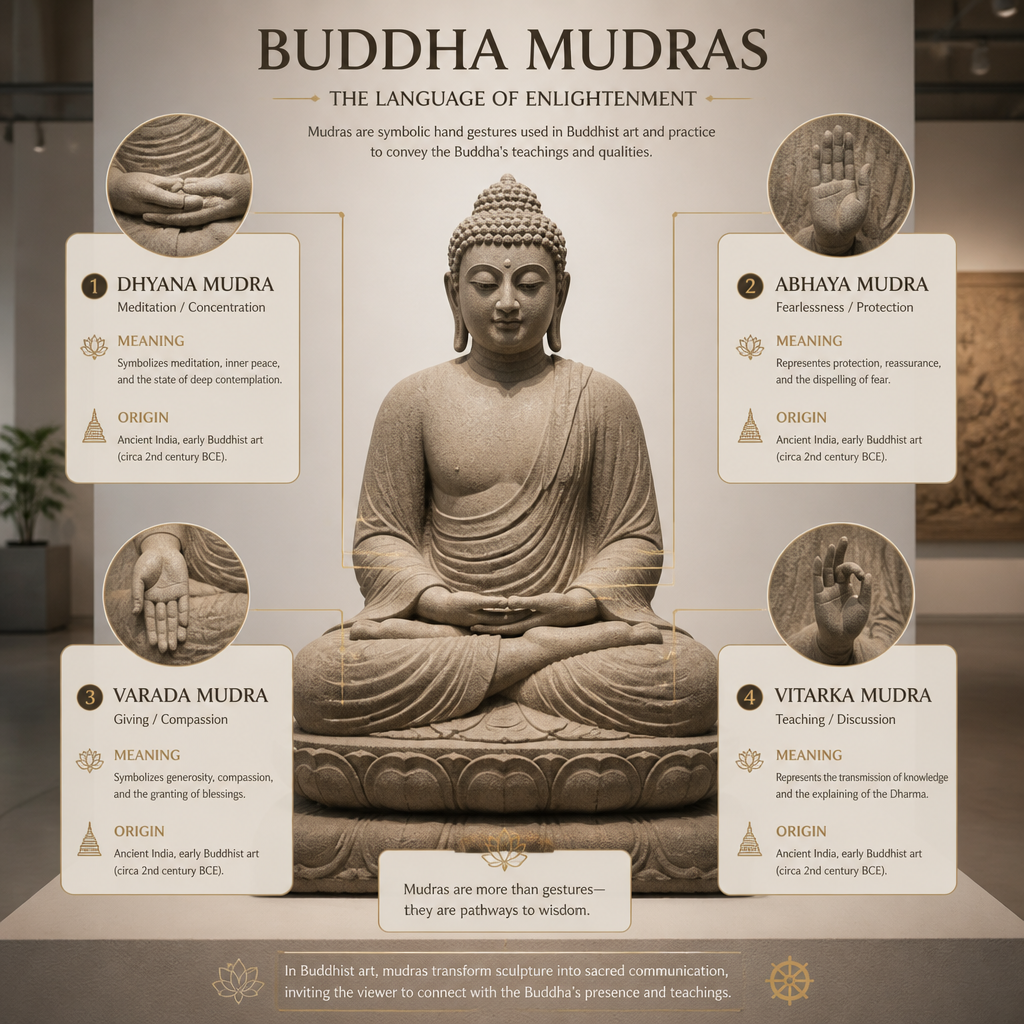
Hay docenas de mudras en las tradiciones budistas, pero cinco aparecen con una frecuencia abrumadora en las estatuas que encuentran la mayoría de los coleccionistas y practicantes. Estos cinco forman el vocabulario esencial. Todo lo demás se construye a partir de aquí.
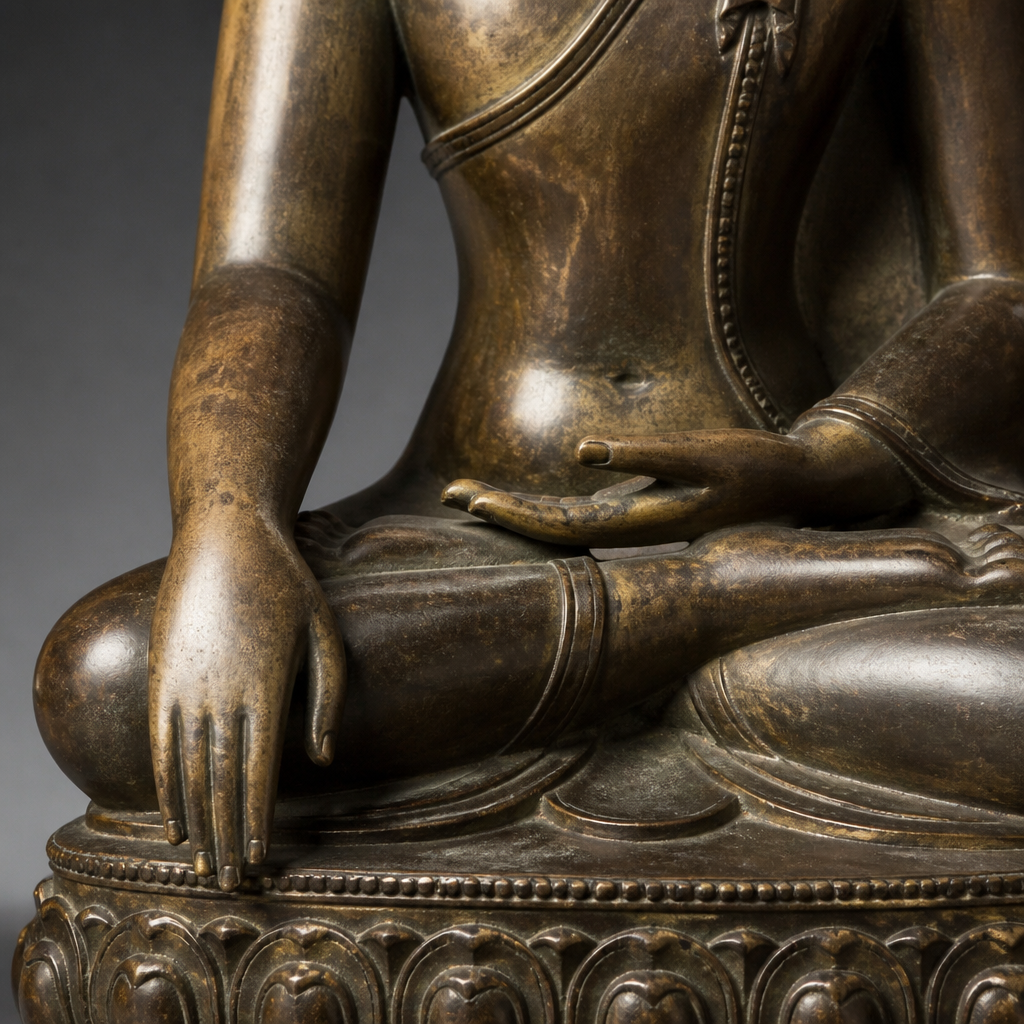
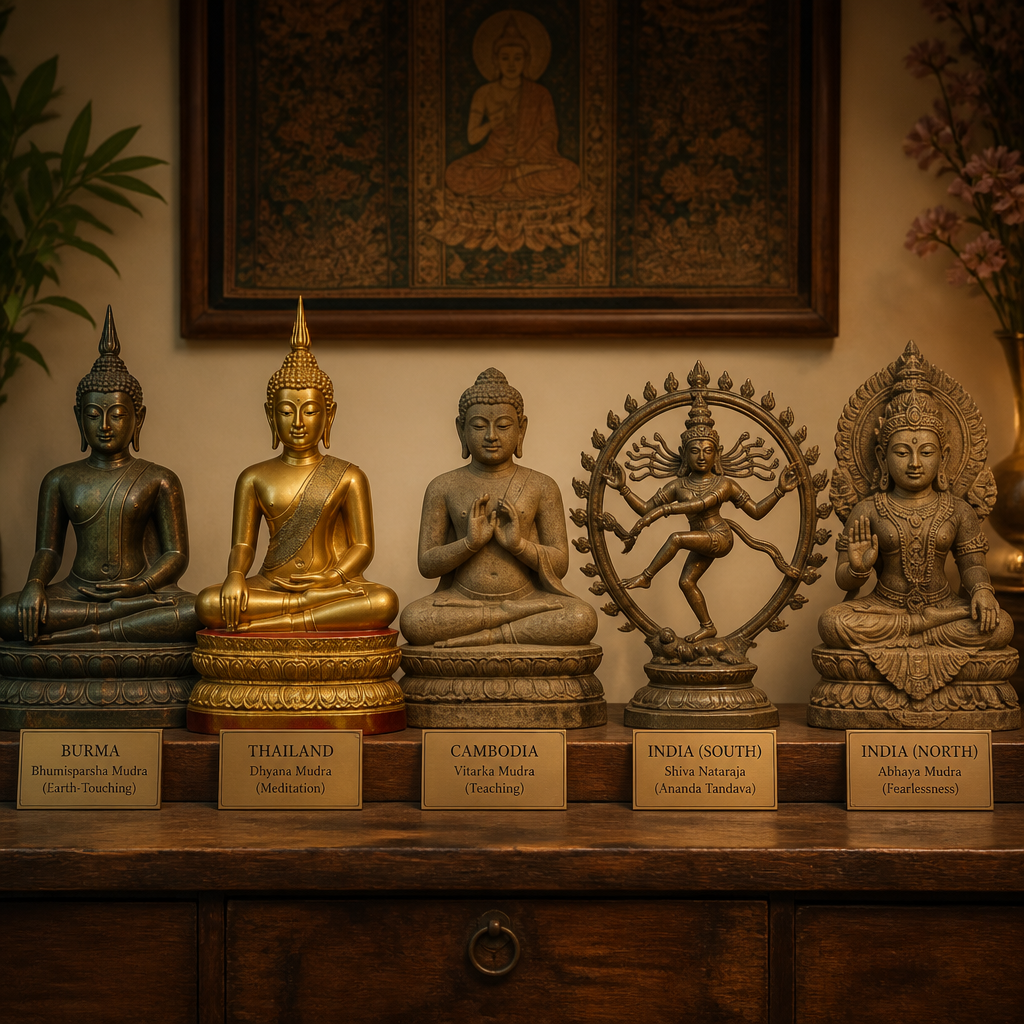
Bhumisparsha: el gesto de tocar la tierra
el mudra bhumisparsha, que se traduce literalmente como "tocar la tierra", muestra la mano derecha extendiéndose para tocar el suelo con los cinco dedos extendidos. La mano izquierda descansa sobre el regazo, con la palma hacia arriba. Este gesto representa el momento singular en el que Siddhartha Gautama, sentado bajo el árbol Bodhi, llamó a la tierra misma para presenciar su iluminación frente a los desafíos de Mara, el demonio de la ilusión.
Es el mudra más común en el arte budista del sudeste asiático y aparece ampliamente en esculturas de Tailandia, Birmania y Camboya. El gesto comunica una resolución inquebrantable, la superación de obstáculos internos y el momento del despertar mismo. Si colocas sólo una estatua en un espacio de meditación y quieres que lleve todo el peso de la historia de Buda, este es el mudra que la lleva de forma más completa.
Consejo profesional: Al comprar una estatua de Bhumisparsha, preste atención al ángulo de la muñeca y a la extensión de los dedos. En auténticos talleres regionales, la geometría precisa de este gesto varía significativamente entre las tradiciones tailandesa, birmana y jemer. Un Bhumisparsha tailandés tiende hacia una curva de muñeca más elegante; Un ejemplo birmano muestra a menudo una posición de la mano más plana y directa. Estos no son errores. Son firmas regionales.
Dhyana: el gesto de meditación
El Dhyana mudra coloca ambas manos en el regazo, la derecha apoyada sobre la izquierda, ambas palmas hacia arriba y los pulgares ligeramente tocándose para formar un triángulo u óvalo. A veces se coloca un cuenco entre las manos. Esta configuración representa una profunda absorción meditativa y, en muchas tradiciones, la unidad de la sabiduría y la compasión.
El Dhyana mudra está asociado con el Buda Amitabha en las tradiciones Mahayana. En la práctica, es el gesto más directamente útil para los practicantes que utilizan una estatua como punto focal para la meditación sentada. La forma de las manos refleja la posición recomendada en muchas tradiciones de meditación, creando una conexión visual directa entre la postura del practicante y la de la estatua.
Abhaya: el gesto de protección
El Abhaya mudra levanta la mano derecha hasta la altura del hombro, con la palma hacia afuera, los dedos apuntando hacia arriba y el brazo ligeramente doblado. La palabra Abhaya significa "valentía" en sánscrito, y el gesto comunica exactamente eso: protección, seguridad, disipación del miedo y buena voluntad hacia quienes se acercan.
Este es uno de los mudras más antiguos y difundidos en la escultura budista, y aparece en figuras de pie y sentadas en todas las tradiciones regionales importantes. Es el gesto más directamente asociado con el papel de Buda como protector y refugio. Para su colocación en el hogar, una estatua de Abhaya colocada cerca de una entrada tiene una intención claramente legible: este espacio ofrece seguridad.
Varada: el gesto generoso
El Varada mudra muestra la mano derecha extendida hacia abajo, con la palma abierta y mirando hacia el espectador, con los dedos apuntando hacia el suelo. En sánscrito, Varada significa "conceder una bendición". Este gesto indica generosidad, caridad, compasión en acción y concesión de deseos a quienes buscan ayuda.
Varada está asociado con Ratnasambhava, uno de los cinco Budas Dhyani en la iconografía Mahayana. En la práctica, el gesto casi siempre aparece combinado con Abhaya en la mano opuesta, creando una declaración combinada de protección y generosidad. Por el contrario, vale la pena examinar una estatua que muestra solo el gesto de Varada sin un mudra emparejado en el contexto regional o estilístico.
Dharmachakra: el gesto de enseñanza
el Mudra del Dharmachakra lleva ambas manos a la altura del pecho, con los dedos de ambas manos formando círculos, la mano derecha mirando hacia afuera y la palma izquierda a veces mirando hacia el pecho o hacia arriba. Este gesto representa el "giro de la rueda del Dharma", específicamente el momento en que el Buda recién iluminado pronunció su primer sermón en Sarnath a sus cinco antiguos compañeros. Es el gesto de la enseñanza misma.
Ningún otro acontecimiento biográfico en la vida de Buda utiliza este gesto. Cuando lo ves, estás mirando un momento histórico y espiritual específico, el punto en el que Buda eligió compartir lo que había descubierto en lugar de permanecer en la contemplación privada. Para los coleccionistas interesados en la riqueza narrativa de la iconografía budista, el mudra Dharmachakra conlleva una cantidad excepcional de significado en un gesto compacto.
Mudras secundarios que vale la pena reconocer
Más allá de los cinco gestos principales, un puñado de mudras secundarios aparecen con suficiente frecuencia como para que los coleccionistas y practicantes se beneficien al reconocerlos.
Vitarka: el gesto de enseñanza y discusión
El Vitarka mudra levanta la mano derecha con la palma hacia afuera y el pulgar y el índice tocándose para formar un círculo, los dedos restantes apuntando hacia arriba. A veces se le llama mudra de "argumento" o "discusión" y representa la comunicación de una enseñanza específica o un punto dhármico. Está relacionado con el Dharmachakra mudra, pero es distinto de él: Dharmachakra señala el inicio de la enseñanza como un evento; Vitarka señala la transmisión de una doctrina o idea específica.
Anjali: el gesto de reverencia
El Anjali mudra, familiar para cualquiera que haya practicado yoga como posición de oración o "namaste", junta las palmas de las manos a la altura del pecho. En las estatuas budistas, aparece más comúnmente en figuras asistentes, bodhisattvas o devotos que en el propio Buda. Cuando aparece en una figura de pie que flanquea una imagen central de Buda, indica respeto y devoción.
Karana: la disipación del gesto maligno
El Karana mudra levanta la mano con el dedo índice y el meñique extendidos hacia arriba mientras que los dedos medio y anular están doblados hacia abajo, sostenidos por el pulgar. Se entiende que este gesto disipa la energía negativa o el mal. Aparece más comúnmente en las tradiciones budistas tibetanas y de Asia oriental que en las esculturas del sudeste asiático más familiares para los coleccionistas occidentales.
Consejo profesional: Cuando una estatua muestra una posición de la mano inusual o desconocida, resista la tentación de llamarla "decorativa". Observe qué dedos están extendidos, cuáles doblados y en qué dirección mira la palma. Estas tres variables juntas casi siempre se corresponden con un mudra específico con un significado documentado, incluso si no es uno de los cinco más comunes.
Cómo las tradiciones regionales cambian el mismo mudra
Una de las cosas más importantes que hay que entender sobre los mudras es que el mismo gesto puede verse significativamente diferente dependiendo de dónde y cuándo se hizo una estatua. El significado simbólico sigue siendo consistente. La ejecución visual varía según la región, el período y la escuela artística de manera significativa más que arbitraria.
Tailandia y Laos
En la escultura budista tailandesa y laosiana, el Abhaya mudra se asocia particularmente con el Buda andante, una postura prácticamente desconocida en el arte budista indio pero muy desarrollada en el sudeste asiático. El Buda andante con la mano derecha levantada en Abhaya es una de las contribuciones más distintivas de la escuela de Sukhothai a la tradición iconográfica budista. El gesto en este contexto se vincula narrativamente con el Buda descendiendo de los cielos después de enseñar a su madre, o con el acto de dejar su huella como bendición.
Birmania
La escultura budista birmana a menudo muestra una franqueza característica en su ejecución del mudra. El mudra Bhumisparsha en los bronces birmanos tiende a mostrar la mano en una posición más angular y asertiva en comparación con las sinuosas curvas de la muñeca de los talleres tailandeses. Las figuras birmanas de pie también muestran con frecuencia el Abhaya mudra con ambas manos levantadas simultáneamente, una configuración menos común en otras tradiciones regionales e inmediatamente distintiva para los ojos entrenados.
Camboya y la tradición jemer
La escultura jemer de Camboya integra mudra dentro de un programa escultórico general de extraordinario control formal. Las manos en las imágenes del Buda jemer suelen ser más estilizadas que naturalistas, con los dedos dispuestos con precisión geométrica. El Dhyana mudra en las imágenes jemeres aparece con frecuencia en el contexto del Buda protegido por Naga, donde la figura meditante se sienta protegida por la capucha del rey serpiente Mucalinda. Esta combinación de mudra y entorno iconográfico crea uno de los tipos de imágenes con mayor riqueza narrativa de todo el arte asiático.
Japón y China
Los escultores budistas japoneses y chinos heredaron el vocabulario mudra a través de la transmisión del budismo a lo largo de la Ruta de la Seda y a través de Corea. La escultura budista japonesa, particularmente en las tradiciones esotéricas (Shingon y Tendai), desarrolló un sistema de mudras enormemente elaborado, con cientos de variantes de gestos asociados con deidades y rituales específicos. Para los coleccionistas centrados en el arte budista del este de Asia, los sistemas de mudras chinos y japoneses recompensan el estudio dedicado, ya que las variaciones dentro de un solo tipo de gesto pueden ser sutiles pero iconográficamente significativas.
Comparación de Mudra: elegir la estatua adecuada para su intención
Para los coleccionistas y practicantes que deciden qué estatua adquirir para un propósito específico, el mudra es el factor más decisivo. La siguiente tabla resume los tres tipos de mudras más comunes que se encuentran en la colección HD Asian Art y los compara en las dimensiones más importantes para la colocación y la práctica.
|
mudra |
Significado primario y asociación |
Mejor uso en el hogar o en el espacio de práctica |
|---|---|---|
|
Bhumisparsha (Tocando la Tierra) |
Iluminación, resolución inquebrantable, el momento del despertar. Asociado con la victoria histórica del Buda sobre Mara. Dominante en las tradiciones del sudeste asiático de Birmania, Tailandia y Camboya. |
Salas de meditación, espacios de altar dedicados, entornos donde la intención principal es la conexión a tierra y la conexión con la historia de la iluminación del Buda. Más poderoso como una sola imagen central. |
|
Abhaya (Protección) |
Audacia, protección, seguridad, buena voluntad. Uno de los mudras más antiguos de la escultura budista. Asociado con Amoghasiddhi en el sistema del Buda Mahayana Dhyani. Aparece tanto en figuras de pie como sentadas. |
Entradas, áreas de recepción, espacios donde la sensación de bienvenida y seguridad es la intención principal. Efectivo en contextos donde la estatua se ve antes que cualquier otra cosa en una habitación. |
|
Dhyana (Meditación) |
Absorción meditativa profunda, quietud interior, equilibrio. Asociado con el Buda Amitabha. Las manos forman un cuenco o triángulo en el regazo, simbolizando la unidad de la sabiduría y la compasión. |
Espacios de meditación, dormitorios, zonas de estudio. La postura de las manos en el regazo crea un ancla visual para que los practicantes establezcan su propia postura meditativa. Particularmente efectivo en alturas de visualización bajas donde las manos son prominentes. |
Errores comunes al leer los gestos de las manos en las estatuas de Buda
Incluso los coleccionistas experimentados cometen errores predecibles al interpretar los mudras. Saber dónde se agrupan esos errores ahorra tiempo y evita la identificación errónea.
Confundir a Vitarka con Abhaya
Ambos mudras levantan la mano derecha con la palma hacia afuera, lo que lleva a muchas personas a tratarlos como intercambiables. La distinción está en los dedos: Abhaya tiene todos los dedos extendidos hacia arriba; Vitarka tiene el pulgar y el índice tocándose para formar un círculo. Esta no es una variación estilística menor. Cambia el significado por completo, de "protección y valentía" a "enseñar un punto específico de doctrina".
Asumir que Dhyana Mudra significa que Buda está durmiendo
Quienes no están familiarizados con la iconografía budista a veces interpretan las manos apoyadas en el regazo con los ojos bajos como una figura dormida. Ésta es una interpretación errónea importante. El Dhyana mudra representa una intensa concentración meditativa, uno de los estados mentales más activos en la práctica budista, en un cuerpo que está deliberadamente quieto. La distinción es importante tanto para comprender la imagen como para utilizarla eficazmente en la práctica.
Ignorando la mano izquierda
La mano derecha en la mayoría de las descripciones de mudras es la mano primaria y activa. Pero la posición de la mano izquierda, ya sea descansando en el regazo, sosteniendo un objeto, elevada en un mudra secundario o apuntando hacia abajo, es igualmente parte de la declaración iconográfica. Un Bhumisparsha mudra en el que la mano izquierda está ausente o dañada, por ejemplo, es una estatua que ha perdido la mitad de su frase visual. Al evaluar una pieza, lea siempre ambas manos como componentes de una sola afirmación.
Aplicación de reglas iconográficas indias a las estatuas del sudeste asiático
El vocabulario mudra se originó en la India, pero las reglas para su ejecución se adaptaron significativamente a medida que el budismo se extendió a Birmania, Tailandia, Camboya, Laos, Sri Lanka, Indonesia y, más al este, a China y Japón. Un mudra que es inusual o raro en el arte budista indio puede ser completamente estándar en la escultura tailandesa. Antes de calificar una posición inusual de la mano como "incorrecta" o "no canónica", verifique a qué tradición regional pertenece la estatua.
el Guía de arte asiático en HD para leer estatuas budistas Cubre el método de lectura de tres pasos: comenzar con las manos, luego leer la postura, luego identificar las marcas físicas y los objetos simbólicos. Esta secuencia funciona porque el mudra reduce el campo interpretativo antes de examinar cualquier otra cosa. Acertar primero con el mudra evita la identificación errónea de todo lo que sucede más adelante.
Para los coleccionistas interesados en las marcas físicas que acompañan a los mudras en esculturas auténticas, el Guía de arte asiático en HD sobre las 32 marcas de Buda proporciona un desglose detallado de cómo esas marcas varían según las tradiciones birmana, jemer, china y japonesa. El mudra y las marcas físicas funcionan como un sistema de lectura combinado, no como sistemas separados.
Preguntas frecuentes
¿Qué significa "mudra" y de dónde viene la palabra?
Mudra es una palabra sánscrita que significa "sello" o "signo". En las tradiciones budista e hindú, se refiere a un gesto con la mano codificado que se utiliza en escultura, ritual y meditación para comunicar un significado, estado mental o momento biográfico específico. El término indica que se trata de comunicaciones fijas y precisas, no de posiciones de manos improvisadas o decorativas. El vocabulario mudra en la escultura budista fue codificado en gran medida en el siglo III d.C., basándose en tradiciones anteriores de gestos en la interpretación clásica india.
¿Qué mudra de Buda es el más común en la escultura del sudeste asiático?
El mudra Bhumisparsha, el gesto de tocar la tierra, es el mudra más común en la escultura budista de Birmania, Tailandia y Camboya. Representa el momento de la iluminación del Buda, con la mano derecha extendiéndose para tocar el suelo mientras la tierra es llamada a presenciar su despertar. Su predominio en el arte budista del sudeste asiático refleja la centralidad del momento de iluminación en la práctica devocional budista Theravada.
¿Puede el mismo mudra tener diferentes significados en diferentes tradiciones budistas?
El significado central de un mudra sigue siendo consistente en todas las tradiciones, pero las asociaciones y el énfasis pueden cambiar. El Dhyana mudra, por ejemplo, representa universalmente la meditación, pero en las tradiciones Mahayana se asocia específicamente con el Buda Amitabha y la Tierra Pura. En la escultura Theravada, el mismo gesto no conlleva necesariamente esa asociación de Amitabha. Las escuelas regionales también difieren en cuanto a a qué Buda Dhyani está vinculado un mudra en particular, particularmente en los sistemas Mahayana y Vajrayana, donde cada mudra corresponde a uno de los cinco Budas cósmicos.
¿Cómo utilizo el conocimiento de los mudras al elegir una estatua de Buda para comprar?
Comience por identificar la intención principal de la estatua. Si desea una pieza que comunique la iluminación de Buda y funcione bien como ancla de meditación, el mudra Bhumisparsha es la opción más directa. Si su intención es proteger y crear una sensación de bienvenida en un espacio, el Abhaya mudra cumple ese propósito claramente. Si la estatua es para una sala de práctica de meditación donde la conexión visual con la postura de meditación es importante, el Dhyana mudra es más efectivo. El mudra es la guía más confiable para determinar el significado previsto y la ubicación adecuada de una estatua.
¿Los mudras sólo se encuentran en las estatuas de Buda, o las estatuas de deidades hindúes también los usan?
Los mudras también aparecen ampliamente en la escultura hindú. Muchas deidades hindúes se representan con gestos específicos con las manos que conllevan significados iconográficos precisos, y algunos gestos se superponen entre las tradiciones budista e hindú dadas sus raíces culturales indias compartidas. El Abhaya mudra, por ejemplo, aparece en imágenes de Vishnu, Shiva y varias diosas hindúes, no sólo en la escultura budista. En el contexto de las estatuas budistas específicamente, el vocabulario mudra es el más sistematizado y mejor documentado de las dos tradiciones, pero los coleccionistas de esculturas budistas e hindúes se benefician del estudio del sistema de gestos.
¿Cómo puedo saber si un mudra se está ejecutando correctamente en una escultura?
Las tres variables a verificar son: qué dedos están extendidos o doblados, la dirección en que mira la palma y la altura y el ángulo de la mano con respecto al cuerpo. Un Abhaya mudra ejecutado correctamente, por ejemplo, tiene todos los dedos extendidos hacia arriba, la palma hacia afuera y la mano a la altura del hombro o ligeramente por encima. Cuando una de estas variables está equivocada, puede indicar una variante estilística regional, una reproducción posterior o un error de fabricación. Piezas auténticas con calidad de museo provenientes de talleres regionales establecidos ejecutan el mudra con precisión porque los escultores trabajan dentro de una tradición iconográfica viva, no improvisando.
Si tienes una estatua de Buda en casa y recién ahora te has dado cuenta de que no estabas seguro de qué mudra muestra, nos encantaría escuchar lo que descubras cuando mires nuevamente. Comparte tu experiencia en los comentarios a continuación.
Referencias
-
Panorama general de los mudras en el arte budista, sus orígenes y significados, de Smarthistory
-
Convenciones iconográficas del Buda en la escultura budista tailandesa y laosiana, de Wikipedia
