



Arte budista antiguo versus reproducción: una guía para coleccionistas
Arte budista antiguo versus reproducción: una guía para coleccionistas
Al evaluar esculturas budistas, comprender la distinción entre arte antiguo y reproducción determina fundamentalmente sus decisiones de compra y su práctica espiritual. En HD Asian Art, hemos guiado a innumerables coleccionistas a través de esta evaluación crítica.
La diferencia se extiende más allá del precio, hacia la autenticidad, la importancia cultural y el potencial de inversión. Esta guía analiza los marcadores concretos que separan las antigüedades genuinas de las reproducciones de alta calidad.
Tabla de contenidos
Un auténtico Bodhisattva tibetano de bronce dorado del siglo XVIII inspira respeto y valor que una réplica artesanal contemporánea no puede igualar. Sin embargo, muchas reproducciones de alta gama ofrecen una autenticidad espiritual y un mérito artístico que rivaliza con sus homólogos antiguos, a menudo a una fracción del coste. A continuación, le mostramos exactamente cómo distinguir entre ellos utilizando métodos prácticos de identificación, pruebas científicas y experiencia que separa a los coleccionistas ocasionales de los profesionales serios.
Comprender el arte budista antiguo frente al de reproducción
La diferencia fundamental radica en cómo cada uno sirve para diferentes propósitos. Una escultura budista antigua tiene procedencia histórica, artesanía original de su origen cultural y energía espiritual acumulada durante siglos de devoción. Una reproducción, particularmente las versiones de alta gama, ofrece habilidad artesanal contemporánea, precisión cultural y accesibilidad sin las complicaciones éticas que a veces acompañan a las antigüedades.
La verificación de procedencia representa un elemento de un valoración de antigüedades, sin embargo, muchos coleccionistas pasan por alto esto por completo. La evaluación restante depende de los materiales, la artesanía, la precisión iconográfica y el estado, áreas donde las reproducciones pueden competir favorablemente.
Las antigüedades son artefactos históricos irremplazables. Las reproducciones son creaciones contemporáneas que honran las técnicas tradicionales. Un inversor serio que busca una apreciación a largo plazo apunta a las antigüedades autenticadas. Un practicante que busque una pieza espiritualmente resonante para la práctica diaria podría encontrar una reproducción contemporánea consagrada más significativa que una pieza de museo guardada detrás de un vidrio.
Cómo identificar estatuas y esculturas de bronce antiguas
Para identificar auténticos bronces budistas antiguos es necesario examinar la técnica de fundición, la precisión proporcional y las características de la superficie que revelan la edad y el uso.
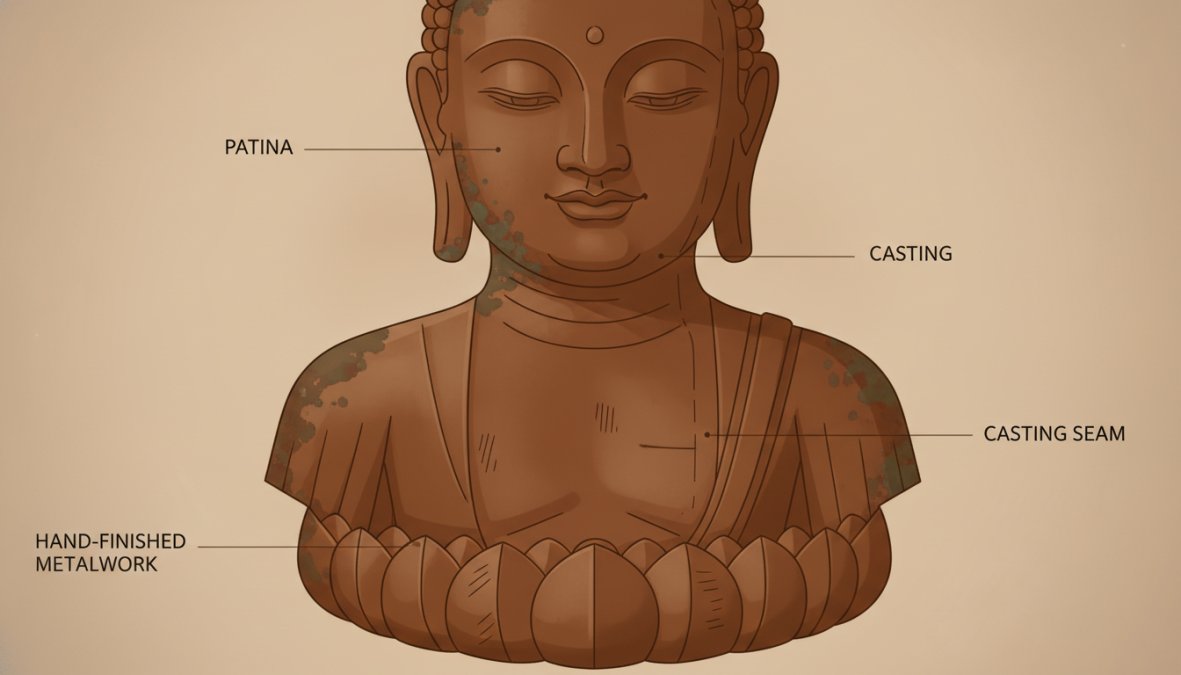
Técnicas de fundición y calidad de la carpintería metálica.
Los bronces antiguos de los siglos XV al XVIII se crearon mediante fundición a la cera perdida, que dejó firmas distintivas. Este proceso de escultura manual produjo ligeras irregularidades, espesores de pared desiguales, defectos menores en la fundición y variaciones de composición que la fundición industrial moderna elimina.
Examine la base y las superficies interiores. Las piezas antiguas muestran tallado y acabado a mano: marcas de lima, textura superficial intencionada e impresiones de herramientas que indican intervención artesanal. Las uniones donde se unen las secciones del molde son visibles pero refinadas, no suavizadas con el esmerilado moderno. Las reproducciones contemporáneas a menudo parecen deliberadas más que orgánicas, el desgaste parece aplicado en lugar de ganado.
La distribución del peso revela autenticidad. Los bronces antiguos se sienten sustanciales y ligeramente desequilibrados debido a las variaciones en la fundición manual. Las reproducciones modernas distribuyen el peso con precisión matemática. Esta evaluación táctil, combinada con la inspección visual, elimina aproximadamente el 60% de las reproducciones de forma inmediata.
Proporciones y estilo escultórico
La iconografía budista sigue estrictas pautas proporcionales evolucionadas a lo largo de siglos y regiones. Un bodhisattva tibetano del siglo XVII muestra proporciones diferentes a las de un ejemplo chino, pero ambos siguen la geometría sagrada de sus respectivas tradiciones.
Mida la relación entre el tamaño de la cabeza y la altura del cuerpo. En las piezas tibetanas auténticas, la cabeza ocupa un octavo de la altura total; Los ejemplos chinos muestran proporciones de un séptimo. Estos reflejan siglos de tradición religiosa. Las reproducciones que no respetan estas proporciones indican un origen contemporáneo.
Examine los rasgos faciales prestando atención a los patrones de uso. Las esculturas antiguas muestran un desgaste selectivo acorde con la edad: ligero aplanamiento de los puntos altos, profundización de las áreas rebajadas y una pátina constante en todas las superficies. Las reproducciones muestran un acabado superficial uniforme porque son nuevas; Incluso las piezas envejecidas artificialmente carecen del desgaste selectivo que crean siglos de manipulación.
Signos de edad en esculturas budistas: qué buscar
El envejecimiento auténtico produce patrones específicos y predecibles que los falsificadores luchan por replicar de manera convincente.
Pátina, patrones de desgaste y deterioro de la superficie
La pátina, la capa de oxidación coloreada del bronce, a menudo se malinterpreta. La pátina genuina se forma a lo largo de décadas o siglos mediante la interacción química entre el bronce, el oxígeno atmosférico y la manipulación. No es uniforme, más oscuro en las zonas recónditas donde se acumula la humedad, más claro en los puntos altos que experimentan fricción. El color varía: verde intenso en climas húmedos, verde parduzco en regiones más secas, azul verdoso en ambientes costeros.
La pátina artificial parece uniforme y aplicada. La pátina auténtica se integra en la superficie del metal. Pase el dedo por un bronce antiguo: la pátina se siente parte de la superficie, no de un revestimiento. Esta distinción separa las piezas genuinas de las falsificaciones especializadas en segundos.
Los patrones de uso cuentan historias. Las manos de un bodhisattva de 300 años muestran la suavidad de miles de toques devocionales. El rostro muestra un desgaste selectivo donde los dedos tocaron repetidamente la frente durante la práctica ritual. La base presenta rayones por colocación en altares y movimiento durante ceremonias. Estos patrones aleatorios y variados son casi imposibles de fabricar de manera convincente.
Envejecimiento natural versus patinado artificial
La pátina natural se desarrolla de manera desigual porque la exposición es desigual. Una escultura guardada en un santuario experimenta diferente humedad, luz y manipulación que una almacenada en un sótano. Su pátina refleja esa historia. La patinación artificial intenta la uniformidad, opuesta a la realidad.
Examine la pátina en la base versus las superficies superiores. En las antigüedades auténticas, estos difieren notablemente. La base muestra una coloración diferente a la de las superficies superiores expuestas. En reproducciones envejecidas artificialmente, la pátina parece consistente en todas las superficies, una señal de alerta que indica un tratamiento químico reciente en lugar de siglos de oxidación natural.
El papel de la procedencia en la autenticación del arte budista
La procedencia y el historial de propiedad documentado separan las antigüedades con calidad de museo de las piezas de origen incierto. Una escultura con clara procedencia de un templo conocido, una colección privada o un comerciante respetado tiene exponencialmente más valor y credibilidad.
Documentación, historial de propiedad y tasación pericial.
Las esculturas budistas antiguas legítimas vienen con rastros de papel. Una pieza procedente de un importante monasterio posee registros institucionales. Una escultura de una respetada colección privada incluye documentación de adquisición, historial de exposición y tasaciones previas.
Solicite la documentación disponible antes de comprar. Los distribuidores legítimos proporcionan registros de adquisición, historial de propiedad anterior, tasaciones de expertos o certificados de autenticación, historial de exhibición e informes de condición que documentan la restauración.
La ausencia de procedencia no indica automáticamente una falsificación, pero reduce significativamente el valor y plantea dudas. Las evaluaciones de expertos calificados añaden credibilidad. Organizaciones como el consejo internacional de museos mantener directorios de tasadores de arte certificados especializados en antigüedades asiáticas. Para piezas de más de $5,000, una tasación profesional es una práctica estándar.
Métodos de prueba científica para la autenticación
La autenticación moderna va más allá de la inspección visual y llega al análisis de laboratorio, proporcionando datos objetivos que respaldan la evaluación visual.
Datación por termoluminiscencia y análisis de materiales.
La datación por termoluminiscencia (TL) mide la desintegración radiactiva en materiales cerámicos y proporciona una edad aproximada. En el caso de las esculturas de bronce, el análisis de la composición del material ofrece una visión más directa. La espectroscopia de fluorescencia de rayos X (XRF) mide la composición elemental sin dañar la pieza. Un bronce tibetano del siglo XVIII contiene proporciones específicas de cobre, estaño, plomo y metales traza que reflejan la metalurgia de la época. Las aleaciones modernas a menudo muestran firmas compositivas que difieren de los ejemplos antiguos auténticos.
Laboratorios de pruebas acreditados proporcionan informes detallados que especifican la metodología y los intervalos de confianza. Sea escéptico con los vendedores que afirman que están autenticados sin informes técnicos. Los costos de las pruebas suelen oscilar entre $ 500 y $ 2000, según la complejidad.
Estas pruebas respaldan la autenticación, pero no reemplazan la evaluación visual ni la verificación de procedencia. Una pieza que pasa pruebas científicas pero que carece de procedencia y muestra patrones de desgaste sospechosos sigue siendo cuestionable.
Comprender el valor de la reproducción del arte budista
El mercado de la reproducción ha evolucionado espectacularmente. Los artesanos contemporáneos que trabajan en Nepal, el Tíbet y el sudeste asiático crean piezas que rivalizan con los ejemplos de los museos en presencia espiritual y calidad artística, pero que cuestan una fracción de las antigüedades.
Reproducciones de alta gama versus réplicas producidas en masa
Las reproducciones de alta gama se crean conscientemente como piezas contemporáneas utilizando técnicas tradicionales. Los artesanos capacitados en métodos de linaje funden y terminan a mano las piezas y, a menudo, las consagran antes de la venta. Estos honran las tradiciones budistas y al mismo tiempo son honestos sobre el origen.
Las réplicas producidas en masa se fabrican en instalaciones industriales utilizando moldes y procesos de línea de montaje. A menudo se los tergiversa como "antiguos" a pesar de tener semanas de antigüedad. El problema ético no es su existencia; es marketing engañoso que oscurece su origen contemporáneo.
Una reproducción hecha a mano por un experto artesano de Nepal cuesta entre 1.500 y 8.000 dólares, según el tamaño y el material. Estos muestran variaciones individuales y un trabajo manual inconfundible. Una réplica producida en masa cuesta entre 200 y 800 dólares y muestra una reveladora uniformidad en la fundición del molde.
Potencial de inversión y autenticidad espiritual
Las reproducciones no se valoran como las antigüedades. Una pieza contemporánea de 2.000 dólares no se convertirá en una inversión de 20.000 dólares. Sin embargo, la autenticidad espiritual, la sensación de presencia que conlleva una escultura, no es una propiedad exclusivamente antigua. Una reproducción contemporánea consagrada puede servir a la práctica devocional tan eficazmente como una pieza de 500 años de antigüedad.
El cálculo de la inversión difiere entre los coleccionistas y los profesionales. Los coleccionistas serios que compran antigüedades esperan apreciarlas y ven las piezas como activos financieros. Los practicantes que compran reproducciones priorizan la resonancia espiritual y la armonía estética. Estos no son valores en competencia; son diferentes perfiles de coleccionistas que toman decisiones diferentes.
Las reproducciones de alta gama mantienen su valor. Una pieza fundida a mano de 3.000 dólares mantiene ese valor porque la calidad justifica el precio. Las réplicas producidas en masa se deprecian marcadamente porque son mercancías.
Abastecimiento legal y ético de arte budista antiguo
El mercado de antigüedades conlleva serias complicaciones legales y éticas que las reproducciones contemporáneas evitan por completo.
Evitar el robo de antigüedades y respetar el patrimonio cultural
Muchas esculturas budistas de colecciones privadas fueron retiradas de templos y lugares sagrados durante períodos coloniales o conflictos. Comprarlos perpetúa la demanda e incentiva un mayor saqueo.
Los anticuarios legítimos verifican la exportación legal. Para esculturas de Nepal, Tíbet, India o el sudeste asiático, esto significa documentación que demuestre la exportación legal antes de 1970, cuando las leyes internacionales sobre propiedad cultural se hicieron más estrictas. Las piezas que carezcan de dicha documentación pueden ser bienes culturales robados.
La Convención sobre Bienes Culturales de la UNESCO estableció estándares internacionales que protegen los artefactos culturales. La mayoría de los países hacen cumplir leyes que impiden la exportación de antigüedades importantes sin permiso del gobierno. La compra de piezas exportadas ilegalmente lo expone a responsabilidad legal.
Compre antigüedades únicamente de comerciantes acreditados con abastecimiento documentado. Si un comerciante no puede explicar cómo obtuvo una pieza o dónde estaba antes de 1970, es una señal de advertencia.
Las reproducciones contemporáneas eliminan toda esta categoría de preocupación. Una pieza creada el año pasado en Nepal no conlleva bagaje histórico ni complicaciones legales.
Iconografía y significado simbólico en la autenticación
La iconografía budista sigue estrictas convenciones desarrolladas a lo largo de siglos. Comprender estos símbolos ayuda a autenticar las piezas y profundiza su apreciación.
Atributos simbólicos y variaciones regionales
Cada Bodhisattva muestra marcadores iconográficos específicos. Avalokiteshvara, el Bodhisattva de la Compasión, aparece con múltiples brazos y a menudo sostiene una flor de loto o un jarrón. Manjushri, el Bodhisattva de la Sabiduría, porta una espada de fuego. Ksitigarbha aparece con túnicas monásticas sin ornamentación elaborada.
Éstas son declaraciones teológicas, no elecciones decorativas. Un Avalokiteshvara tibetano del siglo XVIII debería mostrar marcadores iconográficos consistentes con la tradición budista tibetana. Una reproducción que mezcla elementos iconográficos tibetanos y chinos indica un error o engaño artesanal.
Examine cuidadosamente los gestos con las manos (mudras). Las posiciones específicas tienen significado: el Abhaya mudra (palma hacia adelante) significa valentía; el Bhumisparsha mudra (mano tocando la tierra) hace referencia a la iluminación de Buda. Las piezas antiguas muestran mudras anatómicamente correctos que reflejan la comprensión teológica del escultor. Las reproducciones a veces simplifican estos gestos, revelando el desconocimiento del artesano.
Los detalles de la vestimenta y los adornos varían según la tradición y la época. Las piezas tibetanas presentan joyas elaboradas y complejos diseños de coronas. Las piezas del sudeste asiático muestran una ornamentación más sencilla. Los ejemplos chinos muestran diferentes enfoques estéticos. Comprender estas variaciones regionales ayuda a identificar el origen de una pieza y evaluar la alineación iconográfica con la procedencia reivindicada.
Un artesano concienzudo honra los requisitos iconográficos precisamente porque al hacerlo demuestra respeto por la tradición.
| Factor de identificación | Características antiguas | Características de reproducción |
|---|---|---|
| pátina | Desigual, más oscuro en los huecos, integrado en la superficie | Aspecto uniforme, calidad aplicada. |
| Costuras de fundición | Visible, refinado a mano, ligeramente irregular. | Aspecto alisado y uniforme. |
| Distribución de peso | Ligeramente desequilibrado debido al moldeado manual. | Matemáticamente preciso, perfectamente equilibrado |
| proporciones | Seguir proporciones iconográficas tradicionales | Puede variar, a veces simplificado. |
| Patrones de desgaste | Selectivo, aleatorio, concentrado en los puntos altos. | Uniforme o ausente, aspecto deliberado. |
| Procedencia | Historial de propiedad documentado | Creación contemporánea, origen transparente. |
| Composición de materiales | Refleja la metalurgia de la época. | Composición de aleación moderna. |
| Iconografia | Preciso, teológicamente informado | Varía, a veces simplificado. |
La distinción entre antigüedad y reproducción. arte budista refleja su filosofía y prioridades de coleccionismo. Los inversores serios que buscan activos valiosos y artefactos históricos buscan antigüedades autenticadas con procedencia documentada, aceptando costos más altos y complejidades éticas por un significado histórico genuino. Los profesionales y coleccionistas de estética a menudo encuentran mayor valor en reproducciones contemporáneas de alta gama que honran la artesanía tradicional y al mismo tiempo ofrecen autenticidad espiritual y claridad ética.
Cualquiera que sea el camino que elija, compre de fuentes confiables. Los distribuidores legítimos proporcionan información transparente sobre el origen, los materiales y los trabajos de restauración. En HD Asian Art, nuestra colección cuidadosamente seleccionada de tesoros antiguos y piezas contemporáneas hechas a mano refleja nuestro compromiso con la autenticidad. Explore nuestra selección para encontrar piezas que resuenen con su práctica espiritual y visión estética.
Preguntas frecuentes
¿Cómo saber si una estatua budista es antigua?
El auténtico arte budista antiguo muestra características distintivas: pátina natural con coloración desigual, costuras de fundición visibles en piezas de bronce dorado, patrones de desgaste consistentes con la edad y procedencia documentada. Examine la iconografía en busca de precisión histórica, proporciones que coincidan con el estilo escultórico de su supuesto período y materiales apropiados para su supuesto origen. Las pruebas científicas, como la datación por termoluminiscencia de piezas de cerámica, proporcionan una autenticación objetiva. Consulta tasaciones de expertos de casas de subastas o galerías especializadas para verificar la autenticidad antes de la compra.
¿Cuáles son las principales diferencias entre el arte budista antiguo y la reproducción?
Las esculturas budistas antiguas poseen una procedencia auténtica, signos naturales de envejecimiento y artesanía histórica de artesanos tradicionales. Las reproducciones, especialmente las de alta gama, utilizan técnicas y materiales de fundición modernos, carecen de patrones de desgaste y no tienen una historia documentada. Las antigüedades se valoran y tienen un significado cultural; las reproducciones sirven para fines decorativos o devocionales a menor costo. Si bien las reproducciones pueden tener significado espiritual y estar bellamente hechas, carecen de la antigüedad y el potencial de inversión de las piezas genuinas. Comprender esta distinción ayuda a los coleccionistas a elegir en función de sus objetivos.
¿Vale la pena comprar una reproducción de arte budista?
Las reproducciones de alta calidad ofrecen un valor significativo para los profesionales y coleccionistas con limitaciones presupuestarias. Las piezas hechas a mano por artesanos tradicionales del Tíbet, Nepal y el sudeste asiático mantienen la autenticidad espiritual y una mano de obra excepcional, apoyando a las comunidades artesanales vivas. Las réplicas con calidad de museo brindan una apreciación visual y estética de piezas famosas. Sin embargo, las reproducciones no se valoran como antigüedades y carecen de procedencia histórica. Son ideales para espacios de meditación, altares y decoración del hogar en lugar de inversión. Elige en función de tu propósito: la práctica espiritual favorece las reproducciones de calidad; El coleccionismo y la inversión exigen antigüedades auténticas.
¿Qué preocupaciones legales y éticas rodean al coleccionismo de arte budista antiguo?
Muchas esculturas budistas antiguas fueron retiradas de templos y sitios arqueológicos, lo que planteó cuestiones jurídicas y de patrimonio cultural. Coleccionistas acreditados verifican la procedencia anterior a 1970 (cuando comenzaron las principales restricciones a la exportación) y compran únicamente de fuentes legítimas, como galerías y casas de subastas establecidas. Evite piezas con un historial de propiedad poco claro o aquellas sospechosas de ser antigüedades robadas. Apoyar a comerciantes éticos que respetan las comunidades de origen y cumplen con las leyes internacionales de propiedad cultural garantiza que su colección defienda la integridad espiritual. HD Asian Art y galerías curadas similares priorizan el abastecimiento legal y el respeto cultural.
