






-
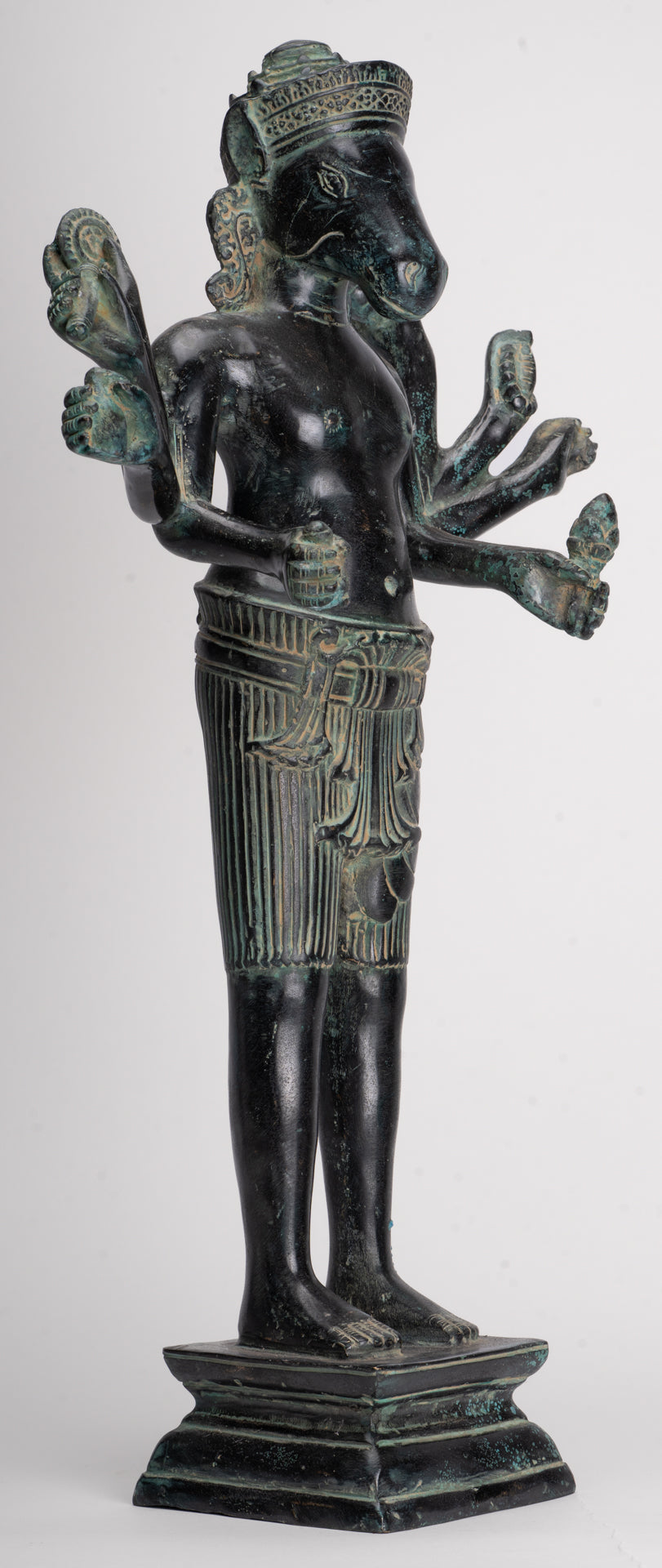
Antique Khmer Style Mounted Bronze Hayagriva Horse of Vishnu - 51cm/20"
Eight-Armed Horse Headed Form of Vishnu
Measurements Height 51cm/20"
An impressive antique Khmer-style bronze depicting Hayagriva, the horse-headed form of Vishnu associated with knowledge, sacred learning, spiritual clarity, and the recovery of divine wisdom. Standing in a formal frontal stance upon a stepped pedestal, this exceptional eight-armed figure combines the calm authority of Vishnu with the vigorous symbolic power of the horse-headed deity.
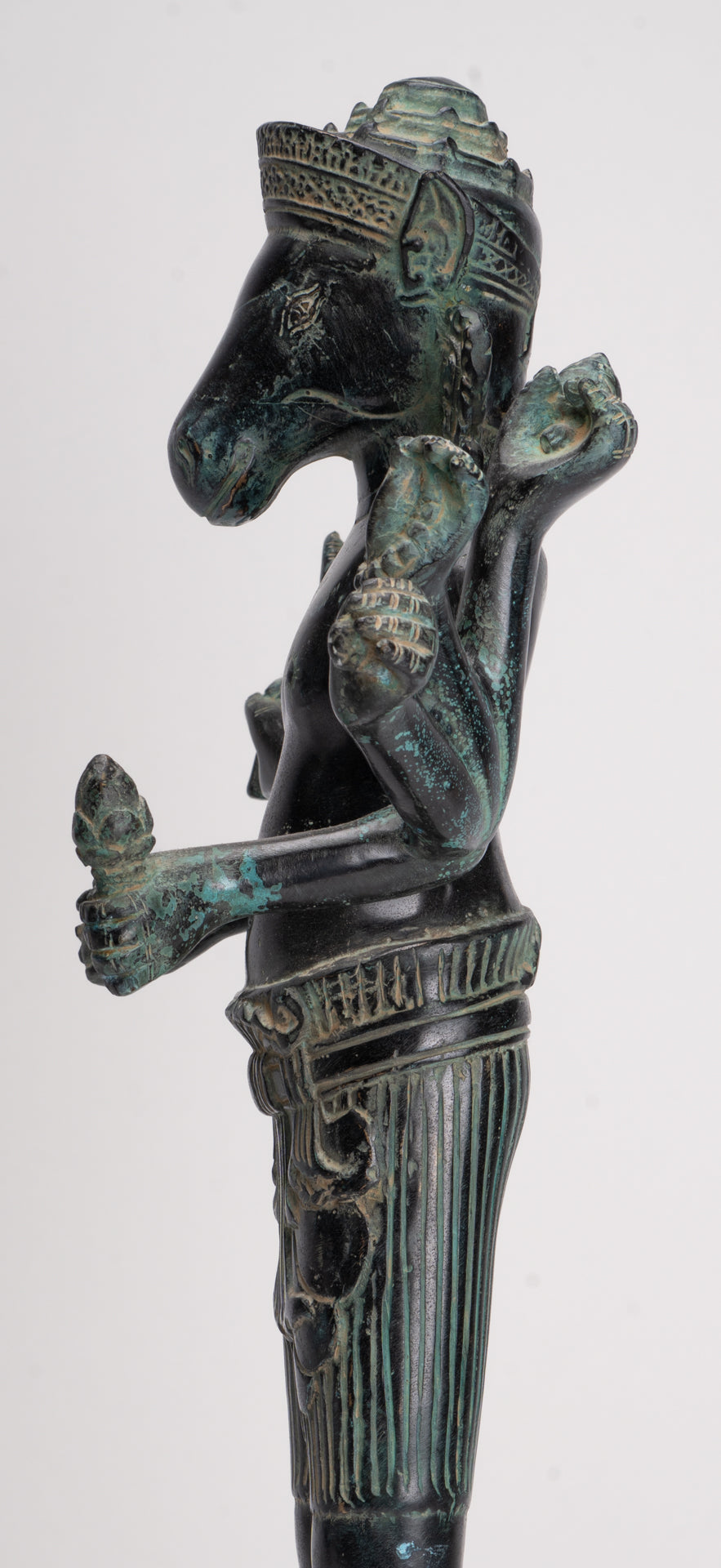
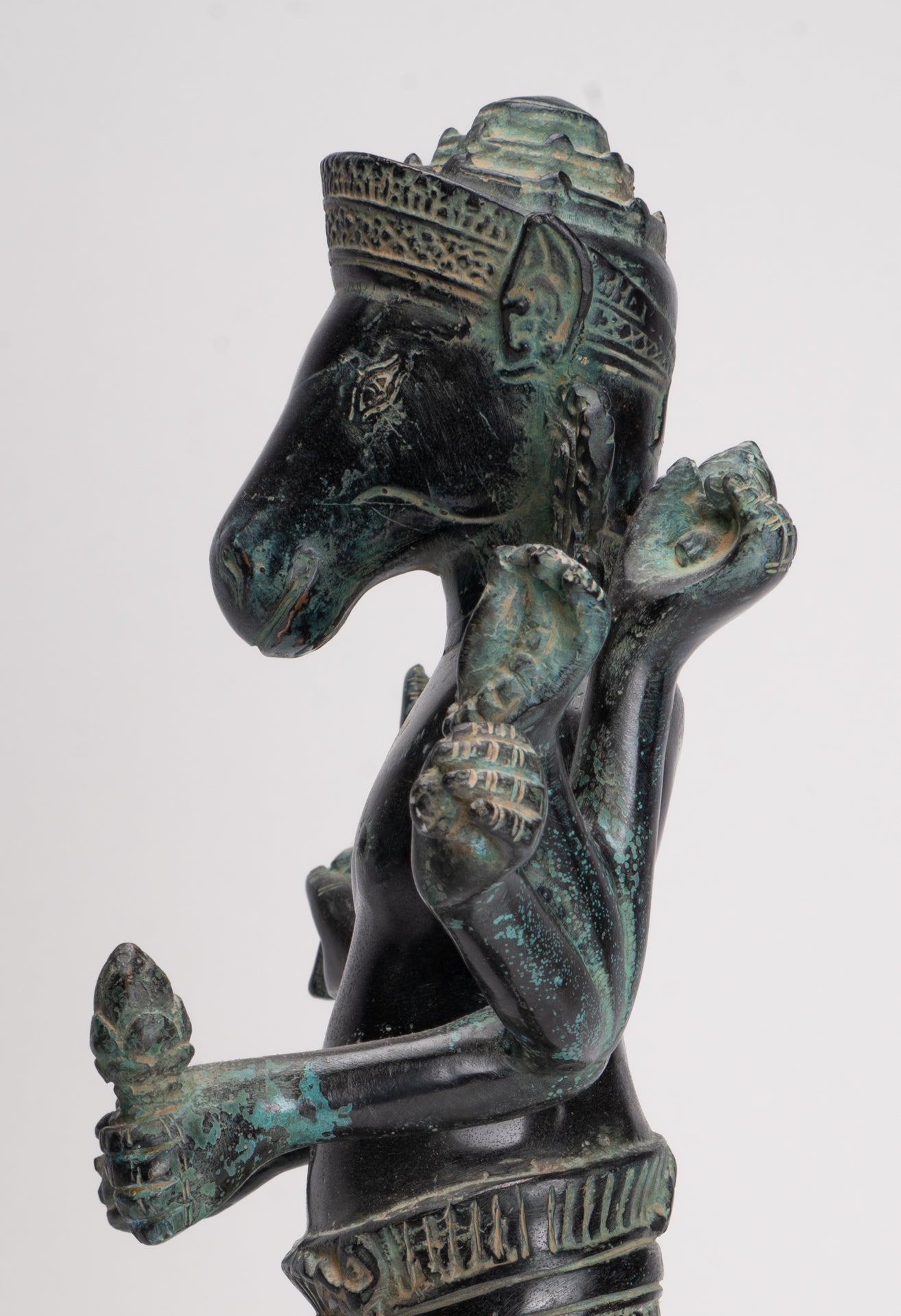
Measuring approximately 51 cm / 20 inches high, the sculpture presents a powerful silhouette: the human body stands upright and balanced, while the horse head, tall crown, broad diadem, flowing earrings, and radiating arms create an imposing sacred presence. The figure wears a finely detailed Khmer-style sampot, arranged in vertical pleats and decorative folds, and the surface carries a deep dark patina enriched by areas of soft green verdigris.
Hayagriva holds an array of sacred attributes, including a lotus bud, mala beads, conch shell, chakra or discus, sutra or sacred text, and mace, together with further objects whose precise reading should remain cautious. These attributes unite Vishnu’s customary powers of preservation and protection with Hayagriva’s special associations with meditation, scripture, learning, and awakened understanding.
Hayagriva and Kalki
This image is best identified as Hayagriva, though horse-headed forms of Vishnu are sometimes described commercially as Hayagriva or Kalkin. The two are related through Vishnu but have different primary identities.
Hayagriva is the horse-headed form of Vishnu associated with knowledge, wisdom, the Vedas, sacred learning, and eloquence. He is commonly portrayed as a human-bodied, horse-headed deity who bears Vishnu’s attributes, including the conch and discus, while also holding objects associated with study or meditation, such as a book or rosary.
Kalki, also called Kalkin, is traditionally understood as Vishnu’s future tenth avatar, who will appear at the end of the Kali Yuga to renew dharma, or righteous order. Kalki is more commonly represented as a warrior riding a white horse and carrying a sword, rather than as a standing multi-armed horse-headed deity.
A secondary phrase may note its broader association with the horse-headed Vishnu/Kalkin tradition, but “Hayagriva” is the stronger iconographic identification.
Sacred attributes
The deity’s multiple arms express his ability to act across many dimensions at once: preserving order, defeating ignorance, protecting sacred knowledge, and guiding devotees toward spiritual insight.
-
The lotus bud symbolises purity, spiritual potential, compassion, and the unfolding of wisdom.
-
The mala, or rosary, signifies disciplined meditation, sacred recitation, concentration, and the continuity of spiritual practice.
-
The conch, or shankha, represents the primordial sound of creation and the call to awakening.
-
The chakra, or discus, is Vishnu’s Sudarshana Chakra: a symbol of cosmic order, divine insight, time, protection, and the defeat of destructive forces.
-
The sutra or sacred text reflects Hayagriva’s role as guardian of sacred teachings, wisdom, learning, and eloquence.
-
The mace, or gada, represents strength, disciplined authority, and the ability to overcome ignorance and disorder.
The meaning of Hayagriva
Hayagriva’s horse head is traditionally associated with speed, alertness, purity of thought, and the capacity of divine knowledge to move beyond the limitations of ordinary understanding. The figure represents wisdom as something active: not passive learning, but a power that confronts confusion, dispels darkness, and recovers truth.
The name Hayagriva is often translated as “horse-necked” or “horse-headed.” In Vaishnava tradition, he is especially revered as a protector of the Vedas and a source of knowledge, memory, speech, and intellectual illumination.
In this light, the sculpture can be read as an image of clarity overcoming confusion, sacred learning overcoming ignorance, and divine order overcoming destructive or chaotic forces.
Key features
-
Antique Khmer-style bronze of Hayagriva, the horse-headed form of Vishnu.
-
Impressive height of approximately 51 cm / 20 inches.
-
Eight-armed standing deity in a formal, symmetrical pose.
-
Horse head beneath a tall Khmer-style crown and detailed diadem.
-
Elaborate pendant earrings and finely modelled facial and equine features.
-
Holds a lotus bud, mala beads, conch shell, chakra, sutra or sacred text, mace, and additional attributes.
-
Multi-armed form expresses the deity’s manifold powers of wisdom, protection, order, and spiritual transformation.
-
Finely detailed Khmer-style sampot with incised pleats and layered decorative folds.
-
Raised on a stepped pedestal.
-
Rich dark bronze surface with areas of green patina.
-
A powerful work for a collection of Hindu, Vishnu, Khmer, Cambodian, Southeast Asian, or Asian bronze sculpture.
Frequently Asked Questions
Who is Hayagriva?
Hayagriva is a horse-headed form of Vishnu associated with sacred knowledge, wisdom, learning, memory, eloquence, and the preservation of the Vedas. He is revered as a source of intellectual and spiritual illumination.
His horse head is not a decorative feature; it identifies a particular divine form whose energy is active, alert, and directed toward the recovery and protection of truth.
Is this Hayagriva or Kalki?
The sculpture is best identified as Hayagriva. Hayagriva is usually shown as a horse-headed deity with a human body, often carrying Vishnu’s conch and discus together with a book, rosary, or other symbols of knowledge.
Kalki is Vishnu’s future tenth avatar. He is generally shown as a warrior riding a white horse and carrying a sword, appearing at the end of the Kali Yuga to restore dharma. While both forms have a horse-related iconography and relate to Vishnu’s power over disorder, this standing multi-armed bronze aligns more closely with Hayagriva.
Why does Hayagriva have eight arms?
Multiple arms allow Hindu artists to show several divine powers and attributes at the same time. The eight arms communicate an exceptional form of spiritual capability: Hayagriva can preserve sacred knowledge, protect devotees, dispel ignorance, guide meditation, uphold cosmic order, and overcome destructive forces.
The number and identity of attributes vary across regions, periods, and artistic traditions. The present image uses a rich iconographic programme centred on Vishnu’s emblems and Hayagriva’s connection with wisdom.
What do the conch and chakra mean?
The conch, or shankha, symbolises the primordial sound of creation and the awakening call of sacred knowledge. The chakra, or Sudarshana Chakra, represents the cycle of time, divine justice, clarity of perception, protection, and Vishnu’s power to overcome disorder.
Together, they locate Hayagriva firmly within the Vaishnava tradition of Vishnu as preserver and guardian of cosmic order.
What is the significance of the mala and sacred text?
The mala, or rosary, represents meditation, repetition of sacred names or mantras, focused concentration, and disciplined spiritual practice. The sacred text or sutra represents learning, the transmission of religious knowledge, and Hayagriva’s guardianship of wisdom.
These attributes distinguish Hayagriva’s iconography from a purely martial form of Vishnu: his power is intellectual, spiritual, and protective as well as forceful.
What does the lotus bud represent?
The lotus bud represents purity, spiritual potential, compassion, and the unfolding of wisdom. While the open lotus conveys enlightenment fully realised, the bud suggests the potential for awakening that is present but not yet fully opened.
What does “Khmer style” mean?
“Khmer style” refers to the artistic traditions of historic Cambodia and the wider Khmer cultural world. Khmer sacred sculpture is admired for its frontal balance, elaborate crowns, distinctive garments, elegant jewellery, and powerful treatment of Hindu and Buddhist deities.
How should the bronze be cared for?
Display the sculpture indoors on a stable, level surface away from direct sunlight, moisture, high humidity, fireplaces, radiators, and sudden temperature changes. Support it from the pedestal and central body when moving it; never lift it by the crown, ears, arms, conch, discus, text, mace, or other attributes.
Dust lightly using a soft, dry brush or clean microfibre cloth. Do not use metal polish, oil, wax, water, abrasive products, solvents, or household cleaning agents, as these may permanently affect the established patina and delicate surface detail.
SATISFACTION GUARANTEE - We have been offering SE Asian Art for many years and are proud of the reputation we have developed for fair and honest listings. However, if for any reason, whatsoever, you are unhappy with your purchase please just let us know and we will provide a full refund. We want you to be 100% happy with your purchase.
-
-
The majority of orders will be shipped with DHL. This is a secure, express and fully tracked service.
Items less than 2Kg we typically ship using Royal Mail.
Once we receive your order we try to ship all orders the same or next working day.
Large and/or fragile pieces requiring palletising, specialist crating and/or extra packaging may take a little longer. Palletised shipments will be delivered curbside.
All orders over 35 GBP will be shipped free of charge.

-
We genuinely hope that all purchases delight.
However, if they do not, regardless of reason, we will refund all orders upon receipt of the unwanted item. Just notify us within 14 days of receiving your order that you wish to make a return and send the piece back to us with 30 days of delivery.


