







-
Antique Khmer Style Bronze Bayon Style Lokeshvara Statue - 55cm/22"
Bayon-Style Eight-Armed Bodhisattva of Compassion
Measures - (Height) 55cm/22"
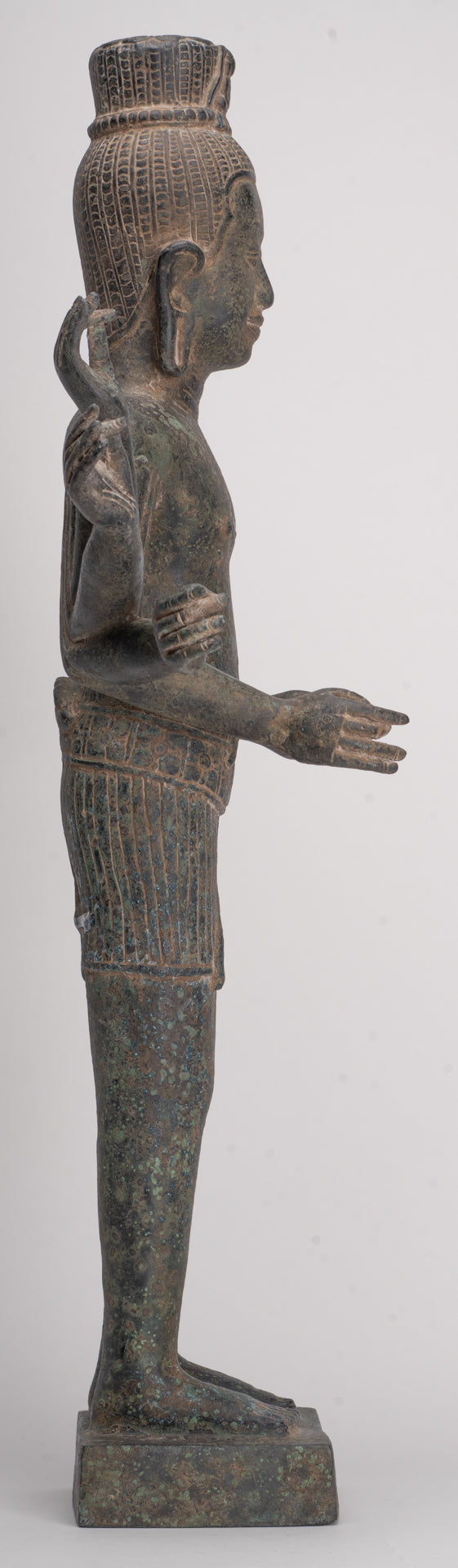
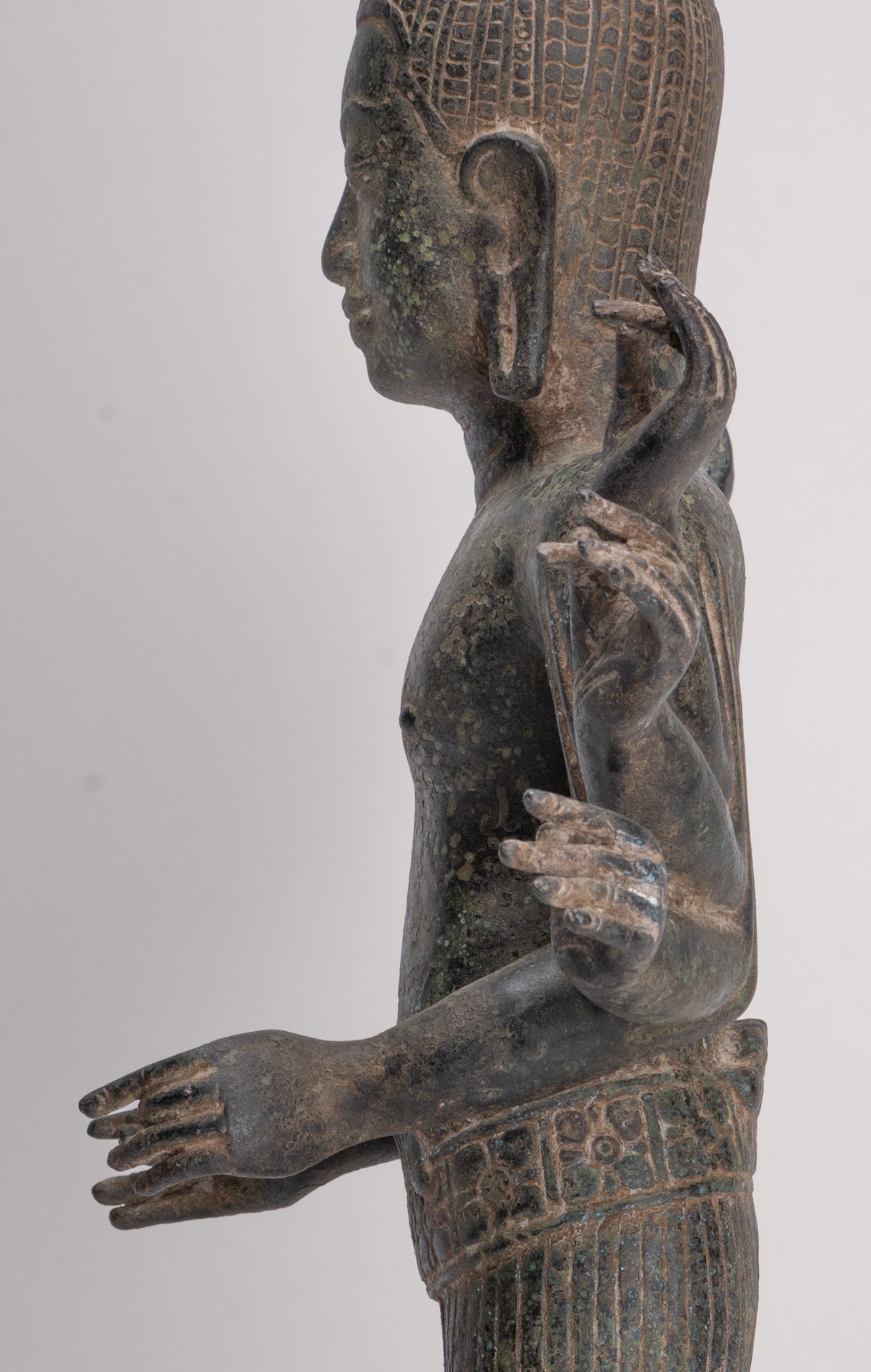
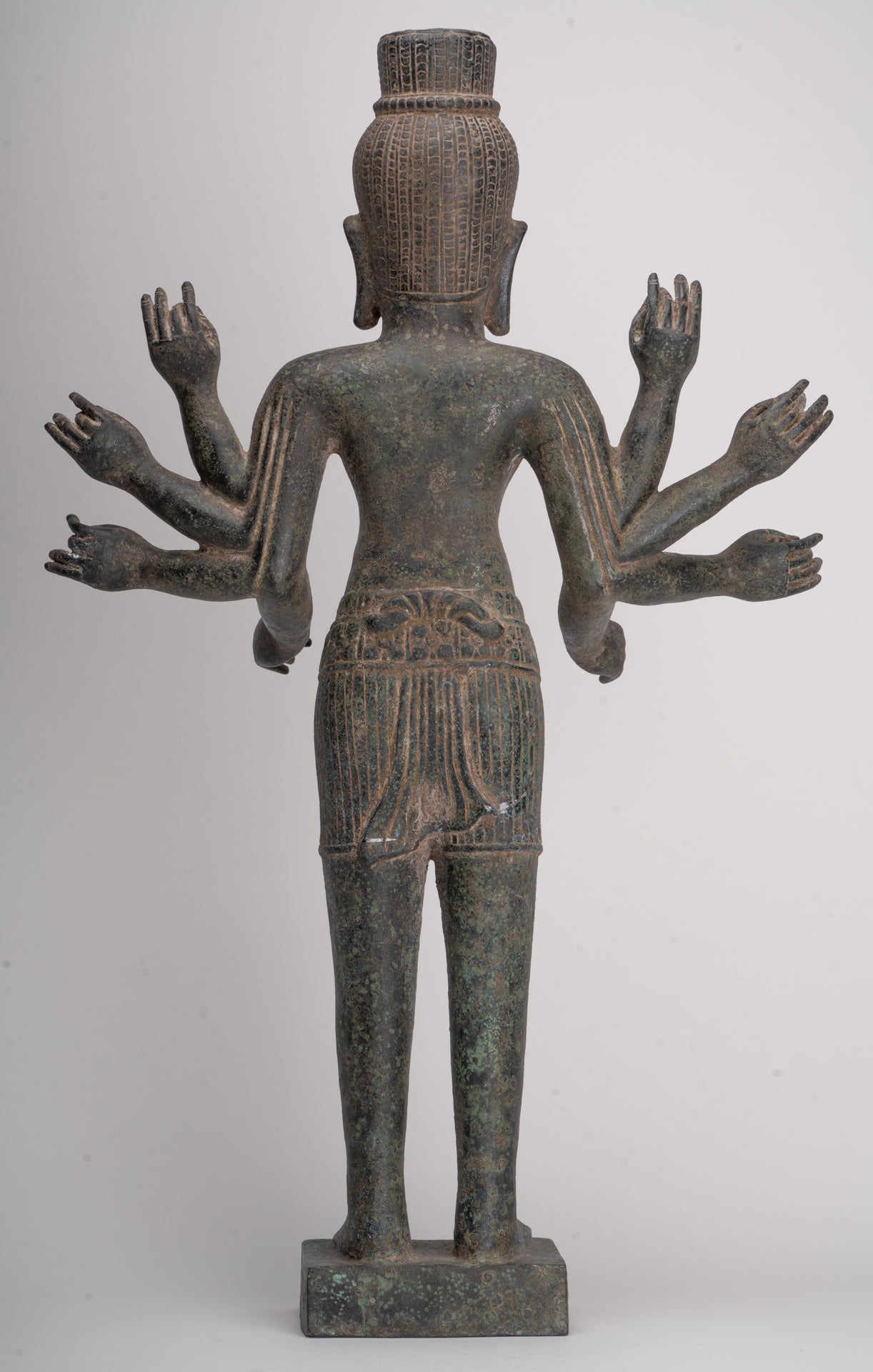
A finely cast antique Khmer-style bronze depicting Lokeshvara, the bodhisattva of compassion, in the expressive sacred manner of the Bayon period. Measuring approximately 55 cm / 22 inches high, the figure stands in the balanced frontal posture known as samapada, with eight arms radiating in a formal, protective display around the body.
Lokeshvara is shown wearing a short, tightly fitted sampot with a distinctive fishtail pleat at the front, secured by an ornamented jewelled sash. The torso is elegantly modelled with broad shoulders, a narrow waist, and a composed, upright stance. His hands are arranged in a variety of expressive gestures, while the face is rendered with gently lowered eyes, arched brows, a broad nose, and a restrained smile—the calm and compassionate expression associated with Khmer Buddhist imagery.
Most notably, the deity wears a tall cylindrical headdress or chignon adorned with a small seated Amitabha Buddha. This is a key iconographic feature of Lokeshvara, identifying him as an emanation of Amitabha and affirming his role as a guide who responds compassionately to the suffering of all beings.
The bronze has developed a richly varied dark brown and green patina, enhancing the finely cast details of the crown, hands, garment, jewelled belt, and pedestal. With its strong silhouette and exceptional eight-armed arrangement, this is an imposing representation of compassion, healing, and spiritual protection.
Lokeshvara: Bodhisattva of compassion
Lokeshvara—also known by the Sanskrit name Avalokiteshvara—is one of the most important bodhisattvas of Mahayana Buddhism. His name is often understood as “Lord Who Looks Down with Compassion,” expressing his readiness to hear and respond to the suffering of the world.
A bodhisattva is an enlightened being who postpones final liberation in order to assist others on the path to awakening. Lokeshvara therefore embodies compassion not simply as an emotion, but as active, limitless concern expressed through protection, healing, wisdom, and practical aid.
In Khmer Buddhist art, Lokeshvara may appear with two, four, six, or eight arms in freestanding sculpture. His characteristic attributes can include a lotus bud, rosary, book, and a vessel containing amrita, the nectar of immortality.
Bayon style
The Bayon style is associated with the late 12th and early 13th centuries, particularly the reign of the Buddhist Khmer king Jayavarman VII. The Bayon temple, at the heart of Angkor Thom, was created as a symbolic centre of the Buddhist universe, while images of Lokeshvara occupied an especially important place in the religious art of the period.
Bayon-style sculpture is often recognised by its serene but expressive faces, rich ornament, finely patterned costume, and sense of spiritual power conveyed through calm formal balance. Lokeshvara worship reached a particular height under Jayavarman VII, appearing in temple art and in the chapel programmes associated with healing and compassionate service.
This figure’s cylindrical crown, small seated Buddha, short sampot, fishtail pleat, jewelled sash, wide facial features, and radiating arms all create a strong Bayon-style character.
The Amitabha Buddha in the crown
The small meditating Buddha set within Lokeshvara’s headdress is Amitabha, the Buddha of Infinite Light. Amitabha is regarded in Mahayana Buddhist tradition as Lokeshvara’s spiritual source or celestial Buddha family.
The image of Amitabha is therefore more than a decorative element. It identifies the bodhisattva, expresses the connection between compassion and enlightened wisdom, and brings a further sense of radiance and spiritual continuity to the sculpture. Khmer sources specifically note an Amitabha image on Lokeshvara’s chignon as a defining iconographic detail.
Key features
-
Antique Khmer-style bronze of Lokeshvara / Avalokiteshvara.
-
Bayon-style Buddhist bodhisattva of compassion.
-
Measures approximately 55 cm / 22 inches high.
-
Eight-armed standing figure in samapada, a balanced frontal posture.
-
Arms radiate around the body in a powerful, symmetrical arrangement.
-
Tall cylindrical crown or chignon containing a small seated Amitabha Buddha.
-
Calm Khmer facial type with lowered eyes, arched brows, broad nose, and restrained smile.
-
Short sampot with a characteristic fishtail pleat.
-
Jewelled sash and patterned belt with detailed cast ornament.
-
Raised on a simple rectangular bronze pedestal.
-
Variegated dark brown and green patina.
-
Strong association with late Angkor / Bayon Mahayana Buddhist artistic traditions.
-
A meaningful focal point for a collection of Khmer, Cambodian, Buddhist, Southeast Asian, or Asian bronze sculpture.
Frequently Asked Questions
Who is Lokeshvara?
Lokeshvara, also called Avalokiteshvara, is the Mahayana Buddhist bodhisattva of compassion. He represents the compassionate impulse to recognise suffering and actively help all beings move toward wisdom and liberation.
His name is often translated as “Lord Who Looks Down with Compassion,” reflecting his role as a merciful protector and guide.
Why does Lokeshvara have eight arms?
Lokeshvara may be shown with two, four, six, or eight arms in Khmer freestanding sculpture. The additional arms express his ability to act in many directions at once: hearing suffering, offering protection, guiding meditation, granting wisdom, and responding to the needs of different beings.
The radiating arms also create a visual image of compassion as active, expansive, and all-encompassing.
What is the small Buddha in the headdress?
The small seated figure in the cylindrical crown is Amitabha Buddha, the Buddha of Infinite Light. Amitabha identifies the deity as Lokeshvara and expresses Lokeshvara’s connection with a wider Mahayana Buddhist lineage of compassion and enlightened wisdom.
What is samapada?
Samapada is a balanced upright standing posture in which the body’s weight is evenly distributed through both legs. In sacred sculpture, it conveys calmness, stability, dignity, and spiritual equilibrium.
The pose is particularly suited to a protective bodhisattva such as Lokeshvara, who appears composed and unshakable while remaining responsive to the suffering of the world.
What is a sampot?
A sampot is a traditional Khmer wrapped lower garment. In classical Khmer art it is often shown as a close-fitting textile, arranged with elegant pleats, folds, drapery, and ornamental belts.
The sharply defined fishtail pleat at the front is a particularly recognisable Khmer sculptural feature. The National Museum of Cambodia identifies the shark-tail or fishtail-shaped pleat as characteristic of Bayon-style costume.
What does “Bayon style” mean?
Bayon style refers to the later Angkor artistic tradition associated with Jayavarman VII and the Buddhist temple of the Bayon, broadly dating to the late 12th and early 13th centuries. It is known for expressive but serene faces, elaborate dress and jewellery, dynamic religious imagery, and an important Mahayana Buddhist content.
How should the bronze be cared for?
Display the sculpture indoors on a secure, level surface away from direct sunlight, moisture, high humidity, fireplaces, radiators, and rapid temperature changes. Support it from the base and central torso when moving it; do not lift it by the crown, seated Buddha, arms, hands, or garment projections.
Dust softly with a clean, dry brush or microfibre cloth. Avoid metal polish, water, wax, oils, abrasive cleaners, solvents, and household chemicals, as these can alter the established patina and obscure fine cast detail.
SATISFACTION GUARANTEE - We have been offering Asian Art for many years and are proud of the reputation we have developed for fair and honest listings. However, if for any reason, whatsoever, you are unhappy with your purchase please just let us know and we will provide a full refund. We want you to be 100% happy with your purchase.
-
-
The majority of orders will be shipped with DHL. This is a secure, express and fully tracked service.
Items less than 2Kg we typically ship using Royal Mail.
Once we receive your order we try to ship all orders the same or next working day.
Large and/or fragile pieces requiring palletising, specialist crating and/or extra packaging may take a little longer. Palletised shipments will be delivered curbside.
All orders over 35 GBP will be shipped free of charge.

-
We genuinely hope that all purchases delight.
However, if they do not, regardless of reason, we will refund all orders upon receipt of the unwanted item. Just notify us within 14 days of receiving your order that you wish to make a return and send the piece back to us with 30 days of delivery.


