





-
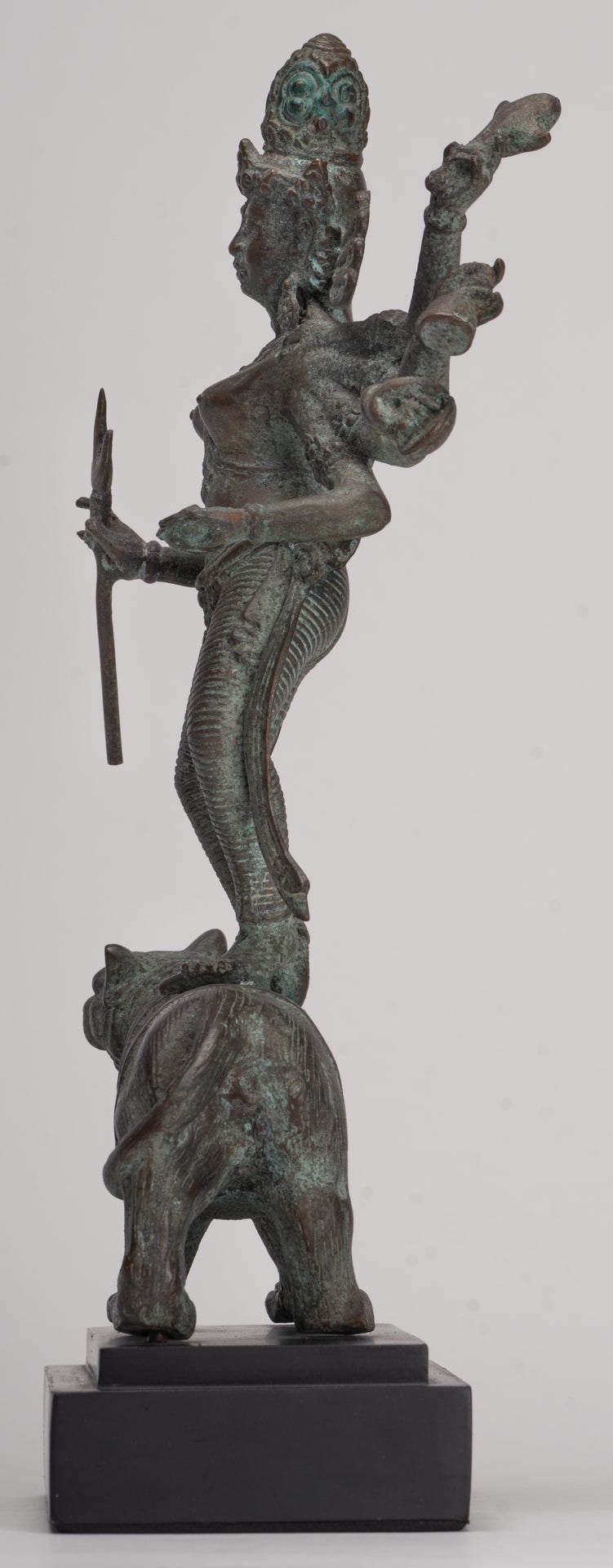
Antique Javanese Style Majapahit Durga Statue - 37cm/15"
Eight-Armed Goddess on Her Lion Mount
Measures (Height) 37cm/15"
A powerful Majapahit-style bronze depicting Durga, the great Hindu goddess of protection, courage, and victorious divine energy. The multi-armed goddess stands in commanding equilibrium upon her lion mount, her body framed by an elegant fan-shaped halo or backplate and her arms radiating outward in a display of authority and celestial power.
Durga wears a tall, richly detailed crown, pendant earrings, necklaces, armlets, and a finely patterned lower garment. Her composed face contrasts with the formidable array of weapons and ritual objects held in her eight hands. This union of serenity and power is central to her image: Durga is at once a protective mother goddess and the invincible force that restores cosmic order.
Measuring 37 cm / 15 inches high, the sculpture has an impressive vertical presence. The substantial lion below is modelled with an alert head, powerful legs, curling tail, and decorated saddle-like covering, while Durga’s flowing sash descends behind her legs to unite the upper figure with the mount.
Durga and the Lion
Durga is one of Hinduism’s most important goddesses. Also known as Devi or Shakti, she embodies the active divine feminine force that protects the universe and confronts disorder. Her most celebrated form is Mahishasuramardini, “Slayer of Mahishasura,” in which she defeats the buffalo demon Mahisha after the gods are unable to overcome him.
The lion is Durga’s vahana, or sacred vehicle. It represents courage, strength, sovereignty, and the fearless power with which the goddess meets chaos. Although this image does not show the buffalo demon, Durga’s weapons and lion mount clearly evoke her martial and protective identity.
The many arms do not represent physical excess; instead, they show that the goddess possesses the combined powers of the gods. Each weapon or attribute conveys a different aspect of divine protection, wisdom, discipline, and victorious force.
Attributes and symbolism
The goddess holds a varied group of weapons and ritual implements, including a bell, discus, trident, sword, noose, mace, and further attributes. Together, these objects identify her as a powerful multi-armed form of Durga.
-
The bell represents sacred sound, ritual awakening, and the calling forth of divine presence.
-
The discus (chakra) is associated with Vishnu and represents cosmic order, protection, and the cutting away of ignorance.
-
The trident (trishula) is associated with Shiva; it signifies spiritual authority and the piercing of destructive forces.
-
The sword represents discernment, courage, and the cutting through of delusion.
-
The noose (pasha) binds and restrains harmful forces, attachment, and illusion.
-
The mace (gada) expresses strength, discipline, protection, and the force of divine justice.
Durga’s iconography commonly incorporates weapons bestowed by the gods, including the trident, discus, sword, bell, noose, shield, bow, arrow, spear, and mace
Majapahit style
The work draws on the Hindu-Buddhist artistic traditions of East Java’s Majapahit world, which flourished between the late 13th and early 16th centuries. Majapahit-style sculpture is admired for its elaborate crowns, elegant jewellery, formal symmetry, finely patterned textiles, animated multi-armed deities, and strong combination of royal refinement with sacred power.
The figure’s tall crown, attenuated body, carefully patterned trousers or lower garment, flowing sash, and disciplined arrangement of multiple arms all give it a distinctly Indonesian, Majapahit-inspired character. As with any bronze, a precise historical date and place of manufacture require technical examination, provenance research, and comparison with securely documented works.
Key features
-
Majapahit-style bronze of Durga, the Hindu goddess of protection and victorious divine power.
-
Eight-armed form shown standing upon her lion mount.
-
Measures approximately 37 cm / 15 inches high.
-
Holds a bell, discus, trident, sword, noose, mace, and additional ritual or martial attributes.
-
Tall, richly ornamented crown with detailed floral and beaded decoration.
-
Graceful face with a calm yet commanding sacred presence.
-
Elaborate earrings, necklace, armlets, bracelets, waist ornaments, and patterned garment.
-
Fan-shaped halo or backplate framing the head and upper body.
-
Flowing sash falling behind the figure and connecting visually with the lion mount.
-
Substantial lion with alert head, decorated body, curling tail, and strong four-legged stance.
-
Dark bronze surface with varied green and brown patination.
-
A striking devotional, decorative, or scholarly addition to a collection of Hindu, Javanese, Indonesian, Southeast Asian, or Asian bronze sculpture.
FAQs
Who is Durga?
Durga is a principal form of the Hindu Great Goddess, also called Devi or Shakti. She represents divine feminine energy, protection, courage, justice, and the restoration of cosmic order.
She is widely revered as a guardian who confronts danger and disorder while protecting devotees. Her name is often translated as “the invincible” or “the inaccessible.”
Why does Durga have many arms?
Durga’s many arms show that she possesses several forms of power simultaneously. In the traditional story of her battle against Mahishasura, the gods give her their weapons and divine energy so that she can defeat a threat none of them can overcome alone.
The multiple arms allow the sculpture to show those combined powers visually: Durga holds the gifts, authority, and protective force of many gods at once.
What is the meaning of the lion?
The lion is Durga’s sacred mount, or vahana. It symbolises courage, strength, royal authority, fearlessness, and the power to overcome danger.
By standing or riding upon the lion, Durga is shown as fully in command of these qualities. The lion is not simply an animal companion; it is an extension of her protective and victorious nature.
Is this Durga Mahishasuramardini?
The image belongs to the wider iconographic tradition of Durga as Mahishasuramardini, the slayer of the buffalo demon Mahisha. Her lion mount and array of weapons strongly relate to that victorious form.
However, Mahishasuramardini images usually show the goddess actively attacking Mahisha, often represented as a buffalo, a buffalo-headed figure, or a human figure emerging from the buffalo. As no buffalo demon is visible here, the most precise identification is simply Durga standing on her lion mount, with Mahishasuramardini symbolism.
What are the objects she holds?
The visible attributes include a bell, discus, trident, sword, noose, mace, and other objects. These are sacred weapons and implements associated with Durga’s role as a protector and conqueror of destructive forces.
The exact identification of every remaining attribute should be made with caution from photographs alone, especially where a hand, implement, or terminal is obscured, worn, or incomplete. Durga’s imagery legitimately varies across regions, periods, and textual traditions.
How should this bronze be cared for?
Display the sculpture indoors on a stable, level surface and keep it away from direct sunlight, moisture, high humidity, fireplaces, radiators, and rapid changes in temperature.
Handle it from the strongest sections—ideally beneath the lion base or around the central body—rather than by the crown, arms, weapons, raised attributes, or tail. Dust gently with a soft dry brush or microfibre cloth. Do not use metal polish, abrasive cleaners, wax, oil, water, or household products, as these may damage the patina and surface detail.
SATISFACTION GUARANTEE - We have been offering SE Asian Art for many years and are proud of the reputation we have developed for fair and honest listings. However, if for any reason, whatsoever, you are unhappy with your purchase please just let us know and we will provide a full refund. We want you to be 100% happy with your purchase.
-
-
The majority of orders will be shipped with DHL. This is a secure, express and fully tracked service.
Items less than 2Kg we typically ship using Royal Mail.
Once we receive your order we try to ship all orders the same or next working day.
Large and/or fragile pieces requiring palletising, specialist crating and/or extra packaging may take a little longer. Palletised shipments will be delivered curbside.
All orders over 35 GBP will be shipped free of charge.

-
We genuinely hope that all purchases delight.
However, if they do not, regardless of reason, we will refund all orders upon receipt of the unwanted item. Just notify us within 14 days of receiving your order that you wish to make a return and send the piece back to us with 30 days of delivery.


