



Seated Anjali Mudra Variations for Yoga Practice
Seated Anjali Mudra Variations for Yoga Practice
Table of Contents
- What Is Anjali Mudra and Why Practice It Seated
- The Anjali Mudra Hand Position: Alignment and Pressure
- Seated Prayer Pose Yoga: Cross-Legged and Grounded Variations
- Chair Yoga Prayer Hands: Accessible Variations for Every Body
- Anjali Mudra Breathing Practice: Linking Breath to Gesture
- Common Mistakes and How to Troubleshoot Discomfort
- Frequently Asked Questions
What Is Anjali Mudra and Why Practice It Seated
Anjali Mudra is the gesture of pressing the palms together at the heart center, and it is one of the most widely recognized hand seals in yoga.
Most people meet this gesture at the start or end of class, standing, in a quick Namaste. Seated practice changes the experience.
At HD Asian Art, we think of the seated form as a way to build a small, repeatable ritual.
A seated anjali mudra gives you three things a standing version rarely does:
- A grounded base, so the spine can lengthen without effort
- Longer, slower breath cycles
- A natural doorway into meditation
The seated variations below cover cross-legged practice, chair practice, and the props that make both easier.
The Anjali Mudra Hand Position: Alignment and Pressure
The correct Anjali Mudra hand position is simple: palms together, fingers straight and pointing up, thumbs resting lightly against the sternum. The hands sit at the center of the chest, not at the chin and not at the belly.
Alignment matters more than most guides admit. Keep the forearms roughly level. Let the elbows fall naturally. If the shoulders creep up toward the ears, the hands are too high.
Where to Place the Hands at the Heart Center
Place the base of the palms at the sternum. The thumbs rest against the breastbone. The fingertips angle slightly away from the chest, so the hands form a gentle steeple rather than a flat press.
Two checks keep this honest:
- Can you feel the thumbs touching bone, not muscle?
- Are the wrists straight, with no bend?
If the wrists ache, lower the hands an inch. Comfort beats precision.
How Much Pressure to Apply Between the Palms
Press evenly, and press lightly. Think of holding a small amount of water between the palms. There should be contact along the whole length of the fingers, not just at the fingertips.
A common mistake is gripping hard. That tension travels up the forearms and into the jaw. You will feel it in the face before you feel it in the hands.
Seated Prayer Pose Yoga: Cross-Legged and Grounded Variations
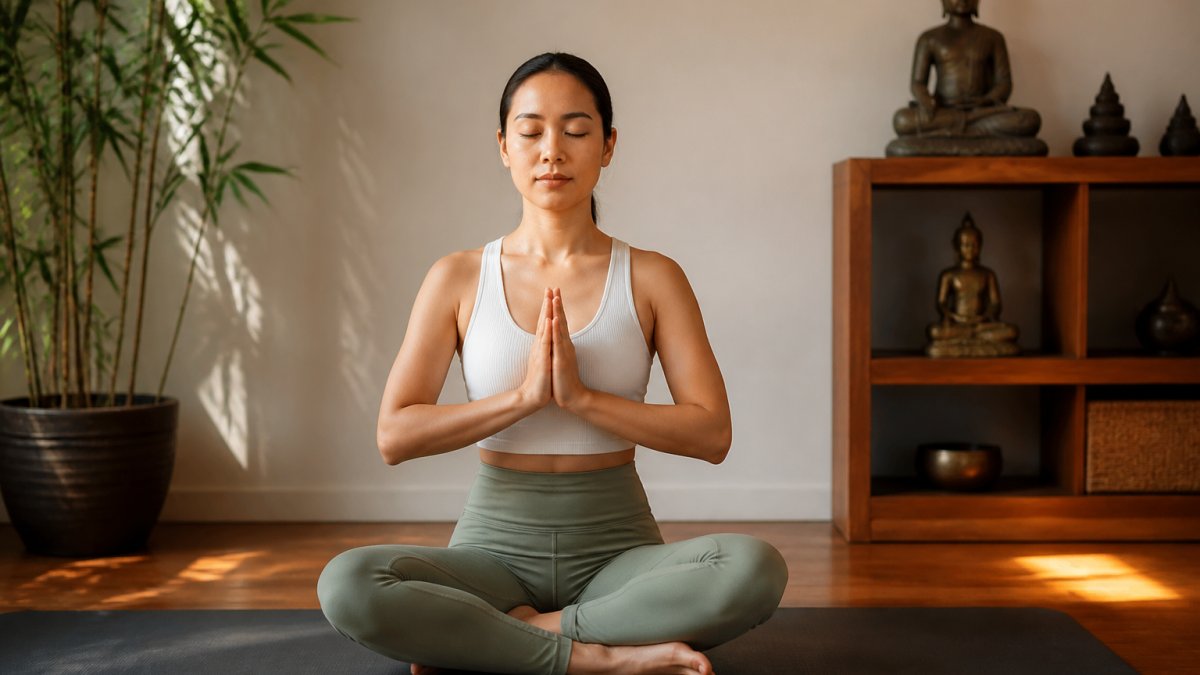
Seated prayer pose yoga is the classic form: hips on the floor or a cushion, legs crossed, spine tall, prayer hands at the chest. Most guides list the seat names and stop there.
How to Choose Your Seat
Before you sit, answer two questions:
- Do your knees drop below your hip crease when your legs are crossed? If yes, a floor seat will work. If no, raise the hips on a prop.
- Can you sit for five minutes without leaning back or rounding? If not, start on a bolster or a chair.
The right seat is the one where the spine stacks without effort. Everything else is secondary.
Variation 1: Easy Pose (Sukhasana) with Prayer Hands
Posture cues: Lengthen the spine on an inhale. Soften the shoulders down and back.
Breath: Five slow breaths, inhaling for a count of four and exhaling for a count of six.
Transition: Release the hands to the knees, take one free breath, then rejoin the palms.
Expected result: a steady seat and a quieter mind within a minute or two.
Variation 2: Lotus and Half-Lotus Seated Prayer
Setup: In Half-Lotus, one foot rests on the opposite thigh. In full Lotus, both do.
Hand position: Same as Easy Pose, palms at the sternum, thumbs on the breastbone.
Posture cues: The locked hips make the spine feel self-supporting.
Breath: Six to eight breaths, same 4-in, 6-out rhythm.
Transition: Uncross slowly, one leg at a time, and spend a few breaths in Easy Pose before standing.
The trade-off is real. Lotus demands open hips and healthy knees.
Variation 3: Seated on a Bolster or Block
Setup: Place a bolster or a yoga block under the hips.
Hand position: Palms at the sternum.
Posture cues: Let the front of the pelvis tip down.
Breath: Five to ten breaths.
Transition: Slide off the prop to one side, come to hands and knees, and rise slowly.
Raising the seat by even a couple of inches (about 5 cm) changes the whole posture.
Quick Comparison
| Variation | Setup | Hand Position | Posture Cue | Breath | Best For |
|---|---|---|---|---|---|
| Easy Pose | Floor, simple cross | Palms at sternum | Sit on folded blanket | 5 breaths, 4-in/6-out | Beginners |
| Half-Lotus / Lotus | Foot on opposite thigh | Palms at sternum | Root sit bones, lift crown | 6-8 breaths | Open hips |
| Bolster or Block | Raised floor seat | Palms at sternum | Tilt pelvis forward | 5-10 breaths | Slumped posture |
Chair Yoga Prayer Hands: Accessible Variations for Every Body
Chair yoga prayer hands bring the gesture to anyone who cannot sit on the floor. That includes people with knee or hip limits, office workers, and anyone practicing in a small space. The gesture does not care where you sit. Establishing this consistent physical anchor becomes even more effective when designing a meditation space that supports your daily practice.
Variation 4: Upright Chair Seat with Palms at Sternum
Sit toward the front of the chair. Both feet flat on the floor. Spine tall, shoulders soft.
Then bring the palms together at the heart center. Elbows drop toward the ribs. Hold for five breaths, then release and repeat.
This is the most portable version of the practice. It fits in a lunch break.
Variation 5: Chair Prayer with Elbows Supported
Some people find the arms tire before the mind settles. Rest the elbows on a desk or on a folded blanket in the lap. The hands stay at the chest, and the shoulders fully relax.
This variation suits longer sits. It also helps anyone with shoulder tension, because the arms no longer have to hold themselves up.
| Variation | Seat | Best For | Main Cue |
|---|---|---|---|
| Easy Pose | Floor, cross-legged | Beginners | Sit on a folded blanket |
| Half-Lotus / Lotus | Floor, foot on thigh | Open hips | Skip if knees lift high |
| Bolster or Block | Raised floor seat | Slumped posture | Sit at the front edge |
| Upright Chair | Chair, feet flat | Limited mobility | Elbows toward ribs |
| Supported Chair | Chair plus desk | Longer sits | Rest the elbows down |
Anjali Mudra Breathing Practice: Linking Breath to Gesture
Anjali Mudra breathing practice pairs the hand gesture with a simple breath count. The hands give the mind a place to land. The breath gives the hands a rhythm. Most guides stop at "breathe slowly." Here is a concrete sequence with duration options you can follow today.
Why the Longer Exhale Works
The longer exhale is the active ingredient. A slow, extended exhale activates the parasympathetic branch of the nervous system, the "rest and digest" response, which slows the heart rate and settles the body. The hands simply ride along, giving the mind a physical anchor so it does not wander.
The Basic Count
- Sit in any variation above.
- Inhale for a count of four.
- Exhale for a count of six.
- Keep the palms pressed evenly throughout.
- Repeat for ten rounds.
If counting feels fussy, drop the numbers. Just feel the contact between the palms on each inhale, and let it soften on each exhale. That is the whole practice.
A Concise Seated Routine (5 Minutes)
Use this when you want a complete practice rather than a single drill.
- Minute 1, Settle: Sit in Easy Pose on a bolster. Hands on knees. Take five natural breaths.
- Minutes 2-3, Link: Bring the palms to the sternum. Breathe 4-in, 6-out for ten rounds. Keep the palm pressure even.
- Minute 4, Soften: Release half the palm pressure. Let the exhale lengthen to a count of eight if comfortable. Five rounds.
Duration Options
- 3 minutes: Minutes 1, 2, and 5 only, a quick reset.
- 5 minutes: The full routine above.
- 10 minutes: Repeat the 2-3 minute link segment twice, then close.
Breath Cues to Watch
- If the shoulders rise on the inhale, you are breathing into the chest. Let the belly soften first.
- If the exhale feels forced, shorten the count to 4-in, 5-out until it settles.
- If the mind races, return attention to the palm contact, the physical sensation is the anchor.
Common Mistakes and How to Troubleshoot Discomfort
Most discomfort in seated prayer comes from three habits. Fix these and the practice gets much easier.
Mistake 1: Hands too high. Palms at the chin strain the shoulders. Lower them to the sternum.
Mistake 2: Gripping the palms. Hard pressure creates tension in the forearms and jaw.
Mistake 3: Collapsing the spine. Slumping closes the chest and pushes the hands forward.
One more thing worth knowing: the seated form is not lesser than the standing one. Many practitioners find it deeper, because the body has stopped moving and the mind has nowhere to hide.
If you keep a meditation space at home, a quiet focal point helps the habit stick. Our collection of Buddhist and Hindu statues is chosen with exactly those corners in mind, from small shelf pieces to larger temple-inspired works.
Frequently Asked Questions
How do you practice Anjali Mudra while seated?
Sit in a comfortable seated position, either cross-legged on the floor or upright in a chair. Bring your palms together at the center of your chest, fingers pointing up and thumbs lightly resting against your sternum. Keep your spine tall and shoulders relaxed. Close your eyes or soften your gaze, then breathe steadily for five to ten rounds. The key is even pressure between the palms and a relaxed jaw. If your shoulders tense, lower your hands slightly until your elbows feel comfortable.
What are some seated variations of Anjali Mudra?
Common seated variations include Easy Pose with prayer hands, half-lotus and lotus seated prayer, sitting on a bolster or block for hip support, and chair yoga prayer hands with the spine upright. You can also vary the hand position: palms at the sternum, thumbs at the heart center, or hands resting in the lap with palms together. Each variation changes the demand on your hips, spine, and shoulders, so choose the one that lets you breathe without strain.
Can you practice Anjali Mudra in a chair?
Yes. Chair yoga prayer hands are one of the most accessible forms of the gesture. Sit toward the front of the seat with both feet flat on the floor and your spine tall. Bring your palms together at your heart center, keeping your elbows relaxed and your shoulders down. This version suits people with limited mobility, office workers taking a short break, or anyone recovering from a knee or hip injury. Hold for five to ten slow breaths.
What should you do if pressing your palms together feels uncomfortable?
Ease the pressure. Pressing too hard is a common mistake and can strain the wrists, elbows, or shoulders. Lighten the contact until your palms simply touch, or separate the heels of your hands slightly while keeping the fingertips together. If your shoulders round forward, raise your hands an inch or two. Anyone with wrist pain can turn the palms to face each other without contact. Comfort comes first; the gesture works through attention, not force.
Seated practice rewards consistency more than intensity. Five quiet minutes in Easy Pose, or at a desk, will do more than an hour of forcing Lotus before the hips are ready. Start with the bolster variation, keep the palms light, and let the breath set the pace.
Browse the HD Asian Art collection to find a focal piece for your practice space, with free shipping on every order.
