



Why Asian Sculpture Adds Spiritual Energy to Your Space
Why Asian Sculpture Adds Spiritual Energy to Your Space
Most people assume sculpture is decorative. A beautiful object, well-crafted, placed to fill a corner or complete a room. Asian sculpture challenges that assumption at its foundation. Understanding why Asian sculpture adds spiritual energy requires looking past the surface form and into the centuries of religious practice, symbolic coding, and devotional use embedded in each piece. These objects were never made to be looked at passively. They were made to transmit something. This article unpacks the cultural, symbolic, and psychological reasons that make Asian sculpture a genuine source of spiritual energy, not just visual interest.
Table of Contents
- Key Takeaways
- Why Asian sculpture adds spiritual energy: the historical roots
- Symbolism and design elements in Asian sculpture
- How viewers experience spiritual energy from Asian sculptures
- Practical ways to use Asian sculpture for spiritual energy
- My perspective on what makes these objects genuinely different
- Explore authentic Asian sculptures at Hdasianart
- FAQ
Key Takeaways
| Point | Details |
|---|---|
| Sacred origins matter | Asian sculptures were created as religious instruments, not decorative objects, giving them deep spiritual significance. |
| Symbolism carries energy | Specific motifs, iconography, and compositional principles encode spiritual meaning that engages viewers at a perceptual level. |
| Practice activates the object | Repeated devotional attention and meditation focused on a sculpture stabilizes and amplifies its spiritual potency over time. |
| Placement and context count | Creating a dedicated meditative space around a sculpture significantly increases its effect on spiritual well-being. |
| Authenticity deepens connection | Sculptures with genuine cultural and historical roots carry symbolic resonance that reproductions rarely replicate. |
Why Asian sculpture adds spiritual energy: the historical roots
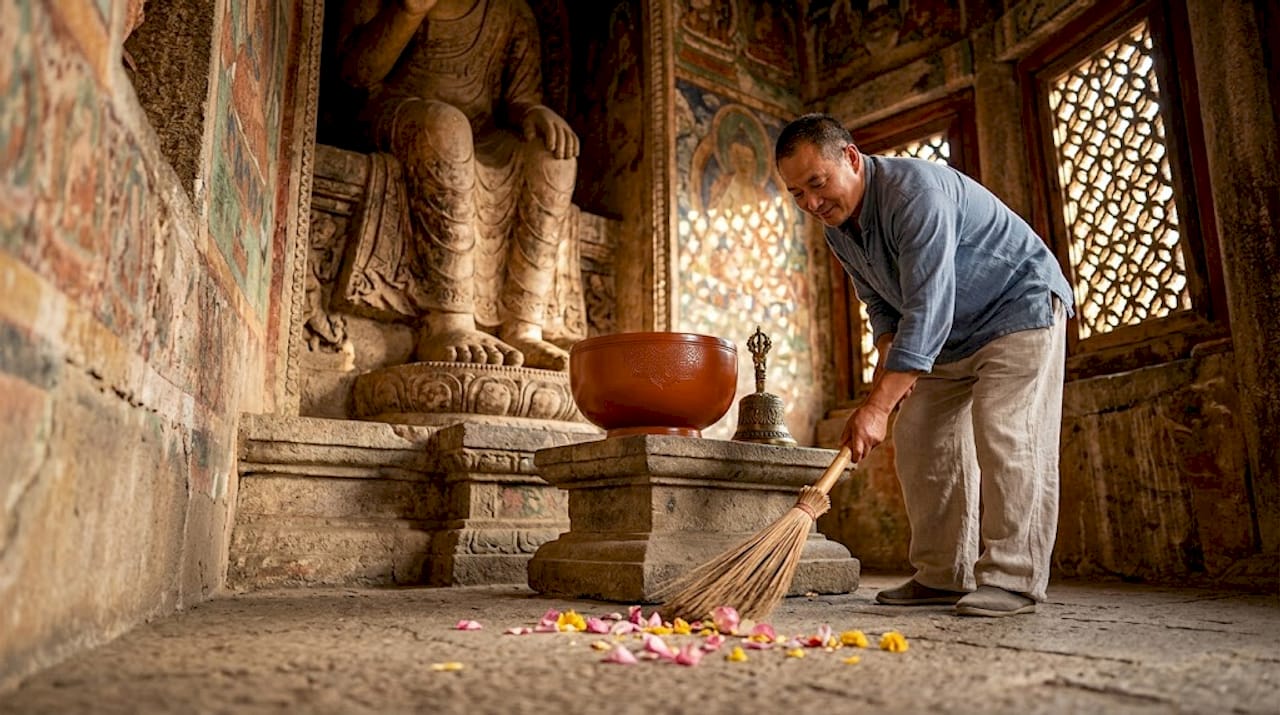
The spiritual significance of Asian art does not begin with aesthetics. It begins with function. Buddhist stupas, Hindu temples, and Khmer sanctuaries were built around sculpture as the central religious act. The statue was not placed inside the sacred space. In most traditions, the statue was the sacred space.
Buddhist temple sculptures were designed specifically to inspire devotion and meditative focus rather than to decorate. A seated Shakyamuni Buddha in a Thai wat, a multi-armed Avalokiteshvara in a Cambodian shrine, a dancing Shiva Nataraja in a South Indian temple: each was conceived as a focal point embodying divine presence, guiding worshippers toward enlightenment. The form carried the function.
What makes this history relevant today is continuity. Sacred imagery in Asian art has a documented capacity to maintain its religious identity across transformations in material and context. Analysis of Tang-period murals and Song-Liao gold jewelry shows that sacred motifs like kalavinka were re-coded, not erased, as they moved across media and centuries. The spiritual charge traveled with the symbol.
Key historical contexts where Asian sculpture functioned as a spiritual instrument:
- Buddhist stupas and viharas: Sculptures marked the presence of the dharma and served as objects of circumambulation and meditation.
- Hindu temple sanctums: Deity sculptures received daily ritual care, including bathing, dressing, and offering, treating the form as a living divine presence.
- Zen monasteries: Spare, asymmetrical forms were used to cultivate stillness and awareness in practitioners.
- Domestic shrines across Southeast Asia: Smaller bronze and stone figures brought temple-level devotional practice into the home.
Pro Tip: When researching a specific sculpture, trace its regional origin. A Cambodian Vishnu carries different iconographic codes than a Thai one, and understanding that distinction deepens your engagement with the object.
Symbolism and design elements in Asian sculpture
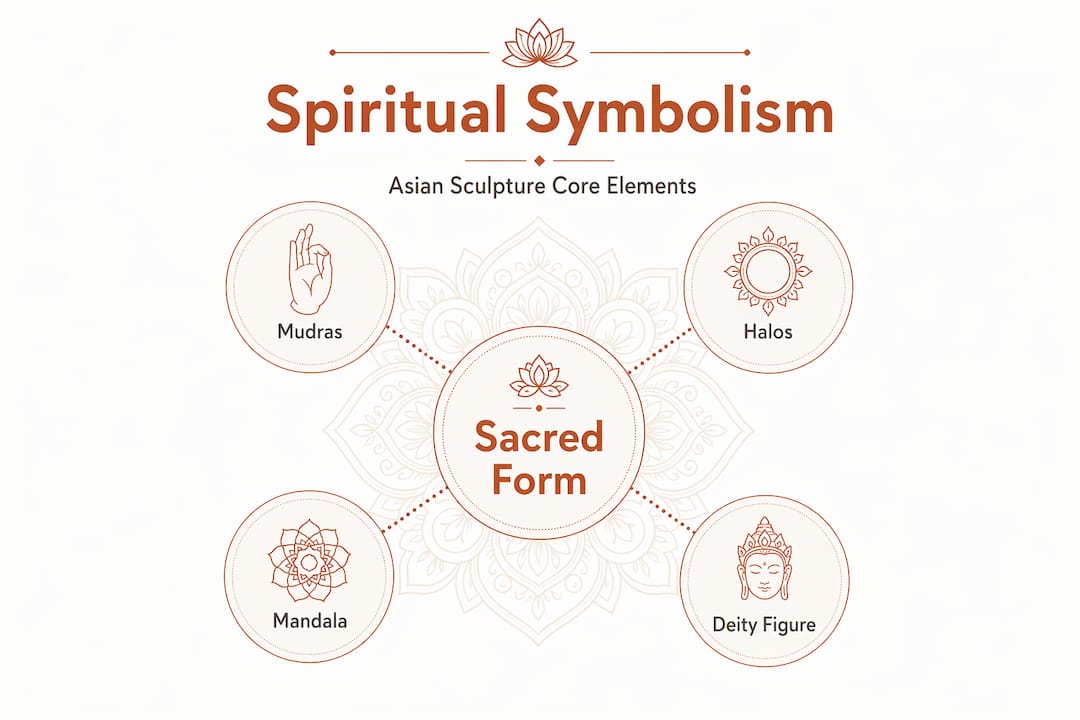
Every deliberate choice in an Asian sculpture, from the position of a hand to the curve of a halo, carries encoded meaning. This is not metaphor. It is a precise visual language developed over centuries of religious scholarship and artistic tradition.
Sacred iconography as spiritual transmission
Mandalas and deity sculptures hold multifaceted spiritual meanings that operate on both external and internal levels. The mudras (hand gestures) of a Buddha figure are not stylistic choices. The dhyana mudra signals meditation. The abhaya mudra signals protection. The bhumisparsha mudra references the moment of enlightenment. Each gesture activates a specific spiritual narrative in the informed viewer.
The kalavinka, a celestial bird from Buddhist cosmology, appears across Tang-period murals, Cambodian lintels, and Song-dynasty decorative arts. Its sacred function persists through material changes because the symbolic placement and sensory cues remain consistent. This is why even a viewer unfamiliar with the specific iconography often senses something beyond the decorative in these objects.
Zen aesthetics and the power of negative space
Zen visual culture operates differently from the dense iconography of Hindu or Theravada Buddhist art. Here, negative space and economy of means are the primary tools. Machine learning analysis of Southern Song Zen painting has quantified how these compositional principles create spatial patterns fundamental to perceived spiritual intensity. Less, in Zen terms, genuinely transmits more.
Imperfect, asymmetrical forms express impermanence and authenticity central to spiritual perception in wabi-sabi aesthetics. A rough-surfaced stone Bodhidharma figure or an asymmetrical tea-ceremony ceramic communicates something a perfectly symmetrical object cannot: the acceptance of transience as a spiritual truth.
| Design Element | Spiritual Function |
|---|---|
| Mudras (hand gestures) | Communicate specific spiritual states or divine actions |
| Ushnisha (cranial protrusion) | Marks transcendent wisdom in Buddha figures |
| Negative space (Zen forms) | Invites viewer participation, activating contemplation |
| Asymmetry and imperfection | Expresses wabi-sabi, the spiritual truth of impermanence |
| Mandala geometry | Structures sacred cosmology for meditative focus |
How viewers experience spiritual energy from Asian sculptures
The importance of sculpture in spirituality is not passive. It requires something from the viewer. This is where Asian sculpture diverges most sharply from Western decorative art traditions.
Zen gardens meditated on for centuries demonstrate how contemplative spaces are completed by viewer participation. The spiritual charge is not entirely in the object. It is activated by the quality of attention brought to it. Zen art’s sparse design specifically encourages this: the viewer fills the silence with awareness.
Here is a practical sequence that reflects how this works in practice:
- Approach with intention. Sit or stand before the sculpture with a specific purpose, whether that is calming the mind, seeking clarity, or simply observing. Random glancing does not engage the same perceptual depth.
- Engage the senses. Sculptures’ three-dimensionality allows immersive interaction that paintings cannot replicate. Move around the piece. Notice how light changes the form. Touch the surface if the piece allows it.
- Focus on a single symbolic element. A mudra, a facial expression, a decorative motif. Hold that focus for several minutes. This is the beginning of ritualized viewing.
- Return consistently. Regular meditation and chanting focused on a sculpture stabilizes its spiritual potency in a home setting. The relationship between viewer and object deepens with repetition.
- Learn the iconography. Understanding what a gesture or symbol means transforms passive looking into informed devotional attention. Read about the tradition the sculpture comes from. Visit resources like the Hdasianart blog for context on Buddhist iconography and regional traditions.
Pro Tip: Place a single sculpture at eye level in your meditation space rather than on a high shelf. Eye-level placement creates a direct, equal relationship between viewer and object, which is how these pieces were positioned in their original devotional contexts.
The psychological dimension here is real. Devotional interaction with Asian sculptures parallels centuries-old monastic meditation practice. The consistency of that attention, repeated daily, stabilizes what practitioners across traditions describe as the object’s spiritual potency. This is not mysticism. It is the result of conditioning the mind to enter a specific state in the presence of a specific form.
Practical ways to use Asian sculpture for spiritual energy
Knowing why Asian sculpture carries spiritual energy is one thing. Applying that knowledge in your own space requires specific decisions about selection, placement, and practice.
Choosing the right sculpture
Not all Asian sculptures carry equal spiritual resonance. Authenticity matters here, not as snobbery, but as a practical consideration. A sculpture produced with genuine knowledge of its iconographic tradition carries the full symbolic vocabulary. A generic reproduction often strips away the precise details that activate meaning.
- Verify iconographic accuracy. Check that mudras, attributes, and proportions follow the canonical standards of the tradition. A Buddha with incorrect hand positions has lost part of its communicative function.
- Consider the material. Bronze, stone, and wood each carry different tactile and visual qualities. Bronze Cambodian pieces, for example, have a specific weight and surface texture that contributes to the sensory experience of interaction.
- Research regional origins. A Gandharan Buddha from the northwest of the Indian subcontinent carries Greek-influenced stylistic codes. A Sukhothai Buddha from Thailand has a flame-shaped ushnisha. These distinctions are not trivial. They tell you which lineage of spiritual transmission you are engaging with.
- Prioritize pieces with documented provenance. Knowing a sculpture’s history adds layers of meaning and confirms that the iconographic tradition has been respected.
Creating a meditative space
The cultural impacts of Asian sculpture are most strongly felt when the surrounding environment supports contemplative attention. A sculpture placed on a cluttered shelf next to unrelated objects loses much of its effect.
- Clear a dedicated area, even a small one, where the sculpture is the primary focus.
- Use natural light where possible. The way light moves across a bronze or stone surface across the day is part of the visual experience.
- Add minimal complementary elements: a candle, incense, a small offering bowl. These are not superstition. They are sensory cues that signal to the mind that this space has a different quality of attention.
- Avoid placing spiritually significant sculptures in bathrooms or on the floor. In most Asian traditions, height and position signal respect and activate the object’s sacred function.
Developing daily practice
Asian sculptures in mindfulness practices work best when interaction is consistent rather than occasional. A five-minute daily practice of sitting quietly before a sculpture, focusing on a single element of its form, builds a cumulative effect over weeks and months. This is how the object becomes a genuine anchor for spiritual attention rather than a beautiful piece of furniture.
My perspective on what makes these objects genuinely different
I’ve spent years studying and working with Asian sculpture, and the question I hear most often is some version of: “Does it actually work, or is it just belief?” My honest answer is that the distinction matters less than people think.
What I’ve observed is that the sculptures that consistently generate the strongest reported spiritual experiences share two things: precise iconographic execution and a history of devotional use. A bronze Bodhisattva that spent decades in a Cambodian household shrine carries something a newly cast reproduction does not. Whether you call that accumulated intention, cultural memory, or simply the patina of genuine age, the effect on the viewer is measurable in the quality of attention the object commands.
What I’ve also learned is that the most common mistake people make is treating these objects as passive. They place a beautiful Buddha on a shelf and wait for something to happen. The spirituality in Eastern art is participatory. The object is a tool. The practice is what activates it. I’ve seen people develop profound meditative depth over six months of consistent daily engagement with a single sculpture, and I’ve seen others own extraordinary pieces for years without ever crossing into that territory because they never developed the practice.
The deeper point, and the one most articles miss, is that Asian sculpture is not spiritual because it looks spiritual. It is spiritual because it was made within living traditions that understood form as a vehicle for transmission. That history does not disappear when the object moves into a Western home. It waits for someone to engage it correctly.
— James, HDAsianArt.com

Explore authentic Asian sculptures at Hdasianart
Hdasianart offers a carefully curated collection of antique Buddhist and Hindu sculptures sourced from Cambodia, Thailand, Indonesia, Sri Lanka, Vietnam, and beyond. Each piece is individually researched and described by experts, with attention to iconographic accuracy, material quality, and spiritual symbolism. Whether you are building a meditation space or deepening an existing collection, the Hdasianart gallery provides museum-quality pieces with documented provenance and worldwide insured shipping. Authentic sculpture, selected with knowledge of its sacred function, is a different category of object entirely from decorative reproductions. Browse the collection and find the piece that fits your practice.
FAQ
What makes Asian sculpture spiritually significant?
Asian sculptures were created as religious instruments within living devotional traditions, encoding specific iconographic meanings through mudras, attributes, and compositional principles that transmit spiritual content to informed viewers.
How does sculpture enhance meditation practice?
Sculpture provides a three-dimensional focal point for sustained attention. Regular devotional interaction with a specific piece conditions the mind to enter contemplative states more readily, deepening meditation over time.
Does the material of an Asian sculpture affect its spiritual energy?
Material matters practically. Bronze, stone, and wood each offer different sensory qualities, including weight, texture, and surface response to light, that shape the viewer’s immersive experience and the depth of engagement.
How should I place an Asian sculpture in my home?
Position the sculpture at eye level in a dedicated, uncluttered space. Most Asian devotional traditions place sacred figures at height as a mark of respect, and this placement also supports focused meditative attention.
Do I need to follow a specific religion to benefit from Asian sculpture?
No specific religious affiliation is required. The spiritual significance of Asian art operates through symbolic form and contemplative practice. Learning the iconographic tradition of your sculpture and engaging with it consistently is what activates its effect.
