



Who Is God in Hinduism: A Collector's ID Guide
Who Is God in Hinduism: A Collector's ID Guide
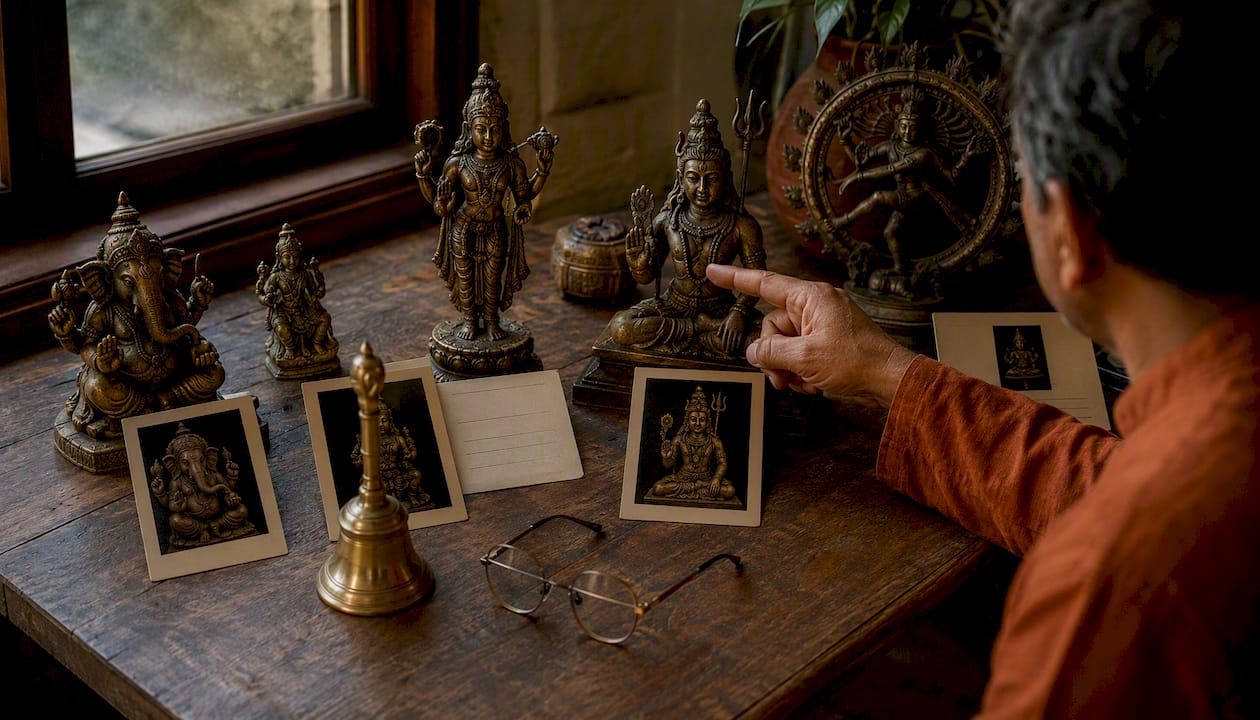
Four visual cues identify which Hindu deity a statue represents: primary attributes (held objects or weapons), head and face type, arm count, and vahana (vehicle/mount). Add mudra (hand gesture) and posture, and you can name most deities before reading a single catalog entry. For collectors, curators, and interior designers, that identification formula is the starting point for accurate cataloging, provenance verification, and value assessment.
Quick reference cues:
- Ganesha: elephant head, broken tusk, mouse vahana
- Shiva: trident, third eye, matted hair with crescent moon, Nandi bull
- Vishnu: chakra (discus), shankha (conch), Garuda eagle
- Saraswati: veena, book, rosary, swan or goose
- Brahma: four heads, four arms, Vedas, rosary
These cues come directly from standardized iconographic records maintained by major museum collections. When a piece is correctly identified, every downstream step — provenance research, condition reporting, insurance valuation — becomes more reliable.
Table of Contents
How to read Hindu iconography as a visual language
Hindu iconography is a precise code, not decorative convention. Arm count signals a deity’s capacity and roles; a single-armed figure and an eight-armed figure are rarely the same deity. Each category below narrows identification quickly.
- Head/face type: Human, animal, or multi-headed. Elephant head = Ganesha, no exceptions.
- Arm count: Two arms suggest a more approachable or human form; four or more indicate expanded divine power.
- Held attributes: Weapons, instruments, lotus, conch, book. Cross-reference at least two objects before committing to an ID.
- Mudra: Hand gesture. The Abhaya mudra (palm raised, fingers up) signals protection and appears across many deities; the Varada mudra (palm open downward) signals gift-giving. Understanding mudra distinctions prevents mislabeling a Vishnu as a bodhisattva.
- Posture: Samabhanga (erect, weight evenly distributed), tribhanga (triple-flexed, weight on one hip), or dancing. Nataraja is always Shiva in tribhanga-derived dance posture.
- Vahana: The mount or vehicle beneath or beside the figure. When present, it is often the fastest single identifier.
Material and scale also carry information. Bronze figures from South India tend toward fine casting with detailed jewelry; stone pieces from Cambodia show broader facial features and a more frontal posture. These regional markers affect both dating and attribution.
“Hands, posture, vehicle, ornament and surrounding figures are key visual clues; an iconography manual enables identification when the vahana is present.” — Metropolitan Museum of Art
Pro Tip: When requesting photos from a seller, ask specifically for close-ups of both hands, the base (including any inscription or stamp), the back of the figure, and any pierced or attached ornaments. These four views resolve most identification disputes.
Quick ID cheat sheet for deities commonly found in collections
The table below maps each deity to its strongest visual identifiers. For detailed guidance on female divine forms, the attributes for Lakshmi, Saraswati, and Durga deserve particular attention in mixed collections.
| Deity | Unmistakable attributes | Vahana | Common mudra/posture | Regional note |
|---|---|---|---|---|
| Ganesha | Elephant head, broken tusk, modaka (sweet) | Mouse | Seated or standing; Abhaya | Reclining Ganesha common in Southeast Asia |
| Shiva | Trident, third eye, crescent moon, serpent | Nandi bull | Meditative seated; Nataraja dance | Nataraja form dominant in South India |
| Nataraja | Drum (damaru), ring of fire, raised leg | None (dancing) | Ananda Tandava dance posture | Chola-period bronze is the benchmark form |
| Vishnu | Chakra, shankha, mace, lotus | Garuda eagle | Standing (samabhanga); Abhaya + Varada | Four-armed standard; avatar forms vary widely |
| Brahma | Four heads, four arms, Vedas, rosary | Hamsa (goose) | Seated; teaching posture | Rarely depicted alone; often flanks Vishnu |
| Saraswati | Veena, book, rosary | Swan or goose | Seated; playing veena | White garments; calm expression |
| Lakshmi | Lotus flowers, gold coins flowing from palm | Owl or elephant | Standing; Abhaya + Varada | Flanked by elephants in Gajalakshmi form |
| Durga | Multiple arms, weapons, lion | Lion or tiger | Standing or riding lion; fierce expression | Mahishasuramardini form shows buffalo demon underfoot |
| Hanuman | Monkey face, mace, devotional posture | None | Standing; Anjali (prayer) or mace raised | Often depicted with Rama image on chest |
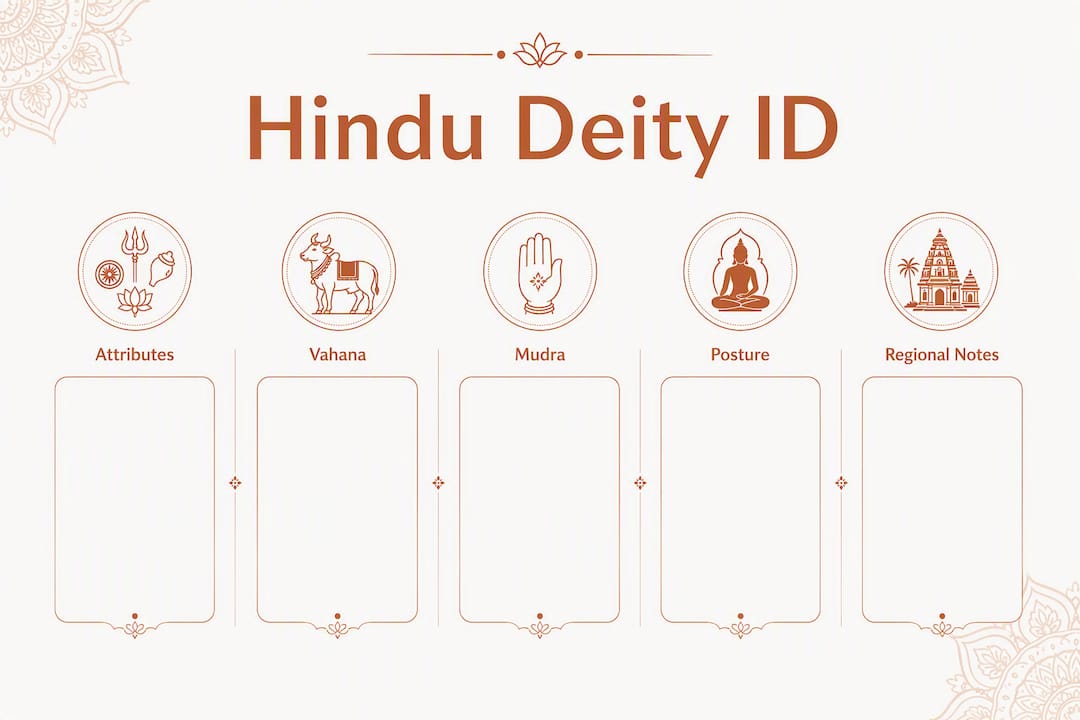
Look-alike risks: Southeast Asian depictions can differ markedly from Indian prototypes, and regional workshop styles sometimes blend Hindu and Buddhist iconographic elements. A multi-armed figure with a lotus is not automatically Vishnu; check for the chakra and Garuda before confirming. Buddhist bodhisattvas, particularly Avalokiteshvara, share several visual elements with Vishnu.
Quick checklist to avoid mislabeling:
- Confirm at least two independent attributes, not just one
- Check the vahana if present; it is rarely ambiguous
- Note the expression: fierce (ugra) vs. benign (saumya) narrows the field significantly
- Cross-reference with a Hindu deity sculpture classification guide before finalizing catalog entries
Why the term “murti” matters in catalog records
A murti (Sanskrit: मूर्ति) is a consecrated form that embodies spiritual reality. The term “idol,” by contrast, is a colonial-era pejorative that misrepresents the object’s function and carries no descriptive accuracy for catalog purposes.
Three practical reasons to use “murti” in acquisition records and sales listings:
- Catalog accuracy: “Murti” specifies a sacred sculptural form, distinguishing it from decorative sculpture or architectural fragment.
- Provenance integrity: Community organizations, temples, and repatriation bodies use “murti” in formal correspondence; matching that vocabulary prevents miscommunication in legal and cultural contexts.
- Search and discovery: Museum databases and specialist auction records increasingly index under “murti,” improving discoverability for authenticated pieces.
Pro Tip: If a piece shows evidence of ritual use (oil staining, vermilion residue, worn contact points from garlands), note it factually in the condition report as “evidence of devotional use” without making theological claims. This detail adds provenance depth and is valued by both collectors and institutions.
Provenance and authentication checklist for U.S. buyers
U.S. collectors operate under specific legal obligations. The National Stolen Property Act and U.S. Customs regulations require documented import history for antiquities. Request the following before any purchase.
Documents to request:
- Full provenance chain with named prior owners and dates
- Past auction catalog entries or dealer invoices
- Export and import paperwork (country of origin and U.S. entry)
- Condition report with dated photographs
- Any prior conservation or restoration records
Physical verification points:
- Patina: bronze should show uneven, layered oxidation; uniform green coating suggests artificial aging
- Casting seams and tool marks consistent with hand-finishing, not machine production
- Stone surfaces: tool marks and mineral accretion in recessed areas indicate age
- Wood and lacquer: look for insect damage, shrinkage cracks, and old repair fills
- Mounting evidence: wear patterns on the base consistent with long-term display
Non-invasive testing: X-ray fluorescence (XRF) identifies metal alloy composition. Thermoluminescence (TL) testing applies to terracotta only. Use accredited conservation labs; the American Institute for Conservation (AIC) maintains a directory of vetted professionals.
“Describe before judging — note material, posture, hands, objects present, base, inscriptions and location; this slows mislabeling.” — Bhaktilipi Sculpture Symbols Guide
Red flags: Inconsistent provenance dates, modern machine-made casting seams, no documentation when the seller claims pre-1970 antiquity, and mismatched patina between the figure and its base.
Pro Tip: A simple provenance query to a seller: “Can you provide the name of the prior owner, the date of acquisition, and any export documentation from the country of origin?” A reputable seller answers this without hesitation.
Consult a licensed customs broker or attorney for CITES compliance and U.S. import regulations before finalizing any purchase of a piece claimed to be over 100 years old.
Conservation, display, and handling basics
By material:
- Bronze: 45–55% relative humidity; avoid salt air. Clean only with a soft dry brush; no household oils or acidic cleaners.
- Stone: Stable at 40–60% RH; avoid rapid temperature swings that cause micro-fractures.
- Wood/lacquer: Most sensitive to humidity fluctuation; keep at 50% RH ±5%. Never place near heating vents.
Safe handling:
- Always use clean cotton gloves; skin oils accelerate bronze corrosion
- Support heavy stone pieces from the base, never by projecting limbs
- Photograph condition before any transport, including close-ups of vulnerable areas
Display:
- Mount bronzes on padded, non-reactive bases; avoid direct contact with raw metal stands
- Display height of 4–5 feet places the deity’s face at eye level, consistent with traditional darshan (viewing) practice
- Museums and designers should use UV-filtering glazing or lighting to protect pigmented surfaces
Pro Tip: Create a one-page condition report for each incoming piece: date, material, dimensions, existing damage, and photographic references. Update it after every move or loan.
When to involve an expert
Clear triggers:
- Estimated value above $5,000
- Conflicting or incomplete provenance claims
- Complex prior repairs or reattached components
- Ambiguous iconography that two references cannot resolve
- Any piece claimed as a pre-1970 antiquity
Expert types to consult:
- Conservator (AIC-certified): Material analysis, condition assessment, safe treatment
- Epigrapher or inscription analyst: Reads Sanskrit, Tamil, Khmer, or other scripts on the base
- Regional art historian: Identifies workshop style, period, and geographic origin
- Accredited appraiser (AAA or ASA member): Formal valuation for insurance or acquisition records
Questions to ask a seller or appraiser:
- What is the earliest documented owner, and when was the piece acquired?
- Has the piece been restored? If so, by whom and when?
- What is the workshop tradition or regional style attribution?
- Is there export documentation from the country of origin?
Document all expert opinions in writing and retain them with the acquisition file. Insurance underwriters and institutional acquisition committees require this record.
Key Takeaways
Identifying a Hindu deity in statuary requires reading at least two independent visual cues — attributes, vahana, mudra, and posture — before assigning a catalog name.
| Point | Details |
|---|---|
| Use the four-cue ID formula | Attributes, vahana, mudra, and posture together identify most deities reliably. |
| Use “murti” in all records | The term is accurate, respectful, and aligns with museum and community standards. |
| Request full provenance documents | U.S. buyers need a provenance chain, import paperwork, and a condition report before purchase. |
| Match material to conservation method | Bronze, stone, wood, and lacquer each require different humidity and handling protocols. |
| HDAsianArt provides authenticated pieces | Each piece is individually researched, photographed, and documented to museum-quality standards. |
A collector’s perspective on iconographic literacy
Most authentication problems in the Hindu statue market trace back to one gap: buyers who can recognize a deity by name but cannot read the visual code that confirms the identification. A Ganesha with a replaced head is still sold as Ganesha. A Vishnu missing the chakra gets cataloged by a seller who assumes the form from the posture alone. These are not rare edge cases.
The iconographic system described in the Puranas and Agamas is precise. Arm count, mudra, and vahana are not stylistic choices; they are specific theological and ritual codes. A collector who reads those codes independently is far harder to mislead than one who relies on a seller’s label. That literacy also produces better catalog records, which directly supports provenance integrity and long-term value.
The Hindu Trinity context — Brahma, Vishnu, Shiva — is a useful organizing framework, but it should not become a shortcut. Many deities in active collections sit outside that triad, and regional Southeast Asian adaptations regularly repurpose iconographic elements in ways that do not map cleanly onto South Asian prototypes. The discipline is to describe first, identify second.
Authenticated murtis and museum-quality statues from HDAsianArt
HDAsianArt sources and individually authenticates antique and traditional Hindu and Buddhist statues from Cambodia, Thailand, Indonesia, Sri Lanka, Vietnam, and beyond. Every piece in the collection comes with expert iconographic description, detailed provenance documentation, and high-resolution photography that meets museum cataloging standards.

For collectors and institutions working through the identification and authentication steps described above, HDAsianArt’s listings provide the documentation baseline most private sellers cannot match: condition reports, provenance chains, and insured worldwide DHL shipping. Browse authenticated Southeast Asian bronzes directly in the gallery, or contact the team to request condition photos and provenance records for a specific piece before committing to a purchase.
Useful sources for further research
Collectors doing deeper iconographic or authentication research will find these sources reliable and specific:
- Recognizing the Gods — Metropolitan Museum of Art: Standardized visual vocabulary for identifying Hindu and Buddhist deities; the benchmark for museum-level cataloging.
- Hindu Iconography — Achari, SAACSDMA: Detailed treatment of symbolic meanings drawn from the Puranas and Agamas; covers mudra, posture, and attribute systems.
- Iconography in Hinduism — D’source: Deity-by-deity reference covering Brahma, Vishnu, Shiva, and their iconographic variants; useful for cheat-sheet cross-checking.
- Indian God and Goddess Sculptures: Symbols Guide — Bhaktilipi: Practical guide to material, posture, and attribute reading for collectors handling physical objects.
- How to Identify Hindu Gods and Goddesses — Tamil and Vedas: Addresses regional variation and Southeast Asian adaptations; essential for collectors working with non-Indian provenance.
- Ganesh statue meaning, symbolism, and placement — Root & Still: Practical reference for Ganesha placement and devotional context; useful for interior designers and spiritually minded buyers.
For high-value acquisitions, supplement these sources with a written opinion from an AIC-certified conservator or a regional art historian. HDAsianArt’s team can assist with specialist referrals and documentation requests.
