



What Is Ganesh the God of in Plain Terms
What Is Ganesh the God of in Plain Terms
Ganesha is the god of auspicious beginnings, of wisdom and discernment, and of the removal of obstacles, with prosperity understood as the hoped-for result of a well-directed start rather than his own private treasury. Around 1.0 million people in England and Wales identified as Hindu in the 2021 Census, 1.7% of the population, up from roughly 818,000, or 1.5%, in 2011, a rise of about 182,000 people, or 22%, across the decade.
That growth sits behind most of the questions people bring to his image. Why is the elephant-headed figure at the shop door, on the dashboard, in the study corner and on the wedding invitation? And why does almost every short description settle for "god of wisdom and success", a phrase that fits a greetings card and explains almost nothing about his role?
So what is Ganesh the god of, once you get past the trunk and the sweets? The short answer takes a minute. Understanding why those roles belong to a single deity, and where the popular answers drift, takes a little longer.
Table of Contents
- What Ganesha Is the God Of
- Why Beginnings and Obstacles Sit Together
- How Four Arms and a Rat Carry the Meaning
- How a Threshold Spirit Became the First Invoked
- Where Ganesha Appears in Ordinary Life
- Why He Is Not Simply the God of Luck or Wealth
- Choose the Meaning Before You Place a Figure
What Ganesha Is the God Of
Ganesha, also written Ganesh and called Ganapati, is the elephant-headed deity linked with auspicious beginnings, wisdom, the removal of obstacles, and prosperity as the fruit of successful effort. These are overlapping functions inside one system, not four separate job titles handed to the same figure. The system runs on thresholds.
The words need unpacking. Wisdom here is buddhi, practical discernment rather than a school subject. Beginnings means the instant before something starts. Obstacle removal is the work of clearing what stands in the way. Prosperity is what a well-directed start can produce.
Five functions that hold each other up
| Role | Plain meaning | Where it shows up |
|---|---|---|
| Beginnings | The first deity invoked so a venture starts under auspicious conditions | New business, wedding, puja, house move, start of study |
| Thresholds | Guardian of doors, gates and crossroads | Entrance, gateway, start of a journey |
| Removal of obstacles | Clears impediments and, in some accounts, can place them when conditions fail | Exams, travel, ceremonies, difficult projects |
| Wisdom and learning | Buddhi, memory and disciplined discernment | Study corner, students, writers, ritual learning |
| Auspicious result | Plenty and success as the outcome of well-directed effort, not a private treasury | Laddu or sweets, completed work, celebrations |
Read down the middle column and the logic appears. Each row leans on the one above it. A start needs a threshold, a threshold needs clearing, clearing needs judgement, and the result arrives only when judgement has done its work. Break the chain and the label collapses into a slogan, which is exactly how a rich figure becomes a line on a poster.
What the UK numbers do and don't tell you
The scale of the tradition here is the easiest thing to state. The 2021 Census for England and Wales recorded approximately 1.0 million people identifying as Hindu, 1.7% of the population, up from about 818,000, or 1.5%, in 2011: an increase of roughly 182,000 people, or 22%, over the decade.
Two limits matter before anyone quotes that figure at you. The census counts religious affiliation, not which deity a household worships, so it says nothing about how many front rooms hold a Ganesha. It also covers England and Wales rather than the whole United Kingdom, because Scotland's census was conducted in 2022 and Northern Ireland's in 2021. What the number does establish is presence: a tradition with a million-strong footprint in England and Wales, whose art sits in museums, shops and hallways.
For a collector, a designer or a householder, the useful part is that the figure in front of you is doing specific work. The British Museum calls him the Lord of all Beginnings, and that phrase is a job description rather than a compliment.
Why Beginnings and Obstacles Sit Together
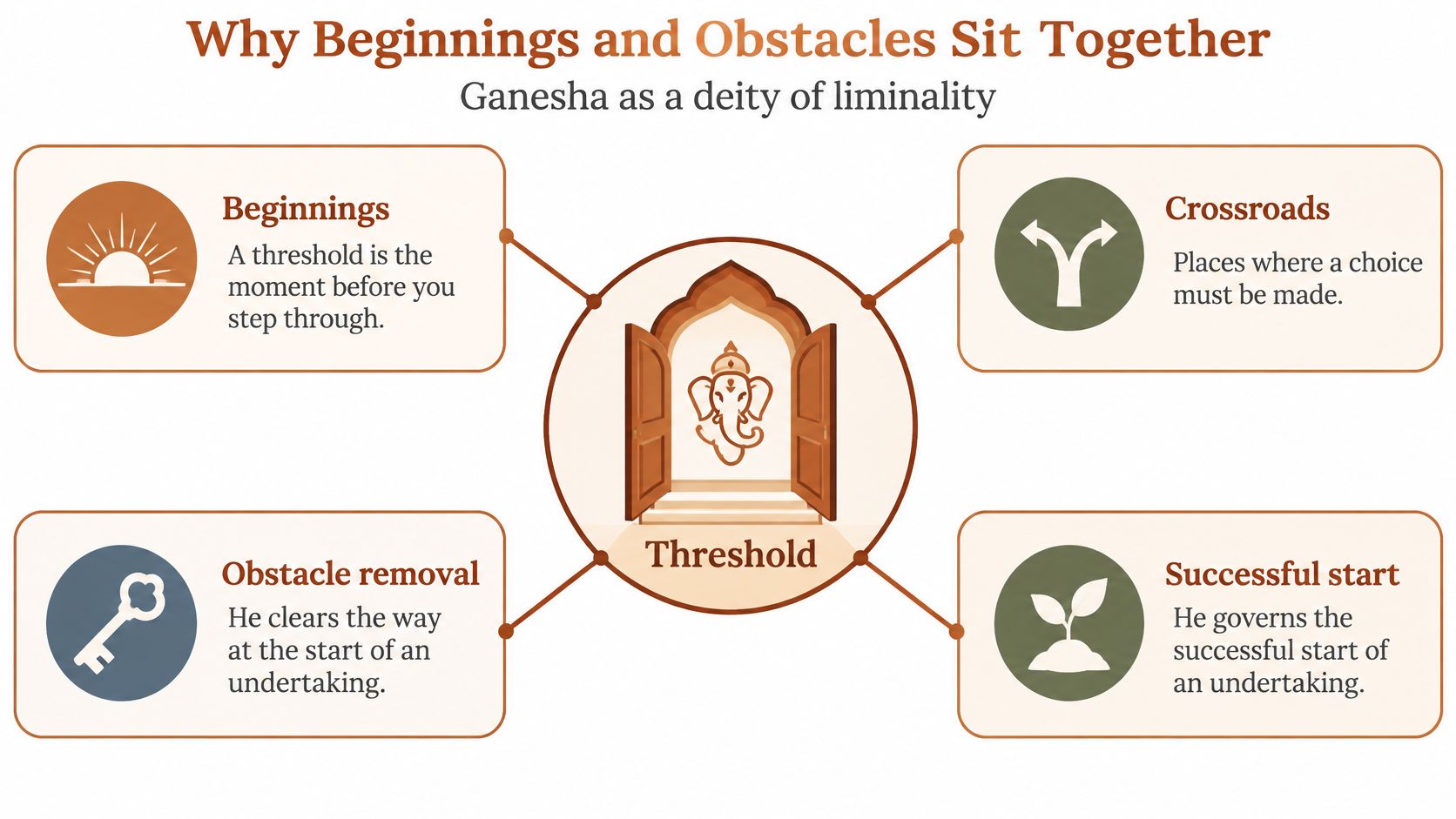
Why does Ganesha's role in beginnings sit alongside his power over obstacles? The two ideas meet at a threshold: the moment when someone is about to cross from one situation into another. Starting a journey, opening a home or beginning a task all involve a step into the unknown, where progress may depend on what lies ahead.
Ganesha is a deity of liminality, meaning he is associated with boundaries and transitions. The British Museum's record for Ganesha notes that he was originally connected with crossroads and thresholds before becoming the first deity invoked in Hindu ritual.
The cause and effect behind the title
People invoke Ganesha to seek auspicious conditions and the removal of impediments. Yet his authority at the threshold has two sides: he may also place obstacles when ritual or ethical conditions are deficient. The meaning is not that every path will be made easy.
He is both the placer and the remover of obstacles. The title describes authority over the doorway, not a promise that nothing will ever go wrong.
This makes intention and conduct part of the picture. A student who invokes Ganesha before an exam marks the beginning of an undertaking and seeks a clear head. The prayer does not guarantee a grade; it gives the moment a focus.
Why the body matches the role
The elephant head conveys strength, intelligence, memory and the capacity to clear a path. Beneath him, the rat or bandicoot, his vahana, suggests the ability to reach confined spaces. Together, they express two complementary forms of action: force to move an obstruction and reach to get into places that force alone cannot.
Choosing a suitable moment is a separate practice. Households seeking an auspicious time for a launch, move or wedding may consult a panchang for muhurta, the selection of timing. The Kismo panchang for muhurta planning provides a tool for considering that timing; it does not define Ganesha's role.
Ganesha is revered by Hindus and by some Buddhists and Jains, and is invoked at important life events. His threshold role can therefore make sense in different devotional settings. A figure kept at home may serve as a reminder that a new undertaking calls for both hope and attention to what could hinder it.
How Four Arms and a Rat Carry the Meaning
A doorway is easier to read once the tools on it are named. Ganesha's body works the same way. Each object marks a step in one job: clear the way, steady the mind, and let a good result follow. In the standard four-armed forms documented by the British Museum's Ancient India gallery guide, those attributes divide the work between obstacle management, knowledge and abundance.
| Feature | What is shown | What it signals |
|---|---|---|
| Ankusha | Elephant goad | Directed control or correction |
| Parashu | Axe | Cutting away impediments |
| Mala | Rosary or prayer beads | Disciplined prayer or concentrated learning |
| Laddu | Bowl of sweets | The desirable result of successful effort |
| Broken tusk | One tusk snapped or held | Sacrifice turned toward intellectual accomplishment |
| Vahana | Rat or bandicoot beneath him | Reaching or governing obstacles of every scale |
The goad and the axe do different work
The two are often lumped together. They do different jobs. The goad steers. It corrects a course the way a mahout turns an elephant without stopping the walk. The axe cuts. It takes an impediment out of the path. Direction and removal sit side by side because a beginning fails in both ways: you drift, or something blocks you.
The rosary is the discipline that makes either action reliable, bead by bead, the way a student repeats a line until it holds. The bowl of sweets is what follows once that work is done. Plenty is the consequence of crossing the threshold. It is one result inside a wider role, not the whole of what he governs.
The tusk, the ears and the extra heads
The broken tusk is commonly read as sacrifice, endurance, or a physical limit turned toward intellectual accomplishment. One familiar story has him snap it off to keep writing when no other stylus is to hand. The damage becomes a tool for knowledge.
The large ears are read as attentive listening. Take in more than you announce.
A reading habit worth keeping: name what each hand holds before you name the deity. The objects tell you which Ganesha you are looking at.
Some images are far more elaborate, including five-headed forms in which multiplicity signals heightened or omniscient power. Those are the exception, not the template. Extra heads and extra hands widen the same system, giving more ways to watch a threshold.
The rat, or bandicoot, finishes the picture from below. Large force clears a road. A small mount gets into the gap the road never reaches. Scale is the point. An obstacle can be a mountain or a crack in the floorboards.
How to catalogue a standard four-armed figure
For collectors, curators and interior designers, identification is a practical act. A four-armed figure holding axe, goad, rosary and sweets should be recorded as an auspicious, obstacle-removing Ganesha, not filed only as an elephant-headed Hindu figure. That wording moves a label from decoration to meaning. For a closer walk through each object, this guide to what Ganesha holds in his hands takes the attributes one at a time.
How a Threshold Spirit Became the First Invoked
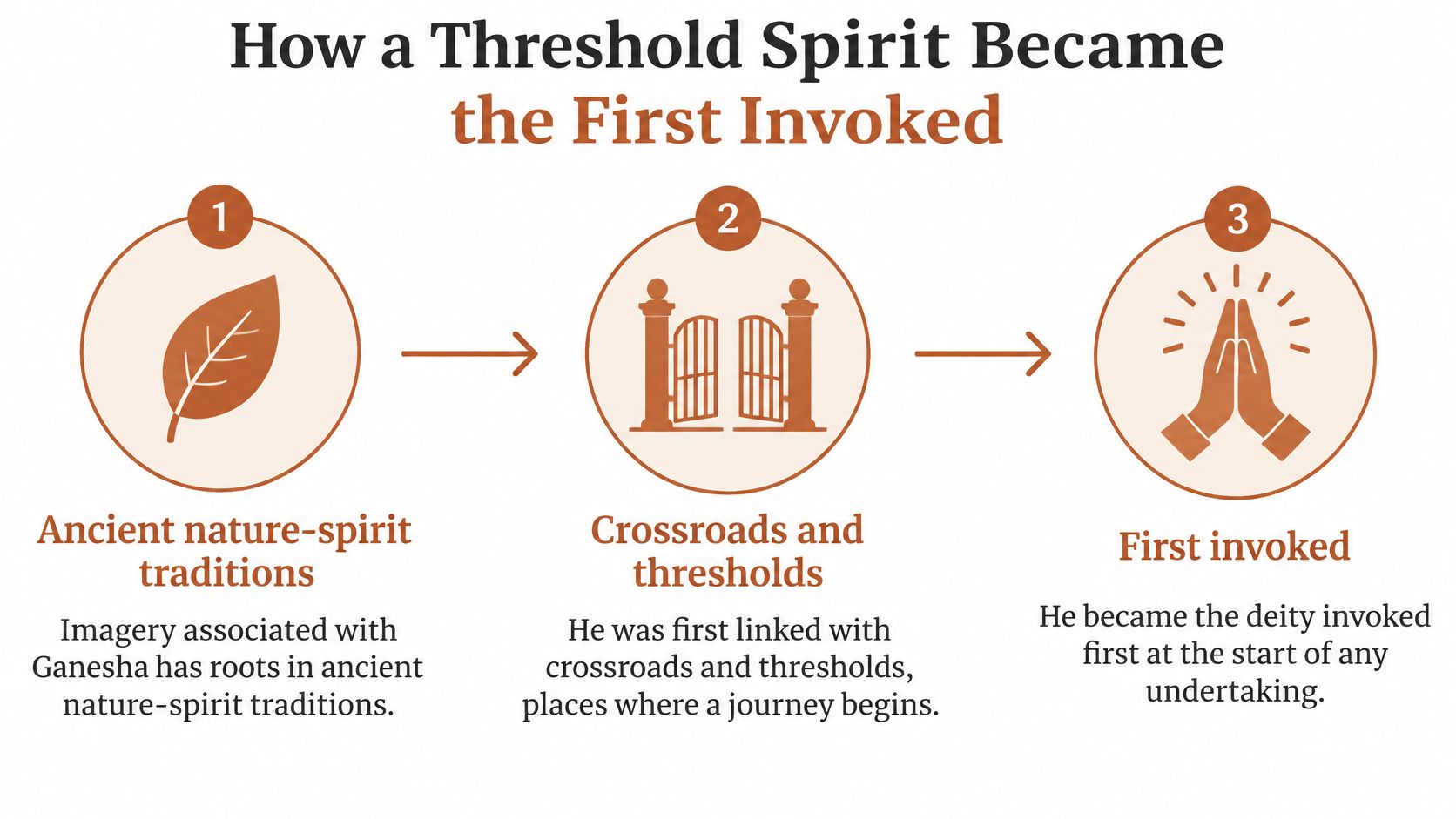
The change happened in stages, and the order matters. Imagery associated with Ganesha has roots in ancient nature-spirit traditions. He was first linked with crossroads and thresholds, the places where a traveller chooses a road and where danger or blessing can meet you coming the other way.
The short version of the family story
As the son of Shiva and Parvati, he is often pictured earning his elephant head through a violent misunderstanding at a doorway, then receiving a place of honour, including leadership of the ganas, the hosts who attend Shiva. From that comes the name Ganapati, lord of the ganas. Regional tellings differ in detail, so hold the story lightly as living tradition rather than a fixed script.
From local gatekeeper to first invoked
Over centuries that local gatekeeping widened into a pan-Indian role as protector of auspicious action, learning and prosperity. He became the deity customarily called on before other rites, the one whose name opens a ceremony.
Public visibility in Britain followed. During a nationwide British Museum loan programme, a 13th-century sculpture of Ganesha travelled to museums in Forest Hill and Brent in London, then to venues in Manchester and Luton, and was seen by more than 620,000 people across the UK, as the British Museum's annual review records. That tour settles an argument about whether he belongs only to private devotion. He is also a major subject in Britain's public presentation of South Asian religious and artistic heritage.
The consequence for anyone arranging a home or a gallery is practical. If he grew out of threshold symbolism, then a figure by the door is doing the oldest job he has, and the guide to why a Ganesha statue is placed at an entrance covers the reasoning behind protection, vastu and auspicious starts.
Strip away the tour and the myth, and the historical answer to what Ganesh the god of is still the threshold. Beginnings, successful transitions, wisdom and obstacle removal all grew from it, which is why he still stands at entrances, shrines, workplaces and ceremony halls.
Where Ganesha Appears in Ordinary Life
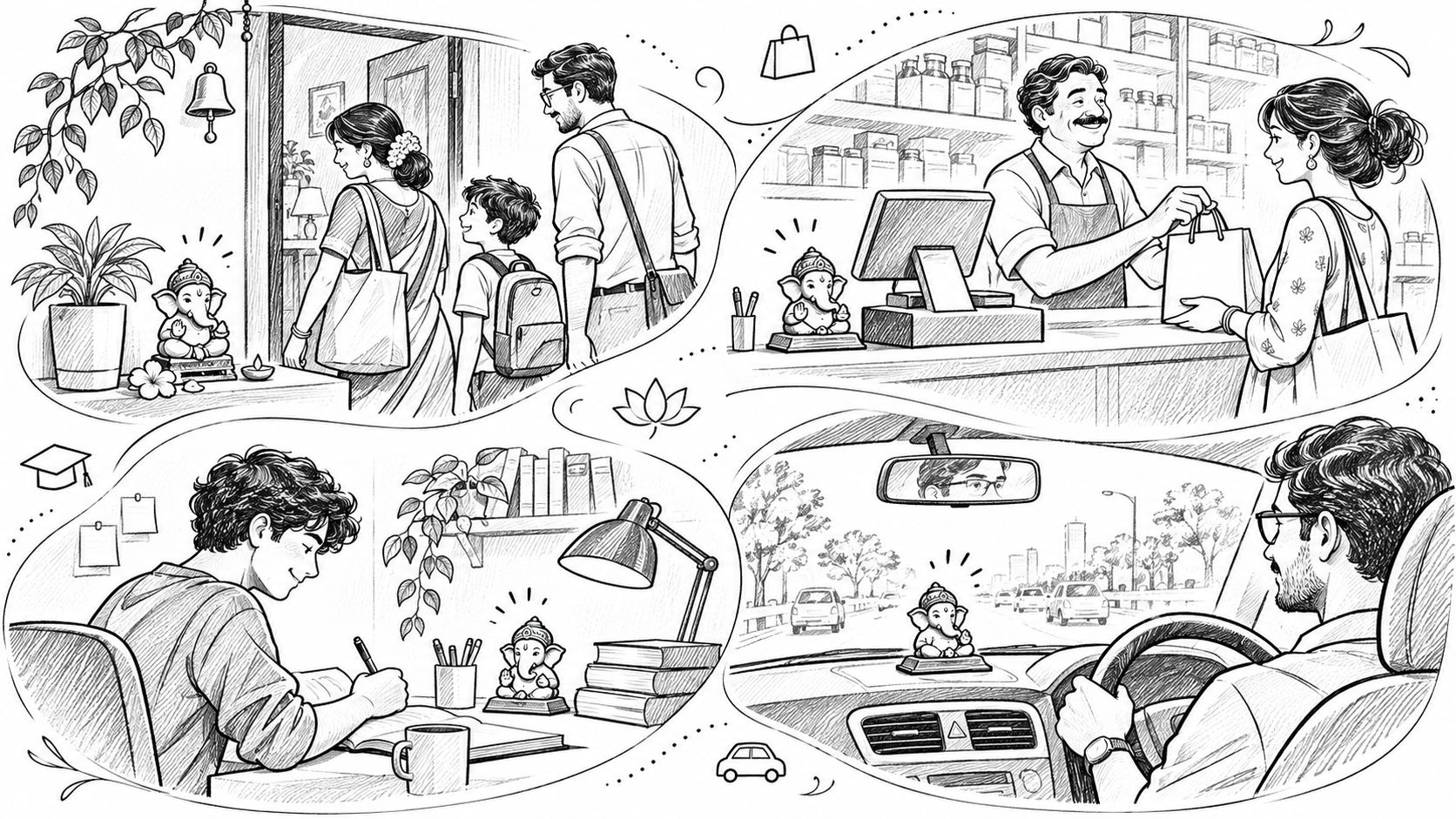
Many encounter Ganesha in a setting rather than a scripture. The setting tells you which emphasis is in play, and the same figure can carry a different intention in each place.
At the door and on the road
At a front door or gate he marks the physical start of a home. Guests pass his gaze on the way in, and the household treats the threshold as the place where trouble is cleared before it settles. The same logic explains the small figure on a dashboard: a journey is a beginning with obstacles in it.
At the study desk and at a launch
In a study corner the emphasis shifts to learning and patience. The figure is a prompt to listen carefully and persist, not a guarantee of results. A writer or a student who keeps one beside the desk is marking the difference between wanting an outcome and doing the work that produces it.
At a workplace the emphasis moves again. A new laboratory, studio or shop is a beginning dense with obstacles, which makes the remover of obstacles an obvious companion for the first day. One buyer chose a Ganesha as a present for someone starting his own lab, on the grounds that the remover of obstacles seemed like exactly the right figure for the moment.
"Ganesh, the remover of obstacles, seemed like the perfect thing" for a friend about to open a lab.
At a wedding, a housewarming or a first day
At a wedding, a housewarming, a naming ceremony or a child's first lesson, he is called first so the rite itself starts well. The figure is often small, sometimes no larger than a hand, because the point is the invocation rather than the scale.
Custom, not law
An image near an entrance, a desk or a workspace can carry different intentions, and placement advice is not a universal religious rule. A clean, calm shelf or shrine corner is ordinary domestic courtesy. It isn't a claim that interior design guidance is scripture, and it shouldn't be presented to anyone as though every Hindu household follows one arrangement.
Why He Is Not Simply the God of Luck or Wealth
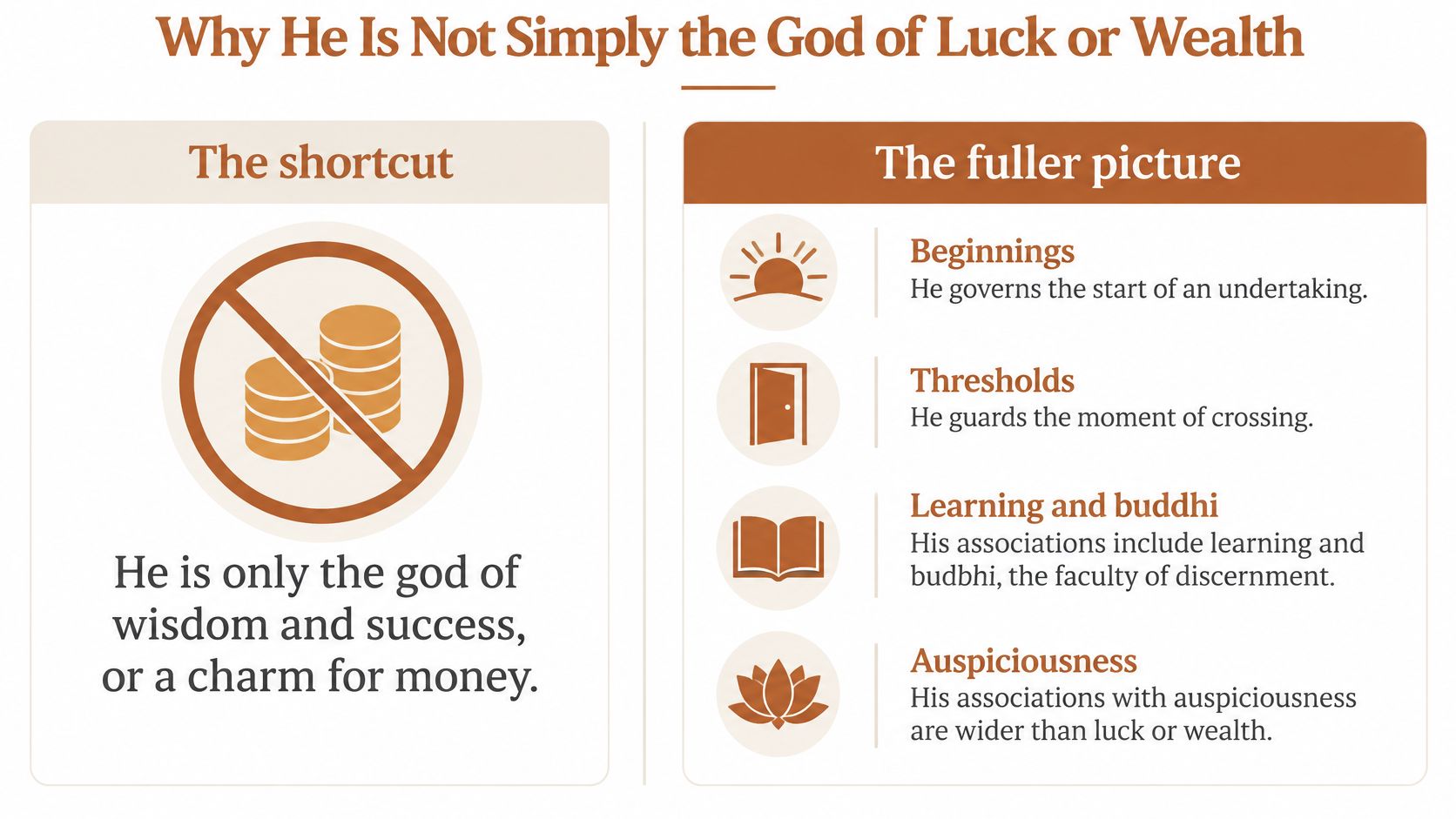
The most common shortcut is that Ganesha is the god of wisdom and success, or a charm for money before a big meeting. Both versions flatten him. Beginnings, thresholds, obstacle removal, learning, buddhi and auspiciousness are connected functions, and the worship model keeps a condition attached: effort, discernment and proper intention matter.
Where Ganesha ends and Lakshmi begins
Lakshmi is the goddess commonly associated with prosperity and abundance, and merging her with Ganesha creates real confusion for gift buyers, collectors and anyone setting up a home shrine. Ganesha is primarily invoked for auspicious beginnings, discernment, learning and overcoming impediments. Prosperity may follow a successful and well-directed undertaking, but it isn't his exclusive domain, and the two figures aren't interchangeable presents.
The audience for that distinction is younger than many guides assume. In England and Wales in 2021, 68.4% of Hindus were aged 16 to 64 and 20.3% were under 16, against 62.9% and 18.5% for the overall population, according to the ONS analysis of religion by age and sex.
Three layers to keep apart
Tradition, custom and décor answer different questions, and mixing them is where most explanations go wrong. Scriptural and widely shared tradition covers the invoked-first role and the attributes. Regional custom covers variation, including differences in which son of Shiva is emphasised in parts of north and south India. Contemporary interior practice covers the study shelf and the office desk.
A further caution belongs here. Census affiliation cannot prove belief or active practice. Roughly 1.0 million people in England and Wales identified as Hindu in 2021, up from about 818,000 in 2011, yet that count is identity rather than a survey of home shrines, and not every Hindu worships Ganesha in the same way. If you're weighing whether a figure carries luck, this piece on whether Ganesha brings good luck separates the popular expectation from the tradition.
Label it accurately: god of auspicious starts and the clearing of obstacles, with wisdom as the means and prosperity as a possible result.
Choose the Meaning Before You Place a Figure
Start with the moment rather than the object. Is this figure for a new home or a new business, a study, a gift for someone beginning something, or a shrine where he is greeted first? Answer that and the choice narrows quickly, because you're no longer shopping for a generic elephant.
Three checks do most of the work. Respect over clutter: treat the image as a figure with a function, not as filler on a busy shelf. A clean, calm position: a shelf, a pooja corner or an entrance rather than a bathroom or beside a bin. Read the attributes: where present, axe, goad, rosary and sweets mark obstacle, discipline and result, so note them instead of describing them as ornament. If a larger piece needs siting and fixing, these sculpture installation tips from Colorado Art Services cover the practical side of display.
Style will change what you see without changing what it means. A compact seated wooden figure and an elaborate bronze sit at opposite ends of the same tradition, and both carry the association with beginnings and wisdom.
HD Asian Art, a UK specialist in Hindu and Buddhist sculpture, keeps those domains distinct in its own guidance: a meditation Buddha for a calm room or altar, Ganesha for new beginnings and wisdom, Shiva for transformation, Vishnu for protection and Lakshmi for abundance. The gallery's curated collection of museum quality, design led, unique Asian sculpture includes Ganesha among its Buddha, Vishnu and Shiva pieces, so forms can be compared side by side once you know which role you mean to honour.
Ganesha statues at HD Asian Art are chosen and described by the role each figure carries, from auspicious beginnings and obstacle removal to the quieter seated forms suited to a study or shrine corner. If this guide has clarified which moment you're marking, whether a new home, a new venture, a gift for someone starting out or a place where he is greeted first, you can compare seated and standing figures in the collection. Browse the Hindu sculpture at HD Asian Art and choose the form that matches the threshold you're crossing.
