



What Does the Ushnisha Represent in Art: Symbolism & History
What Does the Ushnisha Represent in Art: Symbolism & History
Table of Contents
Understanding what does the ushnisha represent in art requires looking beyond its physical appearance as an ornamental crown. At HD Asian Art, we've observed that collectors and spiritual practitioners often encounter this distinctive feature on Buddha statues without fully grasping its layered significance.
The ushnisha carries profound meaning across multiple dimensions, from royal status and renunciation to enlightenment itself, and its interpretation has evolved dramatically across Buddhist cultures and centuries.
What Does the Ushnisha Represent in Buddhist Art
The ushnisha is a cranial protuberance or crown-like elevation depicted on the top of the Buddha's head in Buddhist statuary and iconography. Unlike a simple ornament, it functions as one of the thirty-two Mahapurusha lakshanas, the distinguishing marks that identify an enlightened being. In early Buddhist texts, the ushnisha symbolizes spiritual awakening and transcendence, marking the Buddha as fundamentally different from ordinary humans.
The physical representation varies across regions and time periods. In some Theravada traditions, it appears as a subtle topknot or chignon. In Mahayana depictions, particularly from East Asia, it becomes increasingly prominent and ornate, sometimes resembling a flame or supernatural crown. This evolution reflects changing artistic conventions and theological emphases within different Buddhist schools.
The ushnisha serves a dual purpose: it's simultaneously a visual marker of enlightenment status and a symbol of the Buddha's transcendence beyond physical limitations.
Ushnisha Meaning Across Ancient Indian Traditions
The ushnisha didn't originate with Buddhism. In ancient Indian culture, elongated earlobes and elevated head ornaments were markers of royalty, nobility, and supernatural status. When Siddhartha Gautama was born as a prince, he would have worn such ornaments as part of his daily existence in the Shakya clan palace.
After abandoning his palace life, the Buddha gave up these external markers of status. Yet the artistic tradition retained them, not as signs of continued attachment to wealth, but as visual reminders of what he transcended. The elongated earlobes visible in many Buddha statues reference the ear holes left behind after he removed his heavy royal earrings. The ushnisha becomes a spiritual crown replacing the material ornaments he discarded.
Buddhist Iconography: The Ushnisha and the Lakshanas of Buddha
The ushnisha holds its place among the thirty-two major and eighty minor distinguishing marks of a Buddha. These lakshanas represent physical characteristics that signify enlightenment and are described in detail across Buddhist scriptures. The ushnisha specifically marks the crown of the head as the seat of wisdom and spiritual elevation.
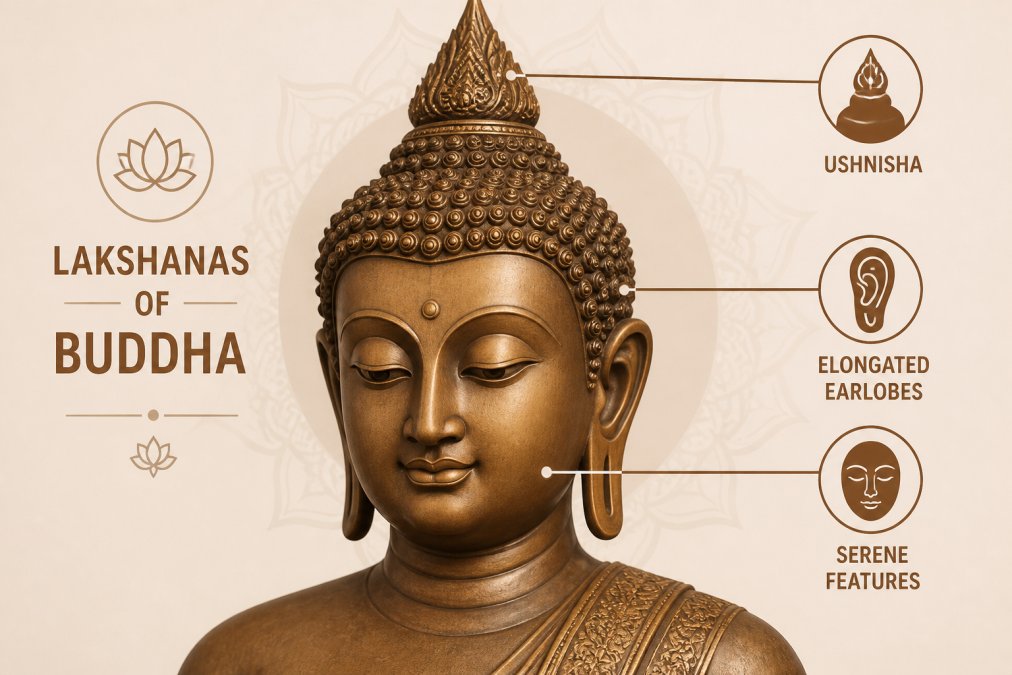
In Theravada tradition, the ushnisha is often depicted more subtly, a gentle elevation suggesting the Buddha's transcendent status without overwhelming the face's serene expression. Mahayana sculptors, particularly in Tibet and East Asia, developed increasingly elaborate ushnisha forms. Some appear as flame-like crowns, others as jeweled diadems, and still others as supernatural emanations of light itself.
The relationship between the ushnisha and the elongated earlobes deserves specific attention. Together, they tell the story of sensory detachment. The earlobes stretched by royal jewelry symbolize listening, the Buddha's capacity to hear the cries of the world's suffering beings. The ushnisha above represents the wisdom that processes that suffering and generates compassion. Different Buddhist traditions emphasize different aspects of this iconography. Theravada schools tend to focus on the ushnisha as a marker of the historical Buddha's unique status. Mahayana traditions sometimes extend the ushnisha to bodhisattvas and other enlightened beings, suggesting that spiritual elevation isn't limited to one Buddha. Tibetan Buddhism often depicts the ushnisha with intricate detail, incorporating symbolic colors and flame imagery that reference tantric philosophy.
Symbolism of Wisdom, Detachment, and Spiritual Awakening
The ushnisha represents the pinnacle of spiritual attainment, the crown of enlightenment itself. While a literal crown adorns a king's head, the ushnisha adorns the Buddha's mind. The Buddha's authority comes not from inherited power or military strength, but from direct realization of ultimate truth.
Wisdom in Buddhist philosophy isn't intellectual knowledge. It's prajna, direct insight into the nature of reality, the impermanence of all things, and the emptiness of a fixed self. The ushnisha, positioned at the very top of the head, symbolizes this wisdom dwelling at the highest point of consciousness.
The symbolism of detachment works through the ushnisha as well. The Buddha renounced all worldly attachments, yet the statues preserve the visual markers of his former princely status. This paradox is intentional. The ushnisha and elongated earlobes remind viewers that the Buddha didn't become enlightened by denying his past but by transcending attachment while maintaining full awareness of the physical world.
The Ushnisha in Different Cultures and Buddhist Traditions
Buddhist art spread across Asia through trade routes, missionary activity, and cultural exchange. As it traveled, the ushnisha transformed. What remains constant is its function as a marker of enlightenment. What changes is its artistic expression, reflecting local sculptural traditions, materials, and theological emphases.
In Southeast Asia, particularly Cambodia, Thailand, and Laos, sculptors developed distinctive ushnisha forms. Khmer Buddha statues often feature a refined, subtly elevated ushnisha that rises gracefully from the crown of the head. The Khmer tradition emphasizes restraint and elegance; the ushnisha enhances the statue's spiritual presence without overwhelming it. These pieces, which HD Asian Art offers, demonstrate how regional artistic traditions shaped the symbol's visual language while preserving its spiritual meaning.
Chinese and Japanese sculptors approached the ushnisha differently. In these East Asian traditions, the ushnisha often becomes more prominent, sometimes developing a spiral or flame-like quality. This reflects Mahayana Buddhism's embrace of more elaborate iconography. Some Japanese depictions show the ushnisha emitting light, a visual metaphor for wisdom radiating outward.
Tibetan Buddhism created perhaps the most elaborate ushnisha forms, frequently appearing as a jeweled crown or flame-like emanation, sometimes incorporating symbolic colors. Indian Buddhist sculpture, particularly from the Gandhara and Mathura periods, shows the ushnisha developing gradually from subtle topknots to increasingly prominent elevations.
Anatomical Reality Versus Artistic Symbolism
The ushnisha is not primarily a realistic anatomical feature. The Buddha was a human being with a normal human head. The ushnisha is symbolic architecture, not biological fact.
Early Buddhist texts describe the ushnisha as one of the thirty-two marks without specifying exactly how it appears physically. This ambiguity allowed sculptors creative freedom. Some interpreted it as a topknot, literally tying the hair atop the head. Others saw it as a supernatural crown, a visible manifestation of enlightenment that transcends ordinary anatomy.
The evolution of the ushnisha across centuries reveals sculptors grappling with this tension between the symbolic and the representational. In the earliest Buddhist art, particularly from the Gandhara region where Greek sculptural influence was strong, artists tried to make the ushnisha appear somewhat naturalistic. As Buddhist art developed, sculptors increasingly abandoned anatomical realism in favor of symbolic clarity. The ushnisha became more abstract, more ornate, more obviously supernatural. This shift reflects a changing theological emphasis: artists were less interested in depicting the Buddha as he might have appeared and more interested in expressing the transcendent nature of enlightenment.
Choosing Authentic Ushnisha Statuary for Your Meditation Space
When selecting a Buddha statue for your home meditation space, understanding the ushnisha helps you make informed decisions about authenticity and artistic tradition. Examine the ushnisha carefully before purchasing. Is it subtle and refined, suggesting Southeast Asian or classical Indian influence? Is it more elaborate and ornate, indicating East Asian or Tibetan tradition? The treatment of this single feature can help you verify whether a statue's claimed provenance matches its actual artistic style.
Pay attention to the relationship between the ushnisha and the rest of the face. In well-executed pieces, the ushnisha harmonizes with the overall composition, enhancing spiritual presence without dominating the face's serene expression. The material and patina matter as well. Authentic antique pieces show consistent aging across all surfaces, including the ushnisha. A ushnisha that appears artificially darkened or inconsistently aged compared to the rest of the statue raises questions about authenticity.
Scale and placement in your meditation space deserve consideration. A statue with an elaborate, prominent ushnisha needs adequate visual space. A more subtle ushnisha works well in smaller spaces or as a secondary focal point. Consider also the tradition represented. If you practice within a specific Buddhist lineage, choosing statuary from that tradition creates spiritual coherence.
Conclusion
The ushnisha represents far more than a decorative crown; it's Buddhism's visual answer to the question of what enlightenment looks like. It carries the weight of ancient Indian royal symbolism, the Buddha's renunciation of worldly status, and the transcendent wisdom that characterizes awakening. Across cultures and centuries, sculptors have expressed this meaning through infinite variations, creating a visual language that communicates spiritual realization to anyone who understands its grammar.
When you're seeking an authentic Buddha statue to anchor your meditation space, the ushnisha becomes your guide. It reveals the sculptor's tradition, the piece's probable origin, and the artistic philosophy embedded in the work itself. Selecting statuary with a well-executed ushnisha ensures that your meditation focal point carries genuine spiritual presence rather than mass-produced decoration. Buddhist iconography resources from the Smithsonian Asian Art Collections provide additional context for understanding these symbolic elements. Explore HD Asian Art's carefully curated collection of authentic Southeast Asian and Khmer Buddha statues, each selected for the quality of its craftsmanship, historical authenticity, and spiritual presence.
Frequently Asked Questions
What is the ushnisha a symbol of in Buddhist art?
The ushnisha represents spiritual awakening, enlightenment, and the Buddha's transcendence beyond the physical world. It symbolizes wisdom accumulated through lifetimes of practice and serves as a visual marker of the Buddha's supernatural attributes. In ancient Indian tradition, the ushnisha also references the crown worn by nobility and royalty, transforming that symbol of earthly status into one of spiritual attainment and detachment from material luxury.
How does the ushnisha meaning relate to compassion and listening?
The ushnisha, paired with the Buddha's elongated earlobes, symbolizes the capacity to listen deeply to the cries of the world with compassion and empathy. The elongated earlobes represent the ability to hear suffering and respond with wisdom. Together, these iconographic features convey the Buddha's dedication to understanding and alleviating the suffering of all beings, making the ushnisha a visual representation of enlightened listening and spiritual awakening.
What are the lakshanas of Buddha and where does the ushnisha fit?
The lakshanas are the thirty-two distinguishing physical characteristics that mark the Buddha as a being of extraordinary spiritual attainment. The ushnisha, a protuberance or crown-like mark on the top of the head, is one of these key attributes. Other lakshanas include the elongated earlobes, the urna (a mark between the eyebrows), and supernatural proportions. These iconographic features appear consistently across Buddhist statuary and sculpture to identify enlightened beings in Buddhist iconography.
How does the ushnisha appear differently across Buddhist traditions and cultures?
Regional artistic variations shape how the ushnisha is depicted. In Theravada traditions, the ushnisha often appears as a simple, flame-like protuberance or topknot. Mahayana Buddhism sometimes portrays it as an elaborate crown or jeweled headdress, reflecting influences from Hindu royal iconography. Tibetan Buddhist sculpture frequently shows the ushnisha as a towering, ornate structure. Southeast Asian Khmer and Thai statuary display their own distinct proportions and stylistic treatments, demonstrating how the same symbol evolved across cultures while maintaining its core meaning of enlightenment and spiritual authority.
