



Vietnamese Buddhist Art Explained: History and Symbols
Vietnamese Buddhist Art Explained: History and Symbols
Vietnamese Buddhist art is defined as a visual tradition synthesizing Mahayana, Theravāda, and indigenous practices into a distinct iconographic language. With devotional figures like Quan Âm (the Vietnamese form of Avalokiteshvara) and Amitābha at its center, this tradition spans sculpture, architecture, woodblock printing, and ritual objects.
Vietnamese Buddhist art explained properly requires understanding not just individual images but the doctrinal systems, historical forces, and material choices that shape every piece. The tradition is eclectic by design, blending Pure Land devotion, Thiền (Vietnamese Zen), and Theravāda influences across centuries of cultural exchange.
What are the historical influences on vietnamese buddhist art?
Vietnamese Buddhist visual culture did not develop in isolation. Two dominant external forces shaped its earliest forms, and their legacies remain visible in temple collections today.
Chinese Buddhist art predominated Vietnam from the 1st through the 9th centuries CE. Northern Vietnam was under Chinese administrative control during much of this period, which meant Chinese iconographic conventions, bronze casting techniques, and Mahayana doctrinal imagery flowed directly into local workshops. The result was a northern Vietnamese aesthetic closely aligned with Tang and Song dynasty models, particularly in Buddha postures, halo designs, and altar arrangements.
The southern picture was different. The Cham kingdom, which controlled much of central and southern Vietnam, produced Indianized artistic traditions rooted in Hindu and Theravāda Buddhist forms. Champa was annexed in 1471, and its visual vocabulary merged with the Mahayana-dominant north. That merger explains why southern Vietnamese temples often show sculptural proportions and decorative motifs that feel closer to Khmer or Cham work than to Chinese models.
Key historical forces shaping the tradition include:
- 1st–9th centuries: Chinese administrative rule introduced Mahayana iconography and bronze casting to the north
- 7th–15th centuries: Champa contributed Indianized stone carving and Theravāda iconographic programs to the south
- Post-1471: Political unification began integrating northern and southern visual traditions
- 17th–18th centuries: Dynastic patronage under the Nguyen lords produced major sculptural programs, including national treasures at Bút Tháp Pagoda
Understanding the Mahayana art tradition is the clearest entry point for reading northern Vietnamese temple collections. Theravāda contributions, concentrated in the south, require a separate visual vocabulary entirely.
Why is the lotus motif central to vietnamese buddhist symbolism?
The lotus is the single most pervasive symbol in Vietnamese Buddhist art. It represents purity and enlightenment because the flower rises from muddy water without being stained, a direct metaphor for the Buddhist path through suffering toward liberation.
Lotus imagery appeared in Vietnam as early as the 3rd–6th centuries CE, documented on roof tiles at the ancient site of Luy Lâu. By the 10th century, the motif had become structural. The One Pillar Pagoda in Hanoi, built in 1049 under Emperor Lý Thái Tông, places its entire shrine on a single column rising from a lotus-shaped pool. The architecture does not merely depict the lotus. It enacts it.
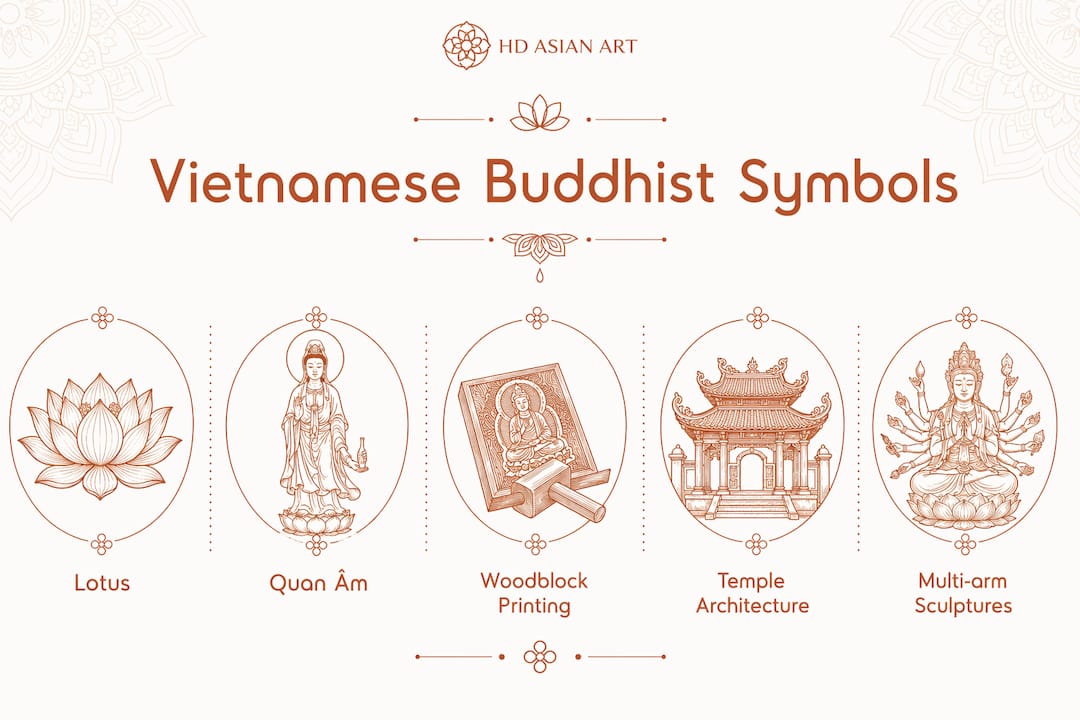
Lotus symbolism operates simultaneously as religious meaning and an overarching design system. You find it carved into stone bases, painted on lacquer panels, cast into bronze censers, and woven into textile altar cloths. No other motif crosses as many media or carries as much doctrinal weight.
| Lotus Application | Medium | Symbolic Function |
|---|---|---|
| Throne base of Buddha statues | Stone, bronze, wood | Purity and transcendence of the physical world |
| One Pillar Pagoda structure | Architecture | Enlightenment rising from the world of suffering |
| Roof tile decoration at Luy Lâu | Fired clay | Early Buddhist presence and royal patronage |
| Altar censer and ritual vessels | Bronze, lacquer | Offering purity to the Buddha |
Pro Tip: When examining a Vietnamese Buddhist sculpture, check the base first. A lotus throne with tightly closed petals signals a different doctrinal emphasis than one with fully open petals. Closed petals represent potential; open petals represent realized enlightenment.
What makes vietnamese buddhist sculpture distinctive?
Vietnamese Buddhist sculpture is most recognizable through its multi-arm, multi-head compositions, which are iconographic programs rather than decorative choices. The role of Avalokiteshvara in Buddhist art explains why: each arm holds a specific attribute, and each head perceives suffering from a different direction. Together they express the bodhisattva’s limitless compassion.
The Bút Tháp Quan Âm sculpture at Bút Tháp Pagoda in Bắc Ninh Province is the defining example. The wooden figure has 11 heads, 46 large arms, and over 900 small arms, created in the 17th century. That count is not arbitrary. Each element maps to a specific doctrinal attribute within the Thousand-Armed Quan Âm iconographic system. The sculpture was recognized as a national treasure in 2012, confirming its status as a benchmark of Vietnamese Buddhist craftsmanship.
The organized, repeatable design of these sculptures suggests Vietnamese workshops operated with a compositional logic built for theological coverage. Workshops did not improvise. They followed established programs that assigned specific attributes to specific positions, allowing viewers to read the sculpture like a text.
Key characteristics of Vietnamese Buddhist sculpture:
- Wood as primary medium: Northern Vietnamese workshops favored lacquered wood over stone, producing warmer, more detailed surfaces than stone carving allows
- Modular iconographic logic: Multi-arm figures follow repeatable compositional rules, not individual artistic invention
- Scale as statement: Large-scale figures in main halls communicate doctrinal primacy, while smaller flanking figures indicate supporting roles
- Polychrome lacquer finish: Gold and red lacquer applied over wood creates visual hierarchy and preserves the surface across centuries
How did vietnamese buddhists use woodblock printing?
Vietnamese Buddhist woodblock printing is a craft tradition that preserved doctrine, trained practitioners, and produced ritual objects simultaneously. It is not simply a reproduction technology. It is a form of sacred making.
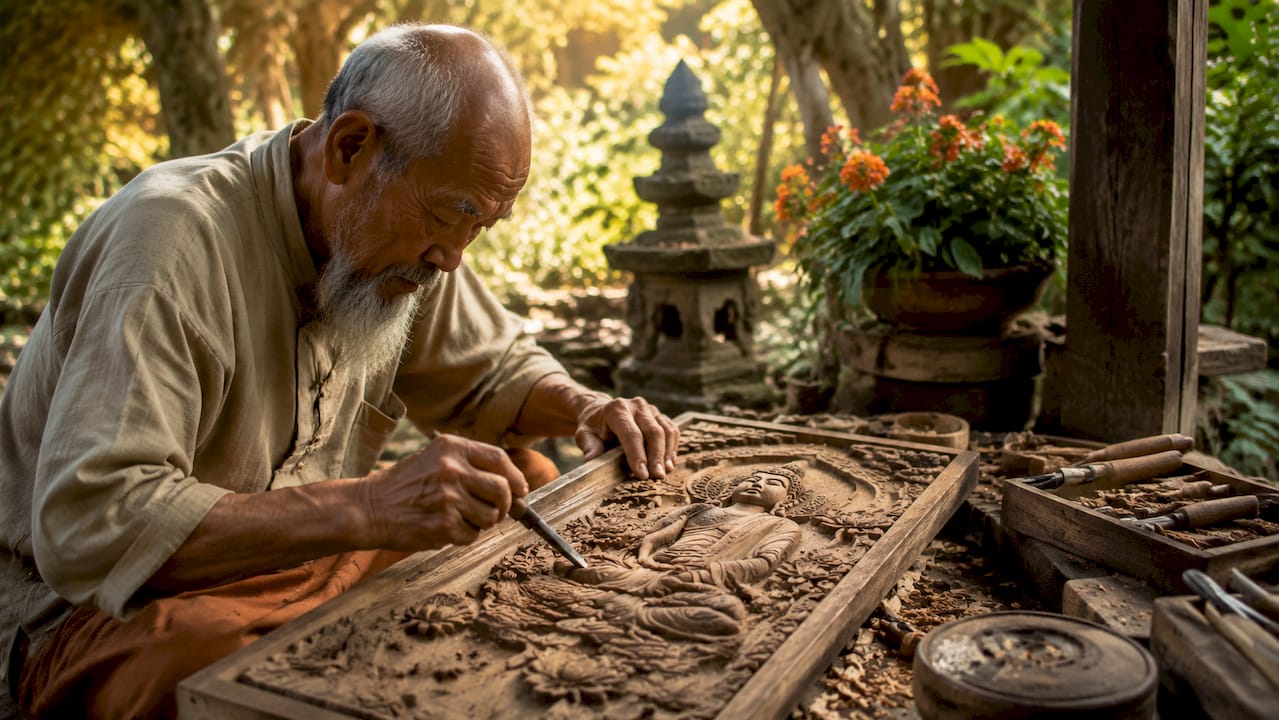
Tram Gian Pagoda in Hanoi preserves over 896 woodblocks of Buddhist scriptures carved from persimmon wood. The collection includes texts such as the Medicine Buddha Sutra and Pure Land writings, with some blocks dating to the 17th and 18th centuries. Persimmon wood was chosen deliberately: its density and resistance to warping made it ideal for fine-line carving that had to remain legible across hundreds of print runs.
The process followed a precise sequence:
- Text preparation: Scribes copied sutras in classical Chinese or Nom script onto thin paper
- Transfer: The paper was pressed face-down onto the planed wood block, transferring the ink in reverse
- Carving: Artisans from Thanh Lieu village cut away the negative space with fine chisels, leaving raised characters and imagery
- Proofing: Trial prints were checked against the source text for accuracy before the block entered production
- Printing and binding: Completed blocks produced sutras, amulets, and legal documents for distribution across temple networks
“Woodblock carving decisions shape the visual grammar of Vietnamese Buddhist art, influencing how teachings are both preserved and aesthetically realized.” — Wooden printing blocks of Tram Gian Pagoda
Woodblock artisans from Thanh Lieu village combined fine-line carving with high aesthetic standards to produce objects that functioned as both spiritual tools and works of art. Recent restoration efforts have revived this tradition, training new carvers in the same techniques documented at Tram Gian.
How do vietnamese buddhist temples express sacredness through space?
Sacredness in Vietnamese Buddhist temples is expressed through structural materials, construction techniques, and spatial organization, not iconography alone. This is the insight most visitors miss. A temple is not a container for sacred objects. It is itself a sacred object.
Research on Theravāda Buddhist spaces among the Kinh people confirms that material choices and spatial planning are inseparable from ritual function. Orientation matters: main halls typically face south or southeast, aligning with cosmological principles that position the Buddha as facing the world of suffering. Courtyards create graduated zones of sanctity, with the outermost areas open to the public and the innermost sanctuaries restricted to ordained practitioners.
Materials carry meaning at every scale. Fired brick and stone foundations signal permanence and royal patronage. Timber superstructures allow the flexible, layered roof forms that Vietnamese temple architecture is known for. Lacquer and gilding on interior surfaces reflect lamplight during rituals, creating a visual effect that reinforces the sense of entering a different order of reality.
Vietnamese temple art is a choreographed spatial experience where architecture, iconographic programs, and materials collectively evoke sacred presence. The sculptures, the woodblock-printed sutras on the altar, and the lotus carvings on the columns are not separate elements. They are components of a single designed environment.
Pro Tip: When visiting a Vietnamese Buddhist temple, walk the full perimeter before entering the main hall. The sequence of gates, courtyards, and subsidiary shrines is intentional. Reading the spatial progression gives you the doctrinal argument the temple is making before you see a single major sculpture.
Key takeaways
Vietnamese Buddhist art is a unified visual system where doctrine, material, spatial design, and iconographic programs work together to express Buddhist philosophy across multiple traditions.
| Point | Details |
|---|---|
| Doctrinal plurality | Vietnamese Buddhist art reflects Mahayana, Theravāda, and Thiền traditions simultaneously, not a single school. |
| Historical layering | Chinese influence shaped the north from the 1st century CE; Indianized Cham traditions shaped the south until 1471. |
| Lotus as design system | The lotus operates across architecture, sculpture, and ritual objects as both symbol and structural organizing principle. |
| Sculpture as iconographic program | Multi-arm figures like the Bút Tháp Quan Âm follow modular compositional rules that encode theological meaning in every attribute. |
| Space as sacred medium | Temple orientation, material choices, and spatial zoning are as doctrinally significant as the sculptures they house. |
Reading vietnamese buddhist art as a whole system
James, HDAsianArt.com, shares this perspective:
The most common mistake I see from students and collectors is treating Vietnamese Buddhist sculptures as isolated objects. A Quan Âm figure pulled from its altar context loses half its meaning. The position it occupied, the figures flanking it, the woodblock-printed sutras on the table in front of it — all of that is part of the work.
What changed my own reading of this tradition was spending time with the woodblock collections at pagodas like Tram Gian. The carvers who produced those blocks were making the same decisions as the sculptors: how to organize visual information so that doctrine becomes legible. The visual grammar of the blocks and the visual grammar of the sculptures are the same grammar. Once you see that, the whole tradition snaps into focus.
My recommendation for anyone serious about understanding Vietnamese Buddhist art is to study the iconographic programs before visiting collections. Know what the Thousand-Armed Quan Âm is communicating before you stand in front of one. The sculpture will tell you far more once you can read it. For collectors, I would also say: pay attention to the base. A lotus throne with original lacquer is as significant as the figure it supports. The Theravāda sculptural tradition offers a useful comparative framework for understanding how material choices differ across Southeast Asian Buddhist schools.
— James, HDAsianArt.com
Explore authentic vietnamese buddhist art at HDAsianArt
HDAsianArt specializes in antique and traditional Asian Buddhist sculptures, with authenticated pieces from Vietnam, Cambodia, Thailand, Indonesia, and Sri Lanka. Each work in the collection is individually researched and described by specialists with direct knowledge of regional iconographic traditions.
For collectors and students who want to move from reading about Vietnamese Buddhist art to examining it directly, the HDAsianArt collection provides museum-quality pieces with full provenance documentation, expert photography, and worldwide insured shipping. Whether you are building a study collection or acquiring a single significant work, HDAsianArt offers the depth of expertise this tradition demands.
FAQ
What types of buddhism appear in vietnamese buddhist art?
Vietnamese Buddhist art reflects Mahayana, Thiền, and Pure Land traditions, along with Theravāda influences in the south. This doctrinal plurality explains the wide range of iconographic figures and compositional styles found across Vietnamese temple collections.
What is the significance of quan âm in vietnamese buddhist sculpture?
Quan Âm, the Vietnamese form of Avalokiteshvara, is the most prominent bodhisattva in Vietnamese Buddhist art. The Thousand-Armed Quan Âm at Bút Tháp Pagoda, with 11 heads and over 900 small arms, represents the bodhisattva’s capacity to perceive and respond to all forms of suffering simultaneously.
How old is the lotus motif in vietnamese buddhist art?
The lotus motif in Vietnam dates to at least the 3rd–6th centuries CE, documented on roof tiles at Luy Lâu. By the 10th century it had become a structural element in temple architecture, most visibly in the One Pillar Pagoda built in 1049.
What wood was used for vietnamese buddhist woodblock printing?
Tram Gian Pagoda’s collection of over 896 woodblocks was carved from persimmon wood, chosen for its density and resistance to warping. This material choice allowed fine-line carving precise enough to reproduce classical Chinese and Nom script sutras across hundreds of print runs.
How does temple architecture function as sacred expression in vietnam?
Sacredness in Vietnamese Buddhist temples is expressed through spatial organization, material choices, and construction techniques, not iconography alone. Orientation, courtyard zoning, and the sequence of gates and halls are all doctrinally significant design decisions.
