



The Lotus Throne in Buddhist Iconography: An Art-Historical Guide
The Lotus Throne in Buddhist Iconography: An Art-Historical Guide
The lotus throne is the stylized pedestal representing Nelumbo nucifera, the Indian lotus, used as the standard base for Buddhas, Bodhisattvas, and divine figures across Buddhist, Hindu, and Jain art. Its role in Buddhist iconography is precise: it signals purity, spiritual elevation, and the presence of an enlightened being. The throne is not decorative background. It is a doctrinal statement rendered in bronze, stone, or wood.
Core symbolic layers at a glance:
- Purity. The lotus rises from muddy water without stain, a metaphor the Buddha uses directly in the Aṅguttara Nikāya to describe the mind untouched by defilement.
- Enlightenment and emergence. The throne marks the figure above it as one who has transcended ordinary existence, born from the world but no longer bound by it.
- Seat of mind. In Vajrayana traditions, the lotus throne is internalized as the heart center, the literal seat of awakening within the practitioner’s own body.
Authoritative examples of lotus-throne figures are held at the Metropolitan Museum of Art, the Rubin Museum of Art, and the Asian Art Museum in San Francisco, each with published catalog records that reward close study.
Table of Contents
How the lotus throne became a standard in Buddhist art
The lotus was already a sacred motif in Indian religious culture long before it anchored Buddhist iconography. Brahma, Lakshmi, and Saraswati all appear on stylized lotus seats in Hindu visual tradition, and the motif carried deep associations with divine origin, purity, and cosmic fertility. When Buddhist artists began producing figural images, they drew on this shared visual vocabulary and adapted it to Buddhist doctrine.
The earliest datable appearances of the lotus throne with seated Buddha images come from Greco-Buddhist art in Gandhara, roughly the late 2nd–3rd century CE. Gandharan sculptors, working at the crossroads of Hellenistic and Indian traditions, placed the Buddha on a lotus base as a standard compositional choice. From Gandhara, the form spread south into the Deccan, east through the Pala-period workshops of Bengal and Bihar, and eventually into Sri Lanka, Southeast Asia, China, Korea, and Japan, each region absorbing and modifying the form.
Two legendary accounts anchor the motif in Buddhist narrative. The first is the birth story: at the moment of Siddhartha’s birth, lotus flowers are said to have sprung up beneath each of his seven steps, a detail recorded in traditional biographies and widely depicted in art. The second is the Padmasambhava birth legend, in which the Vajrayana master is discovered as a child seated in the center of a lotus blossom on a lake in Oddiyana. Both legends reinforce the throne’s function as a marker of extraordinary, world-transcending origin.
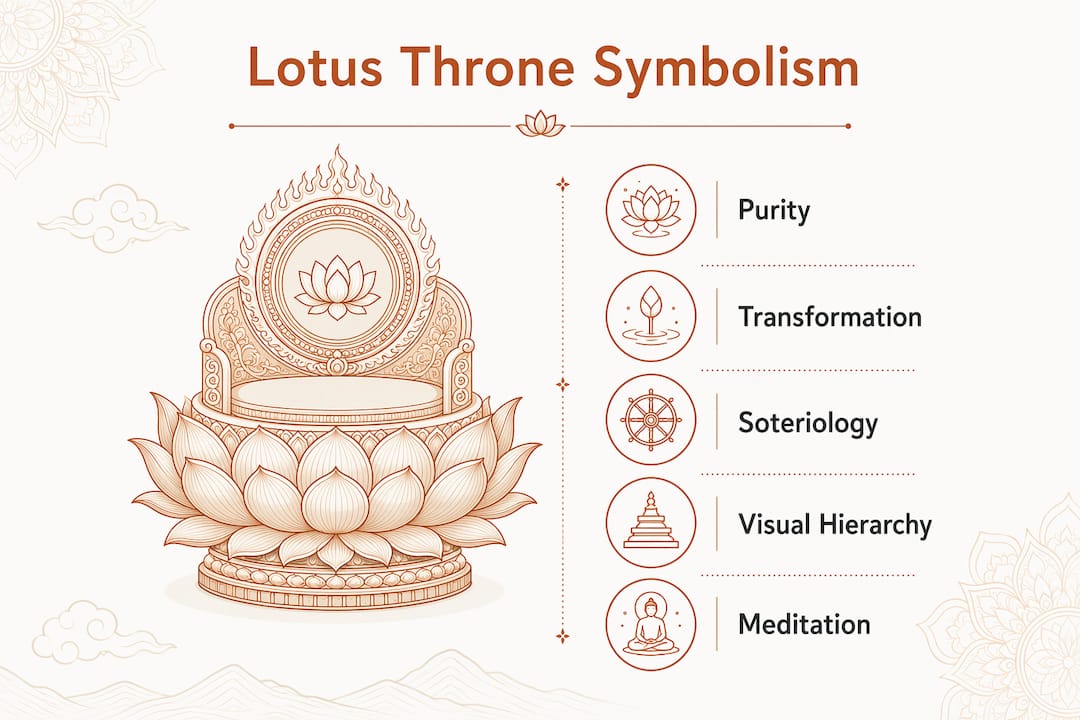
How to read a lotus throne visually: common forms and motifs
Recognizing a lotus throne requires knowing its main structural types. Each carries different iconographic weight and regional associations.
Single lotus. A single open flower, petals fanning outward, forms the seat. This is the simplest form and appears across all periods and regions.
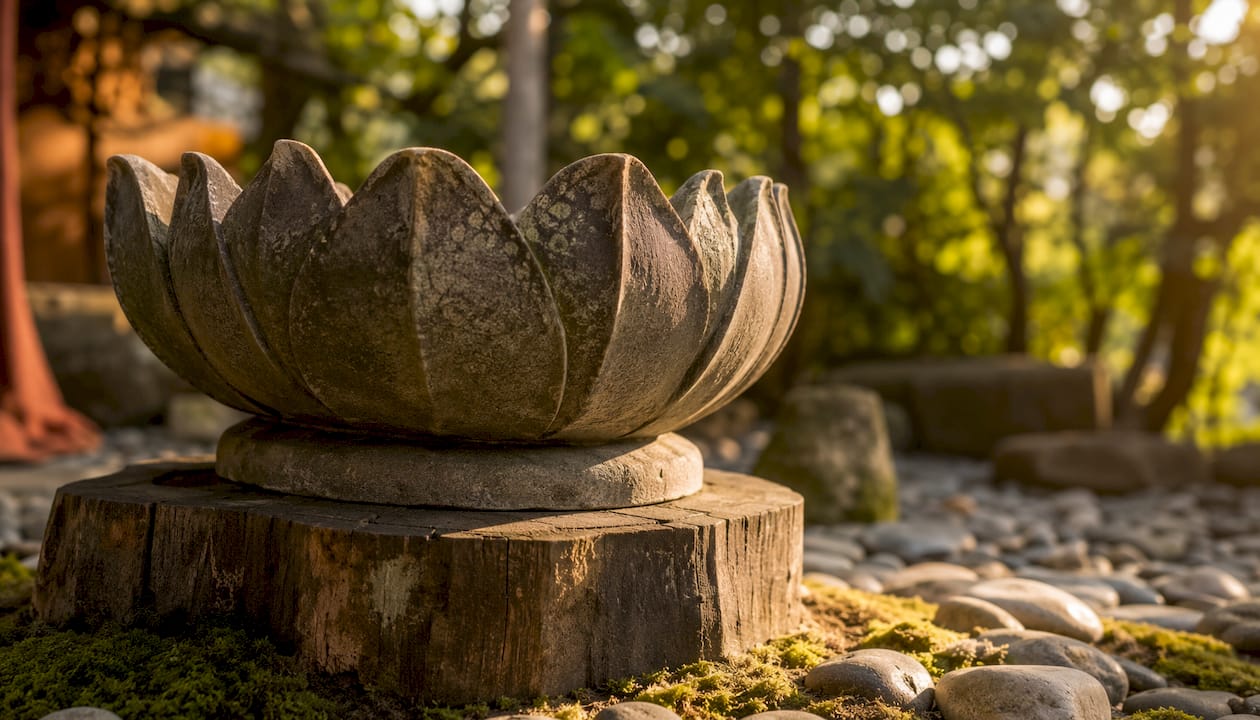
Double-lotus (vishvapadma). The most common historical sculptural form. Petal tiers rise and fall from a central median divider, creating a symmetrical, cushion-like profile. Pala bronzes from Bengal and Bihar frequently use this type, often with deeply undercut petals that cast strong shadows.
Seed-head or flat-top cushion. The top surface of the throne represents the lotus seed pod rather than the open flower. High-quality traditional pieces often show tiny incised seed holes on this surface, a detail that signals adherence to iconographic convention.
Naturalistic painted thrones. East Asian Buddhist painting, particularly in China and Japan, often renders the lotus more realistically, with individual petals showing veining and color gradation rather than the schematic carving of South Asian sculpture.
Diagnostic visual cues to check:
- Petal count and arrangement: single versus double tier, rising versus falling petals
- Undercutting depth: deeply undercut petals suggest Pala or Tibetan workshop traditions
- Seed-hole incisions on the flat top surface
- Secondary supports: stalks emerging from water, naga figures, or elephants beneath the base
- Petal tip treatment: rounded, pointed, or curled tips vary by region and period
- Presence of a median band or dividing line between petal tiers (diagnostic for vishvapadma)
A Gandharan Buddha on a double-lotus base typically shows relatively shallow petal carving in schist or stucco, with petals arranged in a single upward-facing tier. Compare that to a Pala bronze from the 9th–12th century, where the double-lotus is tightly worked with deeply undercut petals, a narrow waist, and sometimes a band of beading at the median. East Asian lacquered wood thrones from the Tang or Song periods may show painted petals in red and gold with no undercutting at all, the form communicated through color rather than relief.
What the lotus throne means doctrinally and meditatively
The lotus throne’s symbolic function in Buddhist thought operates on several levels simultaneously, and collapsing them into a single meaning misrepresents how the tradition actually uses the image.
The most direct layer is visible purity. The lotus rises unstained from muddy water, and the Aṅguttara Nikāya uses this image explicitly to describe the Buddha’s relationship to the world: present in it, not contaminated by it. Placing a Buddha or Bodhisattva on a lotus throne makes that claim visible without a word of text. The throne is the argument.
The second layer is ontological: the throne signals transformation and birth. Buddhas and Bodhisattvas are frequently depicted as born from or seated within a lotus, marking their emergence as categorically different from ordinary human birth. This is not metaphor in a loose sense. It is a precise doctrinal claim about the nature of enlightened beings, rendered in the material language of sculpture.
The third layer is soteriological. The lotus throne placed beneath a teaching figure reminds practitioners that the path leads to this same condition: unstained, elevated, fully awake. The throne is a visual instruction about where practice is headed.
In Vajrayana traditions, the lotus throne is further internalized. Texts and commentaries locate the lotus at the heart center, identifying it as the seat of mind and the ground of awakening within the practitioner’s own body. This interiorization connects the external throne seen on a statue to the internal visualization practices central to tantric Buddhist iconography elements.
Symbolic layers summarized:
- Visible purity: unstained growth from mud, a canonical Pali Canon metaphor
- Ontological emergence: birth and transformation of enlightened beings
- Soteriological direction: the path’s destination made visible
- Vajrayana interiorization: the heart-seat of mind in meditative practice
How the lotus throne changes across regions and periods
Stylistic variation in lotus thrones is not random. Regional workshops developed recognizable conventions, and those conventions are now primary tools for attribution and dating.
| Region / Period | Approximate Date Range | Diagnostic Features |
|---|---|---|
| Gandhara (Greco-Buddhist) | Late 2nd–3rd century CE | Single or shallow double-lotus in schist/stucco; minimal undercutting; rounded petals |
| Gupta India | — | Elegant single-lotus; petals with defined tips; stone or bronze; restrained detail |
| Pala (Bengal/Bihar) | 8th–12th century CE | Deep double-lotus (vishvapadma); strongly undercut petals; beaded median band; bronze |
| Tibetan | — | Double-lotus with gilded bronze; seed-hole incisions common; elaborate secondary decoration |
| Tang/Song China | 9th–12th century CE | Painted or lacquered wood; naturalistic petals; color-differentiated tiers; less undercutting |
| Southeast Asia (Khmer, Thai) | 9th–12th century CE | Stylized single or double-lotus in sandstone or bronze; regional petal profiles |
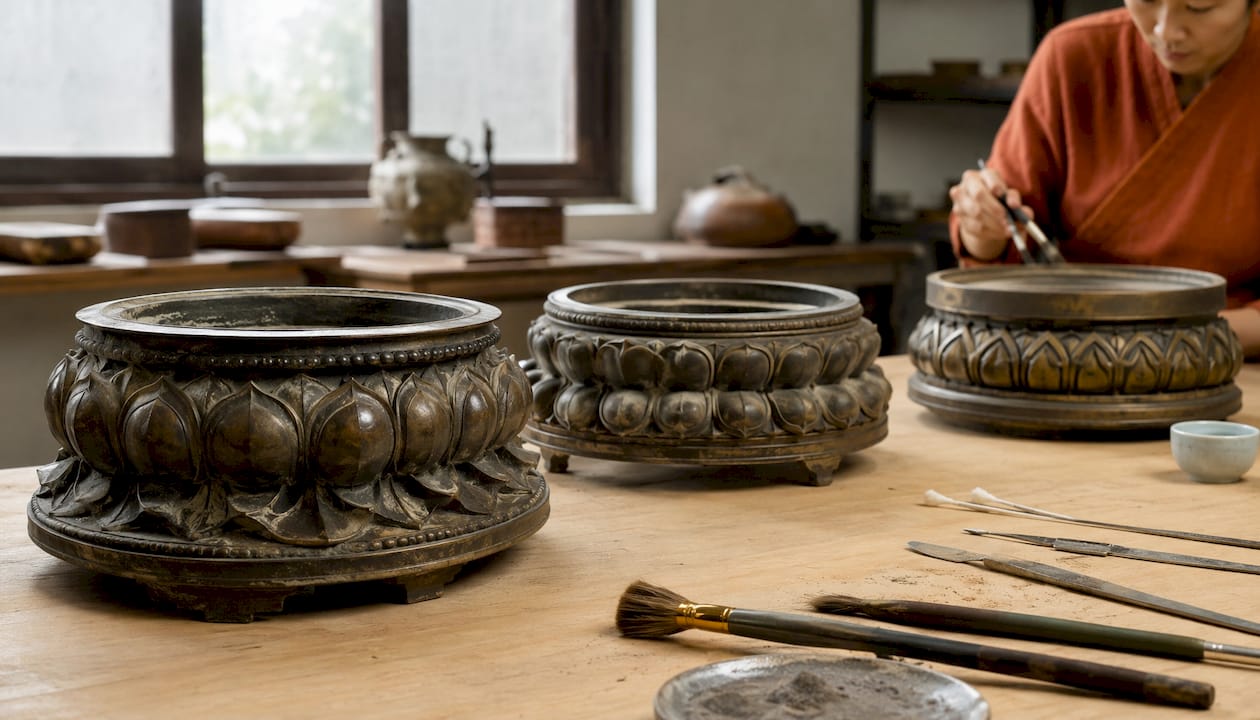
Petal treatment is the single most reliable visual marker. Deeply undercut petals in bronze almost always point to a South Asian or Tibetan workshop. Simplified, low-relief petals in sandstone suggest Khmer or Thai origin. The sacred lotus motif became more naturalistic as it moved into East Asian painting traditions, while sculpture across all regions retained varying degrees of stylization.
Stylization is intentional, not a sign of lesser skill. Art historians stress that petal treatment is a deliberate workshop choice and a key signal specialists use to authenticate and date pieces. A simplified petal profile on a Khmer sandstone throne is not a deficiency; it is a regional convention.
One critical distinction: not every elaborate throne base is a lotus throne. Scholarship differentiates the lotus throne from the bhadrapīṭha, an auspicious throne with roots in Indian kingship iconography. The bhadrapīṭha appears on Buddha footprints and coins and carries different symbolic associations tied to the eight auspicious signs. Context, object type, and inscriptions all inform correct identification.
Regional attribution checklist:
- Petal undercutting depth and profile
- Presence of a median band (vishvapadma indicator)
- Material: bronze, stone type, lacquered wood
- Secondary supports and decorative bands
- Seed-hole incisions (more common in Tibetan and some Pala pieces)
Materials, construction techniques, and authentication cues
Lotus thrones appear in every major sculptural medium used across Buddhist Asia, and each material leaves its own set of authentication markers.
Lost-wax bronze is the dominant medium for portable devotional figures from South Asia, Tibet, and Southeast Asia. The lotus throne is cast as part of the figure or separately attached. Look for casting seams at the join between throne and figure, porosity patterns consistent with traditional alloy compositions, and patina that develops uniformly across both throne and figure surfaces. A throne with fresh, bright metal where it meets an aged figure is a warning sign.
Carved stone thrones in schist (Gandhara), sandstone (Khmer, Thai), and granite (South India) show tool marks on petal surfaces. Traditional carving leaves consistent chisel or punch marks; modern reproductions often show rotary tool marks under magnification.
Lacquered wood thrones from East Asia require attention to the lacquer layer sequence and the wood substrate. Authentic pieces typically show cracking and loss patterns consistent with age and humidity cycling. The wood grain beneath damaged lacquer should show natural aging.
Seed-hole incisions on the flat seed-head surface are a high-value detail. Their presence on a carved or cast piece points to adherence to traditional iconographic conventions. Collectors should look beyond decorative petals to these seed-head details and undercutting, which more reliably indicate traditional carving and casting methods.
Authentication cues to document:
- Patina consistency across throne and figure
- Tool mark type and distribution on carved petals
- Seed-hole incisions on seed-head surfaces
- Join lines between separately cast throne and figure
- Casting porosity pattern and alloy color
Pro Tip: When requesting provenance documentation, ask specifically for prior auction or dealer catalog records that include the lotus throne base in their physical description. A throne described in a catalog from before 1970 carries significant provenance weight under current cultural property frameworks. Photograph the underside of the throne, the join line, and any seed-hole detail before purchase.
For pieces where visual inspection is inconclusive, scientific testing adds a complementary layer. X-ray fluorescence (XRF) analysis of bronze alloy composition can narrow regional origin. Radiocarbon dating of organic supports (wood, lacquer) provides a date range for the substrate. Thermoluminescence testing applies to ceramic or terracotta elements. These methods complement connoisseurship; they do not replace it. A Buddhist art collection guide that integrates both visual and technical analysis gives the most defensible attribution.
How the lotus throne functions in ritual, shrine layouts, and meditation
In a temple or household shrine, the lotus throne does more than support a figure. It establishes visual hierarchy. The central icon, elevated on its throne, sits above offering vessels, incense holders, and secondary figures. That elevation is intentional: the throne physically enacts the doctrinal claim that the figure above it has transcended ordinary existence.
Ritual use reinforces this. Offerings of flowers, water, and light are directed toward the figure on the throne, not the throne itself. During circumambulation, practitioners move around the entire composition, keeping the lotus-throne figure to their right. During visual contemplation, the throne anchors the gaze before it travels upward to the figure’s hands, face, and crown.
The connection between the lotus throne and the seated meditation posture (padmasana, or lotus position) is direct and intentional. A figure seated in padmasana on a lotus throne presents a doubled lotus image: the body’s posture mirrors the throne’s form. This visual reinforcement is not accidental. It communicates that the practitioner’s own seated posture participates in the same symbolic field as the throne.
For respectful display in private settings, the lotus-throne figure should be placed at or above eye level when seated, on a clean surface, and oriented to face the room’s primary direction of activity. Detailed guidance on respectful display of Buddhist art covers placement protocols that align with traditional shrine conventions.
How the lotus throne connects with other Buddhist symbols
The lotus throne does not appear in isolation. It functions within a broader system of Buddhist iconographic elements, and understanding its relationships with other symbols clarifies what any given composition is communicating.
Lotus throne vs. vajra throne. The vajra throne (vajrasana) at Bodh Gaya marks the specific spot where the historical Buddha attained enlightenment under the Bodhi tree. It is a place-specific, historical marker. The lotus throne is a universal attribute of divine presence, applicable to any Buddha or Bodhisattva in any context. The two can appear together: a figure seated in vajrasana may also be depicted on a lotus base.
Lotus throne and the Dharmachakra. The Dharmachakra), the Wheel of the Law, often appears alongside lotus-throne figures to signal the teaching function. A Buddha in dharmachakra mudra (turning the wheel gesture) on a lotus throne combines the symbol of enlightened presence with the symbol of active teaching.
Lotus throne and the Bodhi tree. Early Buddhist art, before figural representation became standard, used the Bodhi tree as a stand-in for the Buddha’s presence. When figural images arrived, the lotus throne took on a parallel function: both mark the location of enlightened being. Narrative scenes sometimes show both together.
Lotus throne and the ashtamangala. The eight auspicious symbols (ashtamangala) include the lotus as one of the eight. In composite iconographic programs, a lotus-throne figure may be surrounded by the full set of auspicious symbols, compounding the visual statement about the figure’s qualities.
Quick reference:
- Lotus throne: universal marker of divine presence and purity
- Vajra throne: site-specific marker of the historical enlightenment event
- Dharmachakra: symbol of the teaching; often paired with lotus-throne figures
- Bodhi tree: early aniconic stand-in for the Buddha; parallel function to the throne
- Ashtamangala: the lotus is one of eight; appears in composite iconographic programs
Avalokiteshvara, the Bodhisattva of compassion, is one of the figures most consistently depicted on a lotus throne across all Buddhist traditions. In Tibetan, Chinese, and Southeast Asian art, Avalokiteshvara’s lotus throne often carries additional lotus flowers in the figure’s hands, compounding the symbol. The Mahayana visual tradition treats this layering as standard compositional practice.
Where to study authoritative lotus throne examples
Three American museum collections offer the deepest publicly accessible holdings for lotus-throne study, each with distinct strengths.
Metropolitan Museum of Art, New York. The Met’s South and Southeast Asian art galleries hold a substantial range of bronze and stone figures on lotus thrones spanning Gandharan, Pala, Khmer, and Thai traditions. The online collection database includes accession records, provenance histories, and high-resolution photography. For lotus-throne study, search the collection by medium (bronze) and culture (Pala, Khmer) to locate pieces with detailed catalog entries. The Met’s published catalog essays on South Asian bronzes are citation-grade scholarship.
Rubin Museum of Art, New York. The Rubin’s collection focuses on Himalayan art, making it the strongest American resource for Tibetan and Nepalese lotus-throne examples. The museum has published scholarship on the lotus as a sacred symbol of transcendence, and its object records typically include iconographic analysis alongside provenance data. Tibetan gilded bronze figures with double-lotus thrones and seed-hole incisions are well represented.
Asian Art Museum, San Francisco. The Asian Art Museum holds significant Chinese, Korean, Japanese, and Southeast Asian Buddhist sculpture, offering the broadest geographic range of any American collection for lotus-throne comparison. Its online collection allows filtering by culture and medium, and the museum publishes accessible interpretive materials alongside technical catalog data.
Practical study recommendations:
- Use each museum’s online collection search to filter by medium and culture before visiting
- Request published catalog essays or object files for specific accession numbers when available
- Note provenance entries carefully: pre-1970 collection histories carry the most weight under current cultural property standards
- Compare petal treatment, median bands, and seed-head details across objects from different regions using the museum’s high-resolution photography
- Follow each museum’s citation guidelines when quoting object records in academic work
For collectors seeking study exemplars beyond museum walls, HDAsianArt’s curatorial pages provide individually researched descriptions and expert photography of authenticated pieces, including Southeast Asian Buddhist sculpture with documented lotus-throne bases.
Key Takeaways
The lotus throne is the single most consistent marker of divine presence in Buddhist art, combining botanical symbolism, doctrinal meaning, and regional craft traditions into one identifiable form.
| Point | Details |
|---|---|
| Canonical definition | The lotus throne represents Nelumbo nucifera and is the standard pedestal for Buddhas and Bodhisattvas across Buddhist art. |
| Primary symbolic meaning | Purity, enlightenment, and spiritual elevation, grounded in the Aṅguttara Nikāya metaphor of the unstained lotus. |
| Key visual type | The double-lotus (vishvapadma) with rising and falling petal tiers is the most common historical sculptural form. |
| Authentication priority | Check seed-hole incisions, petal undercutting depth, patina consistency, and join lines between throne and figure. |
| Study resources | Metropolitan Museum of Art, Rubin Museum of Art, and Asian Art Museum, San Francisco hold the strongest American holdings. |
A gallery perspective on reading lotus thrones
Most collectors focus on the figure seated above the throne. The throne itself tends to get treated as a base, a support, something secondary. That is a mistake, and it is one that costs collectors real money and real understanding.
The lotus throne is where the most reliable authentication information lives. A figure’s face can be recast or restored without obvious evidence. The throne’s petal undercutting, seed-hole incisions, and casting seams are far harder to fake convincingly, and they are far less likely to have been touched in a restoration. When HDAsianArt catalogs a bronze figure, the throne receives the same photographic and descriptive attention as the figure itself, because that is where the workshop’s hand is most legible.
There is also a doctrinal point worth making plainly. The lotus throne is not decorative. Removing a figure from its original throne, or pairing a figure with a replacement throne from a different period or region, breaks the iconographic argument the object was made to communicate. A Pala-period bronze on a 20th-century replacement throne is not the same object it was. Provenance-conscious collectors should ask specifically whether the throne is original to the figure, and request any documentation that addresses that question directly.
The lotus flower’s significance in Buddhism runs deeper than most introductory accounts suggest. The throne is where that significance becomes structural, not just decorative. Reading it carefully is what separates a collector who understands what they own from one who simply owns it.
Selected sources and further reading
Primary and secondary sources used in this article:
- Lotus throne, Wikipedia: Baseline definition, Gandharan dating, vishvapadma description, and canonical symbolism. Useful for cross-referencing standard iconographic terminology.
- Sacred lotus in religious art, Wikipedia: Cross-cultural diffusion of the lotus motif and stylistic divergence between painting and sculpture traditions.
- Lotus throne, Tibetan Buddhist Encyclopedia: Vajrayana interiorization of the throne; seed-hole incision details; pedagogical function of the motif.
- The Enthroned Buddha in Majesty: an Iconological Study: Scholarly differentiation of lotus throne from bhadrapīṭha; composite iconographic programs; terminology precision.
- Lotus throne: Significance and symbolism, Wisdom Library: Cross-traditional significance in Buddhism, Vaishnavism, and Hinduism; doctrinal readings of the throne’s symbolic function.
- The Lotus Flower: Sacred Symbol of Transcendence, Rubin Museum of Art: Museum-level interpretive scholarship on the lotus as a sacred symbol; useful for Himalayan art context.
Evaluating sources: Museum object records and published catalog essays are the most reliable sources for provenance and attribution data. Wikipedia entries and encyclopedia articles are useful for terminology and cross-referencing but should not be cited as primary scholarship. Thesis-level academic work, such as the HAL thesis cited above, provides the most rigorous iconological analysis. Tertiary web summaries vary widely in accuracy; always trace claims back to a museum record or peer-reviewed publication before citing them.
HDAsianArt resources for deeper study:
- Asian religious art overview: Contextual framework for understanding how lotus-throne figures fit into broader collecting and exhibition practice.
- HDAsianArt gallery: Individually researched and authenticated pieces, including a Javanese Avalokiteshvara Bodhisattva statue with lotus-throne base, photographed and described to museum standards with worldwide insured shipping.
Recommended
- The Symbolic Splendor: The Profound Significance of the Lotus Flower i – HD Asian Art
- Tantric Buddhist Iconography: Meanings and Symbols Explained – HD Asian Art
- Vietnamese Buddhist Art Explained: History and Symbols – HD Asian Art
- The Role of the Bodhisattva Avalokiteshvara in Buddhist Art – HD Asian Art
