



Rare Buddhist Reliquary Art: Examples for Collectors
Rare Buddhist Reliquary Art: Examples for Collectors
Buddhist reliquary art sits at the intersection of devotion, diplomacy, and extraordinary craft. For historians and collectors, identifying genuine examples of rare Buddhist reliquary art requires understanding not just aesthetics but provenance, material culture, and ritual function. These objects were not made for display. They were buried, sealed, and consecrated. That context makes surviving examples all the more significant. This article presents specific, well-documented cases spanning centuries and continents, from Gandhāran gold to Vietnamese metalwork to Chinese printed scrolls, each offering a distinct window into Buddhist heritage art at its most concentrated.
Table of Contents
-
1. Examples of rare Buddhist reliquary art: The Bimaran Golden Casket
-
5. Subterranean votive reliquaries and why surviving examples are so rare
-
6. Provenance and the ethics of acquiring rare reliquary artifacts
Key takeaways
| Point | Details |
|---|---|
| Rarity defined by context | Age, burial history, and restricted provenance make Buddhist reliquaries scarcer than most sacred art categories. |
| Anthropomorphic imagery matters | The Bimaran Casket demonstrates how early Buddha representations on reliquaries mark pivotal shifts in devotional practice. |
| Relics extend beyond containers | Sacred texts like the Diamond Sutra qualify as reliquary art, expanding what collectors and historians should examine. |
| Material signals sacred status | Schist, rock crystal, and gold each carry distinct symbolic weight in Buddhist reliquary traditions. |
| Provenance is non-negotiable | International heritage law and ethical stewardship now shape every serious acquisition decision. |
1. Examples of rare Buddhist reliquary art: The Bimaran Golden Casket
The Bimaran Casket is the starting point for any serious survey of rare reliquary artifacts. Dated to the mid-1st century CE, this small gold reliquary stands approximately 7 cm tall and was crafted using the repoussé technique, a process of hammering metal from the reverse to create raised relief imagery. Rubies set in the arched niches amplify its status as a prestige object.
What separates the Bimaran Casket from comparable finds is its iconographic content. The figures in relief show the Buddha flanked by Brahma and Indra, with devotees completing the register. This is one of the earliest anthropomorphic Buddha images on any reliquary, marking a transition from purely symbolic representation toward direct figural devotion. That shift had profound consequences for Buddhist visual culture across Asia.
The casket was discovered inside a stupa at Bimaran in present-day Afghanistan and later acquired by the British Museum, where it remains. Its Gandhāran origin reflects the cultural synthesis of Hellenistic, Persian, and Indian artistic traditions that defined the region.
Key features of the Bimaran Casket:
-
Material: High-purity gold with ruby inlay
-
Technique: Repoussé relief with fine chasing
-
Iconography: Buddha, Brahma, Indra, and lay devotees
-
Provenance: Stupa deposit, Bimaran, Afghanistan
-
Current location: British Museum, London
Pro Tip: When studying Gandhāran reliquaries, cross-reference the iconographic register with contemporaneous coin imagery. Kushan coinage from the same period shows parallel figural conventions, helping date and authenticate pieces without relying solely on stylistic analysis.
2. Vietnamese Nhan Tower reliquary box
Vietnam’s contribution to Buddhist heritage art is frequently underrepresented in Western scholarship. The Nhan Tower reliquary box, dated to the 7th or 8th century CE, corrects that gap. This small rectangular metalwork piece measures 8 cm by 5 cm by 5.5 cm and was designated a national treasure by the Vietnamese government, a classification that restricts its movement and signals its irreplaceable cultural status.
The box was produced during a period of Chinese administrative control over northern Vietnam, and that influence registers clearly in the metalwork. The lotus motifs engraved on its surface carry dual significance: lotus symbolism in Buddhist iconography represents purity and enlightenment, while the technical execution reflects Tang dynasty craft standards adapted to local religious needs.
What makes this piece rare is the combination of factors. Metalwork reliquaries from this region and period are extremely scarce. Most comparable objects were melted down, lost to conflict, or remain unexcavated. The Nhan Tower box survived because of its ritual burial context within a Cham tower structure, a form of architectural stupa that protected it for over a millennium.
-
Dimensions: 8 cm x 5 cm x 5.5 cm
-
Date: 7th to 8th century CE
-
Cultural context: Cham civilization under Chinese influence
-
Designation: Vietnamese national treasure
-
Decorative motifs: Lotus, geometric metalwork borders
3. The Diamond Sutra scroll as reliquary object
What is a reliquary? The conventional answer points to a container for physical remains. Buddhist doctrine, however, extends the concept of relics to include sacred texts and objects associated with enlightened beings. The Diamond Sutra operates within that expanded definition.
Printed in 868 CE, the Diamond Sutra is the world’s oldest dated printed book. It was discovered in Dunhuang’s Library Cave, Mogao Cave 17, sealed behind a plastered wall alongside tens of thousands of manuscripts. The scroll itself depicts the Buddha in conversation with his disciple Subhuti, making it both a doctrinal text and a visual representation of the Buddha. That dual function places it firmly within the category of examples of sacred art.
For collectors and historians, the Diamond Sutra raises a productive methodological challenge. If a text was sealed, venerated, and preserved as a sacred object rather than circulated as a reading copy, it functioned as a reliquary. The cave itself served as a collective reliquary space.
-
Date: 868 CE (colophon dated)
-
Discovery site: Dunhuang, Mogao Cave 17, China
-
Content: Buddha’s discourse on non-attachment with figural frontispiece
-
Current location: British Library, London
-
Significance: Oldest dated printed book and a primary example of sacred art as relic
4. Schist Buddha figures from the 3rd century
Stone reliquaries occupy a distinct category within Buddhist art examples. Schist, a metamorphic rock quarried extensively in the Gandhāra region, was the preferred medium for sculptural reliquary art from roughly the 2nd through 4th centuries CE. The 3rd century schist Buddha figures that survive in museum collections represent a material tradition that was labor-intensive, regionally specific, and largely discontinued after the Kushan period.
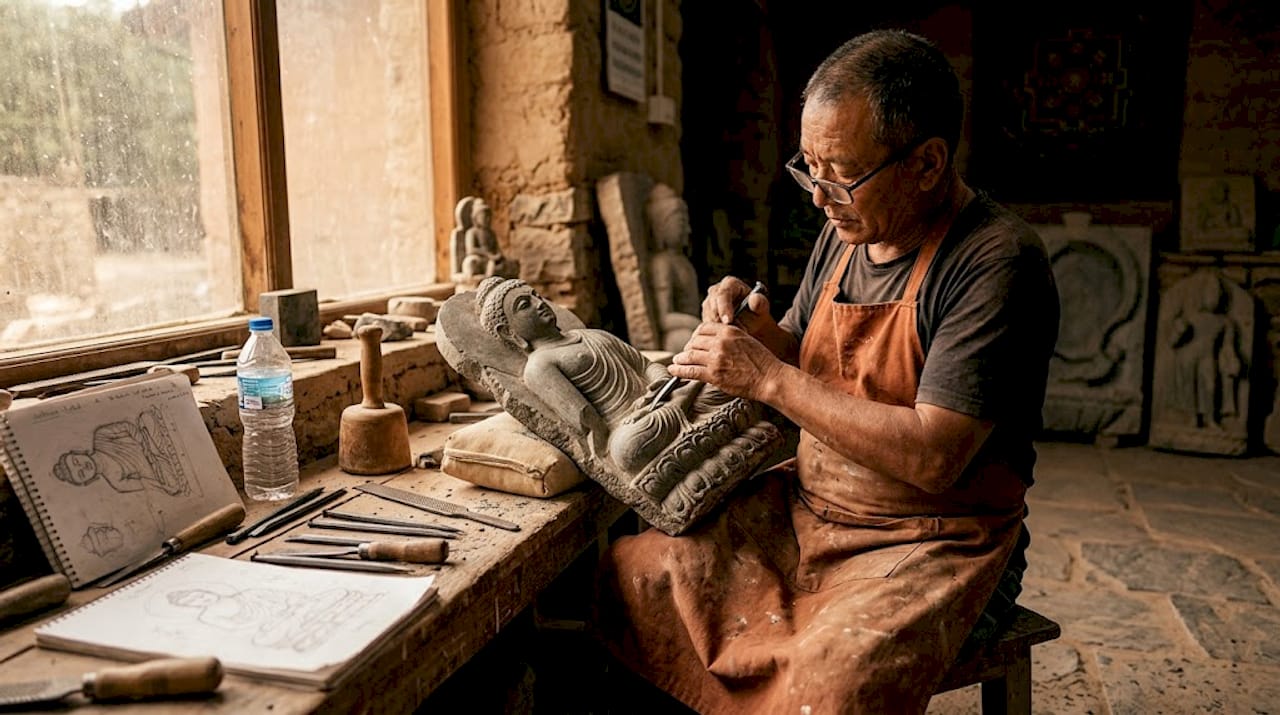
Schist carving required skilled artisans working with hard stone to produce fine drapery folds, facial features, and symbolic hand gestures. The resulting objects were not decorative. They were deposited within stupas as merit-generating votive objects, intended to accumulate spiritual benefit for the donor across lifetimes.
Rock crystal presents a different case. Miniature stupas carved from translucent rock crystal appear in collections from Sri Lanka, Thailand, and the Gandhāra region. Their transparency was not incidental. Crystal was associated in Buddhist cosmology with purity and the clarity of enlightened mind.
| Material | Region | Period | Symbolic meaning |
|---|---|---|---|
| Schist | Gandhāra (Pakistan/Afghanistan) | 2nd to 4th century CE | Permanence, votive merit |
| Rock crystal | Sri Lanka, Thailand, Gandhāra | 3rd to 10th century CE | Purity, clarity of mind |
| Gold | Gandhāra, India, Southeast Asia | 1st to 8th century CE | Divine status, royal patronage |
| Bronze | Cambodia, Thailand, Vietnam | 7th to 14th century CE | Ritual function, temple use |
5. Subterranean votive reliquaries and why surviving examples are so rare
Understanding the rarity of Buddhist reliquary artifacts requires understanding their intended fate. Most were never meant to be seen again. Rare reliquaries were buried within stupas as permanent deposits, sealed at the moment of consecration and left in situ indefinitely. The act of sealing was itself the ritual. Survival depended on accident: stupa collapse, archaeological excavation, or looting.
This burial practice explains why authentic examples are so scarce. A reliquary that was never meant to be removed from its sacred context carries a different kind of authenticity than a decorative object made for display. When one surfaces in a museum or private collection, the chain of custody from stupa to current holder is almost always incomplete.
The Bimaran Casket’s provenance illustrates this clearly. It was removed from its stupa context in the 19th century under colonial archaeological conditions that would not meet modern standards. That history does not diminish its art historical value, but it does complicate its status as a model for contemporary acquisition.
6. Provenance and the ethics of acquiring rare reliquary artifacts
Modern collectors and institutions face a substantially different environment than their predecessors. International heritage frameworks now govern the movement of Buddhist relics across borders, and high-profile repatriation cases have reshaped expectations. India and Sri Lanka have conducted formal relic exchanges as diplomatic gestures, treating these objects as living cultural property rather than historical artifacts.
For researchers and collectors, the practical implications are significant:
-
Verify export documentation. Any piece leaving its country of origin after 1970 requires documented legal export under UNESCO convention standards.
-
Trace stupa or temple context. Reliquaries with documented archaeological provenance, even incomplete, are more defensible than those with gaps.
-
Consult national registers. Countries including India, Sri Lanka, Cambodia, and Vietnam maintain registers of protected cultural property.
-
Engage specialist scholars. Authentication of rare reliquary artifacts requires expertise in regional metalwork, iconography, and material analysis.
-
Prioritize ethical stewardship. Contemporary practitioners view reliquaries as living sacred objects, not static museum pieces. Acquisition decisions carry cultural weight beyond legal compliance.
Pro Tip: Request thermoluminescence testing for ceramic reliquary vessels and X-ray fluorescence analysis for metal pieces. These non-destructive methods provide material dating and compositional data that support both authentication and provenance arguments.
My perspective on rare Buddhist reliquary art
I’ve spent years examining Buddhist reliquary art across museum collections and private holdings, and the most persistent misconception I encounter is the idea that rarity equals age. Age matters, but it’s not the primary criterion. I’ve seen 19th-century reliquaries of extraordinary craft complexity that carry more scholarly significance than poorly documented 1st-century fragments.
What actually defines significance, in my experience, is the integrity of the object’s ritual context. A reliquary that can be traced to a specific stupa, a specific consecration event, or a specific patronage tradition tells a complete story. One that cannot tells only half of one.
The Bimaran Casket is celebrated not just because it is old but because it is documented within a coherent devotional system that art historians can reconstruct. That reconstructability is what makes it useful. Collectors who chase age alone miss the point. The question to ask about any rare reliquary artifact is not “How old is this?” but “What does this object tell us about the people who made it, buried it, and believed in it?”
The field is also changing. Repatriation debates are forcing a long-overdue reckoning with how Western institutions acquired Buddhist heritage art. That reckoning is not a threat to scholarship. It is an invitation to do better scholarship, with more partners, in more places.
— James, HDAsianArt.com
Explore authenticated Buddhist art at Hdasianart
Hdasianart offers a curated selection of antique Buddhist statues, sculptures, and temple art sourced from Cambodia, Thailand, Sri Lanka, Vietnam, and beyond. Each piece in the collection is individually researched and documented by specialists, with detailed provenance notes, high-resolution photography, and material analysis. For collectors and historians who want to move beyond survey articles and engage directly with authenticated objects, the Hdasianart collection provides a reliable starting point. The gallery’s focus on museum-quality craftsmanship and long-term collectability makes it a practical resource for both serious acquisition and comparative research. Worldwide insured shipping is available on all pieces.
FAQ
What is a reliquary in Buddhist art?
A reliquary is a container or object designed to house sacred remains or items associated with the Buddha or revered Buddhist figures. Buddhist doctrine extends the definition to include sacred texts and objects touched by enlightened beings.
Why are Buddhist reliquaries so rare?
Most Buddhist reliquaries were sealed within stupas as permanent votive deposits, never intended for retrieval. Surviving examples reached collections only through archaeological excavation, stupa collapse, or historical looting.
What makes the Bimaran Casket significant?
The Bimaran Casket is significant as one of the earliest anthropomorphic Buddha images on a reliquary, demonstrating a shift from symbolic to figural representation in Gandhāran Buddhist art during the 1st century CE.
How do collectors verify authentic Buddhist reliquary art?
Authentication requires material analysis such as X-ray fluorescence or thermoluminescence testing, iconographic study, and documented provenance tracing the object’s chain of custody from its original ritual context.
Can sacred Buddhist texts qualify as reliquary art?
Yes. The Diamond Sutra, printed in 868 CE and sealed in a cave for centuries, is a primary example of a sacred text functioning as a reliquary object within Buddhist devotional practice.
