



Nyorai vs Bodhisattva Statues: Key Differences
Nyorai vs Bodhisattva Statues: Key Differences
Quick Summary
Nyorai vs bodhisattva comes down to status and appearance: a Nyorai is a fully awakened Buddha shown in plain monastic robes with no jewelry, while a bodhisattva delays final enlightenment to help others and wears crowns, necklaces, and flowing ornaments. If a statue wears jewelry and a crown, it is almost certainly a bodhisattva.
- Nyorai translates as thus come or thus gone, a title for one who has reached full awakening.
- Bodhisattva statue meaning is about movement, not arrival, since the figure keeps helping others.
- Jizo breaks the robe rule, appearing as a plain monk despite being a bodhisattva.
- Work in this order: head, hands, held object, posture, then pedestal.
- Wisdom Kings, known as Myōō, are neither Nyorai nor bodhisattva.
Table of Contents
- Nyorai vs Bodhisattva Statues: A Quick Comparison
- Nyorai Statue Meaning: Fully Awakened Buddhas
- Bodhisattva Statue Meaning: Compassion on the Path
- Nyorai vs Bodhisattva Appearance: Robes, Crowns, and Attributes
- Amida Nyorai and Kannon: A Named Comparison
- Exceptions and Ambiguous Iconography
- A Visual Identification Checklist for Collectors
- Conclusion
- Frequently Asked Questions
Nyorai vs Bodhisattva Statues: A Quick Comparison
Nyorai vs bodhisattva is the first distinction worth learning when you start identifying Buddhist statues, because it explains almost everything else you see in the carving.
Here is the short answer. Nyorai wear plain monastic robes with no jewelry. Bodhisattvas wear crowns, necklaces, and flowing ornaments.
Below, we break down the meaning behind each figure type, the appearance clues that separate them, and the exceptions that trip up even experienced buyers.
| Feature | Nyorai | Bodhisattva |
|---|---|---|
| Spiritual status | Fully awakened Buddha | Being on the path, helping others |
| Japanese name | Nyorai | Bosatsu |
| Clothing | Plain monastic robes | Elaborate garments, flowing drapery |
| Ornaments | None | Crowns, necklaces, armlets |
| Hair | Short curls or snail-shell coils | Often piled high under a crown |
| Role | Teacher, end point of the path | Compassionate guide, attendant figure |
| Common examples | Amida, Shaka | Kannon, Jizo |
Nyorai Statue Meaning: Fully Awakened Buddhas
Nyorai statue meaning centers on completion. The word translates as "thus come" or "thus gone," a title for one who has reached full awakening and will not be reborn.
The Onmark Productions reference on Nyorai and Tathagata explains that Nyorai represent the endpoint of the spiritual path. They have finished the work.
Practically, this is why Nyorai look so austere. The plain robe signals renunciation. Nothing decorative competes with the figure itself.
Bodhisattva Statue Meaning: Compassion on the Path
Bodhisattva statue meaning is about movement, not arrival.
This role explains the ornamentation. A bodhisattva is still active in the world, so the figure is dressed for it: crowns, silk garments, jeweled necklaces.
Kannon and Jizo are the two bodhisattvas you will see most often. Both are approached for help, comfort, and protection. That devotional relationship fits the bodhisattva role exactly.
Nyorai vs Bodhisattva Appearance: Robes, Crowns, and Attributes
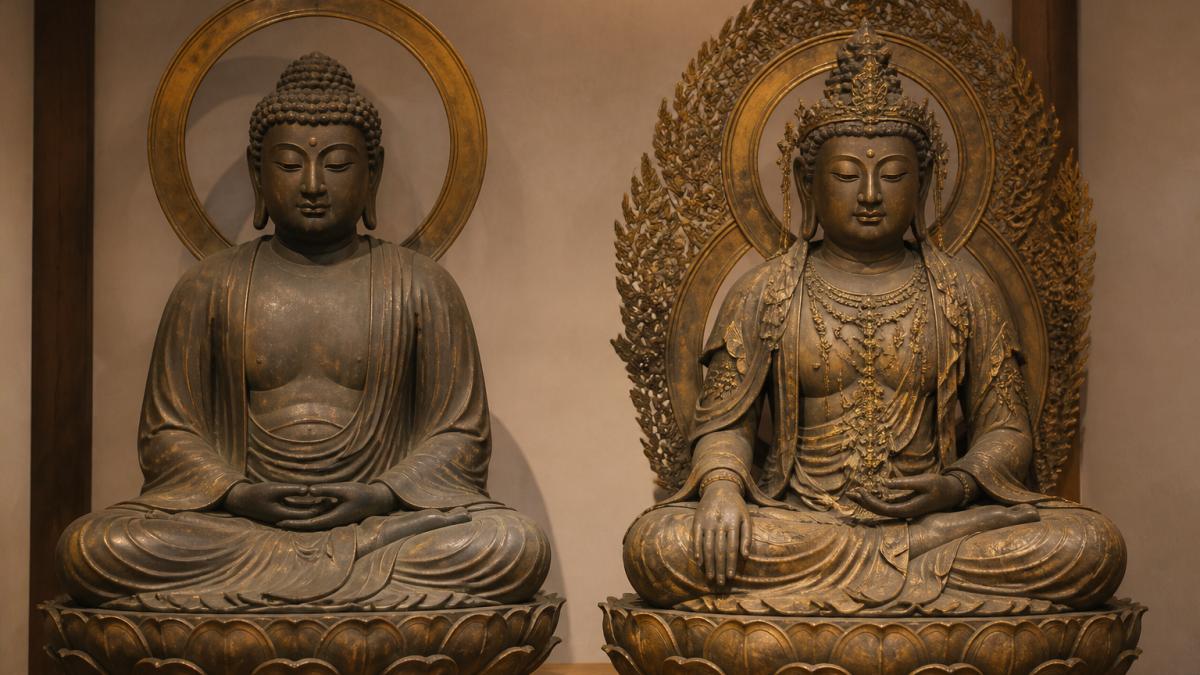
Nyorai vs bodhisattva appearance is usually taught as a single rule: plain robes mean Nyorai, crowns and jewelry mean bodhisattva. That rule is useful, but it is also where most guides stop. Clothing is only the first layer.
Clothing and Ornamentation
The Nyorai robe is a monk's robe. It drapes in simple folds, often across one shoulder, with no crown and no jewelry. Bodhisattvas wear layered garments, elaborate crowns, and necklaces that catch the light.
Treat this as a strong first signal, not a verdict. A crown almost always means bodhisattva. A bare head and plain robe usually means Nyorai, but Jizo and a few other figures break that pattern, which is why the attributes below matter.
Facial Features and Physical Form
Both types share serene expressions, downcast eyes, and elongated earlobes. The difference is in the hair and head. Nyorai usually show short curls or snail-shell coils, plus the ushnisha, the rounded cranial bump that marks a fully awakened being. Bodhisattvas often have hair piled high beneath a crown, and many wear a small image of their teacher or a related Buddha inside the crown.
Posture: Seated Versus Standing
Posture is one of the most reliable secondary clues. Nyorai are most often seated in meditation or in the earth-touching gesture, and when standing they tend to stand alone at the center of a composition. Bodhisattvas appear both seated and standing, but they are far more likely to be shown standing as attendants flanking a central Nyorai. A standing figure to the left or right of a seated Buddha is usually a bodhisattva.
Hand Gestures and Held Objects
Hand gestures, called mudras, and held objects narrow identification further. Common Nyorai gestures include the meditation mudra with hands resting in the lap, the earth-touching gesture with one hand reaching down, and the teaching gesture with thumb and forefinger joined.
Bodhisattvas carry objects that point to their specific role. Kannon holds a lotus, a vase of pure water, or a willow branch. Jizo holds a staff with rings at the top and a wish-granting jewel.
Pedestals and Halos
Pedestals and halos add another layer. Nyorai commonly sit on a lotus pedestal, and Amida is sometimes shown on a lotus throne. Bodhisattvas also use lotus pedestals, but they are more likely to be shown on animals or clouds, as with Fugen's elephant and Monju's lion. Halos follow a similar pattern: Nyorai often have a simple circular halo or a flame-edged mandorla, while bodhisattvas may have a crown-mounted halo or a more elaborate composite halo.
Why the Attributes Beat the Robe Rule
The robe rule fails on Jizo, who appears as a plain monk despite being a bodhisattva, and it can fail on Nyorai shown in ornate contexts in some traditions. Attributes are more stable across periods and regions than clothing, because a held object or a hand gesture is tied to the figure's identity rather than to artistic fashion. When the robe and the attributes disagree, trust the attributes.
Amida Nyorai and Kannon: A Named Comparison
Amida Nyorai and Kannon make the distinction concrete better than any abstract rule. Amida is a Nyorai, the Buddha of infinite light associated with the pure land tradition. Kannon is a bodhisattva of compassion, and in many compositions Kannon stands beside Amida as an attendant.
The pairing is instructive. Amida sits at the center, robed simply, hands in a meditation or welcoming gesture. Kannon stands to the side, crowned and jeweled, holding a lotus.
A Figure-by-Figure Reference
The table below connects the general definitions to the figures you are most likely to see. Use it as a quick lookup when a statue's robe or crown leaves you unsure.
| Figure | Type | Japanese Name | Key Visual Tells |
|---|---|---|---|
| Shaka | Nyorai | Shaka Nyorai | Seated, earth-touching or meditation gesture, plain robe, snail-shell curls |
| Amida | Nyorai | Amida Nyorai | Seated or standing, welcoming gesture, simple halo, plain robe |
| Yakushi | Nyorai | Yakushi Nyorai | Seated, medicine jar in the left hand, right hand raised |
| Dainichi | Nyorai | Dainichi Nyorai | Seated, wisdom-fist gesture, often crowned in esoteric settings |
| Kannon | Bodhisattva | Kannon Bosatsu | Crowned, lotus or vase, flowing drapery, often standing as an attendant |
| Jizo | Bodhisattva | Jizo Bosatsu | Monk's robe, shaved head, staff with rings, wish-granting jewel |
| Monju | Bodhisattva | Monju Bosatsu | Sword and book, often riding a lion |
| Fugen | Bodhisattva | Fugen Bosatsu | Riding an elephant, often holding a lotus |
| Miroku | Bodhisattva | Miroku Bosatsu | Seated in contemplation, crown, sometimes a stupa in the crown |
Reading the Table in Practice
Start with the type column, then confirm with the visual tells. Shaka and Amida are the two Nyorai most collectors encounter, and both are usually seated and plainly robed.
On the bodhisattva side, Kannon and Jizo dominate. Kannon is the crowned, ornamented figure, while Jizo is the plain-robed monk who looks like a Nyorai until you see the staff and jewel.
Buying a Matched Pair
When you shop for a pair like Amida and Kannon, look for consistency in scale and finish. A well-matched set reads as a single devotional arrangement rather than two unrelated pieces. Check that the patina and the carving style are compatible, and that the attendant is slightly smaller than the central figure, which is the conventional proportion in temple groupings.
Exceptions and Ambiguous Iconography
The clothing rule has exceptions, and this is where most identification guides stop too early.
Jizo is the classic case. As a bodhisattva, Jizo is often shown as a simple monk with a shaved head, a staff, and no crown.
Wisdom Kings, known as Myōō, form a third category entirely. They have fierce expressions, flames, and multiple arms. They are neither Nyorai nor bodhisattva, so do not force them into either box.
A Visual Identification Checklist for Collectors
Use this checklist when you examine a statue in person or in photographs. Work through it in order and stop at the first clear answer.
- Check the head: is there a crown? If yes, likely a bodhisattva.
- Check the chest: any necklaces or armlets? Bodhisattva.
- Check the robe: plain and monastic, or layered and flowing? Plain points to Nyorai.
- Check the hair: short curls or piled high? Short curls point to Nyorai.
- Check the hands: what object is held? A staff or jewel may indicate Jizo.
- Check the expression: serene or fierce? Fierce points to a Wisdom King.
This checklist will not resolve every piece, but it handles the large majority. For anything ambiguous, ask for provenance documentation before you buy.
Conclusion
The differences between nyorai and bodhisattva statues come down to a simple visual language: plain robes versus ornament, arrival versus journey. Learn that rule, then learn the exceptions, and you can read most Buddhist sculpture with confidence.
At HD Asian Art, we curate Buddhist and Hindu statues with exactly this kind of context in mind. Our collection spans handpicked antique and contemporary pieces, with a specialty in Khmer and Southeast Asian sculpture, and every order ships free.
Frequently Asked Questions
What is the difference between a Nyorai and a bodhisattva?
A Nyorai is a fully awakened Buddha who has completed the spiritual path, while a bodhisattva is a being who has delayed final enlightenment to help others reach it. In Japanese Buddhist sculpture, this status shows up visually: Nyorai wear plain monastic robes, while bodhisattvas wear crowns, jewelry, and elaborate garments. Nyorai represent the destination of the path; bodhisattvas represent the journey and the compassion that carries others along it.
How can you tell a Nyorai statue from a bodhisattva statue?
Start with the clothing and ornaments. A Nyorai statue typically wears a simple monk's robe with no crown or jewelry, often with a plain halo behind the head. A bodhisattva statue usually wears a crown, necklaces, armlets, and draped silks. Then check the hands and attributes: Nyorai often show mudras like the teaching gesture, while bodhisattvas carry lotus blossoms, vases, or swords. When in doubt, look for adornment first, since it is the most reliable single clue.
Why are bodhisattva statues more adorned than Nyorai statues?
The adornment reflects spiritual role rather than wealth. Bodhisattvas are depicted as princely figures because they remain engaged with the world and with sentient beings, so crowns and jewelry signal their active compassion and their presence along the path. Nyorai have renounced worldly markers entirely, so plain robes signal completion, detachment, and full awakening. The contrast is deliberate: ornamentation shows continuing involvement, while simplicity shows the end of the journey.
Are all Nyorai statues depictions of the historical Buddha?
No. The historical Buddha, Shaka, is one Nyorai among several. Amida Nyorai, associated with the Pure Land tradition, and Dainichi Nyorai, the central figure in esoteric Buddhism, are distinct Nyorai with their own iconography and hand gestures. This matters when identifying a statue, because the mudra and the position of the hands often point to a specific Nyorai rather than to Shaka. Clothing alone tells you the category, not the individual figure.
What are some well-known examples of Nyorai and bodhisattva figures?
Among Nyorai, the most familiar are Shaka (the historical Buddha), Amida (central to Pure Land practice), and Dainichi (the cosmic Buddha of esoteric traditions). Among bodhisattvas, Kannon embodies compassion, Jizo protects travelers and children, and Monju represents wisdom. Pairings are common in temple settings, where bodhisattvas appear as attendants flanking a central Nyorai. Recognizing these named figures helps collectors read a statue's gesture, attribute, and placement together rather than relying on robes alone.

