



Museum-Quality Asian Art: Standards, Provenance & What Buyers Need to Know
Museum-Quality Asian Art: Standards, Provenance & What Buyers Need to Know
The phrase "museum quality" gets applied to Asian art so freely that it has started to lose meaning. You will see it on mass-produced resin reproductions, on bronze castings made last month in a tourist-district workshop, and on genuinely rare 18th-century sculptures that belong in institutional collections.
For a buyer, that ambiguity is not just frustrating - it is expensive. Understanding what museum quality Asian art actually means, how provenance is established, and which physical markers separate the real from the replicated is the difference between building a collection that appreciates in cultural and monetary value and accumulating expensive decorative objects that tell no story at all.
Table of Contents
- What "Museum Quality" Really Means
- Provenance in Asian Sculpture: Why It Is the Gold Standard
- Physical Authentication Markers Every Collector Should Know
- Regional Iconography Standards and Why They Matter
- Comparing Acquisition Approaches for Serious Collectors
- A Practical Buyer Checklist Before Any Purchase
- Frequently Asked Questions
- References
What "Museum Quality" Really Means
The term is not regulated by any governing body. That is the first thing serious collectors must accept. Unlike "organic" on a food label or "hallmarked" on silver, "museum quality" carries no legal definition. What it does carry, when used honestly, is a cluster of specific, verifiable attributes that any institutional collection would demand before acquiring a work.
At its core, a museum-quality piece meets four overlapping criteria: exceptional craftsmanship relative to its period and region of origin, authentic materials consistent with that period, documented or traceable ownership history, and iconographic accuracy that makes it a reliable representative of its cultural tradition. Remove any one of those four and you have something that may still be beautiful, but it no longer qualifies for the label in any meaningful sense.
The craftsmanship standard is worth dwelling on. Institutional conservators examine tool marks, casting seams, the consistency of surface treatment, and the handling of fine details, such as the fingers of a bronze bodhisattva or the flame motif of a Burmese Buddha's ushnisha. Mass-produced pieces show mechanical uniformity; genuinely hand-crafted works from skilled artisans show controlled variation, the kind that comes from a human hand working within a learned tradition rather than a mold pressed in a factory.
A piece earns the museum-quality label not through price alone, but through the convergence of authentic materials, period-accurate craftsmanship, and a traceable ownership history - each one independently verifiable.
Price is not a reliable proxy for quality in this market. Some of the most over-priced pieces available are recent workshop productions with artificially aged patinas. Some of the most under-appreciated pieces are genuine antiques that reached the market without extensive cataloguing. Knowing how to read a piece for itself - rather than relying on a seller's asking price as a quality signal - is the foundational skill for any collector of Asian religious sculpture.
Provenance in Asian Sculpture: Why It Is the Gold Standard
Provenance, the documented ownership history of an artwork, is the single most important factor in assessing the legitimacy and value of any Asian sculpture. It is also the factor most frequently fabricated, omitted, or simply absent from the market. Understanding what good provenance looks like, and what gaps in provenance suggest, is non-negotiable for serious buyers.
The 1970 Benchmark
The year 1970 is a defining threshold in the international art market. The 1970 UNESCO Convention on the Means of Prohibiting and Preventing the Illicit Import, Export and Transfer of Ownership of Cultural Property established the ethical and legal framework that major institutions now follow. The Association of Art Museum Directors (AAMD) and the American Alliance of Museums (AAM) both use 1970 as a provenance benchmark: works that can be shown to have been in Western collections before that date carry substantially more credibility and fewer legal risks than works with undocumented origins entering the market after it.
For collectors of Buddhist and Hindu sculpture, this has a direct practical implication. A piece with documented collection history before 1970, appearing in auction catalogues, published collections, or museum records from that period, starts from a position of demonstrable legitimacy. A piece that appears suddenly in the market with no recorded history prior to recent years requires considerably more scrutiny, even if it looks old.
What Provenance Documentation Actually Looks Like
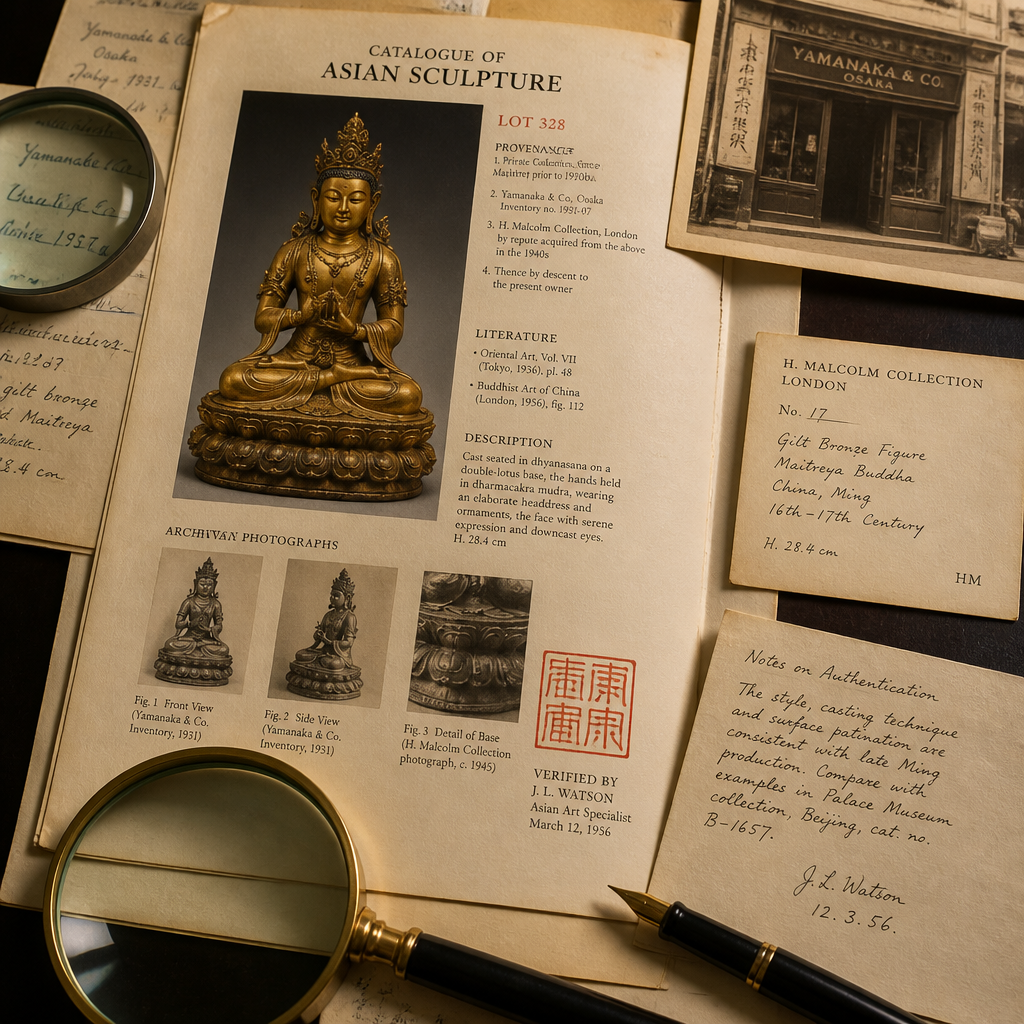
Good provenance documentation is not a single certificate. It is a chain of records: auction house catalogues listing the piece, letters or receipts from previous private collectors, exhibition records, customs documents from legal importation, and publication in scholarly or commercial literature. Legitimate dealers maintain acquisition records and can explain where and how each piece entered their inventory.
Researching provenance involves physical examination of the artwork itself for labels, inscriptions, and marks that may indicate movement between owners or institutions, alongside consultation of archives and published records. It is not unusual for a piece to have periods in its ownership history that are unaccounted for - archival resources are sometimes lost, destroyed, or inaccessible across multiple countries and languages. But a gap is different from an absence. A piece with documented history up to a certain point, then a gap, then reappearance in a credible context is different from a piece with no documentation whatsoever.
Pro tip: Ask any dealer for the acquisition record of a specific piece before discussing price. A credible specialist dealer will have this information readily available. If the response is vague or the seller pivots to describing the artwork's beauty rather than its history, treat that as a significant warning sign.
Physical Authentication Markers Every Collector Should Know
Provenance documents the history of a piece on paper. Physical examination verifies what the object itself tells you. Both are necessary; neither alone is sufficient. When you are standing in front of a bronze Cambodian deity, a lacquered Burmese Buddha, or a stone Ganesh from South India, there are specific physical markers that distinguish authentic antique work from skilfully aged reproductions.
Patina and Surface Condition
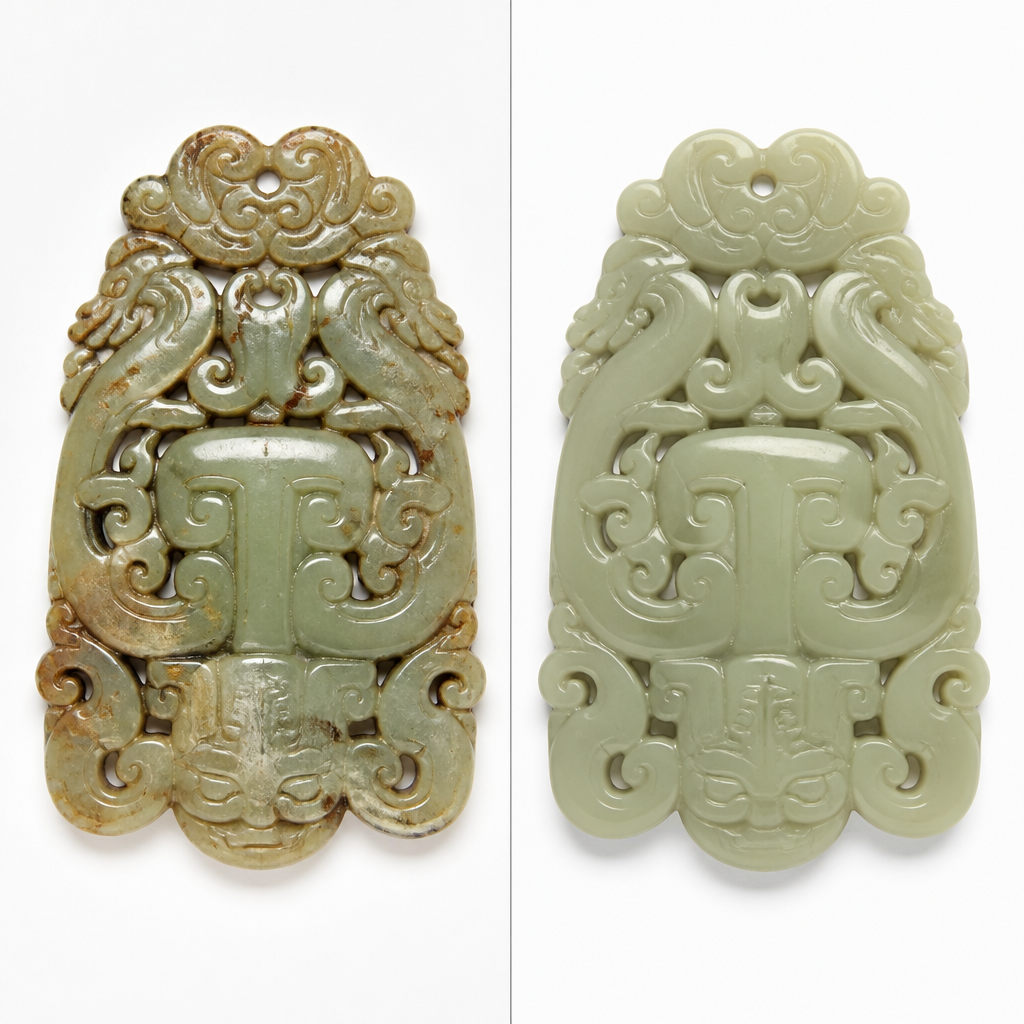
Natural patina on bronze develops over decades and centuries through oxidation, burial, handling, and environmental exposure. Authentic patina is not uniform - it accumulates differently in recesses than on raised surfaces, and its colour and texture reflect the specific alloy composition and burial or storage conditions of the individual piece. Artificially aged bronzes often show uniform green or brown coatings applied chemically, with patina that sits on the surface rather than developing within it. Experienced hands and eyes can distinguish these, and a jeweller's loupe makes the difference even clearer.
Material Analysis and Scientific Testing
For significant acquisitions, scientific testing moves authentication beyond visual assessment. Thermoluminescence (TL) testing on ceramic and stone pieces provides objective material dating. X-ray fluorescence (XRF) analysis on bronzes reveals alloy composition - the ratio of copper, tin, lead, and other metals - which can be compared against known regional casting traditions. These tests are expensive and not necessary for every purchase, but for a major acquisition they are an appropriate and proportionate investment. A seller who is confident in a piece's authenticity will not object to scientific testing.
Construction Techniques by Region
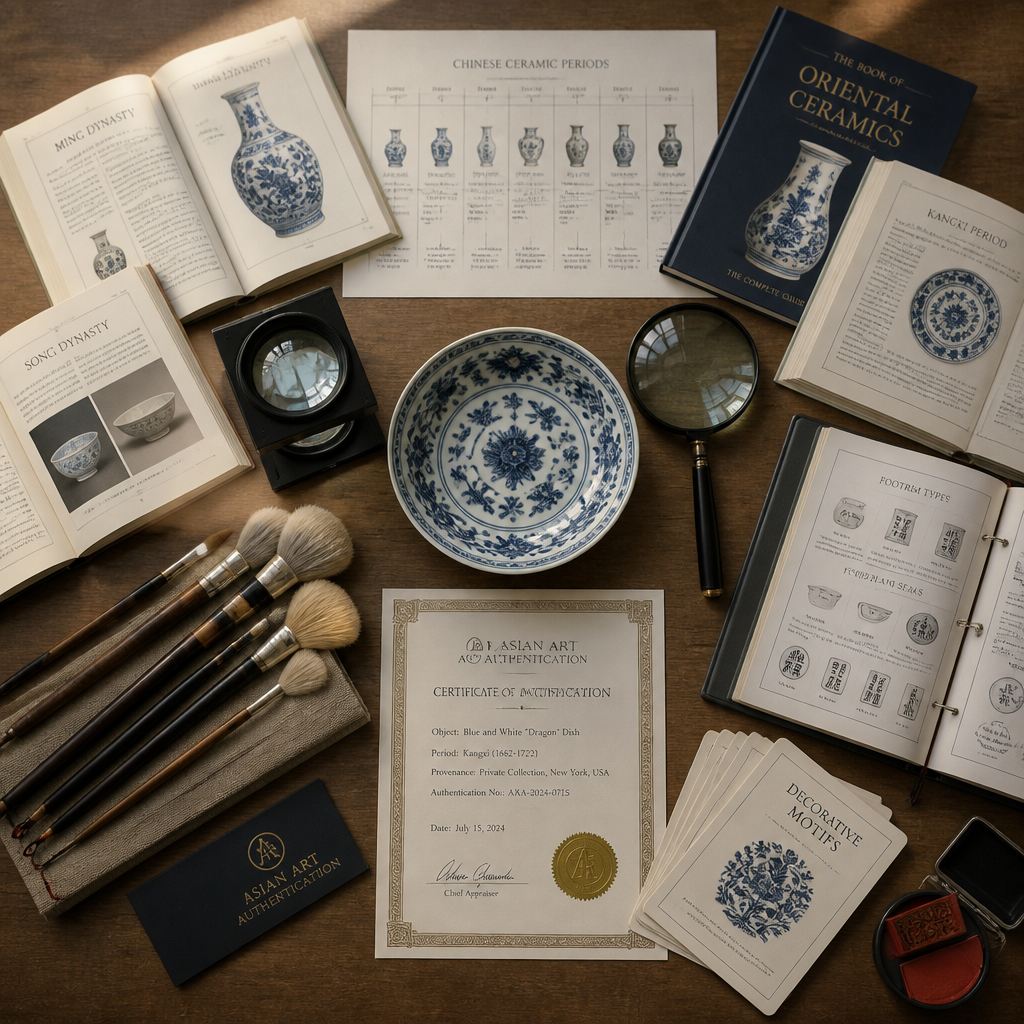
Regional casting and carving traditions leave distinctive technical fingerprints. Thai bronzes from the Sukhothai period show particular characteristics in the flame finial and the treatment of the robe edge. Burmese Mandalay-style bronzes have specific proportional conventions in the face and hands. Cambodian Khmer sandstone carving shows characteristic treatment of the facial features and headdress. Familiarity with these regional conventions, developed through study and time spent with authenticated reference pieces, is what separates an informed collector from one who relies entirely on seller assurances.
Regional Iconography Standards and Why They Matter
Iconography is the visual language of Buddhist and Hindu religious sculpture, and it is one of the most reliable authentication tools available to collectors. Every gesture (mudra), every attribute held by a deity, every crown type, every positioning of the feet, and every treatment of the robe was governed by canonical traditions that varied systematically by region, period, and religious school. A piece that mixes iconographic conventions from different traditions is almost certainly a modern production made for aesthetic appeal rather than a genuine artifact of practice.
Buddhist Iconography Across Asia
The dhyana mudra (meditation gesture, hands resting in the lap) appears across all Buddhist traditions but is rendered differently in Sri Lankan, Burmese, Thai, and Chinese work. The abhaya mudra (right hand raised, palm outward) similarly varies in execution by region and period. The ushnisha (cranial protuberance) is rendered as a flame in Thai work, as a conical point in Cambodian work, and as a rounded dome in Chinese work. Getting these details right is not pedantry - it is the difference between a piece that represents a living artistic tradition and one that represents a manufacturer's best guess at what "Buddhist" looks like.
Hindu Deity Conventions
Hindu sculpture carries even more complex iconographic requirements, because each deity has a specific set of attributes, hand gestures, vehicle (vahana), and associated iconographic elements that must be consistently rendered. Ganesha must have the broken tusk and the modaka sweet. Shiva in his dancing form (Nataraja) stands on the dwarf of ignorance. Lakshmi holds or is flanked by lotus flowers and elephants. These are not arbitrary aesthetic choices - they are a visual theology, and a piece that gets them wrong is either a deliberate forgery or a product made without respect for or knowledge of the tradition.
Pro tip: Before buying any Hindu or Buddhist sculpture, spend time with a regional iconographic reference. There are serious scholarly catalogues covering Thai, Cambodian, Indian, Burmese, and Javanese sculptural traditions. Even basic familiarity with the major mudras and attributes will improve your ability to assess any piece independently, and it will also make conversations with specialist dealers considerably more productive.
Comparing Acquisition Approaches for Serious Collectors
Where and how you acquire museum-quality Asian art shapes not only what you can buy but how much confidence you can have in what you buy. The three main channels each have different strengths and weaknesses for collectors focused on authenticity and provenance.
|
Acquisition Channel |
Provenance Transparency |
Best For |
|---|---|---|
|
Specialist Dealer (focus on authenticated Asian religious sculpture) |
High. Acquisition records maintained per piece; dealer expertise informs selection before inventory is offered. Ongoing relationship allows informed dialogue and returns policy. |
Collectors building a focused collection who want curatorial guidance, iconographic accuracy, and confidence in cultural context - not just a transaction. |
|
Major Auction House (e.g. Christie's, Sotheby's, Bonhams Asian Art departments) |
Variable. Significant lots receive detailed condition reports and provenance research from specialist departments. Smaller lots may receive minimal documentation. |
Experienced collectors with strong independent authentication capability who can conduct pre-sale research and are comfortable with competitive bidding dynamics. |
|
General Online Marketplace or Antique Fair |
Low to variable. Provenance documentation is rarely comprehensive; seller expertise varies widely; authentication burden falls entirely on the buyer. |
Buyers with deep regional expertise hunting for undervalued pieces, or those acquiring decorative rather than collection-grade works. Not recommended as a primary source for serious collectors. |
The specialist dealer model carries a specific advantage that auction houses and general markets cannot replicate: the relationship. A specialist dealer who has curated a collection based on consistent standards for material quality, iconographic accuracy, and provenance documentation effectively pre-authenticates each piece before it reaches the buyer. That curatorial layer is worth accounting for when comparing prices across channels.
A Practical Buyer Checklist Before Any Purchase
Knowing the theory is one thing. Applying it at the point of purchase, when you are looking at a piece you want and a seller who is confident in its value, requires a structured approach. The following checklist applies to any serious acquisition of Buddhist or Hindu sculpture.
Documentation and Provenance
Request all available provenance documentation, including any auction catalogue records, previous collection documentation, importation records, and the dealer's own acquisition record. For pieces positioned as antique, verify whether they can be connected to any published collection or institutional record prior to 1970. If the piece is positioned as a quality contemporary work by a named artisan, request the artist's credentials and, where possible, documentation of the workshop tradition.
Material and Physical Examination
Examine patina, tool marks, and surface consistency in person where possible. For remote purchases, request high-resolution photographs of the base, back, interior (for hollow bronzes), and any areas of repair or restoration. Ask specifically whether any restoration has been carried out and, if so, by whom and to what extent. Undisclosed restoration is one of the most common issues in the mid-range Asian art market.
Iconographic Verification
Verify that the iconographic program of the piece is internally consistent and appropriate to the stated region and period. If you are not confident in your own assessment, ask the dealer to walk you through the iconographic identification. A knowledgeable dealer will do this readily and with detail. One who deflects or gives vague answers about attribution should not be trusted with a significant purchase.
Legal Status
Confirm that the piece can be legally owned and transported in your country. Some categories of Asian antiquity are subject to import restrictions under bilateral agreements between the country of origin and the buyer's country. A reputable dealer will be able to advise on this directly and will not offer pieces with unresolved legal status.
Collectors who work with reputable specialist sources, take time to understand iconography, and ask the right provenance questions consistently make better acquisitions than those who rely on instinct or price signals alone. The market for authentic Buddhist statue and Hindu sculpture is rich and accessible for well-informed buyers, but it has no tolerance for shortcuts in due diligence.
HD Asian Art's full collection spans Buddha statues from Burma, Cambodia, China, India, Indonesia, Japan, Laos, Sri Lanka, and Thailand, as well as Hindu deity sculptures and traditional Burmese lacquerware. Each category brings different authentication considerations, and the site's Collector's Journal provides detailed guidance by region and tradition for buyers who want to develop their eye before purchasing.
Frequently Asked Questions
What exactly makes a Buddhist statue "museum quality"?
A museum-quality Buddhist statue meets four criteria simultaneously: authentic materials consistent with its stated period and region, craftsmanship that reflects genuine skill within a recognized regional tradition, iconographic accuracy according to the canonical conventions of that tradition, and a documented or credibly traceable ownership history. A piece that satisfies only one or two of these criteria may be valuable or attractive, but it does not meet the full standard that the label implies.
How important is provenance when buying Asian sculpture for a home altar or personal collection?
Provenance matters even for personal collections, for two reasons. First, it is the primary tool for confirming that a piece is what the seller claims it is - period, region, and material. Second, pieces with documented provenance retain and appreciate in value more reliably than undocumented works. For buyers primarily motivated by spiritual or aesthetic use rather than investment, provenance still provides the confidence that you are connecting with an authentic cultural object rather than a simulacrum of one.
Can I authenticate an Asian sculpture myself, or do I always need an expert?
Developing a level of personal authentication capability is both possible and recommended for serious collectors. Familiarity with regional iconographic conventions, understanding of how authentic patina develops by material type, and knowledge of historical casting techniques are all learnable through study and time spent with authenticated reference works. That said, for significant acquisitions - those representing meaningful financial investment - specialist assessment and, where appropriate, scientific testing (thermoluminescence for ceramics and stone, X-ray fluorescence for bronzes) are worth the cost. Self-education and expert consultation are complementary, not alternatives.
What does the 1970 provenance rule mean for collectors of Asian art?
The 1970 UNESCO Convention established a widely adopted ethical benchmark: works that can be documented as being in collections outside their country of origin before 1970 are considered to have clearer legal and ethical standing than works entering the market after that date without documented pre-1970 collection history. Major institutions, following AAMD and AAM guidelines, use 1970 as a threshold for acquisition decisions. For private collectors, pieces with pre-1970 documented collection history carry fewer legal risks and greater credibility in any subsequent sale or donation to an institution.
Are contemporary handcrafted sculptures from Asian artisan traditions ever considered museum quality?
Yes. Museum quality refers to standards of craftsmanship, iconographic accuracy, and material integrity - not exclusively to age. A contemporary bronze cast by a master craftsperson working within a living regional tradition, using traditional alloy compositions and iconographic conventions, can be legitimately described as museum quality. What disqualifies a contemporary piece is not its date of creation but its use of inauthentic materials, mechanical production methods, or iconographic shortcuts. The key is that quality and authenticity are evaluated on their own terms, with the piece's contemporary status clearly communicated rather than obscured.
How do I verify that a seller is reputable before committing to a significant purchase?
Several markers distinguish credible specialist dealers from opportunistic sellers. A reputable dealer can provide acquisition documentation for each piece, will discuss iconography and regional attribution in depth and with accuracy, will acknowledge and disclose any restoration work, and will be able to advise on the legal status of a piece for your jurisdiction. They will not pressure a purchase and will support independent assessment or scientific testing for major acquisitions. Dealers who deflect detailed questions, cannot explain where and how they acquired specific pieces, or who position price as the primary quality signal are not operating to the standards that serious collectors require.
If you have bought Asian sculpture before and applied any of these authentication approaches - or found other markers that proved reliable - share your experience in the comments. Every informed perspective helps build a better-educated collector community.
We would love your feedback and any insights you would share with others. What perspective would you add?
References
-
Asian Art Museum provenance research standards and AAMD/AAM guidelines for acquisition
-
Physical authentication markers for antique Buddha statues: a collector's reference guide
-
What museum quality art actually means: craftsmanship, archival standards, and the label's misuse
