



Mudras in Japanese Zen Sculpture: Meanings Guide
Mudras in Japanese Zen Sculpture: Meanings Guide
Table of Contents
- What Mudras Are and Why the Word Means 'Seal'
- The Common Buddha Hand Gestures You Will See Most
- Dhyana Mudra: The Meditation Gesture at the Heart of Zen
- Bhumisparsha Mudra and the Moment of Awakening
- How Mudras Identify Nyorai Figures: Shaka, Amida, Dainichi
- Zen Buddhist Statue Symbolism Beyond the Hands
- Esoteric Mikkyo Mudras vs. Exoteric Zen Gestures
- How to Read a Mudra at Home: A Visual Identification Guide
- Frequently Asked Questions
What Mudras Are and Why the Word Means 'Seal'
A mudra is a codified hand gesture used in Buddhist art and practice to signal a specific state of mind, moment in the Buddha's life, or teaching, and the mudras in Japanese sculpture follow that same logic. In Japanese Zen sculpture, the meaning of mudras in japanese zen sculpture rests on this principle: the hands are not decorative but the sculpture's argument.
The Sanskrit mudra translates as "seal" or "sign." A seal authenticates a document; a sign announces what is present. When a sculptor carves a Buddha's hands into a particular position, they seal the figure with a recognizable identity, the way a signature confirms authorship.
This guide from HD Asian Art walks through the gestures you will encounter most often, how they identify specific figures, and how to read them at a glance.
From Sanskrit Sign to Sculpted Hand
The word traveled from Sanskrit through Buddhist canonical languages into East Asia, where it came to mean a formal, repeatable hand position. Early Indian sculpture used a small set of gestures to mark key moments in the Buddha's life; as Buddhism moved through Central Asia into China, Korea, and Japan, those gestures became a visual grammar any educated viewer could parse.
By the time Japanese workshops were producing bronze and lacquered-wood figures at scale, the mudra system was fixed enough that a gesture alone could identify which Buddha you were looking at. Hand position functions as a label.
The Common Buddha Hand Gestures You Will See Most
Five gestures account for the overwhelming majority of Japanese Buddhist statuary. Learning these five first gives you most of the vocabulary you need.
- Dhyana mudra - hands resting in the lap, palms up, thumbs touching
- Bhumisparsha mudra - right hand reaching down to touch the earth
- Abhaya mudra - right hand raised, palm outward
- Varada mudra - right hand lowered, palm outward
- Vitarka mudra - thumb and index finger forming a circle
Each carries a distinct meaning and appears in specific contexts. The first two matter most for Zen sculpture and get their own sections below; the remaining three belong more to the broader Buddhist iconographic tradition than to Zen specifically.
A useful habit: before you look at the hands, note the figure's overall posture and expression. The gesture confirms what the body already suggests.
Dhyana Mudra: The Meditation Gesture at the Heart of Zen
Dhyana mudra is the gesture of meditation: both hands rest in the lap, palms up, right over left, thumbs lightly touching to form a shallow oval. The name comes from the Sanskrit dhyana, meaning absorption or meditative concentration.
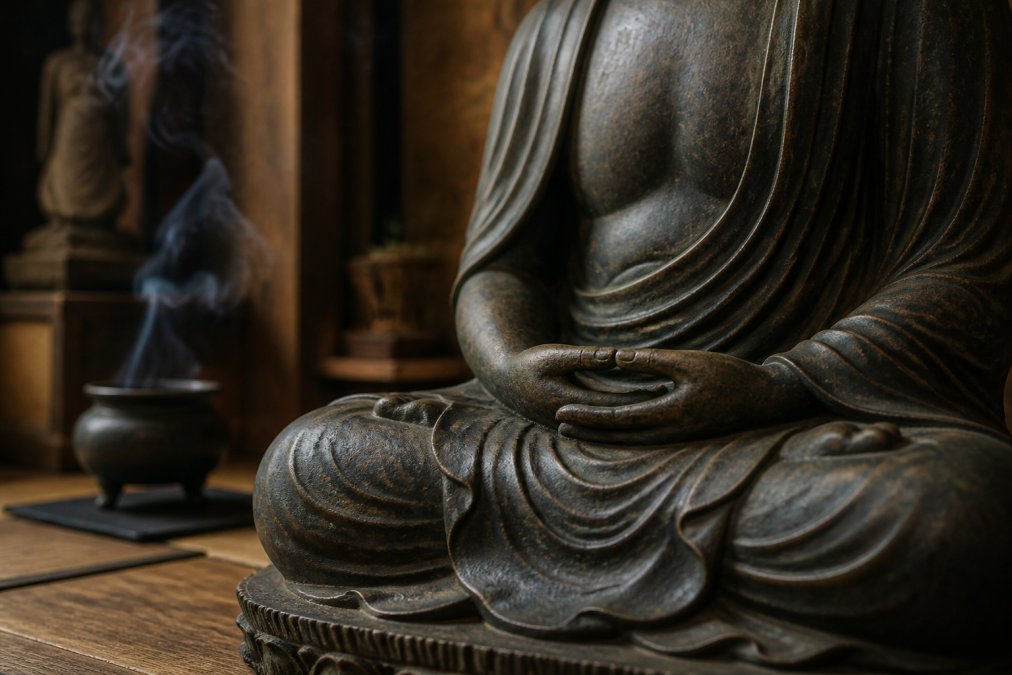
This is the gesture you will see most often in Japanese Zen contexts, and it most directly mirrors actual seated practice. The oval formed by the thumbs is read as a vessel for concentrated attention, holding the mind steady the way cupped hands hold water.
The gesture belongs to Amitabha in many traditions, but in Zen settings it appears on figures where the emphasis is on the act of sitting itself rather than a specific cosmic Buddha.
Bhumisparsha Mudra and the Moment of Awakening
Bhumisparsha mudra shows the right hand reaching downward, fingers extended, palm turned inward, fingertips touching or nearly touching the ground, with the left hand resting in the lap in Dhyana position. The name means "earth-touching," and it depicts the moment the Buddha called the earth to witness his right to awaken.
Facing doubt about whether he had genuinely attained awakening, the Buddha reached down and touched the ground, asking the earth itself to testify. The gesture is therefore a statement of steadfastness, not supplication.
In Japanese sculpture this mudra is strongly associated with Shaka, the historical Buddha.
How Mudras Identify Nyorai Figures: Shaka, Amida, Dainichi
Nyorai is the Japanese term for a Tathagata, a fully awakened Buddha. Their hand positions are the fastest way to tell them apart, but the gesture alone is not a complete identification, school, period, and the figure's role in a mandala or devotional context all shaped which mudra a workshop chose.
| Figure | Primary Mudra | What It Signals | Common Contexts |
|---|---|---|---|
| Shaka | Bhumisparsha (earth-touching) | The historical Buddha at the moment of awakening | Zen halls, Shaka triad, narrative relief |
| Amida | Dhyana, or a raised-and-lowered welcoming pair | Infinite light and the promise of rebirth in the Pure Land | Pure Land halls, raigo (descent) scenes |
| Dainichi | Wisdom-fist (chiken-in) or meditation | Cosmic Buddha, source of the esoteric pantheon | Shingon and Tendai altars, mandala centers |
| Yakushi | Right hand raised with a held object, left hand in the lap | The Medicine Buddha and his healing vows | Healing chapels, Yakushi triad |
Zen Buddhist Statue Symbolism Beyond the Hands
Hands are only part of the story. Zen Buddhist statue symbolism extends to posture, expression, attributes, and the objects a figure holds or sits upon.
A few elements worth reading alongside the mudra:
- The lotus seat signals purity and awakening, since the flower rises unstained from mud
- The ushnisha, the cranial bump, marks wisdom and awakened insight
- The urna, a mark between the eyebrows, indicates spiritual sight
- Half-closed eyes suggest inward attention rather than withdrawal from the world
- Robes and drapery often carry the workshop's stylistic signature more than the face does
Esoteric Mikkyo Mudras vs. Exoteric Zen Gestures
Japanese Buddhist sculpture splits into two gesture traditions, and confusing them leads to misidentification. The split is not just stylistic, it reflects two different theories of what a hand gesture is for.
- Are the hands open or closed? Open palms in recognizable positions point to exoteric iconography. Interlocked or fist-based positions point to esoteric.
- Does the gesture read from a distance? Exoteric mudras are designed to be legible across a room. Esoteric gestures are often more compact and inward.
- Is the figure part of a set? If the gesture seems to address another figure rather than the viewer, the statue likely came from a mandala or triad and was separated from its companions.
How to Read a Mudra at Home: A Visual Identification Guide
If you are building a meditation space around a single figure, the Dhyana gesture is the most natural fit. Its hands mirror what your own hands do when you sit. At HD Asian Art, our collection includes seated figures in the meditation gesture alongside Shaka figures in earth-touching position, so you can choose the gesture that matches the practice you keep. Every piece is handpicked, and we ship free.
Frequently Asked Questions
What are the most common mudras found in Japanese Zen sculpture?
The Dhyana mudra, hands resting palms-up in the lap, appears most often on meditation figures. The Bhumisparsha mudra, right hand touching the earth, marks the moment of awakening. The Vitarka mudra, thumb and index finger forming a circle, signals teaching. The Abhaya mudra, open palm raised, offers reassurance. Most Zen bronze and wood statues use one of these four, and the gesture alone often tells you which figure you are looking at.
What is the significance of the Dhyana mudra in Zen meditation?
The Dhyana mudra represents absorption and steady concentration, the state zazen aims to cultivate. In sculpture, the hands sit in the lap, right hand over left, thumbs meeting to form a shallow vessel. That shape points to the mind holding still. When you sit in front of a statue using this gesture, it works as a visual anchor, reminding you that the posture you are holding is the same one carved into the figure.
How can understanding mudras enhance the appreciation of Zen home decor?
Once you can read the hands, a statue stops being a generic Buddha and becomes a specific moment: teaching, awakening, or calm abiding. That changes where you place it. A Dhyana figure suits a meditation corner because its gesture matches the room's purpose, while an Abhaya figure near an entryway reads as reassurance. Collectors who know the gestures also avoid mismatched pieces and can ask better provenance questions before buying.
Do hand gestures in Zen statues represent specific deities?
Yes, especially among the Nyorai, the fully awakened figures. Shaka is usually shown in the Bhumisparsha mudra, right hand touching the earth. Amida often appears in the Dhyana or Vitarka mudra, depending on whether the statue shows him meditating or welcoming. Dainichi, central to esoteric practice, uses the joined fist of the Bodhi mudra. Reading the hand position is often the fastest way to name the figure before you check any inscription.
Reading mudras turns a sculpture into a document. If you want a figure whose hands say something specific, browse the HD Asian Art collection of handpicked Buddhist and Hindu statues, with free shipping and pieces chosen for altars, meditation spaces, and refined home interiors.
