



Meditating Buddha Statues: Find Your Perfect Style
Meditating Buddha Statues: Find Your Perfect Style
Most people pick a meditating Buddha statue based on how it looks. That is the wrong starting point. The style of posture, the regional artistic tradition, the material, and the mudra all carry specific iconographic meaning, and getting those details right matters whether you are building a dedicated meditation altar or placing a sculpture in a living space.
A meditating Buddha statue is not decorative shorthand for "calm". It is a precise visual language developed across centuries of Buddhist art from Burma to Japan, and understanding it will help you choose something genuinely suited to your practice and your space.
Table of Contents
Quick Takeaways
|
Key Insight |
Explanation |
|---|---|
|
Dhyana mudra is the definitive meditation gesture |
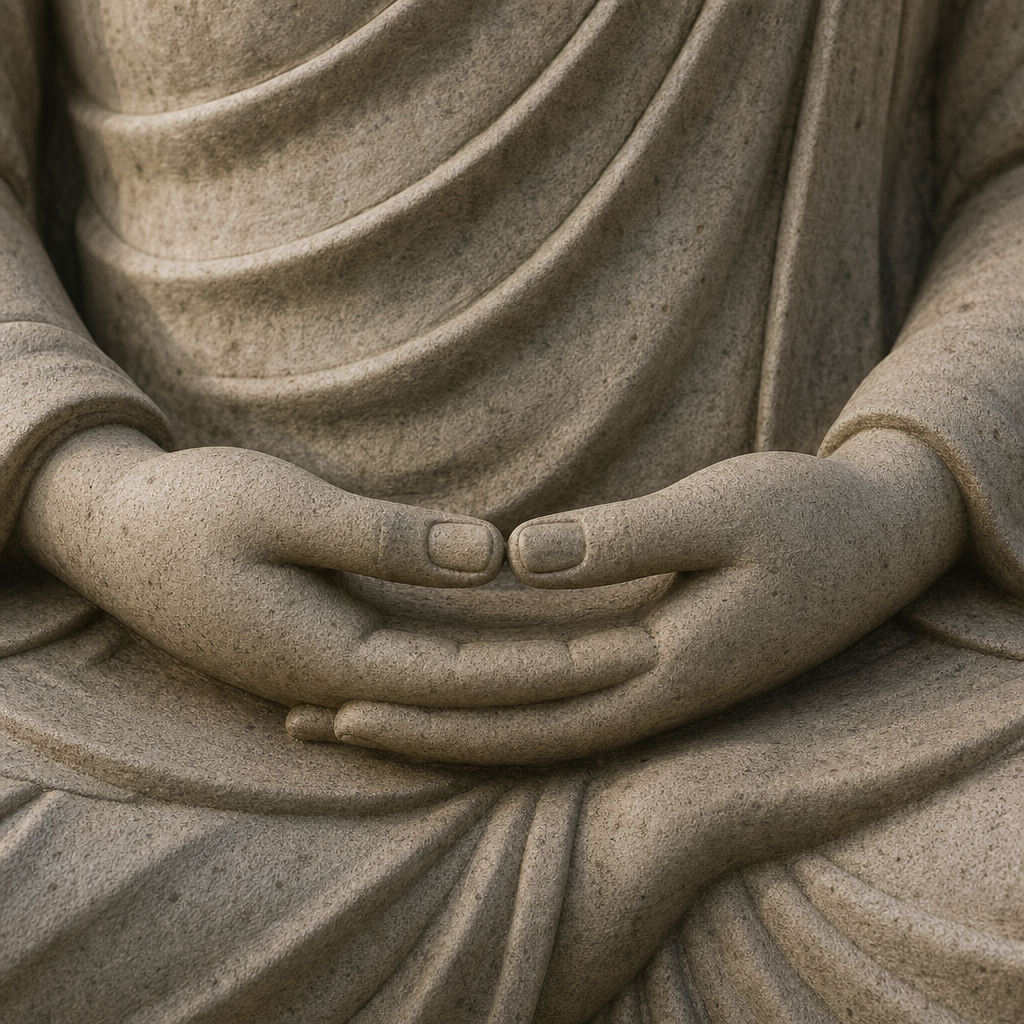
Both hands resting in the lap, palms upward, one placed on the other, indicates deep meditative absorption. If the hands are not in this position, the statue represents a different spiritual state. |
|
Regional style carries doctrinal weight |
Thai meditating Buddhas follow Theravada iconographic rules. Japanese seated Buddhas often reflect Mahayana or Zen aesthetic values. These are not interchangeable in a devotional context. |
|
Material affects the energy and the maintenance |
Bronze ages with handling and develops a patina that many practitioners value. Resin or alabaster statues suit high-humidity environments like bathrooms or outdoor garden spaces. |
|
Size relative to eye level matters for altars |
A statue used for seated meditation should ideally sit at or just above the practitioner's eye level when both are at floor level. Placing a small statue on a tall shelf creates the wrong sightline for practice. |
|
Flame ushnisha versus flat ushnisha signals different periods |
The flame-topped ushnisha is common in Thai and Cambodian sculpture from the 14th century onward. Earlier Khmer work tends toward a more conical or lotus-bud crown. This affects both provenance and aesthetic tone. |
|
A Buddha statue for meditation works best when it is singular |
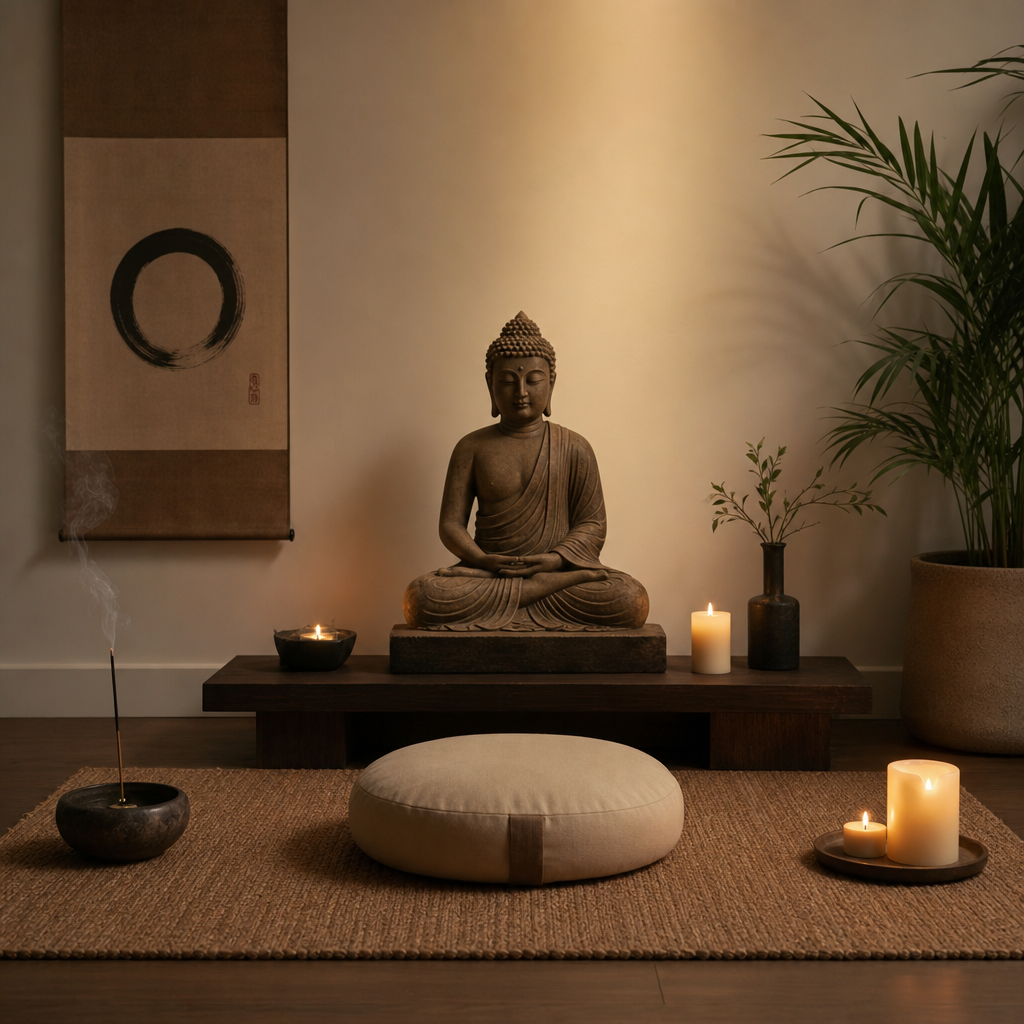
Crowding a meditation space with multiple figures dilutes focus. One well-chosen meditating Buddha statue creates a cleaner anchor for practice than five smaller, mismatched pieces. |
|
Lacquerware altarpieces complement bronze meditating Buddhas |
Traditional Burmese lacquerware panels and boxes are designed as altar components. Pairing a Burmese-style meditating Buddha with lacquerware creates a historically coherent devotional arrangement. |
What Makes a Meditating Buddha Statue Different from Other Buddha Images
Buddhist iconography is precise. A standing Buddha in the vitarka mudra is teaching. A reclining Buddha represents Parinirvana, the final passing from the cycle of rebirth. A seated meditating Buddha statue specifically depicts the Buddha in samadhi, the state of one-pointed meditative concentration. This is not a stylistic choice made by individual sculptors. It is a codified tradition that developed in India at Bodh Gaya, the site of the Buddha's enlightenment, and spread across Asia along trade and pilgrimage routes over roughly two thousand years.
The seated posture itself has two principal variants. The full lotus position, padmasana, with both feet resting on the opposite thigh, is the more demanding posture and carries greater iconographic weight in terms of spiritual attainment. The half lotus, or ardha-padmasana, appears frequently in statues from regions where the full lotus was considered less accessible as a devotional model. Both are correct for meditation imagery. What distinguishes them from simply "a seated Buddha" is the combination of the posture with the dhyana mudra hand gesture.
In practice, the distinction matters when you are choosing a statue for an active meditation space rather than a collection display. A statue that depicts teaching, protection, or earth-touching postures will not function as a visual anchor for concentration in the same way as one depicting absorption. Collectors who focus on aesthetics alone often miss this entirely.
Dhyana Mudra Explained: The Gesture That Defines Meditation
The dhyana mudra Buddha position is simple to identify and impossible to mistake once you know it. Both hands rest in the lap. The right hand lies on top of the left, palms facing upward, with the thumbs touching to form an oval or triangular shape. This gesture represents the mind held in perfect balance, free from distraction in any direction. It is the hand position the historical Buddha, Siddhartha Gautama, held during his meditation under the Bodhi tree at Bodh Gaya.
Variations Across Buddhist Traditions
In Tibetan Buddhist iconography, the dhyana mudra is strongly associated with Amitabha Buddha, the Buddha of Infinite Light, who presides over the Pure Land. Tibetan statues in this mudra are frequently gilded and may incorporate a begging bowl resting in the joined hands. In Theravada traditions from Thailand and Sri Lanka, the mudra is associated directly with the historical Buddha and appears without the bowl.
Japanese Zen aesthetic stripped away much of the ornamentation that accumulated in other regional traditions. Japanese bronze meditating Buddhas tend toward simpler drapery, less elaborate crowns, and an overall quieter visual register. This is not impoverishment. It is a deliberate doctrinal statement about the accessibility of enlightenment. If the spare, minimal quality of Japanese Buddhist sculpture appeals to you, that preference is itself meaningful information about what kind of practice space you are building.
What to Do If the Hands Are Not Clearly Visible
A common mistake is purchasing a statue based on a photograph that does not clearly show the hands. Always verify the mudra before buying. A statue with the right hand resting on the knee and the fingers pointing downward is in the bhumisparsha mudra, the earth-touching gesture associated with the moment of enlightenment. It is a powerful image, but it represents a different moment and a different meditative state than dhyana. Both are valid. Neither is a substitute for the other in a deliberately constructed altar or practice space.
Pro tip: When reviewing product images of any seated Buddha statue, zoom into the hands first. If the image resolution does not allow you to clearly identify the mudra, contact the seller and ask directly. Any reputable dealer of museum-quality Buddhist sculpture will give you an immediate, specific answer.
Regional Styles Compared: Burma, Thailand, Cambodia, Japan, and More
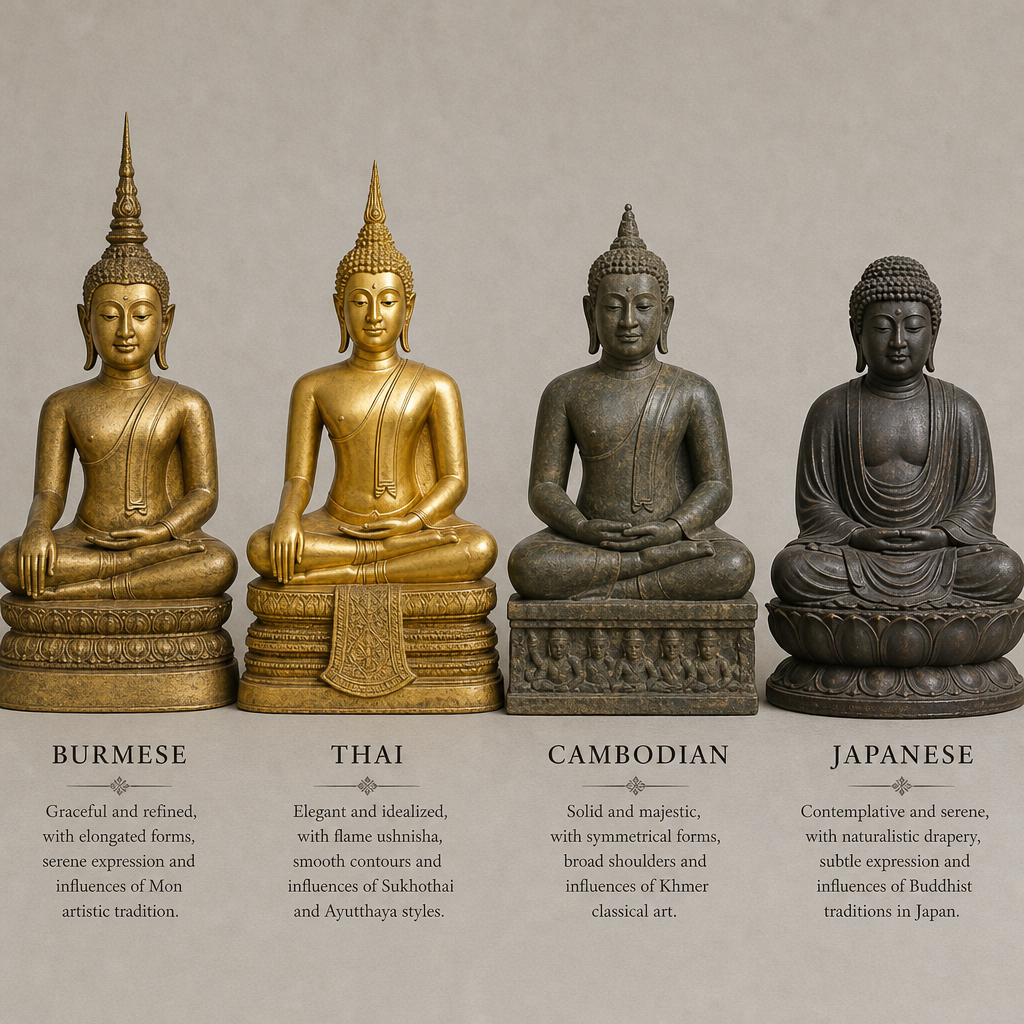
Each major Buddhist artistic tradition developed its own visual vocabulary for the meditating Buddha, shaped by local theology, available materials, and patronage patterns. Knowing the differences helps you choose not just what looks right but what is right for your specific context.
"The Buddha image is not a portrait. It is a diagram of an achieved state. Every formal element, from the elongated earlobes to the ushnisha to the position of the hands, is a data point in that diagram." - Hiram Woodward, scholar of Southeast Asian Buddhist art, in his study of Khmer and Thai sculpture traditions.
Burmese Meditating Buddhas
Burmese Buddhist sculpture, particularly from the Mandalay period of the 18th and 19th centuries, is characterised by white alabaster or marble and heavy gilded ornamentation. The robes often appear as a painted or inlaid surface rather than sculpted fabric. Burmese meditating Buddhas tend to have softly rounded facial features, a gently smiling expression, and a flame ushnisha. They work exceptionally well on dedicated home altars because the ornamental quality signals the devotional intent of the space clearly.
Thai Meditating Buddhas
Thai sculpture from the Sukhothai period, roughly 13th to 15th century, produced what many consider the most refined meditating Buddha form in all of Asian art. The elongated oval face, flame ushnisha, thin robe that reveals the body form beneath, and the extraordinary serenity of expression are consistent across the best Sukhothai-period work. Later Ayutthaya and Rattanakosin period pieces are more elaborately decorated. Both traditions use bronze as the primary material for high-quality work.
Cambodian and Khmer Meditating Buddhas
Khmer sculpture from the Angkor period, 9th to 15th century, reflects the complex syncretic relationship between Hinduism and Buddhism that characterised the Khmer Empire. The most famous Khmer meditation image is the Buddha seated on the coiled body of the naga serpent king Mucalinda, sheltered by the serpent's spread hood. This image is specific to the story of the Buddha meditating through a storm, and it is iconographically distinct from the standard dhyana meditation posture. Both types are found in Khmer-influenced sculpture from Cambodia and Laos.
Japanese Meditating Buddhas
Japanese Buddhist sculpture operates in a different aesthetic register. The Zen tradition in particular produced meditating Buddha images of radical simplicity, often in natural bronze patina without gilding, with minimal ornamentation and a focus on the quality of the casting and finish. These pieces work in contemporary interior spaces in a way that heavily ornamented Southeast Asian sculpture sometimes does not, which is worth considering if your living space has clean lines and neutral tones.
Materials and What They Communicate
Material is not a secondary consideration after style and size. In Buddhist sculptural tradition, the choice of material carries specific meaning, and it also has direct practical consequences for how the statue ages, how it interacts with its environment, and how it feels to touch during a devotional practice.
Bronze is the dominant material for high-quality Buddhist sculpture across most of Asia. Lost-wax cast bronze develops a patina over time from handling, incense smoke, and the oils naturally present in hands. This patina is considered evidence of devotional use and adds rather than subtracts from the piece's character. Museum-quality bronze meditating Buddhas are the most durable investment in this category.
Burmese white alabaster and marble pieces are carved rather than cast, which means each piece is unique at the material level. Alabaster transmits light at its edges in a way bronze does not, giving these statues a particular quality in candlelit altar settings. The trade-off is that alabaster is more fragile than bronze and requires more careful handling.
Gilded wood was widely used across Southeast Asia for interior temple images. Wooden meditating Buddhas are lighter than bronze equivalents and react more strongly to humidity fluctuations. They are not recommended for bathrooms, outdoor spaces, or environments with significant seasonal humidity swings unless they are specifically finished for those conditions.
Resin and composite materials serve a different market. They allow for accurate reproductions of museum-held pieces at accessible price points. For a practitioner who wants a specific Khmer or Thai iconographic form but cannot justify the investment in an original antique or high-quality handmade bronze, a well-produced resin reproduction is a practical choice. The honest differentiation is in the collecting value, not necessarily in the spiritual function.
Pro tip: If you are buying a bronze meditating Buddha for a dedicated altar space, ask the seller about the alloy composition. Traditional lost-wax bronze with a high copper content develops a more complex patina than modern alloys. This is not a dealbreaker, but it is relevant information if long-term patina development matters to your aesthetic intentions.
Choosing a Buddha Statue for Meditation by Space Type
A Buddha statue for meditation has to work within the physical constraints of a real room. Recommendations that ignore scale, lighting, and sightlines are useless. Here is what actually works in practice across four common placement contexts.
A Dedicated Meditation Room or Alcove
This is the context where iconographic precision matters most. The statue should be the room's primary focal point, positioned at a height where a seated meditator at floor level sees the face of the statue at or just above their own eye level. For most adults seated in cross-legged posture, this places the base of the statue at roughly 30 to 45 centimetres above floor level. A Thai bronze in the Sukhothai style or a Japanese cast bronze in a minimal aesthetic works extremely well here. Avoid placing multiple figurines around the primary image. One strong piece at the right scale and height creates better conditions for concentration practice than an elaborate but visually busy arrangement.
A Living Room or Home Office
Here the aesthetic considerations carry more weight relative to the purely devotional ones, though they are not entirely separate. A meditating Buddha placed in a living room works best when it is large enough to register as a considered choice rather than an ornament. A piece under 20 centimetres tends to disappear in a general living space. A Burmese alabaster piece in the 30 to 60 centimetre range on a dedicated shelf or console table reads clearly as a sculptural focal point without overwhelming a domestic interior.
A Garden or Outdoor Space
Outdoor placement requires material selection above all other considerations. Bronze handles outdoor placement well in most climates, developing an outdoor patina that is different from but not inferior to the indoor equivalent. Stone, both natural and reconstituted, is widely used for garden Buddhas. Avoid gilded pieces, alabaster, and painted wood in outdoor settings. Cambodian-style meditating Buddhas in natural bronze or stone are among the most successful outdoor garden images because the Khmer sculptural tradition has a monumentality that reads well in open space.
A Bedroom or Personal Sanctuary
Smaller pieces work well here. A 15 to 25 centimetre bronze dhyana mudra Buddha on a bedside table or a small personal altar shelf is a well-established devotional practice across Theravada Buddhist households. The intimacy of scale suits the personal nature of the space. Sri Lankan-influenced Buddha images, which tend toward a very serene, inward expression, work particularly well in bedroom sanctuary contexts.
Common Mistakes Buyers Make When Choosing a Meditating Buddha
The market for Buddhist sculpture includes a significant amount of merchandise that uses Buddhist iconography decoratively without regard for accuracy. A common mistake is equating price with quality without checking the iconographic details. A mass-produced resin statue can be expensive if the retailer has positioned it as decorative art. A genuinely museum-quality bronze casting from a specialist retailer may cost less than a branded home-decor piece of equivalent size because the pricing reflects actual craft and provenance rather than marketing positioning.
A second mistake is choosing a statue based on a single attribute, usually facial expression, without considering how all the formal elements work together. The expression on a meditating Buddha is always serene, but serenity reads differently across regional traditions. Thai Sukhothai-period faces have a very specific elongated quality. Japanese faces tend to be more symmetrically frontal. Burmese faces are rounder and softer. Buying a statue because the face looks peaceful, without understanding the complete iconographic and regional context, often produces a piece that feels incongruous in a carefully considered space.
A third mistake is ignoring the base and the altar context entirely. A beautiful bronze statue placed on an inappropriate surface, a glass shelf cluttered with unrelated objects or a painted furniture piece with a competing visual pattern, loses much of its presence. The altar context is part of the work. Traditional Burmese lacquerware, which was specifically designed as altar furniture and devotional storage, provides a historically coherent surface for a Burmese-style meditating Buddha. This kind of cultural coherence is not pedantry. It produces visually and spiritually stronger altar arrangements.
Comparison of Meditating Buddha Styles by Space and Practice Type
|
Style and Origin |
Best Suited For |
Key Distinguishing Features |
|---|---|---|
|
Thai Sukhothai Bronze |
Dedicated meditation rooms, Theravada practitioners, minimalist interiors |
Elongated oval face, flame ushnisha, thin draped robe, supreme serenity of expression, lost-wax bronze casting |
|
Burmese Mandalay Alabaster or Marble |
Home altars, devotional spaces, collectors of Southeast Asian art |
White or cream stone, gilded ornamentation, softly rounded features, historically paired with lacquerware altar pieces |
|
Japanese Zen-Influenced Bronze |
Contemporary interiors, minimal practice spaces, collectors preferring restraint |
Minimal ornamentation, natural bronze patina, frontal symmetry, quiet expression, clean casting quality |
Frequently Asked Questions
What is the difference between a dhyana mudra Buddha and a bhumisparsha mudra Buddha?
The dhyana mudra has both hands resting in the lap, palms upward, right hand on top of left, with thumbs touching. It represents deep meditative absorption. The bhumisparsha mudra has the right hand resting on the right knee with fingers pointing downward toward the earth. It represents the moment the Buddha called the earth to witness his enlightenment and defeated the demon Mara. Both are seated postures but they depict different moments and states. For a space dedicated to meditation practice, the dhyana mudra is the more directly relevant image.
Does the direction a meditating Buddha faces matter?
In formal temple settings, the direction of orientation follows established convention. Most Theravada traditions orient the primary Buddha image to face east, toward the direction of the rising sun and the site of the historical Buddha's enlightenment at Bodh Gaya. In a home setting, the most important practical consideration is that the statue faces into the room and is not placed facing a wall or a corner. East-facing orientation in a home altar is respected but not obligatory in most traditions.
What size meditating Buddha statue is appropriate for a home altar?
For a dedicated altar used in seated floor-level meditation, a statue in the range of 30 to 60 centimetres works well for most domestic spaces. For a smaller personal altar on a desk or bedside table, 15 to 25 centimetres is a practical range. The determining factor is not the absolute size but the sightline relationship between the meditator's seated eye level and the statue's face. A statue that is too small creates a downward-looking sightline, which is not conducive to an open, alert meditative posture.
Can I place a meditating Buddha statue in a garden?
Yes, with the right material choice. Bronze and natural stone are the best outdoor materials. Bronze develops an outdoor patina that is typically greener and faster-developing than indoor patina, which many people find beautiful. Avoid placing alabaster, painted wood, or gilded pieces outdoors. Protect any outdoor bronze statue from standing water pooling in hollows or crevices, particularly in climates with freezing winters, as water expansion during freezing can damage cast metal over time.
Is it appropriate to have a meditating Buddha statue if I am not Buddhist?
The statue itself carries no requirement of religious affiliation. Many people who are not practicing Buddhists maintain meditating Buddha statues as objects of aesthetic contemplation, as anchors for secular mindfulness practice, or as expressions of cultural appreciation. The more relevant question is whether you are engaging with the object honestly rather than treating it as a cultural accessory. If you are drawn to the iconography because it genuinely supports your contemplative practice, the absence of formal Buddhist affiliation is not an obstacle.
How do I clean and care for a bronze meditating Buddha statue?
For indoor bronze, regular dusting with a soft dry cloth is sufficient and recommended. Do not use chemical metal cleaners on antique or museum-quality bronzes as they strip the developed patina, which is part of the piece's character and value. If the surface becomes sticky or develops uneven oxidation, a very light application of natural wax, such as beeswax, applied with a soft cloth and buffed off, stabilises and enriches the patina without damaging it. Never use abrasive cloths or water on bronze unless the piece has been specifically finished for outdoor exposure.
If you have a meditating Buddha statue in your own practice or collection, share what drew you to that particular style and how it functions in your space. Real experiences from practitioners and collectors are the most useful guide for others making this choice.
We would love your feedback and any insights you would share with others. What perspective would you add?
References
