



Laotian Buddha Statue: Calling for Rain Pose Guide
Laotian Buddha Statue: Calling for Rain Pose Guide
Most collectors who seek out a Laotian Buddha statue are drawn to the obvious aesthetics first, then discover something far more interesting beneath the surface. Lao Buddhist art is one of the most iconographically distinct traditions in all of Southeast Asia, yet it remains dramatically underrepresented in Western collections compared to Thai or Cambodian pieces.
The Calling for Rain pose, in particular, is almost entirely unique to Laos and northeastern Thailand, making genuine Lao examples among the rarest and most culturally specific sculptures a collector can acquire. Understanding what makes these figures different is not just academic. It directly affects what you buy, what you pay, and what you own.
Table of Contents
Quick Takeaways
|
Key Insight |
Explanation |
|---|---|
|
The Calling for Rain pose is almost exclusive to Laos |
This standing posture with both arms held rigidly at the sides and fingers pointing downward is virtually absent from Burmese, Cambodian, or central Thai traditions. It originates from the Vientiane and Luang Prabang schools. |
|
Lao figures are taller and more elongated than Thai equivalents |
The proportional canon used in Lao sculpture emphasizes a dramatically elongated torso and limbs, giving statues a vertical, almost architectural presence that differs sharply from the rounder Thai style. |
|
The flame finial (ushnisha) on Lao statues is uniquely pointed |
Unlike the lotus-bud finial common in northern Thai sculpture or the conical Thai topknot, the Lao flame finial rises in a sharply tapering spike, which is a reliable identification marker for collectors. |
|
The pose carries specific agricultural and royal significance |
The Calling for Rain posture commemorates the Buddha calling down rain to end a drought, making these statues spiritually relevant in rice-farming communities and historically linked to Lao royal patronage. |
|
Materials differ meaningfully by region and period |
Laotian statues were historically cast in bronze with a high tin content, often producing a distinctively greenish patina. Later wooden examples from the 19th and 20th centuries frequently retain gilt lacquer surfaces. |
|
Lao Buddhist art follows Theravada iconographic rules but adds local mythology |
While the core canon is Theravada, Lao sculptors incorporated elements from local animist traditions and the Pha Lak Pha Lam (the Lao version of the Ramayana), creating a hybrid iconography not found elsewhere. |
|
Genuine pieces are scarce and historically significant |
The upheaval of the 20th century, including the 1975 revolution and decades of conflict, meant that large numbers of Lao temple sculptures were lost, destroyed, or removed. Surviving examples carry significant cultural weight. |
What Is a Laotian Buddha Statue?
A Laotian Buddha statue is a sculptural representation of the Buddha produced within the artistic traditions of Laos, a landlocked country in Southeast Asia whose Buddhist culture developed primarily through the Lan Xang Kingdom (founded 1353 CE). This kingdom, whose name translates roughly as "Land of a Million Elephants," was one of the largest and most powerful states in mainland Southeast Asia for nearly three centuries, and its royal patronage of Buddhism produced a sculptural tradition that is genuinely distinct from those of its neighbors.
The primary centers of Lao Buddhist art were Vientiane and Luang Prabang, each developing slightly different regional styles. Luang Prabang figures tend toward a more refined elegance, while Vientiane-school bronzes often show greater mass and formality. Both share the elongated proportional canon and the distinctive flame finial that set Lao work apart from Thai, Burmese, and Khmer sculpture.
Theravada Buddhism has been the dominant faith in Laos since at least the 14th century, and Lao statues follow Theravada iconographic conventions. However, what makes them visually identifiable is a set of local stylistic choices that Lao craftsmen maintained consistently across centuries, not just variations of a shared regional template.
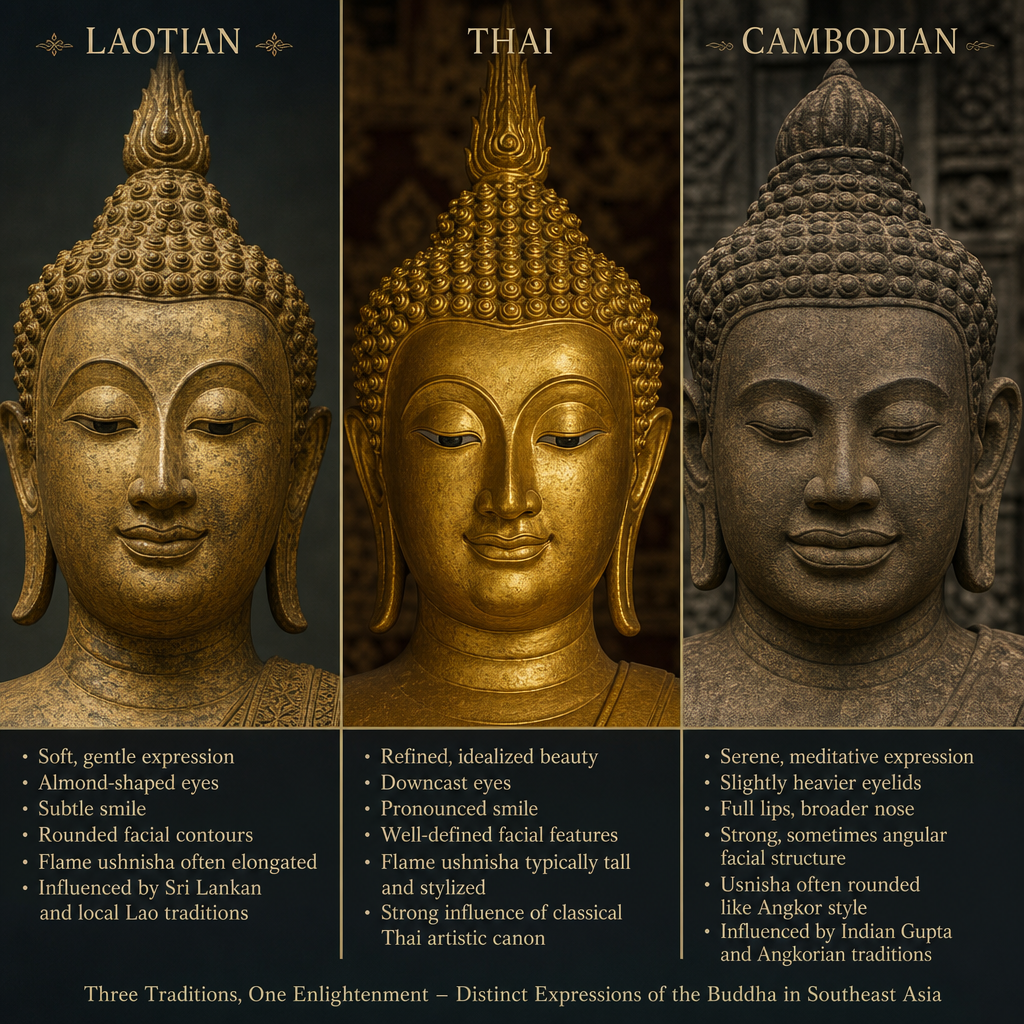
Pro tip: When evaluating a piece described as "Lao style," check the ushnisha immediately. A genuine Lao flame finial is sharply tapering and rises from a narrow base. If it resembles the tiered lotus bud of northern Thailand or the broad conical Thai crown, the piece is almost certainly Thai or a Thai-influenced reproduction, regardless of what the seller claims.
The Calling for Rain Pose Explained
The Calling for Rain pose, known in Lao as "Yuen" (meaning "standing") or more specifically by the gesture it depicts, shows the Buddha standing upright with both arms held close to the body, elbows slightly bent, and fingers pointing downward toward the earth. This is the defining mudra of Lao Buddhist iconography and the posture that most immediately distinguishes Lao sculpture from every other Southeast Asian tradition.
The Myth Behind the Gesture
The pose is rooted in a specific Jataka tale, one of the 547 stories of the Buddha's previous lives. In the version preserved in Lao oral and textual tradition, the future Buddha, in a previous incarnation, stood in meditation requesting rain from the gods to relieve a severe drought that was destroying his kingdom's crops. Both hands point downward as an invitation for rain to fall to the earth, and the posture combines royal authority with compassionate petition.
This agricultural connection is not incidental. Laos is a predominantly rice-farming culture, and the relationship between Buddhist ritual and agricultural fertility is deeply embedded in Lao religious practice. The Boun Khao Phansa festival and water-blessing ceremonies that are central to the Lao Buddhist calendar all connect to the same axis of water, rice, and spiritual intercession.
How the Pose Differs from Other Standing Buddha Postures
A common mistake made by new collectors is to confuse the Calling for Rain pose with the "Abhaya mudra" (Protection pose), where one or both hands are raised with palms facing outward. These are completely different gestures with entirely different meanings. The Calling for Rain pose is characterized specifically by the downward-pointing fingers on both hands simultaneously, a configuration that is practically absent from Burmese, Thai, and Khmer traditions.
The "Bhumisparsha mudra" (Earth-Touching pose) is also sometimes confused with this posture, but that gesture is performed while seated, with one hand touching the ground. The Calling for Rain pose is always standing, always bilateral, and always associated exclusively with the Lao sculptural tradition.
"The standing Buddha with downward-pointing hands is the most distinctively Lao of all Buddhist image types, virtually unknown outside of Laos and the Lao-influenced regions of northeastern Thailand." - Donald Stadtner, art historian and author of "Sacred Sites of Burma" (recognized authority on mainland Southeast Asian Buddhist art)
Pro tip: If you are acquiring a Calling for Rain statue and want to verify its regional authenticity, examine the robe treatment. Lao statues typically show a robe hem that ends in a distinctive "W" or flame-shaped lower border along the front, a detail that Thai reproductions frequently simplify into a straight or slightly curved line.#
Unique Iconographic Features of Lao Buddhist Art
Beyond the Calling for Rain pose, Lao Buddhist art carries a constellation of iconographic features that experienced collectors learn to identify immediately. Knowing these markers separates a knowledgeable acquisition from an expensive mistake.
The Flame Finial and Ushnisha
The ushnisha is the cranial protuberance that crowns every Buddha image, signifying wisdom and enlightenment. In Lao sculpture, this takes the form of a dramatically elongated flame finial that rises from the head in a sharply pointed spike. This feature is consistent across the Luang Prabang and Vientiane schools and across periods from the 16th century onward. The finial often shows a subtle spiral at its base before rising into the flame, a detail that is characteristically Lao.
Facial Anatomy
Lao Buddha faces have specific characteristics that distinguish them from Thai and Burmese faces. The features are typically broad across the cheeks, with arched eyebrows that meet above a straight nose, and lips that curl slightly at the corners in what scholars sometimes describe as the "Lao smile," which is subtler and less theatrical than the famous smile of Sukhothai-period Thai sculpture. The earlobes are elongated and typically loop down without touching the shoulders, unlike Burmese figures where earlobes often rest on the collarbone.
Body Proportions and Robe Treatment
The Lao proportional canon favors an elongated figure with a notably long torso and limbs. This gives Lao statues a vertical, commanding presence that contrasts with the more compact proportions of Burmese figures or the rounded softness of Sukhothai Thai sculpture. The robe is typically shown as a thin, form-fitting garment in the Theravada tradition, with one shoulder exposed (uttarasanga), rendered with minimal modeling of fabric folds, which emphasizes the purity of the body beneath.
Materials and Surface Treatment
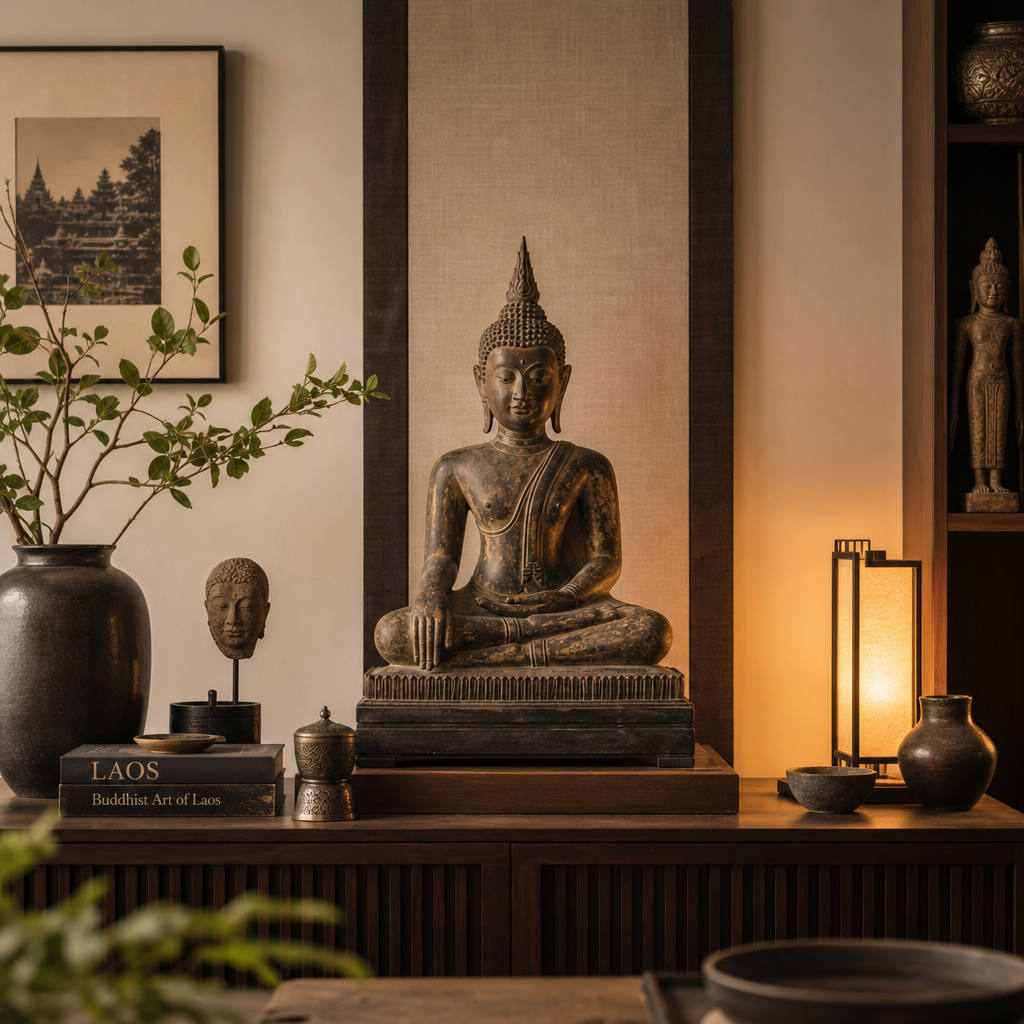
Historic Lao bronzes often have a high tin content in their alloy, which produces a greenish patina over time. Many temple statues were given repeated coats of lacquer and gilt, meaning the original bronze surface may be hidden beneath layers of applied decoration. This layered surface treatment is itself an authentic indicator of liturgical use, as statues in active worship are periodically re-gilded as an act of merit-making by devotees.
Regional Comparison: Lao Versus Thai Versus Khmer
Comparing the major mainland Southeast Asian traditions directly is the fastest way to internalize what makes Lao work distinctive. The table below focuses on characteristics that are objectively observable when examining a statue, rather than stylistic generalizations.
|
Feature |
Laotian Tradition |
Central Thai (Sukhothai/Ayutthaya) Tradition |
Khmer (Cambodian) Tradition |
|---|---|---|---|
|
Ushnisha / Crown |
Sharply pointed flame finial, tapering spike |
Lotus bud or elongated flame, broader base |
Conical tower (prasat), tiered or smooth cone |
|
Calling for Rain pose |
Yes, central and distinctive to the tradition |
Extremely rare, not a native Thai iconographic type |
Absent from the Khmer canon |
|
Body proportions |
Strongly elongated, tall and linear |
Rounded, fluid, flame-like silhouette |
Compact and powerful, emphasized musculature |
|
Facial expression |
Broad cheeks, subtle smile, arched brows meeting |
Refined oval face, pronounced serene smile |
Square jaw, archaic smile, lidded eyes |
|
Primary historic material |
High-tin bronze, gilt lacquer wood |
Bronze, stucco, gilt bronze |
Sandstone, bronze |
|
Religious context |
Theravada with animist and Pha Lak Pha Lam elements |
Theravada, with Brahmanical royal symbolism |
Mahayana Buddhism and Shaivite Hinduism (pre-14th c.) |
In practice, the comparison between Lao and Thai figures trips up even experienced buyers most often at the ushnisha. A large number of pieces sold as "Lao" in the Western market are in fact northern Thai (Lanna-school) figures, which share some elongation but lack the specific flame finial form and the Calling for Rain posture. A genuine Lao piece will show the full cluster of features described above, not just one or two.
How to Identify an Authentic Laotian Buddha Statue
Authenticity in this context does not only mean ancient. A Laotian Buddha statue produced by Lao craftsmen in the 20th century following traditional methods and iconography is an authentic Lao piece. What matters is whether the object conforms to the Lao sculptural tradition, not simply its age.
The Five-Point Identification Checklist
First, examine the ushnisha. The Lao flame finial is non-negotiable. If it is absent or replaced by a different crown type, the piece is not Lao-tradition regardless of any other claim. Second, check the body proportions against the elongated Lao canon. Third, look at the robe hem for the characteristic flame-shaped border. Fourth, assess the facial features for the broad cheeks and the meeting of the brows above the nose bridge. Fifth, if the piece is bronze, look for signs of a greenish patina or evidence of multiple lacquer layers.
Distinguishing Temple Use From New Production
A statue that has seen genuine liturgical use will typically show wear patterns consistent with handling and ritual activity, incense residue in recessed areas, uneven gilt from repeated re-gilding, and sometimes wax or oil deposits at the base. These are not damage indicators; they are evidence of a life of worship, which for many collectors and practitioners is an additional dimension of the object's value.
New production pieces cast in traditional form are perfectly legitimate objects to acquire, but they should be priced and represented accordingly. The collector who understands the difference is never misled by a seller who presents a recent casting with artificially applied patina as an antique temple piece.
Pro tip: Reputable specialist retailers who source directly from Southeast Asia and provide clear provenance information, such as the country and region of origin and the approximate period, are always a safer acquisition channel than generalist auction platforms where mislabeling of Lao pieces as Thai or generically "Southeast Asian" is extremely common.
Placing a Laotian Buddha Statue in Your Home or Altar
The Calling for Rain pose carries specific directional and elemental associations that inform how it is traditionally placed. In Lao temple practice, statues in this posture are often oriented to face east or toward a water source, reinforcing the downward gesture's invitation for rain. For a home altar, facing the statue east (toward the direction of the rising sun) is the most widely observed placement convention in Theravada Buddhist households.
Height matters. In Lao Buddhist tradition, the Buddha image should never be placed lower than the eye level of a standing adult, which is a mark of respect. A dedicated altar shelf, an elevated cabinet, or a purpose-built plinth all serve this function while also protecting the piece from accidental damage.
The elongated, vertical proportions of a Laotian Buddha statue in the Calling for Rain pose make it architecturally effective as a focal point in a room with high ceilings or in a narrow alcove where its verticality is complemented by the surrounding space. The downward-pointing hands create a natural visual axis toward the ground, so placing the statue on a surface with a meaningful object below it, such as a small offering bowl or a lotus motif tile, reinforces the gesture's iconographic meaning.
For collectors who are not themselves Buddhist practitioners, the Calling for Rain pose reads naturally as an image of stillness and downward attention, qualities that translate easily into secular contemplative or decorative contexts without misrepresenting the object's spiritual origin.
HD Asian Art sources Laotian Buddha statues directly from across the region, offering pieces that reflect genuine Lao iconographic tradition rather than the generalized "Southeast Asian Buddhist" category that blurs these important distinctions. Their collection includes both bronze and wood examples, allowing collectors to compare material traditions directly.
Frequently Asked Questions
What makes the Calling for Rain pose unique to Laos?
The posture, a standing Buddha with both arms at the sides and all fingers pointing toward the ground, is documented almost exclusively within the Lao sculptural tradition and in Lao-influenced areas of northeastern Thailand. No other major Southeast Asian Buddhist tradition developed this as a primary iconographic type. It derives from a specific Jataka tale that holds particular cultural resonance in the rice-farming communities of the Mekong region, where agricultural rainfall is both a practical necessity and a subject of religious ritual.
How do I tell a Lao Buddha statue apart from a Thai Buddha statue?
The most reliable single marker is the ushnisha. Lao statues carry a sharply tapering flame finial that rises from a narrow spiral base into a pointed spike. Thai statues, depending on the school, show either a lotus bud (Lanna and early Sukhothai), a flowing flame (later Sukhothai), or a more elaborate gilded crown (Ayutthaya period). Body proportions also differ: Lao figures are more elongated and linear, while Thai figures tend toward a more rounded, fluid silhouette. The Calling for Rain pose itself, if present, is a near-definitive indicator of Lao origin.
Is a Laotian Buddha statue appropriate for a non-Buddhist home?
Yes. These objects have been collected, displayed, and respected by non-Buddhist households across Europe, the Americas, and Australia for well over a century. The key is placement that reflects the statue's cultural significance: above eye level, away from bathrooms or floors, and oriented appropriately. Many non-Buddhist collectors are specifically drawn to the Calling for Rain pose because its gesture of open-handed invitation toward the earth translates across cultural contexts as an image of humility and receptivity.
What period were most authentic Lao Buddha statues produced?
The Lan Xang Kingdom's most productive sculptural period ran from roughly the 16th to the 18th century, coinciding with the reigns of powerful royal patrons who commissioned large bronze temple figures. The 19th century produced significant wood and lacquer examples as the kingdom fragmented. The 20th century, particularly the first half before the political changes of 1975, also produced high-quality traditional pieces. Collectors should not assume that only pre-18th century pieces are worthwhile: 19th and early 20th century Lao Buddhist sculpture maintains strong artistic and cultural integrity.
Why are genuine Laotian Buddha statues rarer than Thai or Burmese examples?
Laos is a smaller country with a correspondingly smaller production history. The political upheaval following 1975, when the Pathet Lao took power and many traditional religious institutions were disrupted or dismantled, resulted in the loss or dispersal of significant numbers of temple sculptures. Additionally, Laos received far less Western scholarly and commercial attention than Thailand or Burma through the 19th and 20th centuries, meaning fewer pieces entered international collections, which simultaneously kept prices lower and genuine examples rarer on the market.
What materials are traditional Laotian Buddha statues made from?
Historic Lao statues are primarily bronze, with alloys that often have a high tin content producing a distinctive greenish-grey patina. Wood is the other major medium, particularly for figures produced from the 18th century onward, often in teakwood or other local hardwoods with applied gilt lacquer. Some historic figures incorporate glass mosaic inlay on the base or robe borders. Modern production pieces use a wider range of bronzing techniques, including sand casting and lost-wax casting, often finished with traditional gilt lacquer to maintain the visual continuity of the historic tradition.
Have you acquired a Laotian Buddha statue or encountered the Calling for Rain pose in a collection or temple context? Share your experience or questions in the comments.
References
