



How to Verify Provenance of Art: A Complete Guide
How to Verify Provenance of Art: A Complete Guide
Table of Contents
What Is Art Provenance and Why It Matters
Provenance refers to the complete ownership history and chain of custody of an artwork, documenting every person, institution, or entity that has possessed it from creation to the present day. At HD Asian Art, we recognize that provenance is far more than paperwork, it's proof of authenticity, legal ownership, and historical significance.
Forgery and misattribution plague the art market. Works without clear provenance are difficult to authenticate, harder to insure, and nearly impossible to resell with confidence. A work with documented provenance commands higher prices, attracts serious collectors, and provides legal protection against future disputes.
Verifying provenance requires patience, skepticism, and access to the right tools and expertise. Below, we'll show you exactly how to trace an artwork's ownership history, identify authentic documentation, and spot warning signs that suggest a piece may not be what the seller claims.
Essential Documents for Verifying Provenance
Legitimate provenance rests on verifiable documents: bills of sale, auction catalogs, gallery invoices, certificates of authenticity, expert appraisals, museum exhibition records, and provenance research reports. When examining any document, verify its source. An invoice from a reputable gallery carries more weight than a handwritten note. A catalog entry from a major auction house provides institutional credibility.
Certificates of Authenticity and Their Role
A certificate of authenticity is a document issued by an expert, appraiser, or institution stating that a work is genuine. The most valuable certificates come from recognized experts in the specific art form or region, include the expert's credentials, examination date, specific methods used, and signature or institutional seal.
Weak certificates, those issued by unknown individuals, lacking specific examination details, or making vague claims, actually raise suspicion. Legitimate experts explain their reasoning and acknowledge limitations in what they can verify. Be cautious of certificates that appear too perfect; real provenance often includes gaps and missing records.
Invoices, Exhibition History, and Gallery Records
Invoices and bills of sale show transactions clearly. An invoice from a reputable gallery carries significant weight because these institutions maintain records and have reputations to protect. Exhibition history adds credibility; if an artwork appeared in a museum exhibition, that institution's records document its existence at a specific time and place.
Gallery records go beyond a single transaction. A reputable gallery maintains files on each artwork, including where it came from and who purchased it. However, gallery records are only as reliable as the gallery itself. Always verify that the gallery exists, has a physical location, and has been in business for the claimed period.
How to Verify Provenance of Art Through Physical Inspection
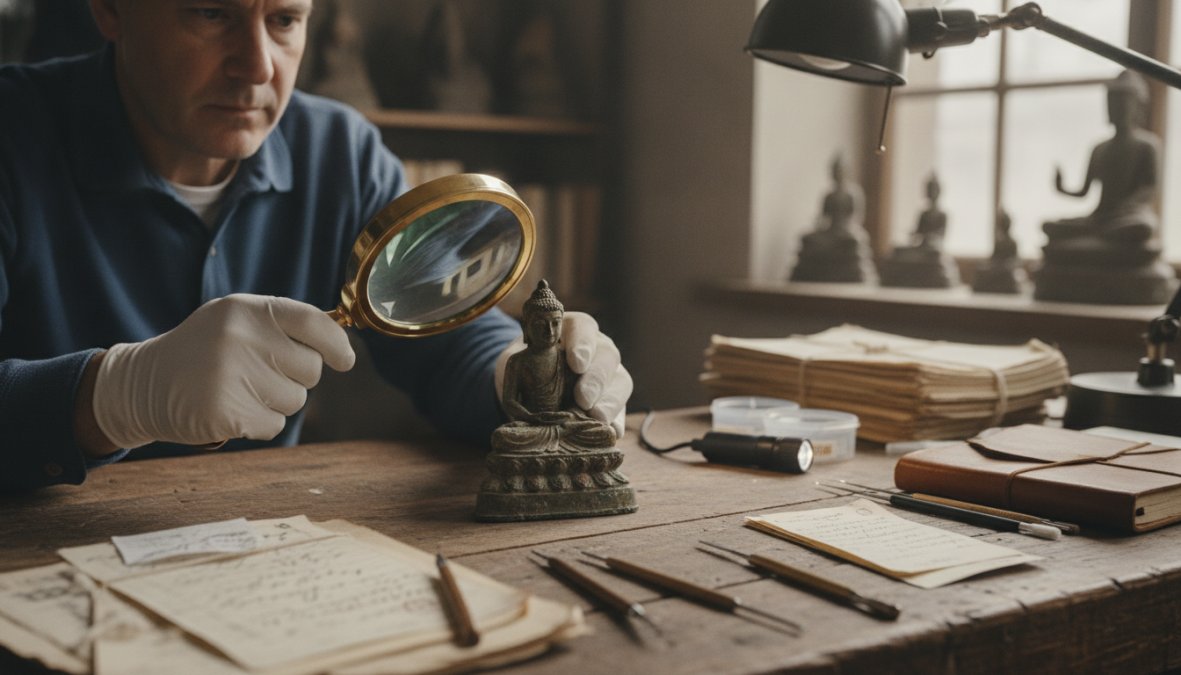
Before diving into documents and databases, the artwork itself tells a story. Physical inspection provides clues about age, authenticity, condition, and handling history.
Start by examining the piece in person whenever possible. Photographs can be deceiving. If you cannot examine the work in person, request high-resolution photographs from multiple angles, including close-ups of surfaces, edges, and any markings or inscriptions.
The physical condition of an artwork should align with its claimed age and provenance. A statue claimed to be from the 15th century should show appropriate patina and wear patterns. If it looks newly carved, that's a red flag. Conversely, if a work claimed to be from the 1950s shows 500 years of weathering, something is wrong.
Examining Inscriptions, Markings, and Signatures
Inscriptions, signatures, and maker's marks provide evidence of attribution and can help date the work. Look for consistency in how inscriptions appear. An authentic artist's signature should show the same hand, pressure, and style across multiple works.
Inscriptions can be carved, painted, inked, or cast into the work. Each method leaves different traces. A carved inscription should show wear consistent with the rest of the piece. A painted inscription should show aging appropriate to its claimed date. If an inscription looks fresh while the rest of the work shows age, the mark may have been added later.
For Asian art, inscriptions often include dates, artist names, or dedicatory messages in Sanskrit, Chinese, Thai, or other languages. If you cannot read the inscription, hire a specialist to translate and authenticate it.
Assessing Condition and Age Indicators
Patina, the surface layer that develops over time, is difficult to fake convincingly. Different materials develop patina differently. Bronze develops a specific greenish or brownish patina over decades. Stone develops weathering patterns. An expert can often assess authenticity by examining patina alone.
Cracks, repairs, and restoration work are legitimate parts of provenance. What matters is transparency about restoration. If a piece has been extensively repaired, that should be documented in its provenance record. Ask about conservation history and request documentation from professional conservators.
Art Authentication Methods and Due Diligence
Scientific testing can determine material composition, age, and authenticity. Radiocarbon dating establishes when organic materials were created. X-ray fluorescence (XRF) analysis identifies elemental composition of pigments and metals. Thermoluminescence dating works for ceramics. These tests provide data points that support or contradict authenticity claims.
Expert appraisal by qualified professionals is essential for high-value acquisitions. An appraiser should have credentials, experience with the specific art form, and no financial interest in the outcome. The appraiser examines the work, researches its history, compares it to similar authenticated pieces, and provides a written assessment.
Due diligence means asking questions and verifying answers. Who is the seller? What is their reputation? How long have they been in business? A reputable dealer welcomes scrutiny. Those who become defensive when asked for documentation are signaling risk.
Art Market Due Diligence: Researching Ownership History
Tracing ownership history requires systematic research. Start with what you know and work backward through time. If you have a recent invoice or gallery receipt, that's your starting point. From there, research the gallery or dealer and ask where they acquired the piece.
Each transfer should be documented. Gallery to collector. Collector to auction house. Auction house to new collector. For works that have appeared in auctions, auction house catalogs are invaluable. Major auction houses maintain archives documenting provenance as claimed at the time of sale, hammer price, and sometimes buyer identity.
Museums and institutions also maintain records. If a work was loaned to an exhibition, that institution's records document its existence and condition at a specific time. If a piece has been in an institutional collection, that's a significant credibility boost.
Tracing Chain of Ownership and Transference Records
The chain of ownership should be unbroken or have explainable gaps. A work created in 1600 that appears in a documented collection in 1800 has a 200-year gap that should be explained. What's concerning is an unexplained gap followed by sudden reappearance with perfect documentation.
Transference records, auction results, bills of sale, insurance documents, institutional transfer records, are the backbone of provenance. Compile a timeline listing each owner with dates and supporting documentation. This visual timeline makes gaps obvious and helps identify which periods need additional research.
Digital Tools for Art Ownership History Research
Online databases make research faster and more thorough. However, these databases are not comprehensive. Use them to gather information, but verify findings through other sources.
Online Databases and Registries
The Art Loss Register is the primary database for documenting stolen and looted art. Check it to ensure a work isn't listed as stolen or missing, particularly for works that changed hands during periods of conflict.
Museum databases and collection catalogs are increasingly digitized. Major museums publish their collections online with provenance information. Auction house databases archive past sales going back decades. Gallery websites and dealer directories indicate membership in professional organizations like the Antiquities Dealers' Association, which requires members to verify provenance before offering items for sale.
Blockchain and NFC-Enabled Authentication
Blockchain technology creates immutable, timestamped records of ownership transfer. NFC (Near Field Communication) tags are small chips that can store provenance information. However, these technologies are only as reliable as the information entered into them. They're most useful for contemporary art and newly acquired pieces, supplementing rather than replacing traditional provenance research.
DIY Verification vs. Professional Provenance Research
You can conduct basic provenance research yourself by reviewing available documents, checking online databases, and asking questions of the seller. For many pieces, this is sufficient to uncover major red flags.
However, professional provenance researchers have access to resources unavailable to the general public. They have relationships with dealers, auction houses, and institutions. They speak multiple languages and understand the art market. For high-value acquisitions, pieces worth tens of thousands of dollars or more, professional provenance research is a worthwhile investment.
When hiring a provenance researcher, ask for references and examples of previous work. A qualified researcher should be transparent about what they can and cannot verify and provide detailed written reports documenting findings and sources.
Legal Implications of Provenance Gaps and Forgery
Provenance gaps create legal risk. If you purchase a work with undocumented ownership periods, you may have difficulty proving legal ownership if the work is later claimed by a previous owner or heir. In some jurisdictions, possession alone is not sufficient to establish ownership.
If you purchase a work represented as authentic and later discover it's a forgery, you may have recourse against the seller for fraud or breach of warranty. However, this requires proof that the seller knew or should have known the work was inauthentic.
The statute of limitations for claiming stolen art varies by jurisdiction but is often lengthy. A work stolen decades ago can still be claimed by the original owner or their heirs. This is why the Art Loss Register is important.
Purchase agreements should include clear representations about authenticity and provenance, specifying what provenance documentation the seller is providing and what representations they're making about the work's authenticity.
Verifying art provenance requires patience, skepticism, and often professional expertise. The strongest provenance combines multiple forms of documentation: invoices, exhibition records, expert appraisals, and physical evidence. When considering a significant acquisition, take time to research thoroughly, ask questions, and request documentation.
At HD Asian Art, every piece in our carefully curated collection comes with documented history and transparent sourcing. We provide detailed provenance information, condition reports, and expert authentication for our antique and contemporary pieces. The Art Loss Register's guidance on art theft prevention, American Alliance of Museums' provenance standards, and International Council of Museums' code of ethics all emphasize the importance of documented provenance in the art market. Build a collection grounded in authenticity and knowledge.
Frequently Asked Questions
What documents do I need to verify the provenance of art?
Essential documents include certificates of authenticity, original purchase invoices, exhibition catalogs, gallery records, and ownership transfer documentation. For Asian art, look for auction house catalogs, museum exhibition records, and any correspondence with previous owners. A complete provenance chain shows the artwork's chain of ownership from creation to present. Missing documents create provenance gaps that may affect value and authenticity confidence.
How do I research art ownership history and verify chain of ownership?
Begin by contacting previous owners, galleries, or auction houses listed in documentation. Use online databases like the Art Loss Register to check for stolen works. For Asian art specifically, consult museum archives, temple records, and specialized registries. Document each transference with dates and seller information. Art market due diligence involves verifying each owner's identity and obtaining written confirmation of authenticity from reputable sources in the provenance documentation chain.
Can I verify provenance online, or do I need a professional art expert?
You can conduct initial DIY verification using online databases, digital registries, and blockchain-enabled authentication tools. However, for expensive or rare pieces, professional provenance research is recommended. Art experts and appraisers can authenticate using scientific methods, access restricted archives, and verify attribution through catalogue raisonné research. For Asian art with complex histories, professional verification provides legal protection and ensures comprehensive art authentication methods are applied.
What are red flags that indicate questionable provenance or forgery?
Watch for missing documentation, vague ownership histories, sudden appearance without prior records, and inconsistent attributions. Physical red flags include anachronistic materials, unnatural wear patterns, or inscriptions that don't match the supposed period. Be cautious of sellers unable to provide certificates of authenticity or exhibition history. Provenance gaps spanning decades, especially for high-value pieces, warrant expert investigation. Legal issues or claims of unknown origins are serious concerns in art market due diligence.
