



How to Identify Authentic Museum-Quality Buddha Statues
How to Identify Authentic Museum-Quality Buddha Statues
Collectors lose thousands of pounds every year to convincing reproductions sold as genuine antique Buddhist art. The global art forgery market is estimated at over $6 billion annually, according to the Fine Arts Expert Institute, and Buddhist sculptures are among the most frequently faked categories.
Knowing how to spot an authentic Buddha statue is not a luxury skill for serious collectors, it is a prerequisite for building a collection that holds cultural and financial value. This guide cuts through the noise and gives you the concrete, hands-on criteria that distinguish museum-quality Buddha sculptures from mass-produced imitations.
Table of Contents
Quick Takeaways
|
Key Insight |
Explanation |
|---|---|
|
Iconography is your first filter |
Mudras, ushnisha shape, and ear-lobe length differ significantly by region and period. Errors in these details almost always indicate a reproduction. |
|
Bronze casting method reveals age |
Genuine antique bronzes use the lost-wax (cire perdue) method and show tool marks, casting seams, and uneven patina that machine-made fakes cannot replicate authentically. |
|
Provenance documentation is non-negotiable for high-value pieces |
Any statue above £1,000 should come with verifiable exhibition history, auction records, or a collector's receipt pre-dating 1970 (the UNESCO cultural property convention benchmark). |
|
Regional style narrows dating dramatically |
A Burmese Mandalay-style Buddha looks nothing like a Khmer sandstone head from Cambodia. Mismatched stylistic elements across regions are a red flag. |
|
Thermoluminescence (TL) testing is the gold standard for ceramics and terracotta |
TL testing from an accredited laboratory costs roughly £200-£400 but provides scientifically verifiable age data, removing all guesswork. |
|
Artificial patina is identifiable under UV light |
Artificially aged surfaces fluoresce differently under ultraviolet light than genuine centuries-old patina. A basic UV torch is an inexpensive first-line tool. |
|
Specialist dealers carry accountability that auction houses often do not |
A dedicated Asian art retailer staking their reputation on each piece has stronger incentive to verify authenticity than a generalist auction room processing hundreds of lots. |
Why Authenticity Matters in Buddhist Art Collecting
Collecting authentic Buddha statues is not simply about financial investment, though that dimension is real. A genuine 18th-century Burmese bronze carries irreplaceable cultural data, including casting techniques, mineral composition, and iconographic conventions that tell scholars something specific about a workshop, a monk's patronage, or a royal commission. A reproduction carries none of that. It is, at best, a decorative object.
For spiritual practitioners setting up a home altar, authenticity carries a different but equally serious weight. Many Buddhist traditions hold that a statue consecrated by monks in its country of origin holds distinct spiritual efficacy, a quality that is by definition absent from a factory-produced replica. Collectors and practitioners alike have skin in the game when it comes to verifying what they are buying.
A common mistake at this stage is treating authenticity as a binary question. In practice, there is a spectrum. A piece can be genuinely old, regionally produced, and artistically significant without being a singular museum exhibition piece. Understanding where a statue sits on that spectrum, rather than simply asking "real or fake?", is the foundation of informed collecting.
Reading Iconographic Markers Correctly
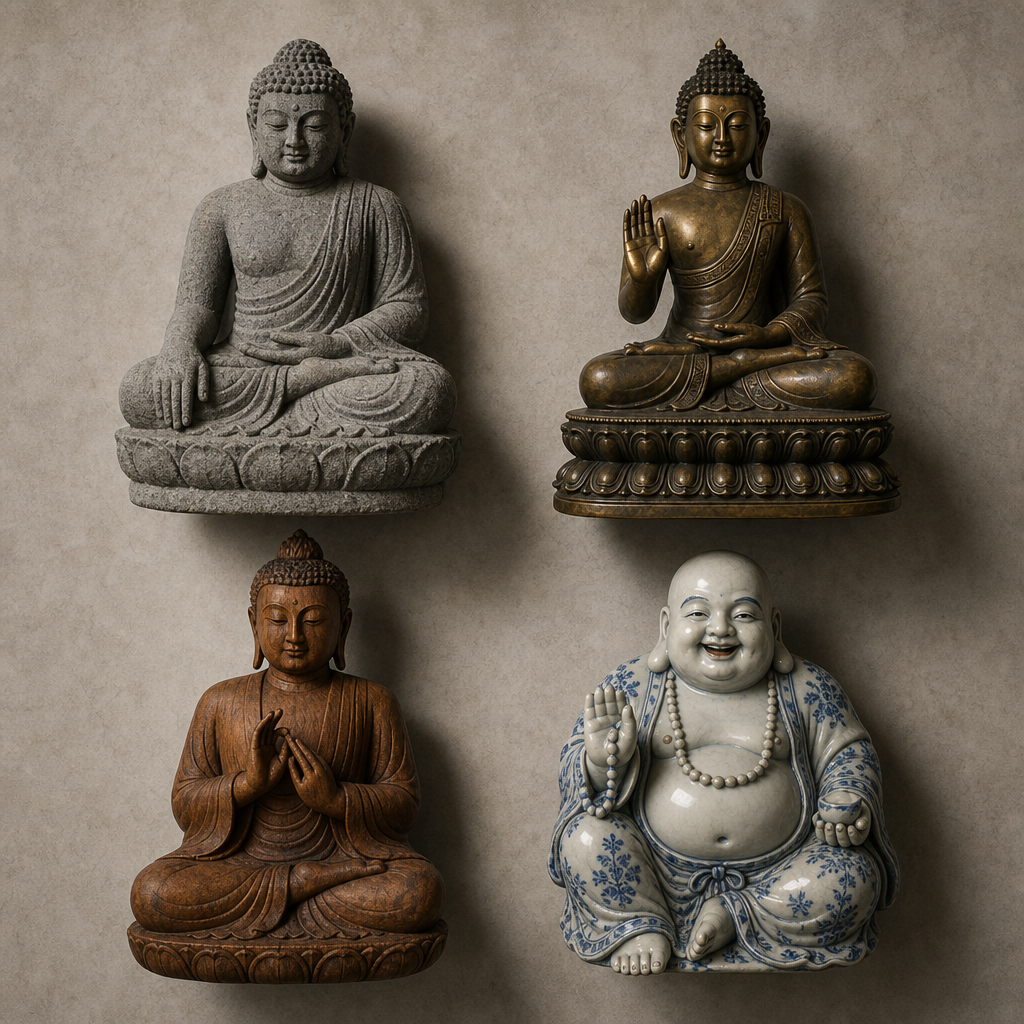
Iconography is the single most reliable starting point for authenticating Buddhist sculptures. Buddhist art follows strict visual grammars developed over more than two millennia, and these grammars vary precisely by region and period. A forger who gets the basic form right almost always fails on the details.
The Mudras: Hand Gestures and Their Regional Variations
The Buddha's hand position (mudra) communicates specific meanings and follows conventions that differ between Theravada and Mahayana traditions, and further between national schools. The Bhumisparsha mudra (earth-touching gesture) is ubiquitous in Southeast Asian bronzes from Burma, Thailand, and Cambodia, but the precise angle of the wrist, the position of the fingers, and the relationship of the hand to the knee vary in ways that are geographically diagnostic. A Burmese Shan-style figure holds this mudra differently from a Thai Sukhothai-period example.
In practice, the most common iconographic error in reproductions is mixing stylistic conventions. A figure with a Thai-style flame ushnisha but Gandharan facial features and a Chinese-style lotus throne is a composite designed to look vaguely "Buddhist" rather than a product of any coherent artistic tradition. Spotting this kind of cultural collage immediately removes a piece from serious consideration.
The Ushnisha, Usnisa, and Cranial Features
The cranial protuberance (ushnisha) is one of the 32 physical marks of the Buddha and its form is a strong regional identifier. Theravada Southeast Asian figures typically feature a flame-shaped ushnisha, often gilded separately. Chinese Chan and Pure Land bronzes from the Song through Qing dynasties favour a more compact, dome-shaped ushnisha. Gandharan figures from the Pakistan-Afghanistan corridor show a tightly coiled topknot influenced by Hellenistic sculpture.
Ear-lobe length is equally diagnostic. All authentic Buddha representations show elongated ear lobes, a reference to the heavy jewellery Siddhartha wore as a prince before his renunciation. However, the degree of elongation, the curvature, and whether the lobe touches the shoulder all vary by tradition. Proportions that seem arbitrarily exaggerated rather than following a specific stylistic rule are a warning sign.
Pro tip: Invest in two or three region-specific iconographic reference texts before you spend serious money on any piece. The Art Institute of Chicago and the Metropolitan Museum of Art both publish openly accessible collection notes that function as solid reference points for regional stylistic conventions.
Material Composition and Craftsmanship Standards
Museum-quality Buddhist sculptures are made from materials appropriate to their region and period. This is not a flexible standard. Thai and Burmese bronzes from before the 20th century use specific alloy compositions (typically high-tin bronze) that differ measurably from modern casting alloys. Chinese lacquered wood figures follow precise layering techniques. Khmer sandstone carvings display tool marks consistent with iron chisels, not modern mechanical grinders.
Bronze Casting: Lost-Wax vs. Sand-Cast vs. Machine Production
The lost-wax casting method (cire perdue) was the dominant technique for Buddhist bronzes across Southeast and East Asia for centuries. It produces subtle asymmetries, thin-walled hollow bodies, and tool-finishing marks that are virtually impossible to replicate systematically in machine production. Run your fingers along the interior of a hollow bronze figure. Genuine lost-wax castings show irregular interior surface texture. Sand-cast or pressure-cast modern reproductions are smooth and uniform inside.
The casting seams on genuine antique bronzes were filed down by hand and are rarely perfectly symmetrical. Modern machine-cast figures show seams in precisely repeating positions, or no seams at all if they are slip-cast. Weight distribution is another indicator. Authentic bronzes are often lighter than they appear because the walls are thin and uneven. Heavy, dense bronzes with perfectly uniform walls are almost always modern production pieces.
Wood, Lacquer, and Stone: Material-Specific Indicators
Burmese lacquerware and gilded wood figures are subject to a specific set of authentication criteria. Genuine Burmese lacquerwork uses thayo (a paste made from sawdust, ash, and lacquer sap) applied in multiple layers over a bamboo or wood armature. The layers crack in characteristic patterns over time, with fine crazing visible under magnification. Modern reproductions use synthetic lacquers that crack differently, or do not crack at all for decades.
For stone figures, specifically Khmer sandstone and Indian granite or schist, the tool marks left by period-appropriate instruments are diagnostic. Iron chisels produce different surface textures than carbide-tipped modern tools. Additionally, genuine stone carvings acquire a bio-patina (lichen, mineral deposits, algae staining) that penetrates the stone surface over centuries. Surface-applied dirt and artificial staining sit on top of the stone and can be partially removed with a damp cloth. Genuine patina cannot.
Pro tip: For bronze pieces, ask the seller for the wall thickness. Museum-quality Southeast Asian bronzes from the 15th through 19th centuries typically have wall thicknesses between 3mm and 8mm. Uniformly thick walls above 10mm across the entire figure are a modern casting indicator.
Provenance, Documentation, and Paper Trails
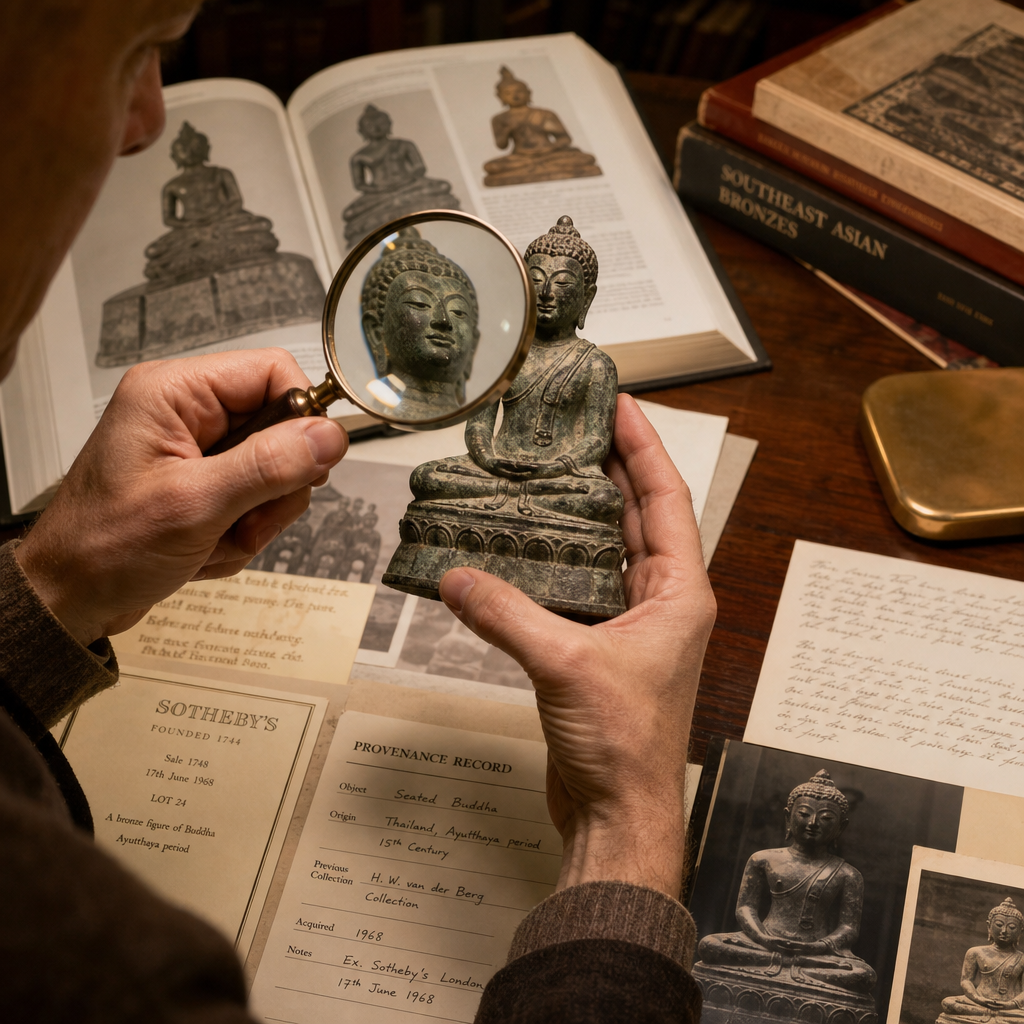
Provenance is the documented history of a sculpture's ownership from its creation to the present. For any piece valued above £500, the absence of provenance is not merely a gap in paperwork. It is itself a yellow flag. Legitimate pieces that have passed through serious collections almost always carry some documentation, even if it is only a typed letter from a previous owner or a photograph in an old auction catalogue.
The 1970 UNESCO Convention on the Means of Prohibiting and Preventing the Illicit Import, Export and Transfer of Ownership of Cultural Property is the internationally recognised benchmark. Any reputable dealer should be able to demonstrate that a piece either pre-dates the convention with documentation or was lawfully exported from its country of origin. This is not bureaucratic red tape. It is the ethical and legal baseline for responsible collecting.
What Good Provenance Documentation Looks Like
Acceptable provenance documentation includes exhibition catalogues with the piece illustrated, auction house records (Christie's, Sotheby's, Bonhams), dealer invoices with descriptions, academic publications featuring the object, and insurance appraisals. A handwritten label on the base of a figure stating a family name and date is useful supplementary evidence but is not sufficient on its own for high-value pieces.
A common mistake is conflating a certificate of authenticity from the selling dealer with independent provenance. A dealer's own certificate is only as credible as the dealer's reputation and methodology. Independent verification from a specialist such as a museum curator, an academic with regional expertise, or an accredited appraiser carries significantly more weight.
Regional Style Identification Across Asia
One of the clearest markers of expertise in Buddhist art collecting is the ability to identify regional styles at a glance. This skill takes time to develop, but the basic framework is learnable. Each major Buddhist art-producing region developed a distinctive visual language that, once internalised, makes misattribution obvious.
Southeast Asia: Burma, Thailand, Cambodia, Laos
Burmese figures from the Mandalay period (19th century) are characterised by highly ornate gilded lacquerwork, jewelled costumes, and a frontal rigidity that reflects the influence of court patronage. Thai figures from Sukhothai (13th to 15th century) are distinguished by their flame ushnisha, oval face, and the walking Buddha posture that is almost uniquely Thai. Khmer figures from Cambodia are stone-dominant, frontal, and feature the characteristic Angkor-period serene smile (sometimes called the "Khmer smile") and tiered crowns on Bodhisattva figures.
Lao Buddhist sculpture closely follows Thai conventions but with regional variations including broader faces, more pronounced lips, and a distinctive "calling for rain" standing posture with arms held straight at the sides, fingers pointing down. This posture is rare in other Southeast Asian traditions and is a strong marker of Lao origin.
East Asia: China, Japan, and Their Sub-Traditions
Chinese Buddhist sculpture spans over 1,500 years and enormous stylistic diversity. Tang dynasty (618 to 907 CE) figures are notable for their rounded, sensuous forms influenced by contact with Central Asian and Indian artistic traditions. Song dynasty figures show greater refinement and introspection. Ming and Qing bronzes are often heavily gilded and follow highly standardised proportions. Japanese Buddhist sculpture, influenced by Chinese models but consistently distinctive, shows a particular mastery of wood carving and a tendency toward psychological expressiveness unseen in mainland traditions.
South Asian figures, including those from Sri Lanka and India, represent the oldest continuous Buddhist sculptural tradition. Gandharan works from present-day Pakistan show Hellenistic influence in the treatment of drapery and facial features. South Indian bronzes from the Chola period are among the most technically accomplished metalwork objects in human history and command corresponding prices on the collector market.
Authentic vs. Reproduction vs. Museum-Quality: A Direct Comparison
Collectors frequently conflate three distinct categories. Understanding the difference between a genuine but modest antique, a high-quality reproduction, and a piece that meets museum exhibition standards is essential for setting realistic expectations and making informed purchases.
|
Criterion |
Genuine Antique (Collector Grade) |
High-Quality Reproduction |
Museum-Quality Authentic |
|---|---|---|---|
|
Age |
50-200+ years, verifiable |
Contemporary production, 0-30 years |
Typically 100+ years with documented history |
|
Craftsmanship |
Hand-finished, period-appropriate techniques |
Machine-assisted, consistent but uniform |
Exceptional hand workmanship, workshop-attributed |
|
Iconographic Accuracy |
Region-accurate with minor wear variations |
Often mixed regional conventions |
Precisely correct for attributed region and period |
|
Provenance Documentation |
Partial, at least one verifiable link |
None or dealer certificate only |
Full chain, pre-1970 documentation preferred |
|
Patina and Aging |
Natural, uneven, penetrating |
Artificial, surface-applied, uniform |
Deeply developed, scientifically verifiable |
|
Scientific Testing |
Rarely tested but testable |
Would fail TL or XRF testing |
Often tested, results on file |
|
Typical Price Range (UK market) |
£300 to £5,000 |
£50 to £500 |
£5,000 to £500,000+ |
Aging Signs, Patina, and Surface Wear Analysis
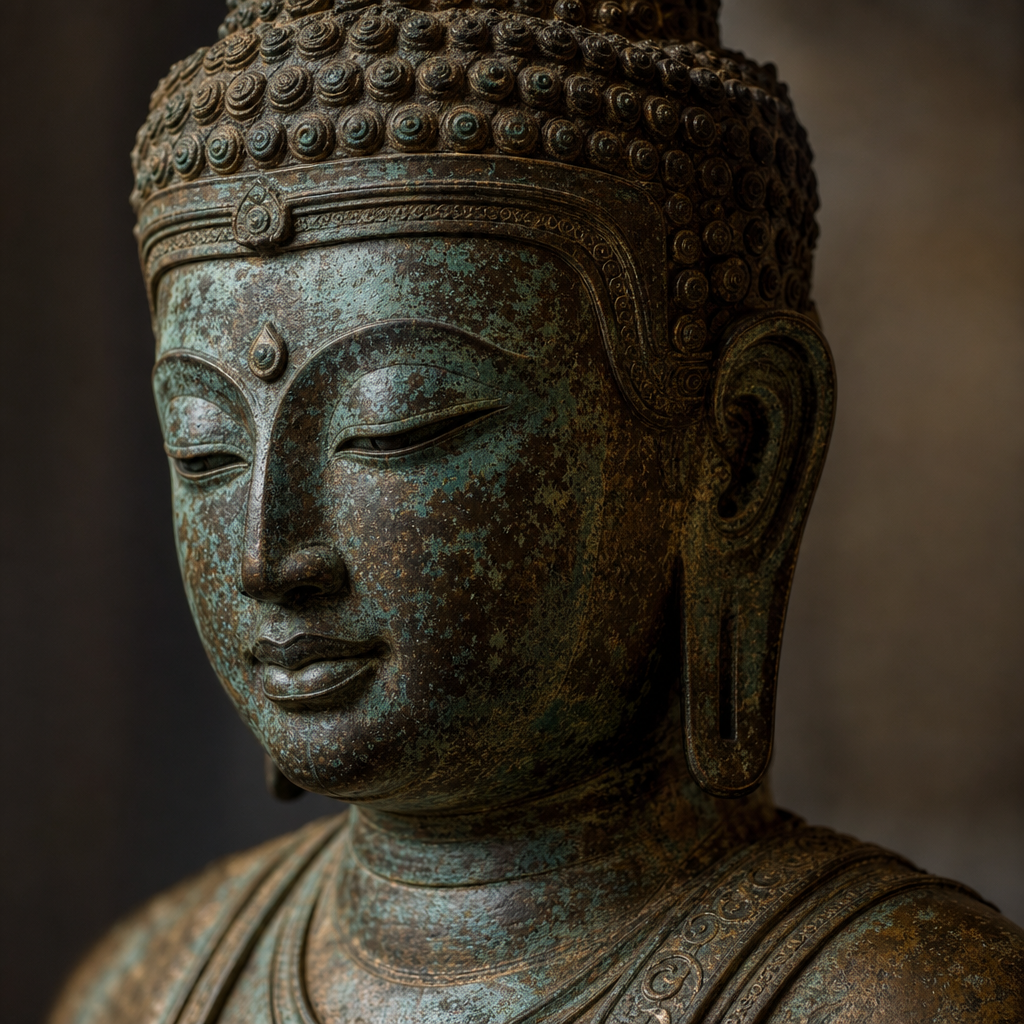
Patina on a genuine antique bronze is the product of centuries of chemical interaction between the metal alloy and its environment, including soil minerals, humidity, organic acids, and atmospheric oxygen. It is not a coating. It is a physical transformation of the surface metal itself. This is the single most important distinction to understand when examining any bronze Buddhist sculpture.
Genuine bronze patina on buried or long-stored figures typically shows several simultaneous chemical compounds, including cuprite (red), malachite (green), and azurite (blue), distributed unevenly and at different depths. Under magnification, genuine patina shows crystal structures embedded in the metal surface. Artificial patina applied with acids or chemical solutions sits as a thin layer on top of the metal and shows under magnification as a uniform coating without crystal structure penetration.
Using Ultraviolet Light for Initial Assessment
A basic UV torch (365nm wavelength is most useful) is an inexpensive tool that belongs in every collector's kit. Under UV light, artificially applied lacquers, paints, and chemical patinas fluoresce differently than naturally aged surfaces. Modern synthetic coatings typically fluoresce bright white or yellow-green. Genuine aged patina on bronze shows dull, irregular fluorescence or none at all.
UV examination is a screening tool, not a definitive test. A piece that passes UV inspection still requires further evaluation. A piece that shows suspicious fluorescence under UV has failed a basic test and should be treated with significant scepticism unless a credible explanation is available (some legitimate restoration work involves modern consolidants that will fluoresce).
Wear Patterns: Where Authentic Age Shows
Genuine antique figures show wear in the places where human hands have touched them over generations. The high points of a bronze figure, including the knees, the top of the head, the tips of the fingers, and the nose, are typically the most worn. Figures that were objects of veneration show additional wear on the feet, where oil offerings and flower garlands have interacted with the metal. This wear is organic and unpredictable in its distribution.
Artificially aged reproductions show uniform wear applied with abrasives or chemical etching. The wear follows geometric patterns related to the tumbling or sanding method used, not the specific touch-points of ritual use. Comparing the wear pattern to the figure's iconographic function is a useful check. A figure that would have been kept in a temple shrine facing forward should show most wear on the front face. A figure shown with significant wear on the back but pristine knees is immediately suspicious.
"The experienced eye learns to read patina as a document. Every layer tells you something about where this object has been, who has touched it, and what it has survived. A forger can copy a shape. They cannot copy two hundred years of human interaction." Dr. Leelananda Prematilleke, archaeologist and Buddhist art specialist, cited in the Journal of the Royal Asiatic Society.
Where to Source Authentic Buddhist Sculptures
The sourcing channel matters enormously. Not all dealers operate to the same standards, and the lack of consistent regulation in the Asian art secondary market means that buyer diligence is the primary protection mechanism. Understanding the strengths and limitations of different sourcing channels helps collectors allocate their trust and their budgets appropriately.
Specialist retailers with deep regional expertise, like HD Asian Art, occupy a distinct position in this market. A dealer who sources specifically from Burma, Cambodia, China, India, Indonesia, Japan, Laos, Sri Lanka, and Thailand, and who focuses exclusively on Buddhist and Hindu sculptures, accumulates the kind of region-specific knowledge that generalist auction houses and antique markets simply cannot match. When a dealer stakes their entire business identity on a narrow category, every piece they carry reflects on their credibility in a way that does not apply to a dealer who sells everything from Georgian silver to tribal African art.
For collectors building a home altar or a focused collection of antique Buddhist art, working with a specialist dealer also offers the practical advantage of informed guidance on iconographic accuracy, cultural context, and appropriate care for different materials. This kind of relationship-based purchasing is qualitatively different from buying at auction, where the buyer bears the full burden of pre-sale research with no ongoing dialogue with a knowledgeable seller.
Auction houses including Christie's, Sotheby's, and Bonhams do handle significant Asian art, and their specialist departments produce detailed condition reports and provenance research for major lots. However, the buyer's premium (typically 25% to 30% on top of the hammer price in the UK) significantly increases the total cost, and the auction environment does not lend itself to the kind of extended examination that responsible authentication requires.
Pro tip: Before purchasing any piece above £500 from a dealer or auction, request a condition report in writing that specifically addresses the material, casting method, patina condition, and any areas of restoration. A dealer unwilling to provide this in writing is giving you important information about their level of confidence in the piece.
Frequently Asked Questions
How can I tell if a Buddha statue is genuinely old without scientific testing?
Start with iconographic analysis to confirm the piece follows regionally correct conventions for its stated origin and period. Then examine the patina under magnification and UV light. Check wear patterns against the figure's likely ritual function. Assess the casting method by examining wall thickness, interior surface texture, and seam finishing. None of these methods is individually conclusive, but a figure that passes all four checks with consistency is significantly more likely to be genuine than one that fails any of them.
What is the difference between a museum-quality Buddha and a decorative reproduction?
A museum-quality piece must satisfy several simultaneous criteria: it must be of documented age, produced using period-appropriate techniques, iconographically accurate for its attributed tradition, and in sufficiently fine condition to merit exhibition. A decorative reproduction is made to evoke the aesthetic of Buddhist sculpture without meeting any of these standards. Many high-quality reproductions are sold legitimately as such, and there is nothing wrong with purchasing them if you know what you are buying. The problem arises when reproductions are misrepresented or when buyers do not ask the right questions.
Is thermoluminescence testing worth the cost for a Buddha statue purchase?
For terracotta and ceramic Buddhist figures, yes. TL testing from an accredited laboratory, costing approximately £200 to £400, provides scientifically verifiable age data that eliminates all uncertainty about whether a ceramic or earthenware piece is genuinely old. For bronzes and stone figures, other methods including XRF (X-ray fluorescence) alloy analysis and isotope testing are more appropriate. The cost of testing should be weighed against the purchase price. For any piece above £1,500, testing is a sound investment that typically pays for itself in negotiating leverage alone.
Can a Buddha statue be authentic but still not worth collecting?
Yes, and this is an underappreciated point. A piece can be genuinely old, regionally produced, and legally obtained, and still hold limited collector or investment value if it is in poor condition, represents a common type rather than a distinctive example, or belongs to a period and region that the market currently undervalues. Authenticity is necessary but not sufficient for collector-grade value. Condition, rarity, iconographic interest, and provenance quality all contribute to a piece's position in the market.
What questions should I ask a dealer before buying a Buddha statue?
Ask specifically: What is the attributed region and period? What materials and casting or carving method was used? Does the piece have any provenance documentation pre-dating 1970? Has it been restored, and if so, what work was done and by whom? Will the dealer provide a written condition report? Is there a returns or authenticity guarantee? A reputable dealer will answer each of these questions directly and specifically. Vague answers, appeals to subjective quality claims, or reluctance to put details in writing are warning signs worth taking seriously.
How do Buddhist art styles from Burma differ from those of Thailand?
Burmese figures, particularly from the Mandalay period, tend to be more elaborately ornamented, with gilded lacquer costumes, jewelled decoration, and a strong emphasis on regal presentation. The faces are rounder and the postures more strictly frontal. Thai figures, particularly from the Sukhothai and Ayutthaya periods, favour a more elongated, idealised beauty with the distinctive flame ushnisha. The walking Buddha (Phra Leela) posture is almost uniquely Thai. Thai bronzes also show a different alloy preference, typically leaning toward higher copper content, which produces a warmer surface colour than Burmese high-tin bronzes.
Have you examined a Buddha statue that turned out to be different from what the seller claimed, or have you found a reliable authentication method that has served you well as a collector? Share your experience in the comments below.
References
