



How to Choose Authentic Buddhist Statues: A Buyer's Guide
How to Choose Authentic Buddhist Statues: A Buyer's Guide
Table of Contents
How to Choose Authentic Buddhist Statues: Core Principles
Choosing authentic Buddhist statues requires understanding spiritual significance, artistic craftsmanship, and historical provenance. The difference between genuine pieces and mass-produced replicas often comes down to subtle details in casting, patina development, and iconographic accuracy. Authentic pieces appreciate in value and maintain integrity through decades, while hand-carved or consecrated statues embody intention and cultural heritage in ways machine-produced versions cannot.
Below, we'll walk you through five core principles that separate authentic Buddhist sculpture from counterfeits: understanding iconography and mudras, evaluating materials and craftsmanship, identifying provenance and historical markers, recognizing consecration and spiritual authenticity, and assessing ethical sourcing.
Understanding Buddhist Statue Iconography and Meanings
Buddhist statue iconography communicates spiritual teachings through visual language. Each Buddha figure represents different aspects of enlightenment and different traditions within Buddhism. Recognizing which Buddha you're looking at is the first step toward authentication, because authentic statues maintain strict iconographic consistency while mass-produced pieces often blend traditions or simplify details.
Shaka Nyorai (Shakyamuni Buddha), the historical Buddha, appears in meditation pose with hands folded in his lap, seated on a lotus throne. Authentic Shaka statues show elongated earlobes (symbolizing his royal past), a ushnisha (cranial bump) representing wisdom, and serene facial features with downcast eyes. Amida Buddha appears in Pure Land Buddhism with hands in the welcoming gesture (raigo mudra). Kannon (Avalokiteshvara), the bodhisattva of compassion, typically shows multiple arms and serene features in East Asian traditions. Authentic pieces maintain these distinctions rigorously, while reproductions sometimes blur iconographic boundaries.
Recognizing Different Buddha Figures: Shaka Nyorai, Amida, and Kannon
Shaka Nyorai statues feature the meditation mudra with both hands turned upward at chest or lap level, seated in full or half-lotus position. Authentic pieces show anatomically correct proportions: torso roughly 40% of total height, legs 35%, head 25%. Antique Shaka statues often show wear on the knees and hands from centuries of devotional touching, while reproductions have uniform wear patterns.
Amida Buddha appears with hands in the raigo mudra (welcoming gesture), thumbs and index fingers forming circles at chest level. Kannon statues typically show a slender, youthful figure with a crown or headdress. In Chinese traditions, Kannon appears as Guan Yin with feminine features and often holds a willow branch or vase. The number of arms (typically 2, 4, 6, or 11) remains consistent within a single authentic statue.
Mudras and Their Spiritual Significance
Mudras are hand gestures that encode specific spiritual meanings and allow instant identification of Buddha figures. The dhyana mudra (meditation gesture) shows both hands in the lap with palms facing upward, representing deep meditation. The abhaya mudra (fearlessness gesture) displays the right hand raised to shoulder height with palm facing outward, representing protection. The varada mudra (wish-granting gesture) shows the right hand lowered with palm facing outward, representing compassion. The raigo mudra (welcoming gesture) shows both hands at chest level with thumbs and index fingers forming circles, representing the welcoming of souls to the Pure Land.
Reproductions frequently show incorrect mudra positioning, missing fingers, or hands that don't align properly with the body's anatomy. These errors are instant red flags for collectors.
Buddha Statue Materials Guide: Bronze, Stone, and Beyond
Material composition directly impacts authenticity assessment. Bronze remains the most prized material for Buddhist statues. Authentic bronze statues show specific casting characteristics: visible casting seams along the back or sides, substantial weight, and a patina that develops naturally over decades. The bronze used in traditional casting contains tin and copper in specific ratios that affect color and durability.
Stone sculptures include marble, granite, limestone, and sandstone pieces. Authentic stone Buddhas show tool marks consistent with hand-carving: chiseling patterns visible in the stone, natural weathering appropriate to age, and sometimes lichen or moss growth on outdoor pieces. Wood statues show grain patterns, natural wood aging, and sometimes insect damage appropriate to age. Gilt and lacquer finishes on authentic pieces show genuine gold leaf application or lacquer that has naturally cracked and worn.
Evaluating Craftsmanship Through Material Quality
Hand-cast bronze statues use lost-wax casting, a labor-intensive process where artisans create individual wax models that are melted out during casting. This produces unique characteristics: slight variations between castings, visible seams that require hand-finishing, and weight distribution reflecting the sculptor's artistic choices. Machine-cast reproductions use molds that produce identical copies with uniform surface finish, perfectly symmetrical details, and casting seams that are either absent or perfectly aligned.
Stone carving quality reveals itself through tool marks and proportional accuracy. Authentic hand-carved pieces show chiseling patterns that vary across the surface with minor asymmetries reflecting human carving. Machine-carved stone shows uniform tool marks and perfect symmetry.
Patina, Casting, and Hand-Carved Indicators
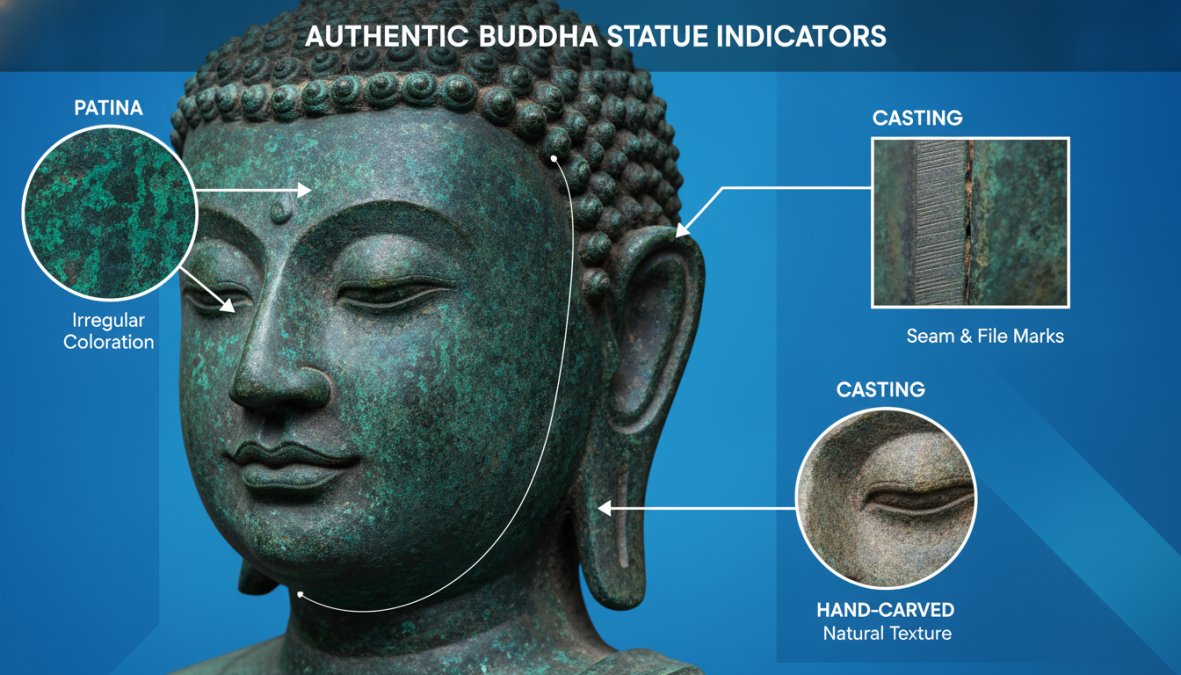
Authentic patina develops through natural oxidation, appearing irregular with darker concentrations in protected crevices and lighter areas on exposed surfaces. The color ranges from deep green to brown to black, and feels slightly rough to the touch.
Artificial patina on reproductions uses chemical treatments to age bronze quickly, creating uniform color and a painted appearance. Artificial patina often flakes or chips if examined closely, revealing shiny bronze underneath.
Casting characteristics reveal production methods. Authentic hand-cast pieces show visible casting seams running vertically along the back or sides with hand-finished file marks and slight irregularities. Hand-carved indicators on stone or wood pieces include chiseling patterns that vary across the surface, minor asymmetries in proportions, tool marks visible in protected areas, and natural weathering appropriate to stated age.
Antique Buddha Statue Identification and Provenance
Provenance, the documented history of ownership and origin, separates investment-grade antique pieces from newer statues. Authentic antique Buddha statues carry evidence of age, use, and historical context that reproductions cannot fabricate convincingly.
Age markers include wear patterns consistent with centuries of handling, environmental patina appropriate to geographic origin, and construction methods specific to historical periods. Geographic markers reveal origin, as bronze casting traditions varied significantly across Buddhist regions. Thai casting shows specific stylistic and technical characteristics different from Burmese, Chinese, or Japanese traditions. Iconographic consistency with historical periods helps date pieces, as certain mudra variations, facial feature proportions, and decorative elements were specific to particular centuries and regions.
Visual Authentication Checklist for Collectors
Material and Weight:
- Bronze feels substantial and dense
- Surface shows natural patina or appropriate aging
- Stone shows tool marks consistent with hand-carving
- Wood displays natural grain variation and appropriate aging
Patina and Surface:
- Patina color is irregular with darker crevices
- Surface texture feels slightly rough, not smooth or painted
- Patina doesn't flake or chip when gently examined
- Protected areas show appropriate aging
Iconography and Proportions:
- Mudra positioning matches documented Buddhist traditions
- Hand positioning is anatomically correct relative to body
- Facial features show appropriate proportions for identified Buddha figure
- Ushnisha is properly proportioned and positioned
Craftsmanship Details:
- Facial features show individual carving characteristics
- Eyes are not perfectly symmetrical
- Fingers show natural positioning, not stiff or uniform
- Surface finish reflects hand-finishing, not machine polishing
Age and Wear:
- Wear patterns are consistent with claimed age
- Knees and hands show appropriate patina from handling
- Wear is irregular, reflecting natural use patterns
Documentation:
- Provenance documentation available
- Geographic origin matches stylistic characteristics
- Historical period consistent with construction methods
Distinguishing Mass-Produced from Artisan Work
Mass-produced characteristics: Identical copies available in multiple locations, perfectly symmetrical facial features, uniform patina applied chemically, machine-finished surfaces with no tool marks, casting seams that are either absent or perfectly aligned, light weight for the size, stiff or unnaturally positioned fingers and features.
Artisan work characteristics: Each piece shows individual variations reflecting the artist's hand, slight asymmetries in facial features and proportions, naturally developed patina, hand-finished surfaces with visible tool marks, visible casting seams that are hand-finished with file marks, appropriate weight to material and size, naturally positioned fingers and features.
The distinction becomes obvious when you examine multiple pieces. Identical reproductions are indistinguishable. Hand-cast pieces each show individual character reflecting the sculptor's choices.
Consecrated Buddha Statues Explained: Spiritual Authenticity
Spiritual authenticity differs from physical authenticity. A statue can be physically authentic but not spiritually activated. Conversely, a contemporary piece can be spiritually consecrated and carry genuine spiritual power despite being newly made.
Consecration is a ritual process where Buddhist monks or teachers formally activate a statue's spiritual purpose. During consecration, sacred texts are often placed inside the statue, mantras are chanted, and the statue is formally dedicated to spiritual practice. Physical evidence of consecration includes a small opening (usually on the back or bottom) where texts were inserted, sometimes visible sealing with wax or resin, and documentation of the consecration ceremony. Some collectors prioritize spiritual authenticity over physical age, as a newly consecrated statue by a respected teacher may carry more spiritual weight for meditation practice than an old, beautiful statue that was never formally activated.
Placement, Feng Shui, and Selecting by Personal Intention
Where you place your Buddha statue matters both spiritually and practically. Feng Shui principles suggest specific placements based on the statue's Buddha figure and your desired outcomes. Shaka Buddha statues placed in meditation rooms support deep practice. Amida Buddha in the western corner of your home represents the Pure Land direction. Kannon statues in living areas enhance compassion and relationships.
Practical placement considerations include eye level or slightly above (showing respect), facing into the room rather than toward a wall, protected from direct sunlight, away from kitchen or bathroom areas, on a dedicated altar with appropriate offerings, and elevated on a stand or shelf rather than floor level.
Intention-based selection means choosing a Buddha figure that supports your spiritual practice. If you're developing compassion, Kannon is appropriate. If you're deepening meditation, Shaka is traditional. If you're working with Pure Land practices, Amida supports that intention.
Creating Your Home Altar with Intention
A home altar centered on an authentic Buddha statue creates a dedicated space for spiritual practice. Basic altar setup includes the Buddha statue as the central focus, elevated on a stand or shelf, with offerings in front: fresh flowers (representing impermanence), incense (representing prayers), candles or butter lamps (representing light and consciousness), and water or tea (representing generosity).
Altar placement should be in a quiet area where you can practice regularly. Maintenance keeps your altar energetically active. Change flowers regularly, keep the space clean and organized, and spend time at your altar daily.
Ethical Sourcing and Cultural Heritage Considerations
Authentic Buddhist statues come from specific cultural and historical contexts. Ethical sourcing means respecting that heritage and ensuring your purchase doesn't contribute to cultural exploitation or environmental damage.
Cultural appropriation concerns arise when Western collectors treat Buddhist statues as decorative objects without understanding their spiritual significance. Looting and illegal export of antique statues from temples and archaeological sites remains a significant problem. Ethical collectors verify provenance and avoid statues that lack documentation of legal export.
Contemporary artisan support offers an ethical alternative to antique collecting. Purchasing hand-carved statues directly from Buddhist artisans in Nepal, Thailand, Myanmar, and other traditional centers supports living craftspeople and ensures ethical production.
Documentation and transparency are ethical markers. Reputable dealers provide clear information about origin, production methods, and any restoration work. They're willing to answer questions about sourcing and can explain how they verify authenticity.
Maintenance and Preservation of Your Buddhist Sculpture
Proper maintenance preserves your statue's authenticity and extends its lifespan for centuries.
Bronze care focuses on patina preservation. Avoid aggressive cleaning; the patina is valuable and protects the bronze underneath. Dust gently with a soft cloth and avoid commercial cleaners, which damage the patina. Water should be minimal, as humidity can accelerate corrosion.
Stone care involves gentle dusting and monitoring for cracks or flaking. Don't use high-pressure washing, which can damage carved details. Wood care requires climate control, as extreme humidity fluctuations cause wood to expand and contract, potentially cracking the statue.
Display environment matters significantly. Stable temperature and humidity preserve all materials. Direct sunlight fades patina and can damage wood and paint. Elevated placement protects the statue from accidental damage.
Professional conservation becomes necessary if your statue shows damage, active corrosion, or structural issues. Avoid amateur restoration attempts, which often damage value. Documentation of your collection helps with insurance and future authentication. Photograph your statues from multiple angles, record measurements and weight, and maintain any provenance documentation.
Choosing authentic Buddhist statues requires balancing spiritual intention, artistic appreciation, and practical authentication knowledge. Whether you're seeking a contemporary piece for meditation practice or an investment-grade antique, prioritize provenance verification, material authentication, and ethical sourcing to ensure you're acquiring pieces with integrity.
Frequently Asked Questions
What are the key signs of an authentic antique Buddha statue?
Authentic antique Buddhist statues typically show natural patina, consistent wear patterns, and visible casting seams from hand-casting methods. Examine the base for artisan marks and inconsistencies that indicate individual craftsmanship rather than mass production. Look for age-appropriate material composition, bronze should show oxidation, and stone should display weathering consistent with its purported historical period. Provenance documentation and expert appraisal provide additional authentication.
How do I identify mass-produced Buddha statues versus hand-carved artisan work?
Mass-produced statues display uniform, perfect symmetry, identical surface textures, and minimal variation between pieces. Hand-carved Buddhist sculptures show subtle asymmetries, tool marks that vary across the surface, and individualized details in mudras and facial expressions. Examine the back and underside, artisan work reveals inconsistencies and natural material variations, while factory pieces are uniformly finished. Weight and material density also differ; authentic bronze castings feel substantially heavier than hollow reproductions.
What is the importance of mudras when choosing a Buddhist statue?
Mudras, hand gestures in Buddhist iconography, convey specific spiritual meanings and intentions. The meditation mudra (hands in lap), teaching mudra (hand raised), and blessing mudra each represent different aspects of dharma and practice. Choosing a statue with a mudra aligned to your personal intention or spiritual focus enhances the piece's relevance to your meditation space or home altar. Authentic representations of these gestures reflect proper sculptural style and cultural heritage, making mudra accuracy a marker of quality craftsmanship.
Should I prioritize consecrated Buddha statues for my home altar?
Consecrated Buddhist statues have undergone ritual blessing and are spiritually activated, making them meaningful for serious practitioners. However, authenticity and craftsmanship matter equally, a beautifully executed, ethically sourced hand-carved statue serves your meditation space effectively even without formal consecration. If spiritual activation is important to your practice, seek statues with documented consecration history. Many collectors value both the artistic and spiritual dimensions, so consider your personal intention and whether the statue's provenance and craftsmanship align with your values.
