



Hanuman Statues: Poses, Meanings and Iconography
Hanuman Statues: Poses, Meanings and Iconography
Most buyers searching for a Hanuman statue already know he is powerful. What they often miss is that each pose carries a precise theological meaning, and choosing the wrong one for your intended purpose, whether devotional, decorative, or protective, is a common and entirely avoidable mistake.
Hanuman is the son of the wind god Vayu, devoted servant of Rama, and the embodiment of strength combined with selfless loyalty. His sculpted forms are among the most iconographically rich in the Hindu tradition, and understanding what each posture communicates will change how you select, place, and experience your piece.
Table of Contents
Who Is Hanuman: Theology Behind the Warrior Deity
Hanuman occupies a unique position in the Hindu pantheon. He is simultaneously a devotee and a deity, a warrior and a servant. In the Ramayana, composed by the sage Valmiki, Hanuman is described as the greatest devotee of Rama, a form of Vishnu. His power comes not from ego but from complete surrender to a higher purpose. That theological paradox, that absolute strength is made possible by absolute humility, is precisely what makes Hanuman iconography so layered and worth studying carefully before you purchase any sculpture.
He is also a Chiranjeevi, an immortal who is said to still exist on earth. This belief makes Hanuman statues more than decorative objects for practicing Hindus. They are considered living presences, which is why the posture of the sculpture matters deeply to those who place them on home altars or in devotional spaces.
The Hanuman Chalisa, a 16th-century devotional hymn by the poet Tulsidas, describes Hanuman as the remover of obstacles, the destroyer of demons, and a physician who cures all illness. These roles map directly onto the poses that sculptors have standardized over centuries of tradition.
"Hanuman is the ideal combination of strength and devotion. He represents the best of what a human being can aspire to be." - Swami Vivekananda, on the character of Hanuman in Vedantic thought.
Quick Takeaways
|
Key Insight |
Explanation |
|---|---|
|
Pose determines devotional purpose |
The Vira (warrior) pose is used for protection; the Anjali (prayer) pose is used for devotion and blessing. Using the wrong pose for your intention weakens the symbolic value of the piece. |
|
The mace (gada) signals divine authority |
When Hanuman holds a mace, the sculpture emphasizes his role as a warrior guardian. Altars focused on protection typically feature this attribute prominently. |
|
The open chest gesture has specific meaning |
In the chest-revealing pose (Bhakta Hanuman), Hanuman opens his chest to show Rama and Sita within his heart. This is the most intensely devotional of all Hanuman forms. |
|
Flying pose represents divine messenger status |
The Veera Hanuman flying with the Sanjeevani mountain symbolizes the role of Hanuman as a rescuer and healer, not merely a fighter. |
|
Color choices in painted sculptures carry meaning |
Red is the traditional sacred color for Hanuman and represents energy and devotion. Orange-vermilion (sindoor) coated statues reflect the story of Hanuman applying sindoor all over his body to please Rama. |
|
Regional styles vary significantly |
South Indian bronze Hanuman statues follow strict Agama Shastra proportions. North Indian stone Hanuman sculptures tend toward more dynamic, narrative poses. Both are theologically valid. |
|
Scale affects perceived purpose |
Large standing Hanuman statues placed at temple gates serve a protective function. Smaller seated or kneeling statues are intended for personal altars and daily puja practice. |
Core Hanuman Poses and Their Specific Meanings
There are six primary postures that appear repeatedly across Hindu monkey god sculpture traditions, and each carries a meaning that practitioners and serious collectors should know by name. Confusing them, or dismissing them as stylistic variations, misses the point entirely.
Vira Hanuman: The Standing Warrior
Vira Hanuman shows Hanuman in a standing position, typically with one foot slightly advanced, holding his mace. This is the pose associated with protection, courage, and the removal of enemies both physical and spiritual. It is the most common form found at the entrances of temples and homes in South India. For buyers seeking a protective piece for a doorway or garden, this is the correct choice.
In practice, Vira Hanuman statues often show the tail curled upward, a detail that matters iconographically. The upward tail signals alertness and divine power. A downward tail would be unusual and would indicate a non-traditional sculpture.
Anjali or Namaskara Hanuman: The Devotee
In this pose, Hanuman stands or kneels with both palms pressed together in the prayer gesture. This is Hanuman as pure devotee, the form that emphasizes his relationship with Rama above all else. It is the preferred form for personal altars used in daily worship. Collectors who practice bhakti (devotional) traditions consistently choose this pose because it reflects the quality of devotion they themselves wish to cultivate.
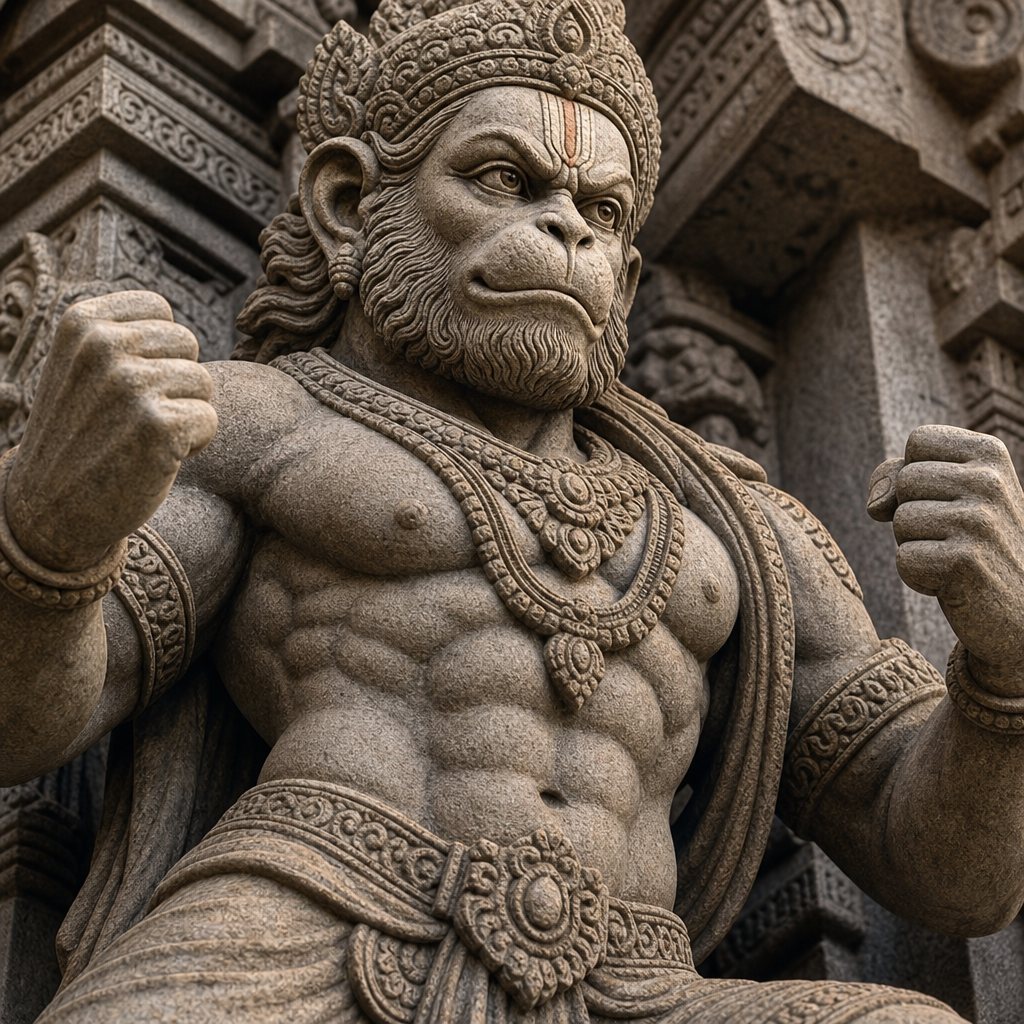
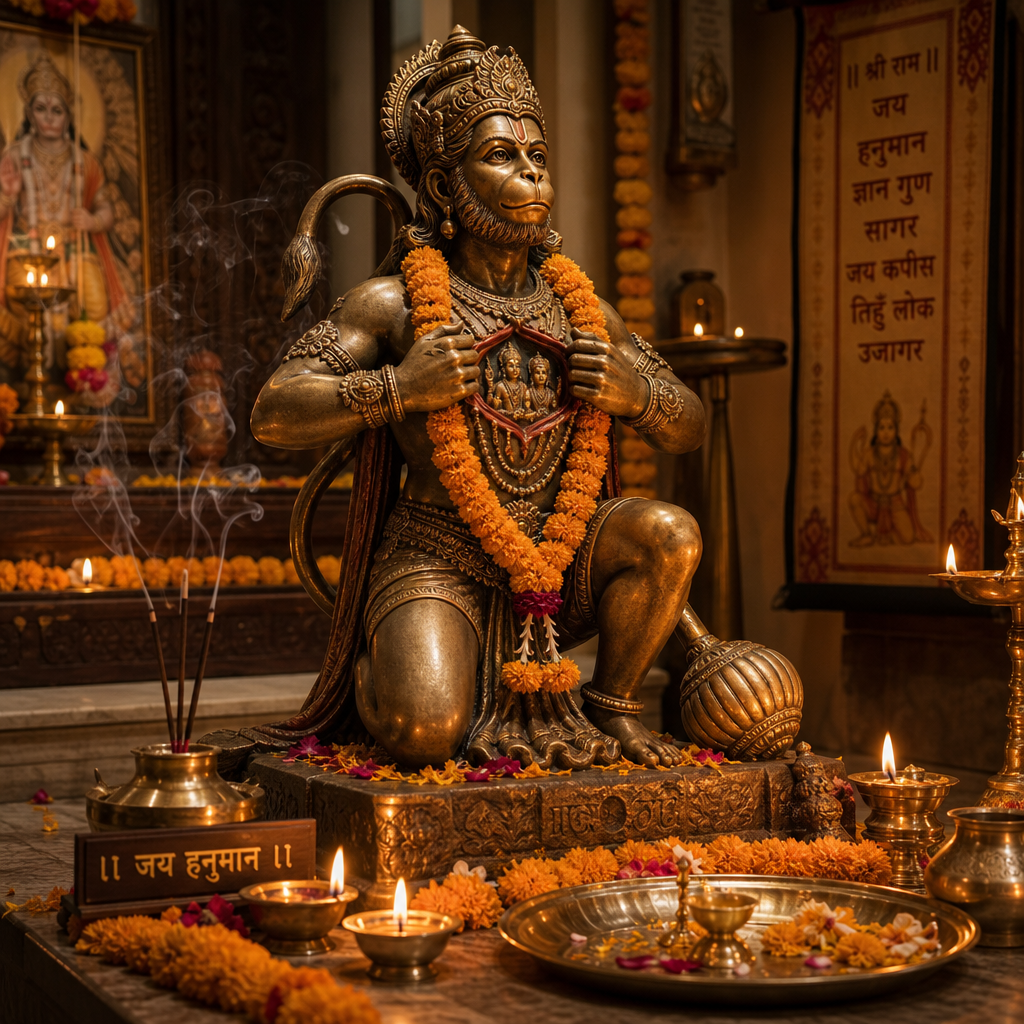
Bhakta Hanuman: The Open Heart
This is the most theologically profound of all Hanuman poses. Hanuman opens his chest with his own hands to reveal Rama and Sita seated within his heart. The Bhakta Hanuman form originates in a story from the Uttara Kanda section of the Ramayana, in which Sita gives Hanuman a pearl necklace as a reward, and Hanuman destroys each pearl because Rama and Sita are not inside them. When challenged that Rama is not inside him either, he tears open his chest to prove otherwise.
This form is less common in sculpture than the standing warrior poses, which makes well-executed examples from HD Asian Art's collection particularly valuable for serious collectors. It is the form most associated with the concept of the heart as a temple.
Panchamukhi Hanuman: The Five-Faced Form
Panchamukhi Hanuman shows five faces: the central monkey face, plus the faces of Narasimha (lion), Garuda (eagle), Varaha (boar), and Hayagriva (horse). This is a tantric form derived from the episode in which Hanuman had to extinguish five lamps simultaneously to defeat the demon Ahiravan. Each face represents a different direction and a different divine power. These sculptures are used in esoteric worship and are considered extremely potent in protective contexts.
Flying Hanuman Carrying the Sanjeevani Mountain
This dynamic pose shows Hanuman airborne, holding an entire mountain in one hand and his mace in the other. It commemorates his rescue flight to bring the medicinal herb Sanjeevani to revive Lakshmana. This form emphasizes Hanuman's role as a healer and devoted rescuer. It is a popular choice for collectors who are drawn to the narrative drama of Hindu mythology rather than purely devotional use.
Virabhadra or Combat Pose
Less common but deeply powerful, this form shows Hanuman in active combat, typically trampling a demon underfoot. It is the form most directly connected to his role as a destroyer of evil, and it appears more often in temple relief sculpture than in freestanding statues intended for home use.
Hanuman Iconography: Reading the Symbols in Detail
Beyond the overall pose, the objects and features visible on a Hanuman statue each carry specific meaning. A collector who can read these details will always make better purchasing decisions than one who relies on visual impression alone.
The Gada (Mace)
The mace is the attribute most commonly associated with Hanuman across all regional traditions. It is the weapon of divine authority and represents his power to destroy obstacles and demonic forces. When the mace is held in the right hand, it signals active readiness for combat. When rested on the ground, it signals a guardian at rest, still powerful but not in a state of active conflict.
The Tail
Hanuman's tail is narratively significant throughout the Ramayana. He uses it to leap across the ocean, it is set on fire by Ravana and used by Hanuman to burn Lanka. In sculpture, a tail that curves up and over the head or arches high behind the figure indicates power and alertness. Some South Indian bronze traditions show the tail arranged in an elaborate coil above the head, functioning almost as a crown.
The Sacred Thread and Crown
Hanuman is depicted wearing the yajnopavita (sacred thread) because he is a Brahmin by education, having studied under Surya the sun god. His crown, when present, marks his divine status and distinguishes him from a merely powerful warrior. The combination of warrior attributes and priestly learning is central to his character and should be visible in any museum-quality sculpture.
Pro tip: When evaluating a Hanuman statue for authenticity to classical iconographic tradition, check for three details together: the sacred thread crossing the chest, the upward-curved tail, and the correctly held attribute in the primary hand. If all three are present, the sculptor worked from a genuine iconographic source rather than improvising.
Sindoor (Vermilion)
Many Hanuman statues are shown covered in or colored with orange-red sindoor. This traces to a story in which Sita applied sindoor to her hair as a mark of devotion to Rama, and Hanuman, wishing to honor Rama with equal fervor, covered his entire body in it. Sculptures with rich vermilion coloring, particularly in painted stone or lacquered wood examples, are depicting this specific act of devotion.
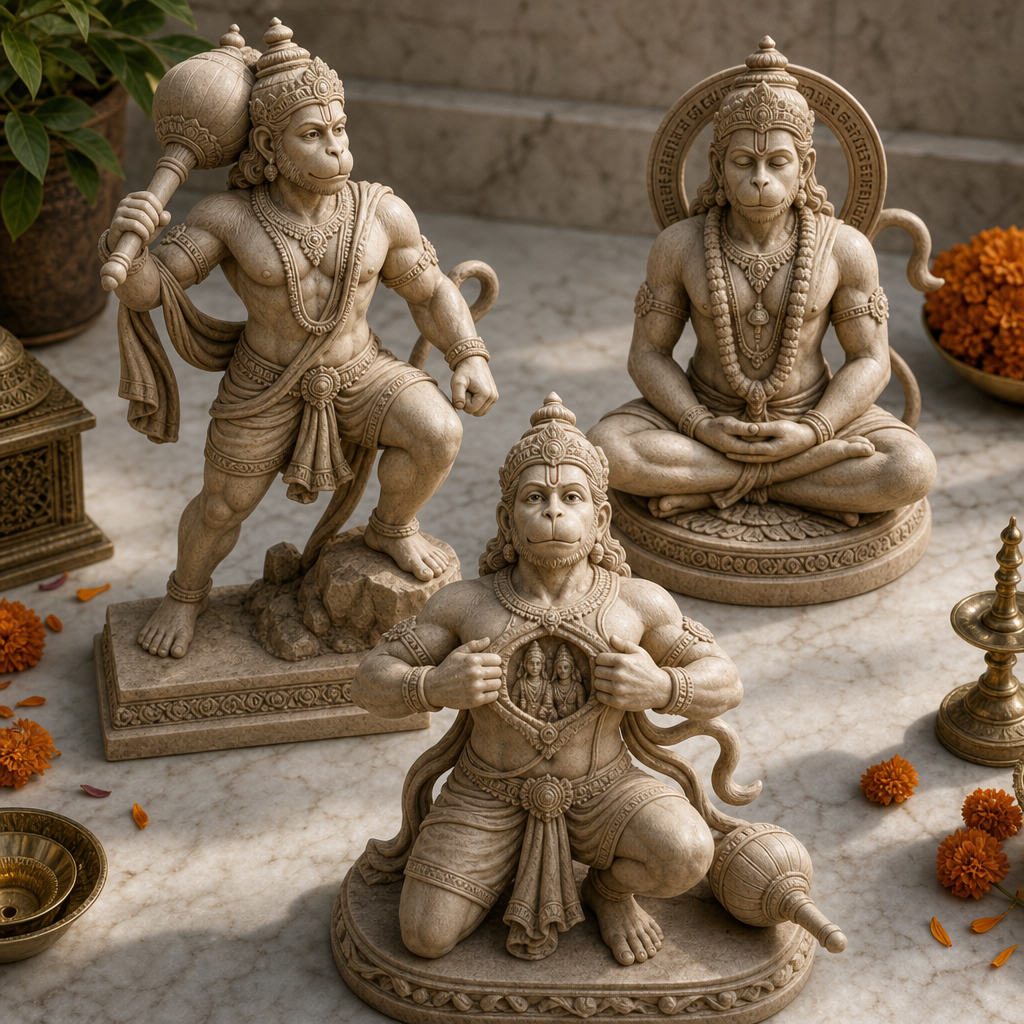
Comparison of Hanuman Statue Types by Purpose
|
Statue Type |
Best Suited For |
Key Iconographic Features to Look For |
|---|---|---|
|
Vira Hanuman (Standing Warrior) |
Doorway protection, garden placement, devotional space entrance |
Mace in right hand, upward tail, foot slightly advanced, crown present |
|
Bhakta Hanuman (Open Heart) |
Personal altar, meditation room, expression of devotional practice |
Both hands pulling open chest cavity, Rama and Sita visible inside, expression of serene devotion |
|
Panchamukhi Hanuman (Five-Faced) |
Powerful protection, esoteric or tantric practice, serious collector piece |
Five distinct faces identifiable as Hanuman, Narasimha, Garuda, Varaha, Hayagriva. Eight or ten arms common in this form. |
Pro tip: If you are building a home altar that combines Buddha statues and Hindu deity sculptures, as many collectors who appreciate both Asian traditions do, the Anjali or Bhakta Hanuman forms integrate most naturally because their energy is inward and devotional rather than outward and combative.
Materials and Regional Styles in Hindu Monkey God Sculpture
The material and regional origin of a Hindu monkey god sculpture affects both its aesthetic character and its connection to specific worship traditions. This is not a matter of preference alone. Different materials carry different histories and theological implications.
South Indian Bronze Casting
South Indian Hanuman bronzes, particularly those from Tamil Nadu, follow the Agama Shastra, a body of temple building and image-making texts that specify exact proportions, postures, and attributes. The lost-wax (cire-perdue) casting method used in these traditions produces sculptures with extraordinary surface detail. These are the most formally correct Hanuman sculptures available and are the standard against which other regional styles are judged by traditional practitioners.
A genuine antique South Indian bronze Hanuman is among the most sought-after pieces in the Hindu devotional art market. Modern reproductions using the same lost-wax method and following Agamic proportions are entirely appropriate for devotional use and represent serious craftsmanship.
North Indian Stone Sculpture
North Indian sculptors working in sandstone or marble tend toward more dynamic, narrative compositions. The Vira Hanuman forms from Rajasthan often show more movement and dramatic scale than their South Indian counterparts. These are sculptures that communicate power through sheer presence rather than through iconographic precision alone.
Painted Wood and Lacquered Sculpture
Painted wooden Hanuman sculptures appear across Rajasthan and Gujarat, often with brilliant polychrome surfaces. The red and orange palette in these pieces directly reflects the sindoor tradition. These sculptures tend to be more accessible in price than bronze or stone equivalents while still maintaining strong iconographic integrity when made by skilled craftspeople.
Collectors building a comprehensive collection of Asian religious art will find that Hanuman sculptures in these three material traditions complement each other beautifully, and pair well alongside the Burmese lacquerware and Buddhist bronze traditions that serious Asian art collectors often explore in parallel.
Placement and Use: Altar, Home, and Collection
Where and how you place a Hanuman statue changes its function, and getting this right matters both symbolically and practically. This is true whether your intent is devotional, aesthetic, or both.
Home Altar Placement
In a dedicated puja room or on a home altar, Hanuman is traditionally placed to the right of Rama, because he is Rama's greatest servant and devotee. The statue should face east or north, and should be placed at eye level or above when the worshipper is seated. Placing a Hanuman statue below waist height on a home altar is considered inauspicious in most North and South Indian traditions.
The Anjali or Bhakta Hanuman forms are both appropriate for altar use. The Panchamukhi form, while powerfully protective, is typically reserved for practitioners with a specific tantric or Shaiva devotional orientation, or for collectors who understand its theological weight.
Entrance and Exterior Placement
Vira Hanuman statues placed at the entrance to a home or garden are meant to function as guardians, turning away negative energy and protecting the household. This tradition is widespread across India and among diaspora communities globally. For exterior placement, stone or resin Hanuman sculptures are more practical than bronze or painted wood, which require protection from weather.
Display in a Collector's Context
For collectors whose interest is primarily art historical, the display of a Hanuman statue need not follow devotional placement rules strictly. However, even in a secular collection context, placing a Hanuman statue on the floor or in a storage area is generally considered disrespectful to the tradition it comes from, and most serious collectors observe a minimum of symbolic respect regardless of their personal beliefs.
HD Asian Art's collection of Hindu deity statues is sourced from across the subcontinent and offers pieces that work both as devotional objects and as museum-quality sculptural works. The same standard of quality that applies to their Buddhist sculptures applies to the Hindu collection, which means buyers can trust the iconographic integrity of what they are purchasing.
Frequently Asked Questions
What does a Hanuman statue represent in Hinduism?
Hanuman represents the ideal combination of strength, devotion, intelligence, and selfless service. He is considered the greatest devotee of Vishnu in his Rama form, and his statues embody his roles as warrior, protector, healer, and devoted servant. Different poses emphasize different aspects of these qualities, so the specific form of the statue matters significantly.
Which Hanuman pose is best for a home altar?
The Anjali Hanuman (prayer pose) and the Bhakta Hanuman (open heart pose) are the most suitable for personal home altars because both emphasize devotion and an inward spiritual orientation. The standing Vira Hanuman with mace is better suited for entrance or protective placement. For daily puja practice, the Anjali form is the most widely recommended across both North and South Indian traditions.
What is the significance of Hanuman's five faces in Panchamukhi sculptures?
Panchamukhi Hanuman's five faces represent Hanuman himself plus four other divine forms: Narasimha facing south, Garuda facing west, Varaha facing north, and Hayagriva facing upward. Together they represent divine power over all five directions. This form originates in the Ramayana episode where Hanuman needed to extinguish five lamps simultaneously to defeat the demon Ahiravan and rescue Rama and Lakshmana.
Why are so many Hanuman statues red or orange in color?
The red and orange coloring of many Hanuman statues reflects the sindoor (vermilion) tradition. According to the Ramayana, Hanuman covered his entire body in sindoor after seeing Sita apply it to her hair as a mark of devotion to Rama. He reasoned that if a small amount in her hair ensured Rama's longevity, then covering his whole body would do even more. This act is considered the ultimate expression of devotional love.
How do I identify a high-quality Hanuman statue versus a poor reproduction?
A high-quality Hanuman statue will show iconographic accuracy: the sacred thread crossing the chest correctly, the tail curled upward rather than drooping, attributes held in the appropriate hands, and proportions consistent with classical canons. Surface detail in the face, particularly in bronze casting, should show clear expression and refined features. Poor reproductions typically flatten facial detail, miss the sacred thread entirely, and show generic rather than specific poses. Buying from a specialist retailer with documented sourcing practices is the most reliable protection against iconographically inaccurate pieces.
Can a Hanuman statue be placed alongside Buddhist statues in the same space?
Yes, and this is a common practice among collectors and spiritual practitioners who appreciate multiple Asian traditions. Hanuman and Buddhist figures coexist in many Southeast Asian devotional contexts, particularly in Thailand and Cambodia where Hindu and Buddhist traditions have historically overlapped. For home display, the most important consideration is that each figure is placed respectfully and at an appropriate height. Devotional and inward-facing Hanuman forms, such as the Anjali pose, integrate most naturally alongside Buddhist figures in meditation spaces.
Share your experience with Hanuman statues in the comments below, whether you chose a specific pose for devotional reasons, as part of a collection, or simply because the sculpture spoke to you, your perspective adds something real to this conversation.
