



Costumes of Khmer Pre-Angkor Sculptures: A Collector's Guide
Costumes of Khmer Pre-Angkor Sculptures: A Collector's Guide
You're standing in front of a Khmer stone figure, trying to work out whether the garment offers a clue to its date or identity. The cloth may look like a simple band around the hips, but a fold, knot or incised line can carry useful information. Read those details carefully, and costume becomes a practical way to compare an object with documented examples, not just a decorative feature.
The costumes of Khmer pre-Angkor sculptures aren't a single uniform. They're a visual language made up of garment shape, jewellery, hairstyle and bodily pose. A disciplined reading starts with what the sculptor carved, then weighs those observations against dated works and other evidence.
Table of Contents
- Reading Pre-Angkor Khmer Sculpture in Context
- The Sampot and Other Pre-Angkor Lower Garments
- A Diagnostic Workflow for Working Collectors
- Jewellery, Hair and Headdress as Companion Signals
- Named Examples That Anchor the Vocabulary
- Common Mistakes When Reading Pre-Angkor Costume
Reading Pre-Angkor Khmer Sculpture in Context
“Pre-Angkor” describes Khmer traditions before the political consolidation conventionally associated with the Angkorian state. It's a useful historical label, but it shouldn't lead us to imagine a single, unchanging style. Khmer sculpture developed across time and place, and the way artists represented dress changed with it.
The Victoria and Albert Museum's Cambodia collection provides a substantial UK reference base for studying dress and material culture, with 121 catalogued objects that include Cambodian sculpture and related textiles (V&A Cambodia collection). The museum identifies the Buddha protected by the naga king Mucalinda as a subject known in Khmer art from as early as the 7th century. It also records a Cambodian sandstone head of a deva dated to the 10th century, showing the continued use of monumental stone imagery as Khmer visual traditions moved towards early Angkorian art.
These milestones help set the frame, but they don't turn every carved garment into a date label. A sculpture's clothes are designed signs, not a complete record of everyday fashion. Stone preserves the artist's choices: which folds to emphasise, how high the waist sits, whether the cloth is wrapped or arranged with a shaped front panel. Stucco, where it survives, can also preserve deliberately modelled details, but neither material should be treated as a transparent snapshot of what people wore.
Read the whole figure, not just the cloth
Begin with the lower garment, then look at the body around it. A simplified waistcloth may still be accompanied by a distinct headdress, hairstyle, necklace or posture that helps distinguish a deity from a royal or supernatural figure. If parts are damaged, surviving accessories can carry more weight, but they don't automatically settle identity.
A concise historical orientation to the period is available in this guide to the pre-Angkorian kingdom of Chenla. Keep the central distinction in mind as you examine an object: costume is evidence of visual convention, not a catalogue of ordinary clothing. That approach leaves room for comparison while avoiding claims the sculpture can't support.
The Sampot and Other Pre-Angkor Lower Garments
The sampot is a wraparound lower-body cloth, and its carved arrangement gives the viewer several features to record. Look first at the waistline. Does the garment sit low on the hips or rise higher? Then follow the cloth towards the front: does it fall, form a central panel, fan into folds or gather at a fastening?
A comparative study of Khmer sculpted images found that represented figures wear lower-body garments made from rectangular cloth, arranged in three principal modes, including a wrapped skirt cloth (study of Khmer costume and inscriptions). The study also describes luxury cloth as wide enough to extend from the waist towards the knee or ankle, with pleating or surface decoration. Those details give you a vocabulary for describing the carving without assuming the original fabric's colour, weave or exact construction.
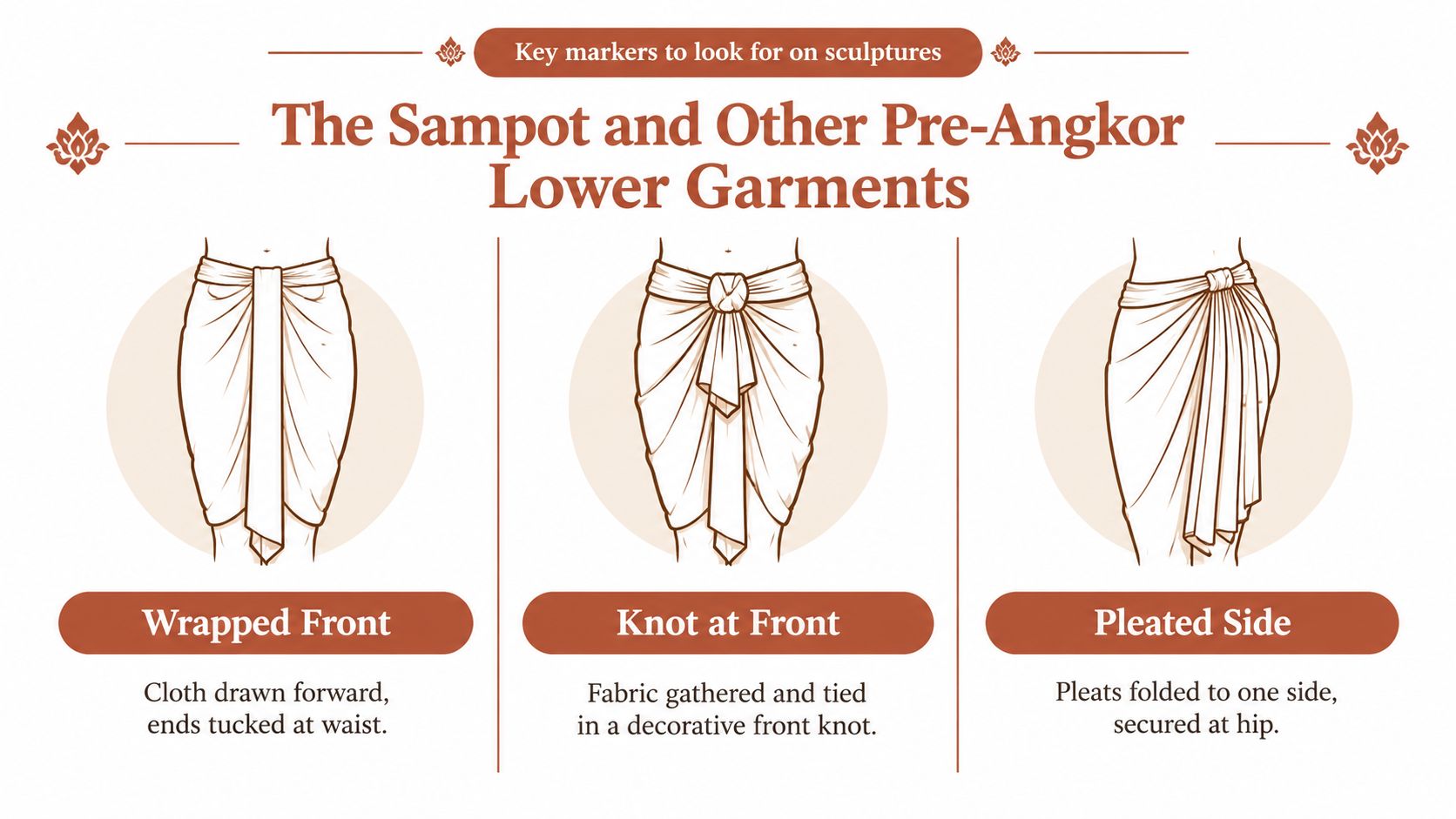
Follow the folds to the fastening
The Metropolitan Museum's Standing Ganesha offers a clear example. Identified with the Prasat Andet style, the figure wears a short wraparound skirt whose front end descends centrally in a series of flaring folds. The museum describes that central, flaring arrangement as characteristic of the style, making it more useful than a vague impression of “draped cloth” (Metropolitan Museum Standing Ganesha).
Compare that with a wrapped skirt cloth. The latter may have fewer clearly modelled front folds, while more elaborate arrangements make the direction of the cloth and the point of gathering easier to trace. Don't assume that every central panel is a knot, or that every line represents a separate pleat. Look for where the lines begin and end, and whether they converge at a fastening or continue down the garment.
A useful object description records waist height, pleat direction, front fall and fastening separately. The evidence doesn't justify assigning every figure to a rigid garment category, especially when carving is worn or incomplete. What it does offer is a reliable way to compare one sculpted arrangement with another.
A Diagnostic Workflow for Working Collectors
A costume assessment works best as a sequence of observations rather than a snap attribution. Textile rarely survives archaeologically, so sculpture is a principal source for how garments were arranged and represented. The challenge is to use that evidence without letting one striking fold decide the whole object's date.
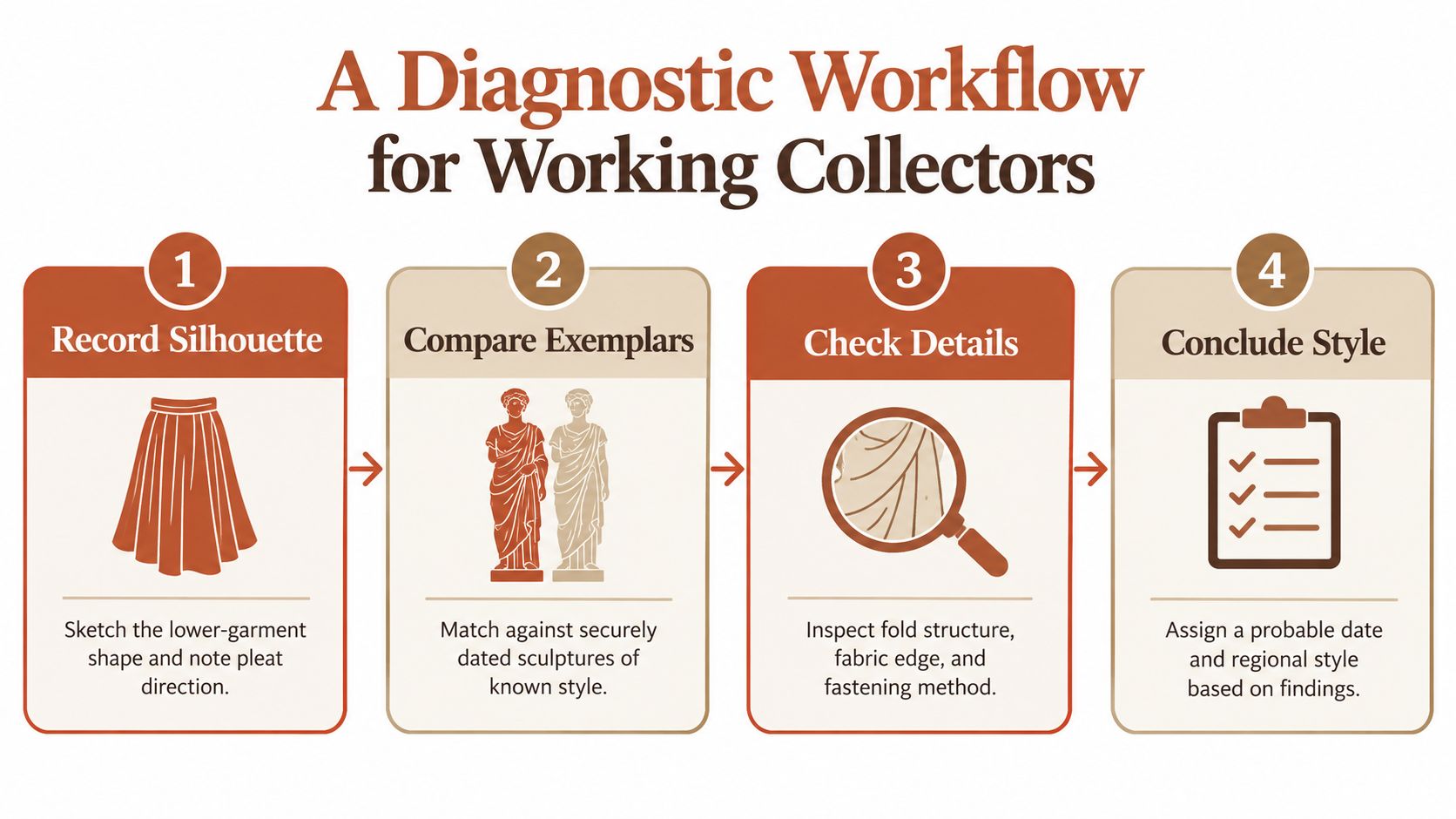
Four steps, with separate conclusions
- Record the garment. Sketch its silhouette and note the waist height, direction of the pleats, knot or fastening, and any surface pattern. Photograph the figure from the front, sides and back where access allows. A drawing can make a fold's path easier to compare than a verbal description alone.
- Compare securely dated examples. Look for the same combination of features in documented sculptures, not just a generally similar outline. A central flare, high waistband or shaped knot may be useful when it recurs in a securely dated work, but no single feature proves a date or regional origin.
- Cross-check the terms and techniques. Compare garment terminology and construction against contemporaneous Khmer inscriptions where relevant. This keeps modern labels from being mistaken for the historical vocabulary and connects what you see on the stone with other evidence.
- Separate costume from style. Record facial type, anatomy and carving treatment independently. The garment can support a stylistic comparison, but it shouldn't be merged with unrelated clues into one confident-sounding conclusion.
A practical overview of the wider attribution problem is available in this collector's guide to identifying Cambodian Buddhist and Hindu sculptures. The principle is straightforward: express confidence comparatively. A costume motif may strengthen an attribution, but it shouldn't stand alone, particularly if the garment is damaged or the sculpture lacks a secure archaeological context.
Jewellery, Hair and Headdress as Companion Signals
A waistcloth rarely identifies a figure by itself. Look upwards and outwards: the sculptor may have used hair, a headdress and jewellery to complete the figure's visual identity. The ensemble can signal divine or royal status even where the garment is rendered with few lines.
A Metropolitan Museum educational publication describes gold ornaments across the head, ears, neck and chest, waist, fingers, upper and lower arms, ankles and toes. That range is a reminder to inspect the full body, not just the most obvious necklace or crown (Metropolitan Museum educational publication on Southeast Asian sculpture). Earrings, armlets, waist ornaments and anklets can form a hierarchy of adornment that works together with the sampot.
Build an ornament map
Record what survives and where. A figure with a distinctive headdress and layered ornaments may communicate a different kind of authority from one with restrained adornment, but don't turn that contrast into a fixed identity rule. The V&A's chronological framework also cautions against treating costume as static: it places early sacred imagery in the pre-Angkor period and records continued development into later Khmer sculpture.
Hair deserves the same careful attention. A carved hairstyle may be visible even when a headdress is broken, and its arrangement can help distinguish the figure's presentation. If the head is missing, describe the garment and surviving jewellery without guessing what sat above them. If the lower cloth is damaged, note whether intact ornaments provide useful points of comparison.
For close looking, separate an object's ornament into zones: head, ears, neck, arms, waist and feet. That simple map reduces the temptation to treat a single surviving jewel as decisive. Readers who want a plain-language introduction to how earrings are shaped and worn can also consult this earring fit guide for shoppers. The comparison is useful for terminology, while the sculpture itself remains the evidence for historical interpretation.
Named Examples That Anchor the Vocabulary
Museum objects turn garment terminology into something you can test with your eyes. Start with the Met's Standing Ganesha, whose Prasat Andet style is associated with a short sampot and a central front end that falls in flaring folds. The point isn't to memorise a label. It's to notice how the fold direction and the position of the cloth combine into a recognisable arrangement.
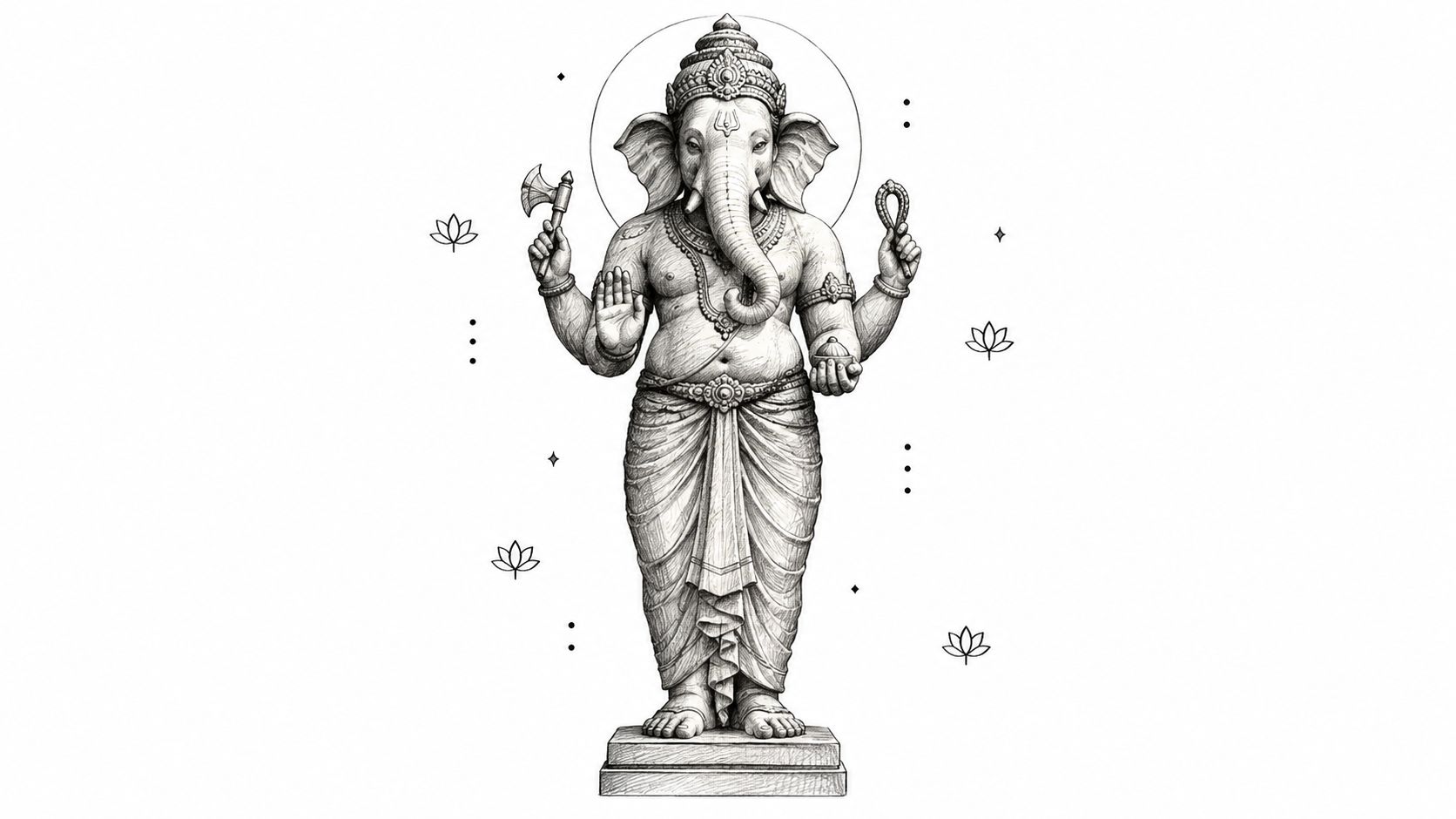
Compare how the sculptor marks cloth
A late-7th-century female deity, or devī, associated with the Musée Guimet shows a different way of conveying costume. A Metropolitan Museum publication describes a pleated waistcloth, multistranded belt and buckle expressed with lightly incised lines, along with a scalloped skirt hem that is also lightly marked. The effect is restrained: the sculptor suggests the garment without modelling its fabric.
The same publication identifies comparable treatment on a devī from Soc Trang province. That parallel helps a collector distinguish a shared approach to rendering cloth from a feature unique to one figure. Incision and shallow relief matter here as much as garment shape. An object with a similar waistcloth but much more descriptive modelling may warrant a different comparison.
When you encounter an unfamiliar torso, ask three questions: where does the cloth begin, how does the front panel fall, and how has the artist marked the fabric? Then compare the answers with the named works rather than relying on a broad resemblance. For wider religious context around the period, this article discusses Kalkin in pre-Angkor Khmer culture. Keep that contextual reading separate from the garment evidence: iconography and costume can inform one another, but neither should substitute for close observation.
Common Mistakes When Reading Pre-Angkor Costume
A familiar garment can create false certainty. The most common error is to project later Angkorian categories backwards and treat them as if they applied unchanged to earlier Khmer sculpture. A second is to read a damaged knot or broken fold as though the complete arrangement remained visible. In both cases, interpretation runs ahead of the surviving evidence.
The Sainsbury Centre's Khmer female torso shows why a careful reading matters. The mature Khmer period work is dated probably to the mid-11th century, partly because the sampot rises high over the hips at the back and forms a butterfly-shaped knot at the front (Sainsbury Centre female torso). Its long pleated skirt remains visible above the break, but the shoulder sockets show that the arms are missing and their original position is uncertain. The garment can assist dating without securely identifying the deity.
Keep the claims separate: a costume match doesn't establish iconographic identity, physical integrity or provenance.
Document before you interpret
Photograph the figure from the front, side and rear, then map folds and attachment points. Distinguish original carving from abrasion, fills or recutting before comparing the garment with dated regional examples. Where a fragment's context is unknown, say so plainly rather than letting stylistic resemblance stand in for provenance.
For UK collection, acquisition or insurance records, keep separate notes for costume match, iconographic identification, physical condition and provenance. A strong match in one field shouldn't erase uncertainty in another. This gives future readers a clearer account of what the sculpture shows and what remains unresolved.
HD Asian Art offers a curated online selection of Buddhist and Hindu statues and Southeast Asian sculpture, alongside articles that help collectors explore forms and symbolism. If you're comparing Khmer costume details with works for a collection or display, visit HD Asian Art to browse its sculptures and learning resources.
