



Choosing a Buddha Statue for Meditation Practice
Choosing a Buddha Statue for Meditation Practice
Table of Contents
- Why the Right Buddha Statue Matters for Your Meditation Practice
- Start with Intention: What Draws You to Meditation?
- Buddha Statue Mudra Meanings: Decoding the Hand Gestures
- Posture and Expression: Seated vs. Standing, Serenity vs. Strength
- Material and Craftsmanship: From Bronze to Wood
- Best Placement for Buddha Statue in Home: Creating a Sacred Corner
- Practical Considerations: Size, Budget, and Care
- Conclusion: Let Your Statue Be a Visual Anchor
- Frequently Asked Questions
Why the Right Buddha Statue Matters for Your Meditation Practice
Choosing a buddha statue for meditation practice is more than selecting decor; it is about finding a visual anchor that deepens your focus and intention. The right statue serves as a physical reminder of the qualities you wish to cultivate: calm, wisdom, and compassion.
A statue that resonates with you can transform a simple room corner into a sacred space. When your eyes rest upon the figure during practice, it should draw you inward, not distract with poor proportions or hollow craftsmanship. This guide will help you move beyond surface aesthetics to choose a companion for your journey toward inner peace.
Start with Intention: What Draws You to Meditation?
Before examining materials or mudras, pause to ask what you seek from your practice: stress relief, spiritual growth, or a connection to a specific tradition like Zen or Tibetan Buddhism. Your answer will guide every subsequent choice, from size to symbolic gestures.
The most common pitfall is buying a statue purely for its look, only to find it feels disconnected from your practice. A figure that embodies serenity supports mindfulness; if your path involves devotion or protection, the iconography should reflect those aspirations. This clarity ensures the buddha statue you select becomes a meaningful spiritual tool rather than an ornamental afterthought.
Buddha Statue Mudra Meanings: Decoding the Hand Gestures
The hand gestures, or mudras, are the statue's primary language, each carrying a distinct significance that can align with different meditation intentions. Understanding buddha statue mudra meanings is essential because these gestures encode specific states of mind and moments from the Buddha's life.
Bhumisparsha Mudra: The Earth-Touching Gesture
This mudra depicts the Buddha seated with his right hand reaching down to touch the earth, representing the moment of his enlightenment. It symbolizes unwavering stability and the triumph of truth over illusion, serving as a powerful reminder of your capacity to overcome distraction, a favored choice for those seeking grounding.
Dhyana Mudra: The Gesture of Deep Meditation
Here, both hands rest in the lap, palms upward, with the right hand gently resting atop the left. This classic posture of deep meditation signifies perfect balance and the unification of wisdom and compassion, the hands often forming a subtle oval representing the wheel of dharma. It is an ideal focus for developing concentration and inner stillness.
Abhaya and Varada Mudras: Protection and Compassion
The Abhaya mudra, with the right hand raised and palm facing outward, is the gesture of fearlessness and protection. The Varada mudra, with the arm extended downward and palm open, symbolizes compassion and the granting of blessings. Often seen on standing figures, these gestures remind you to approach your practice with an open heart and a courageous mind.
Posture and Expression: Seated vs. Standing, Serenity vs. Strength
Beyond the hands, the figure's posture and face communicate its energetic quality. Seated postures, whether in the lotus position or with legs simply crossed, are generally best for meditation spaces as they mirror the act of sitting practice, projecting grounded serenity and introspection.
Standing statues convey purposeful action, protection, or teaching, but can feel less conducive to stillness in a small meditation corner. Pay equal attention to the facial expression; a serene, downcast gaze with a soft smile is ideal, evoking peace rather than sternness.
Material and Craftsmanship: From Bronze to Wood
The material you choose determines the statue's weight, durability, maintenance needs, and how it interacts with the energy of your meditation space. The real question is: what are you actually buying, and how do you spot quality at any price point?
Bronze and Brass: The Investment Standard
Bronze (an alloy of copper and tin) and brass (copper and zinc) are the traditional choices, prized for their density and deep, resonant sound (britannica.com). A solid bronze statue will feel noticeably heavy, a 10-inch piece should weigh several pounds. If it feels hollow or feather-light, it is likely a mass-produced resin casting with a metallic finish.
Look for the 'lost wax' casting method, which allows for fine detail in the face, robe folds, and hair curls; cheaper sand-cast pieces often have blurred features or visible seam lines. Over time, bronze develops a natural patina that many collectors value. To preserve it, dust with a soft, dry cloth and apply a microcrystalline wax (like Renaissance Wax) once or twice a year.
Wood: Warmth and Organic Presence
Wooden statues, typically carved from a single block of sandalwood, teak, or camphor, bring a warmer, more grounded feel that blends into minimalist interiors. Sandalwood is prized for its natural fragrance, which can subtly enhance your meditation atmosphere without incense (nccih.nih.gov).
Look for smooth, continuous grain patterns that follow the body's contours, this indicates a single-block carving. Check the face and hands for crisp, symmetrical details, and avoid pieces with visible glue joints or painted finishes that obscure the grain. Keep wood out of direct sunlight and humidity; dust regularly and apply a thin layer of pure lemon oil if it feels dry.
Stone and Resin: The Trade-Offs
Stone statues (marble, jade, or soapstone) offer an ancient, grounded quality. Marble is elegant but porous and heavy; jade is dense and cool but expensive; soapstone is softer, budget-friendly, and scratches easily. All stone benefits from a sealed finish to prevent staining.
Resin and composite statues are the most budget-friendly option, often priced under $100. They can replicate the look of bronze or wood with surprising accuracy, but lack the weight, durability, and 'living' quality of natural materials. A high-quality resin piece can still serve as a meaningful focal point, but it will not develop a patina or age gracefully.
Spotting Authentic Craftsmanship
A common pattern among serious practitioners is to prioritize the face over everything else. The Buddha's expression should be serene, with downcast eyes and a subtle, knowing smile; if it looks stern, vacant, or cartoonish, the piece fails its primary function. The earlobes should be elongated, and the ushnisha (cranial bump) and urna (forehead dot) should be clearly defined.
Budget vs. Investment: A Practical Framework
Think of your statue as a long-term companion. A $50 resin statue can be a starting point, but as practice deepens, many want more presence. A solid bronze statue is a true investment, quality pieces typically start around $200 and can reach into the thousands. If you are not ready for that, choose a smaller bronze piece over a large resin one; material quality matters more than size.
Whatever your budget, buy from a dealer who can tell you the origin, material, and casting method; if they cannot answer basic questions, that is a red flag. Your statue's material integrity will either support or undermine its role as a physical anchor for decades.
Best Placement for Buddha Statue in Home: Creating a Sacred Corner
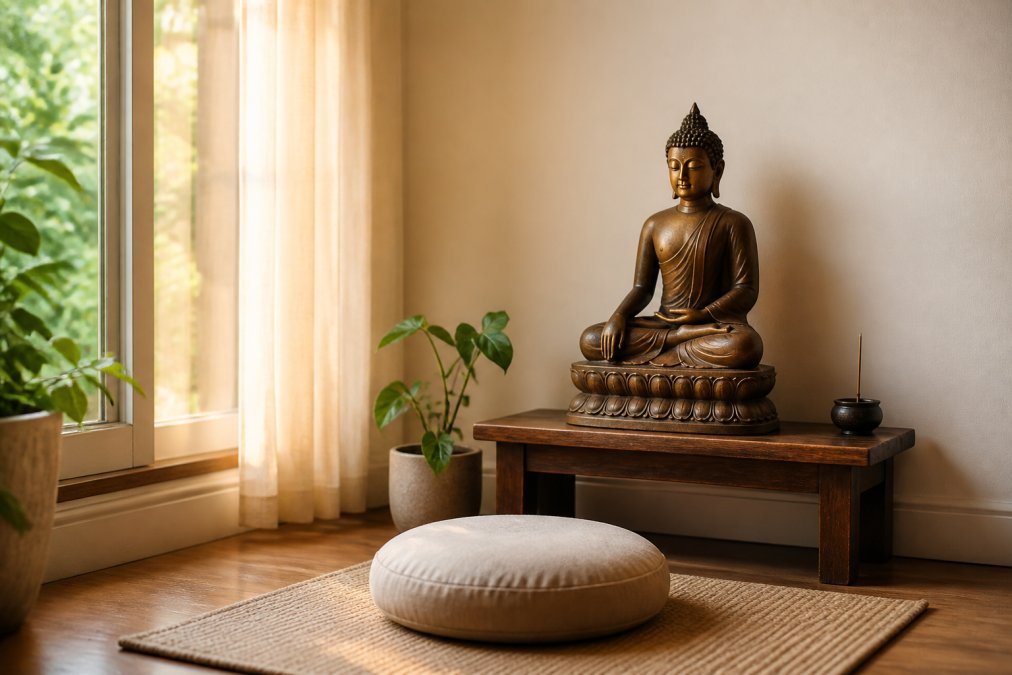
Finding the best placement for buddha statue in home is about creating a dedicated visual anchor that supports your practice. The deeper questions are: eye level relative to what? How do you avoid neck strain during a 30-minute sit? And how do you integrate a sacred object into a modern living room without it feeling like a museum artifact?
The Ergonomics of Viewing Height
The physical ergonomics of your altar matter more than most guides mention. If the statue is too low, you will hunch forward, compressing your diaphragm and restricting breathing; if too high, you will strain your cervical spine and feel 'looked down upon' rather than supported.
The practical rule: sit on your meditation cushion in your normal posture, close your eyes, then open them and look naturally forward (peer-reviewed research). The statue's eyes should land at or just slightly above your natural horizontal line of sight, for most people on a standard 6-inch zafu, between 36 and 42 inches from the floor. Adjust if you sit in a chair.
Place the statue on a low wooden stand or a stack of stable books on a shelf. A common mistake is placing it on the floor or a very low coffee table, forcing you to look down for the entire session, straining the neck and subtly signaling that the sacred is 'below' you.
Where to Avoid Placing Your Statue
Traditional guidance suggests avoiding the floor or areas of clutter, such as a bathroom or busy hallway, to maintain respect and keep the visual field clean. A chaotic space can undermine tranquility; choose a spot that feels naturally quiet and removed from the household's main traffic flow.
Beyond the obvious, consider these less-discussed factors:
- Avoid direct alignment with doorways. A statue directly facing a door can create a subconscious 'startle' response each time someone enters. Angle it slightly toward your sitting spot instead.
- Keep it off the floor. Even in a dedicated meditation room, a floor-level statue forces your gaze downward. Use a low stand or a stacked platform to bring it to eye level.
- Avoid cluttered backgrounds. A statue in front of a bookshelf full of colorful spines or a busy patterned wall will compete for your visual attention. A plain wall, a single plant, or a simple scroll behind the statue helps it stand out as the sole focal point.
Integrating with Modern Home Decor
A common concern is how to place a Buddha statue in a living room that also serves as a home office or entertainment space. The key is to give it a defined 'zone', a dedicated small table or floating shelf in a corner, with a simple plant or candle, creates a visual boundary without requiring a full altar setup.
For minimalist interiors, choose a statue with clean lines and a muted finish, matte bronze or light wood blends more naturally than an ornate, gold-leafed figure. Place it on a shelf with a few carefully chosen objects, a small stone, a dried branch, a single framed print, that echo its aesthetic without cluttering the visual field.
Stability and Safety
Ensure the statue is stable and secure; a wobbly figure can distract from your breath. If you have children or pets, secure it to its stand with museum putty, invisible, non-damaging, and prevents a tragic topple. For larger statues, ensure the shelf can bear the weight; a solid bronze 12-inch statue can weigh 15 pounds or more.
The 'Sacred Corner' as a Daily Ritual
Finally, consider making the placement itself a ritual. When you set up your statue, clean the space, light a candle or incense, and set an intention. This act transforms a simple shelf into a sacred corner, reinforcing the statue's role as a visual anchor; over time, the corner becomes a threshold you return to reconnect with the qualities the statue embodies.
Practical Considerations: Size, Budget, and Care
Selecting the right size is a balance between the scale of your room and the statue's presence. A large statue can overwhelm a small corner, while a tiny figure may get lost in a spacious room. A common approach is to choose a statue that occupies roughly one-third of the height of your altar table or shelf.
Think of the statue as a long-term investment in your practice; focus on quality and authenticity. Look for reputable dealers who can speak to the piece's origin and craftsmanship. Once home, dust it gently with a soft, dry cloth; for bronze, a specialized wax preserves the patina. This simple care ensures your visual anchor remains a source of serenity for decades.
Conclusion: Let Your Statue Be a Visual Anchor
Ultimately, choosing a buddha statue for meditation practice is a deeply personal act of aligning your outer environment with your inner aspirations. The right statue is more than an object; it is a silent teacher, a visual anchor that calls you back to presence, and a tangible reminder of the peace you are cultivating.
We invite you to explore a collection where each piece is chosen with reverence for its spiritual significance and artistic merit. Our handpicked antique and contemporary sculptures are curated to enhance meditation spaces and refined spiritual home interiors, offering free shipping on pieces that can become the heart of your sanctuary. Let the search for your statue be a meditation in itself, and find the figure that will guide you home.
Frequently Asked Questions
Where should you not put a Buddha statue?
Avoid placing a Buddha statue directly on the floor, in bathrooms, or in cluttered, high-traffic areas like entryways or kitchens. These locations lack the reverence and quiet that support contemplation. A statue should never face a wall directly or be placed below waist level, as this diminishes its presence as a visual anchor. Choose a dedicated, clean space where the statue can sit at or above eye level when you are seated in meditation.
What does a meditating Buddha statue symbolize?
A meditating Buddha statue symbolizes the potential for inner peace and enlightenment that exists within everyone. The serene facial expression represents freedom from desire and attachment, while the upright posture embodies stability and mental discipline. For practitioners, it serves as a visual anchor, reminding you of the goal of your meditation practice: calm awareness, compassion, and a mind free from disturbance. It is a mirror of your own aspirational state.
How do I choose between a seated or standing Buddha statue?
Choose based on the energy you want to cultivate. A seated Buddha in the lotus or hero posture is ideal for meditation spaces because it mirrors your own seated practice, reinforcing stillness and introspection. A standing Buddha, often depicted with the Abhaya mudra, projects a sense of calm confidence and protection, making it better suited for a living room or entryway altar. For a dedicated meditation corner, a seated figure is almost always the right choice.
Does the material of the Buddha statue affect its spiritual energy?
The material does not change the statue's spiritual essence, but it does affect how the piece feels in your space and how it supports your practice. Bronze and brass offer a grounding, solid presence and develop a beautiful patina over time. Wood brings warmth and a connection to nature, while stone conveys permanence and antiquity. Choose a material that resonates with your personal aesthetic and the atmosphere you want to create in your meditation room.
Finding a statue that truly resonates can feel overwhelming, but it does not have to be. Focus on the intention behind your practice, learn the language of the mudras, and trust your connection to the craftsmanship.
Browse our selection of authentic Buddhist and Hindu statues to discover a piece that brings harmony and a tangible sense of peace to your daily practice.
