



Buddha Statue for Home Altar: A Collector's Guide
Buddha Statue for Home Altar: A Collector's Guide
Most people buying a Buddha statue for home altar use make one of two mistakes: they pick whatever looks aesthetically pleasing without understanding iconography, or they follow rigid rules so strictly that the statue never actually serves its intended purpose. Neither approach works.
The right choice depends on the tradition you follow, the space you have, the material and craftsmanship quality, and what you want the altar to do for you daily. This guide cuts through the noise and gives you a practitioner's framework for making a confident, well-informed decision.
Table of Contents
Quick Takeaways
|
Key Insight |
Explanation |
|---|---|
|
Mudra determines meaning |
The hand gesture (mudra) defines the statue's symbolic purpose. Bhumisparsha (earth-touching) represents enlightenment; Dhyana (meditation) promotes calm. Match mudra to your intention before anything else. |
|
Regional style affects doctrinal alignment |
A Theravada practitioner should generally lean toward Burmese or Thai statues. Mahayana or Zen practitioners are better served by Chinese or Japanese forms. The style is not interchangeable. |
|
Material quality is non-negotiable for longevity |
Cast resin statues degrade and lose detail within years. Bronze, gilt wood, and carved stone hold their integrity for decades and retain collector value. |
|
Eye level is the correct placement height |
The Buddha's face should be at or above your eye level when you are seated at the altar. Placing it on the floor is disrespectful in most traditions and undermines the altar's energy. |
|
A single, well-chosen statue outperforms a crowded altar |
In practice, collectors who start with one high-quality piece report a more focused and meaningful altar experience than those who accumulate many lower-quality statues rapidly. |
|
Provenance adds both spiritual and monetary value |
Statues sourced directly from craftspeople in Burma, Cambodia, or Thailand carry a traceable cultural lineage that mass-produced imports do not. This matters for serious collectors. |
|
Size should be proportional to the room, not aspirational |
A large statue in a small room creates visual dominance that distracts rather than invites. A 20-30 cm statue is appropriate for most domestic altar niches or dedicated shelves. |
Why Iconography Matters Before Aesthetics
The single most overlooked factor when choosing a Buddha statue for home altar use is iconography. Before you consider the finish, the size, or the country of origin, you need to understand what the statue is actually communicating. Buddhist sculpture is a visual language, and every element from hand position to body posture to throne type carries a specific meaning codified over centuries.
The mudra is your starting point. The Bhumisparsha mudra, where the right hand touches the earth, commemorates the moment of the Buddha's enlightenment and is the most commonly depicted gesture. The Dhyana mudra, both hands resting in the lap, is associated with meditation and inner stillness. The Abhaya mudra, right hand raised with palm outward, conveys protection and fearlessness. If you are building a meditation altar, a Dhyana mudra statue is the more intentional choice. If your goal is spiritual protection, choose Abhaya.
A common mistake is selecting a statue based purely on the face or finish and then realizing later that the mudra contradicts the altar's purpose. This is not a minor issue for practitioners. It is analogous to hanging a piece of text in a language you do not speak and assuming it says what you want it to say.
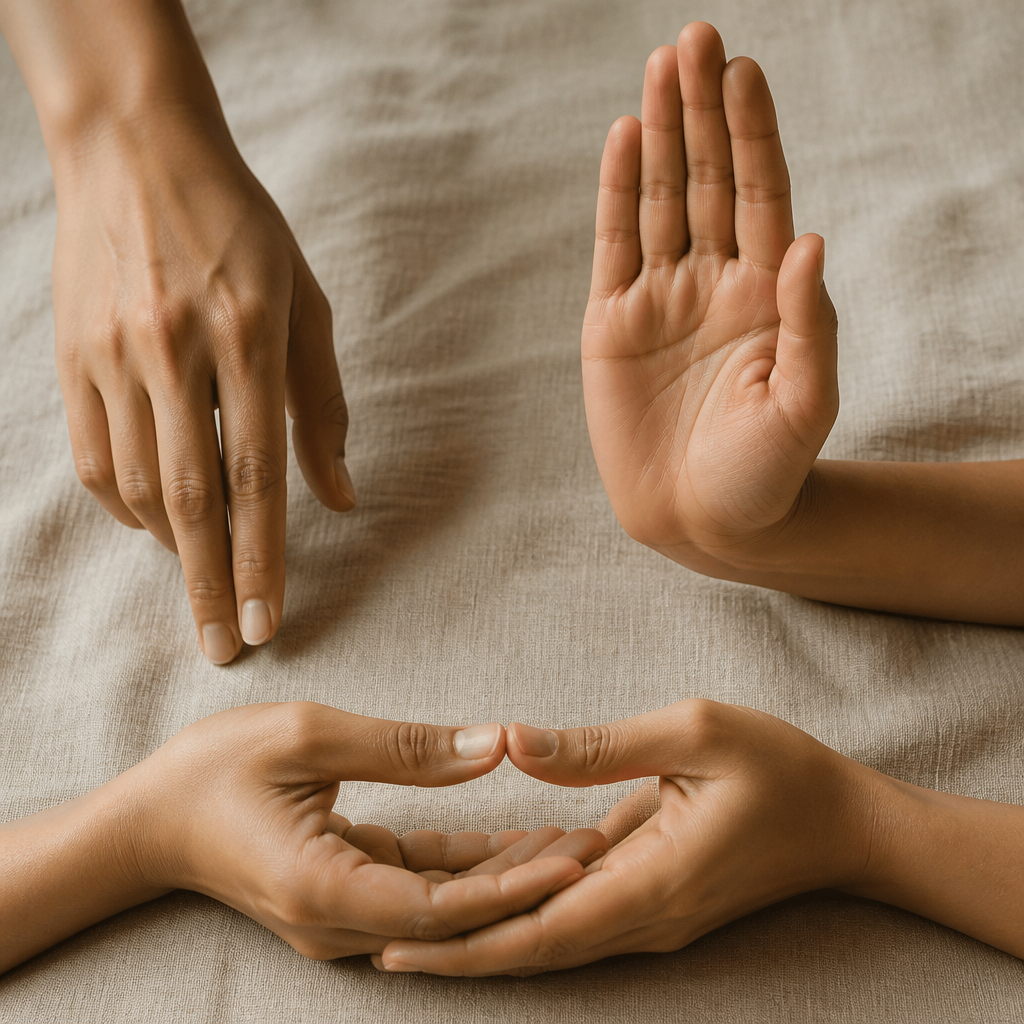
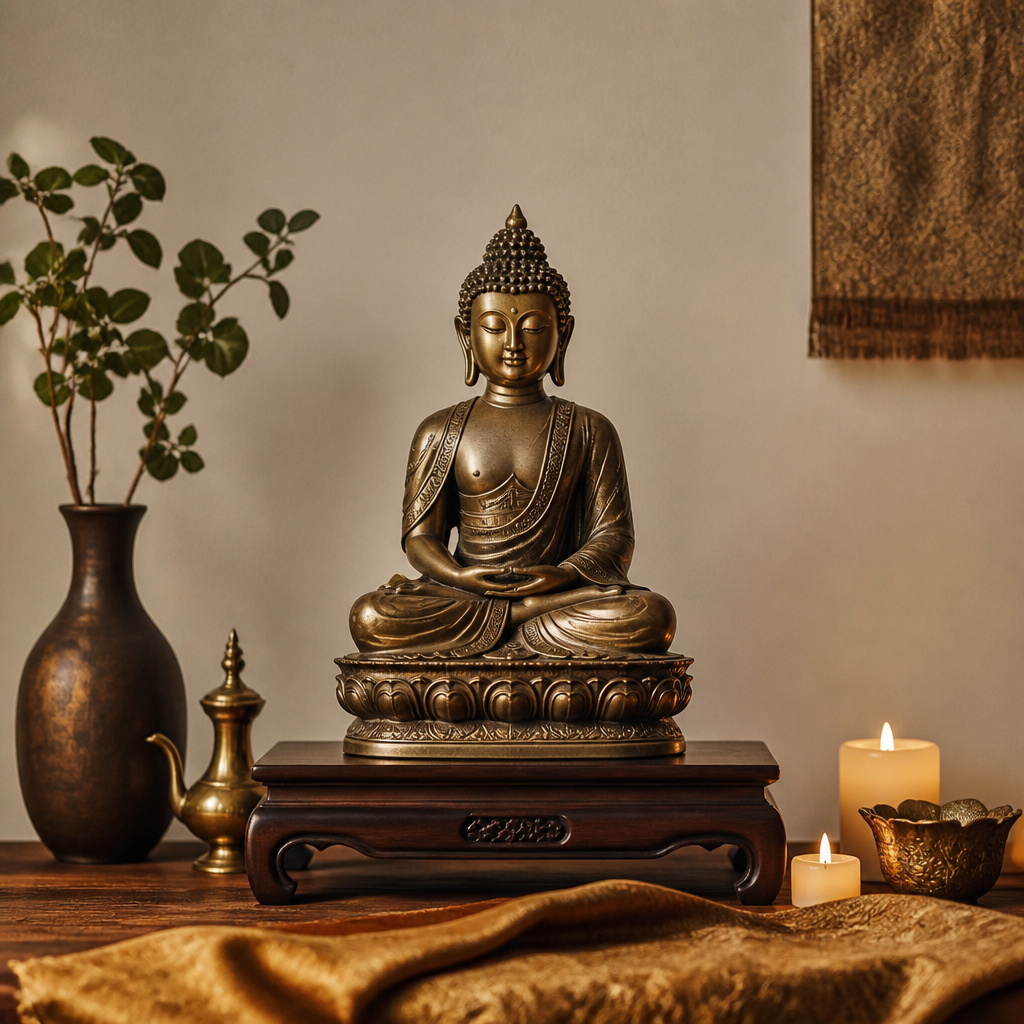
Pro tip: Before purchasing, write down in one sentence what you want your altar to do for you: offer protection, support meditation, honor a teacher, or mark a life transition. Then select the mudra that corresponds to that intention. This single step eliminates the majority of regrettable purchases.
Choosing a Buddha Statue by Tradition
Buddhism is not a monolithic tradition, and the statues that represent it reflect that diversity with real specificity. The three main branches, Theravada, Mahayana, and Vajrayana, each have distinct visual conventions. Choosing a statue that aligns with your practice or the tradition you are honoring is not pedantry. It is accuracy.
Theravada Traditions: Burma, Thailand, Sri Lanka, and Laos
Theravada statues tend toward a more austere, idealized human form. Burmese statues are often characterized by smooth, rounded faces and elaborate gilded surfaces. Thai statues frequently feature the distinctive flame-shaped ushnisha (the cranial protuberance representing wisdom). Sri Lankan and Laotian forms are subtler in ornamentation but highly refined in proportion. If your practice is rooted in Theravada, a statue from any of these traditions will feel doctrinally coherent and aesthetically appropriate.
Mahayana and Chan or Zen Traditions: China and Japan
Chinese Buddhist sculpture encompasses a vast range, from the serene Guanyin (Bodhisattva of Compassion) to the laughing Budai figure often mistaken for the historical Buddha. Japanese Buddhist art, particularly from the Heian and Kamakura periods, is among the most technically sophisticated in the world, with dry lacquer and gilded wood pieces reaching extraordinary levels of detail. For a Mahayana altar, these traditions offer the deepest catalog of options.
Vajrayana Traditions: Nepal, Tibet, and Bhutan
Vajrayana statues, particularly those from Nepal and Tibet, are visually distinct with their use of wrathful deities, multi-armed forms, and elaborate symbolic iconography. These are not typically the right choice for a simple meditation altar unless you are practicing within that specific tradition. The visual complexity serves a doctrinal purpose and can feel overwhelming out of context.
Material and Craftsmanship: What Separates Museum Quality from Mass Production
Material is one of the most reliable proxies for quality in Buddhist sculpture. The relationship between material and meaning is also doctrinally grounded: precious materials have been used in sacred Buddhist art for over two thousand years, not as decoration, but as an expression of the value placed on the Dharma.
Bronze and Gilt Bronze
Lost-wax cast bronze is the gold standard for freestanding sculptures. The process allows for extraordinary detail, and properly cast bronze develops a patina over decades that actually increases its visual richness. Gilt bronze, where gold is applied to the bronze surface, is particularly prevalent in Thai and Burmese traditions. A well-made gilt bronze statue from HD Asian Art, for instance, is a fundamentally different object from a mass-cast alloy piece sold through generic import retailers.
Carved and Gilt Wood
Carved wood statues, particularly those from Burma and Thailand, represent a parallel tradition of extraordinary craftsmanship. Teak and other dense hardwoods allow for fine detail that holds for centuries. Many of the most visually compelling Burmese statues combine carved wood with glass inlay and lacquer gilding, a technique that has no real equivalent elsewhere in the Buddhist world.
Stone: Sandstone, Schist, and Granite
Stone sculptures carry a different weight, both literally and symbolically. Cambodian sandstone sculpture from the Angkor period is among the most recognizable in Southeast Asian art history. Stone is the appropriate material for a dedicated altar space that will not be moved. It rewards permanence and does not suit a frequently rearranged shelf.
"The choice of material in Buddhist sacred art is never arbitrary. Bronze, stone, and precious wood each carry a symbolic weight that communicates the devotee's regard for the object of veneration." - Donald Stadtner, Sacred Sites of Burma
Pro tip: When evaluating a bronze statue, look at the back and the underside. Mass-produced castings cut corners on areas that are rarely photographed. A museum-quality piece shows consistent detail and finish throughout, not just on the front face.
Size, Placement, and Altar Layout
Size is where many buyers make an emotionally driven decision they later regret. There is a widespread assumption that a larger statue signals greater devotion or creates more powerful sacred space. In practice, this is not true. Scale matters in relation to the space, and a statue that overwhelms its setting creates visual chaos, not reverence.
Recommended Sizing by Space Type
For a dedicated altar shelf or niche in a living room or bedroom, a statue between 20 and 40 cm in height is appropriate for most domestic settings. This size allows for supporting objects like candles, incense holders, and offering bowls without the Buddha being visually buried. For a dedicated altar room or meditation space, a statue between 45 and 90 cm creates a genuine focal point without dominating the architectural proportions.
Placement Height and Orientation
The Buddha's face should be at or above the eye level of a seated practitioner. This is consistent across Theravada, Mahayana, and most Vajrayana traditions. Placing the statue on the floor is considered disrespectful in nearly all Buddhist traditions and should be avoided regardless of the statue's size.
Orient the statue to face into the room, ideally toward the east or toward the room's main entrance. East orientation connects to the direction of the rising sun, widely associated with enlightenment across Buddhist traditions. North-facing placement is generally avoided in Theravada countries.
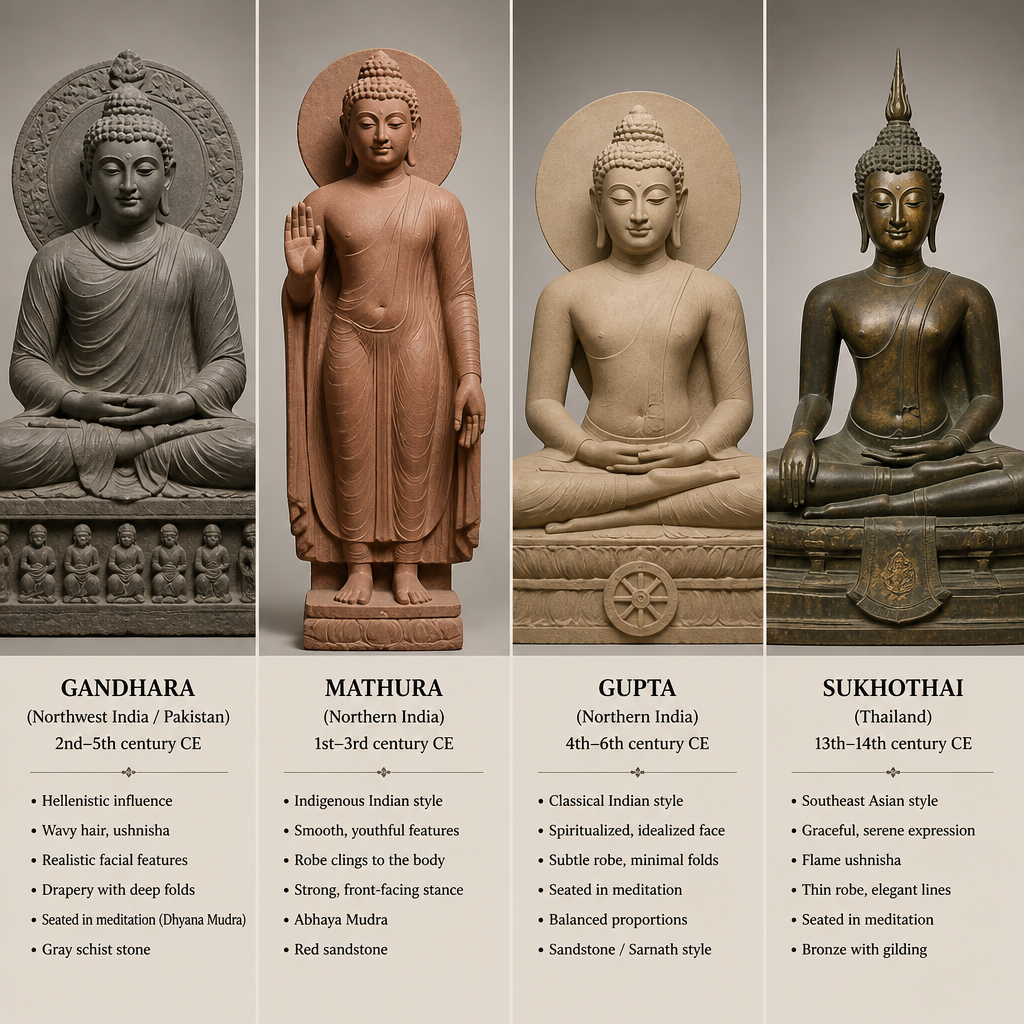
Regional Styles Compared: Burma, Thailand, Cambodia, and Beyond
Understanding regional style differences is not just academic knowledge. It is the difference between buying a statue that resonates and one that leaves you feeling vaguely dissatisfied without knowing why. Each regional tradition has a distinct visual vocabulary shaped by local aesthetics, available materials, and doctrinal emphasis.
Buddhist Home Decor vs. Devotional Use: Understanding the Difference
This distinction matters more than most retailers will tell you. A statue intended for Buddhist home decor and one intended for active devotional use have different requirements. Neither use is more legitimate than the other, but conflating them leads to poor purchasing decisions.
For decorative use, the primary criteria are aesthetic coherence with your interior, material durability, and visual impact. In this context, a beautifully carved Cambodian-style sandstone bust or a lacquered Burmese Buddha head can serve as a genuinely striking design element that also carries cultural depth. The mudra matters less; the visual quality and cultural authenticity matter more.
For devotional use, iconographic accuracy becomes primary. The mudra, the asana (seated or standing posture), the style of robe, and the presence or absence of an ornate crown all carry meaning that affects the integrity of your practice. A collector or practitioner using the statue for daily puja or meditation should prioritize these factors before aesthetics.
|
Criterion |
Decorative Buddhist Home Decor |
Devotional Home Altar |
|---|---|---|
|
Mudra accuracy |
Secondary consideration |
Primary consideration |
|
Material preference |
Any high-quality material that suits the interior |
Bronze, gilt wood, or stone preferred for longevity and tradition |
|
Regional style |
Choose based on visual preference and interior style |
Align with your doctrinal tradition (Theravada, Mahayana, etc.) |
|
Size considerations |
Proportional to the room and furniture scale |
Eye level when seated, sufficient for a dedicated altar arrangement |
|
Supporting objects |
Minimal, or as interior styling dictates |
Candles, incense, offering bowls, flowers as tradition requires |
Common Mistakes Collectors Make
After reviewing hundreds of collector decisions in the Buddhist sculpture space, several mistakes repeat with remarkable consistency. These are not beginner errors. They show up at every level of experience and budget.
The first is conflating age with quality. An old statue is not automatically a good one. A poorly cast 19th-century piece is still a poorly cast piece. Age amplifies the qualities the statue already has. A well-crafted contemporary statue by a master Burmese artisan is a better purchase than a damaged antique of uncertain provenance.
The second is prioritizing the photograph over the physical object. Online purchasing has made this mistake endemic. High-quality photography flatters mediocre casting. The data consistently shows that buyers who examine statues in person, or at minimum request multiple angles including the reverse and underside, are significantly more satisfied with their purchases.
The third is buying without understanding the regional style. A collector who buys a Thai-style Buddha for a Japanese Zen altar has created a visual and doctrinal mismatch that will register as subtle dissonance every time they sit in that space, even if they cannot articulate why.
Working with a specialist retailer that sources directly from craftspeople across Burma, Cambodia, China, India, Indonesia, Japan, Laos, Sri Lanka, and Thailand, rather than a generic marketplace, gives you access to provenance information and stylistic context that transforms a purchase into an informed collection decision.
Frequently Asked Questions
What is the best mudra for a home meditation altar?
The Dhyana mudra, with both hands resting in the lap palms upward, is the most appropriate for a meditation altar. It directly represents the meditative state and supports a calm, inward-facing practice. The Bhumisparsha mudra is the second most common choice and is appropriate for an altar that honors the Buddha's enlightenment specifically.
Can I place a Buddha statue in my bedroom?
Yes. In most Buddhist traditions, there is no prohibition on placing a statue in a bedroom, provided it is positioned with respect, meaning at an appropriate height, not on the floor, and not in a position where it faces a toilet or bathroom door. Many practitioners find a bedroom altar more conducive to morning and evening practice than a living room altar.
Does the material of the statue affect its spiritual efficacy?
From a doctrinal standpoint in most Theravada and Mahayana traditions, the statue functions as a focal point for attention and intention, not as an inherently powerful object. However, material quality affects the statue's longevity, its visual impact, and its ability to hold the practitioner's attention without distraction. A flaking, poorly cast piece is a constant minor distraction. A well-made bronze or carved wood statue rewards sustained attention.
How do I choose between a seated and a standing Buddha statue?
Seated statues are the more traditional choice for a home altar and represent the meditative, contemplative aspect of the Buddha. Standing statues, particularly the Abhaya gesture type, represent active compassion and protection moving outward into the world. For a static altar space, seated is the more common and widely appropriate choice. Standing statues work well flanking an entrance or in a corridor space.
What is the difference between a Buddha statue and a Bodhisattva statue?
The historical Buddha, Shakyamuni, is depicted with specific physical characteristics including the ushnisha, elongated earlobes, and monastic robes. Bodhisattvas such as Guanyin (Avalokiteshvara) or Manjushri are depicted with elaborate jewelry and crowns, reflecting their role as beings who have deferred complete nirvana to assist all sentient beings. Both are appropriate for a home altar depending on your tradition and intention, but they should not be confused with one another.
Is it acceptable to buy a Buddha statue purely for decorative purposes if I am not Buddhist?
This is a question serious collectors ask and deserve a direct answer. Using a Buddha statue as a design object is widely practiced and not inherently disrespectful, provided the statue is treated with basic dignity, meaning it is not placed in a bathroom, on the floor, or in obviously inappropriate contexts. The more important consideration is that you are purchasing a genuine, quality-made piece rather than a mass-produced novelty, which respects the cultural and artistic tradition regardless of your personal beliefs.
What has been your experience choosing a Buddha statue for your home altar? Share what worked, what surprised you, or what you wish you had known before buying.
References
-
The Metropolitan Museum of Art: Buddhist art collection and iconography resources
-
Smithsonian Institution: Asian art history and Buddhist sculpture scholarship
-
The British Museum: Southeast Asian and Buddhist art collections and research
-
The Louvre Museum: Asian antiquities collection including Buddhist and Hindu sculpture
-
Cleveland Museum of Art: Buddhist art research and collection documentation
