



Bronze vs Stone vs Wood: Best Asian Sculpture Material
Bronze vs Stone vs Wood: Best Asian Sculpture Material
Most buyers spend weeks comparing styles and iconography before purchasing a Buddhist or Hindu sculpture, then pick the material almost as an afterthought. That is a costly mistake. The material you choose determines how a piece ages, where it can live in your home, how it interacts with ritual use, and frankly, how much it will mean to you in ten years.
A bronze Buddha statue behaves completely differently from a sandstone Bodhisattva or a carved teak Ganesh, and treating these materials as interchangeable is the fastest way to end up with a piece that disappoints. This guide gives you the specific criteria to make the right call the first time.
Table of Contents
Quick Takeaways
|
Key Insight |
Explanation |
|---|---|
|
Bronze is the top choice for outdoor and humid environments |
Bronze oxidizes slowly into a stable patina rather than cracking or rotting. A well-cast bronze Buddha statue can last centuries with minimal intervention. |
|
Stone sculpture commands physical presence nothing else replicates |
A sandstone or granite Buddhist sculpture reads as immovable and permanent, which is deliberately evocative in a meditation space or garden setting. |
|
Wood is the warmest and most intimate material for home altars |
Carved wooden Hindu statues, especially those in gilded or lacquered finishes, carry visible hand-work that creates an immediate sense of devotional care. |
|
Fine surface detail is best achieved in bronze |
Lost-wax casting allows craftsmen to reproduce precise mudras, facial expressions, and textile folds that stone carving and wood carving cannot match at small scales. |
|
Wood requires the most climate control |
Humidity swings above 60% and below 30% cause wood to expand and contract, risking cracking in carved Hindu statues. Avoid placement near air vents or damp walls. |
|
Stone is the heaviest material and needs structural support |
A solid stone Buddhist sculpture over 30 cm tall can exceed 15 kg. Confirm your shelf, plinth, or altar surface is rated for the load before purchasing. |
|
Bronze patina is a feature, not a flaw |
The green or brown surface oxidation on antique and aged bronze statues signals authenticity and age. Attempting to polish it away destroys both the look and the value. |
Why Material Matters More Than You Think
The material of an Asian sculpture is not just an aesthetic decision. It is a functional and cultural one. Different traditions across Burma, Thailand, Cambodia, India, and Japan favored specific materials for specific reasons, and those reasons still apply when you are choosing a piece for your home, your altar, or your collection.
In practice, the three dominant materials you will encounter at museum quality are bronze, stone, and wood. Each has a distinct manufacturing lineage, a distinct feel in the hand, and a distinct relationship with the environment it inhabits. Choosing wrong does not just mean a mismatch with your decor. It can mean a deteriorating piece, a sculpture that feels wrong in its context, or a financial investment that does not hold up over time.
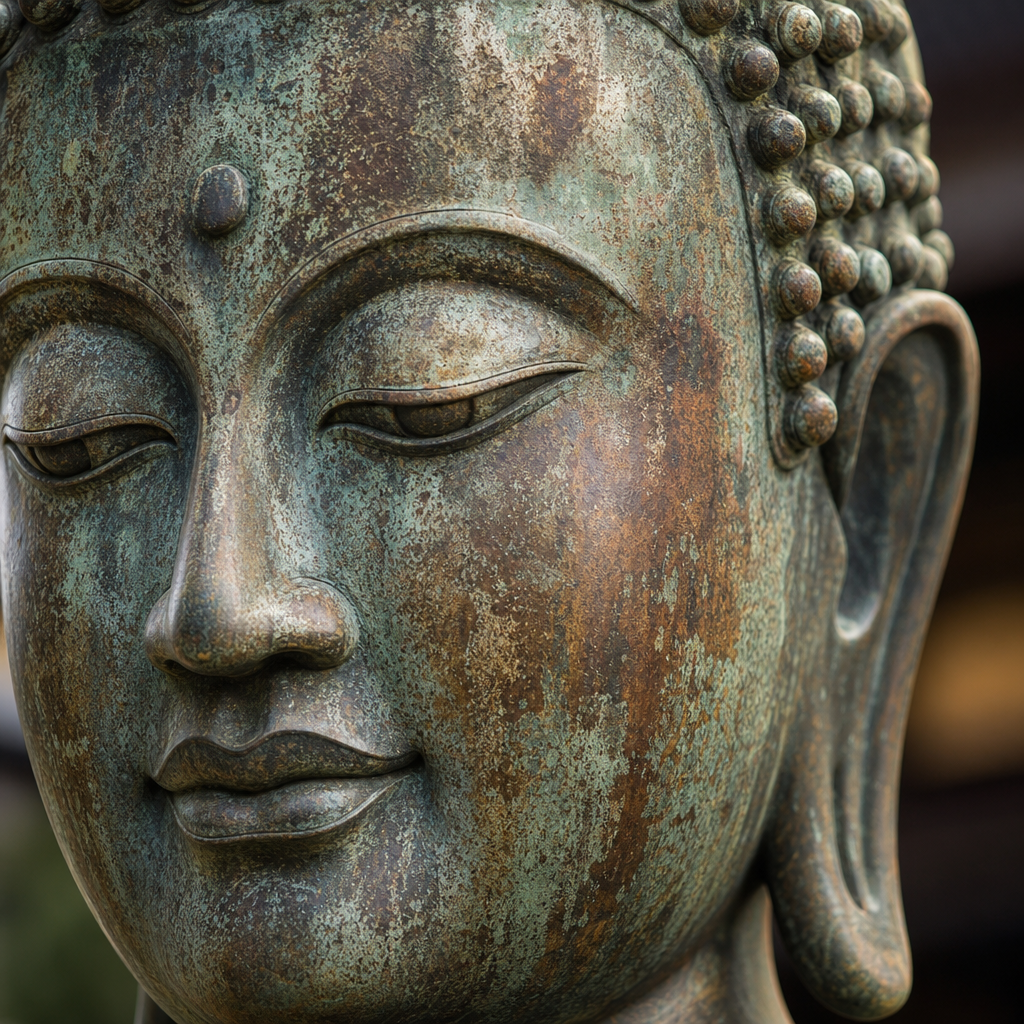
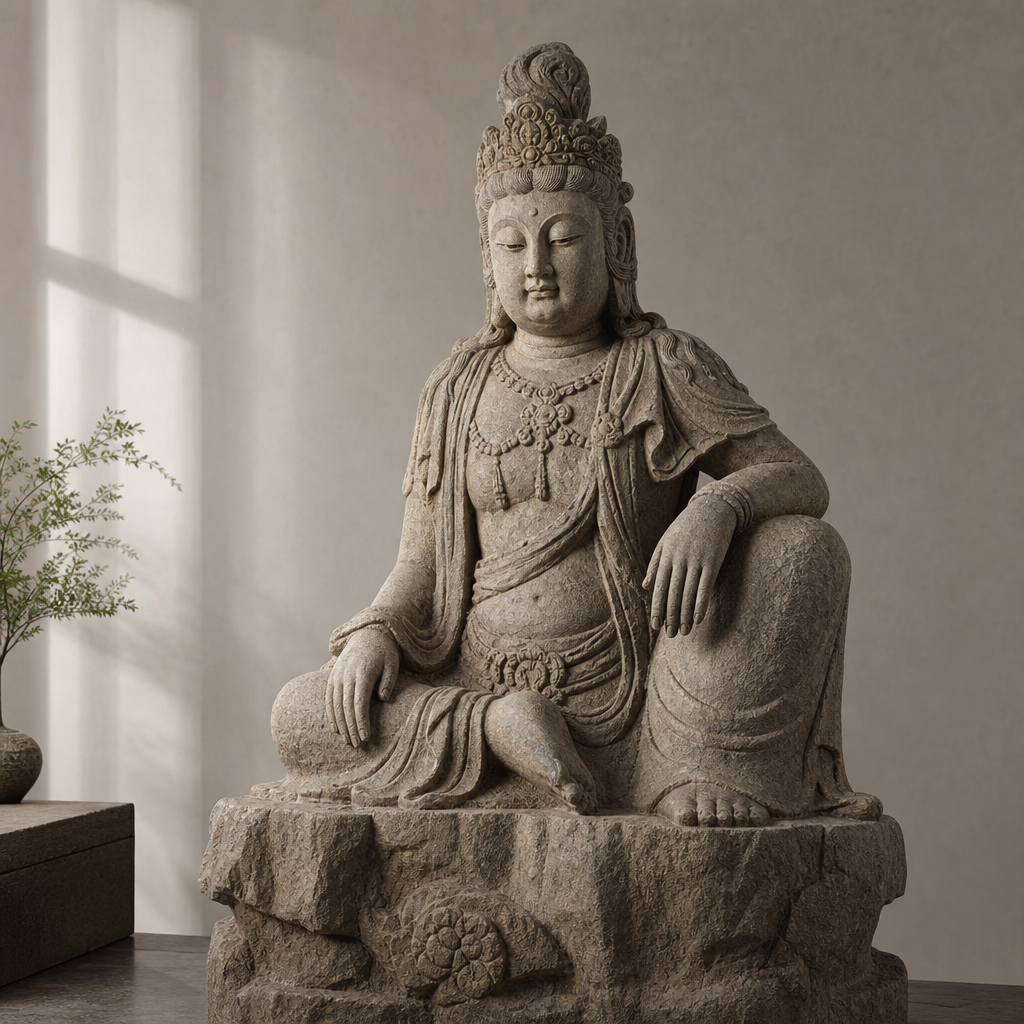
The good news is that once you understand the properties of each material at a working level, the decision usually becomes obvious. The sections below give you that working knowledge, grounded in the specific traditions and origins of Asian religious sculpture.
Bronze Buddha Statues: Durability, Detail, and Ritual Use
Bronze has been the prestige material for Buddhist sculpture across Southeast and East Asia for well over a thousand years. The Pyu period in Burma, the Khmer empire in Cambodia, the Sukhothai and Ayutthaya kingdoms in Thailand, and the Tang and Song dynasties in China all produced bronze Buddha statues of extraordinary quality. There is a reason the tradition persisted across those diverse cultures and centuries: the material performs.
How Lost-Wax Casting Enables Fine Iconographic Detail
The lost-wax casting process, used across Asia for millennia, allows sculptors to capture details that are simply not achievable in stone at small and medium scales. A 30 cm bronze Buddha statue from Thailand can show individually modeled fingernails, visible fabric pleats in the robe, and the precise curvature of the ushnisha at the crown of the head. That level of detail communicates iconographic meaning directly to practitioners who read those forms as spiritual language.
A common mistake is assuming that because bronze is a metal, it reads as cold or industrial. In practice, a well-patinated bronze Buddha statue with a dark brown or warm green surface finish reads as deeply organic and aged. The weight in the hand reinforces that sense of permanence without the brittleness risk of stone.
Why Bronze Works Best for Ritual and Outdoor Use
For practitioners who incorporate statues into active rituals, including water offerings, incense use, or regular touch, bronze is the most forgiving material. It does not absorb moisture in a damaging way, it does not splinter if it receives an accidental knock, and it will not bleach or fade under artificial altar lighting.
For outdoor gardens and courtyards, bronze is the only material among the three that can be left exposed to seasonal weather without a protective shelter. Stone can work outdoors too, but porous stones like sandstone deteriorate faster in wet climates. Wood outdoors is generally not recommended at all.
Pro tip: If you are setting up a garden meditation space and want a Buddha statue as a focal point, a solid bronze casting weighing at least 3 to 4 kg will hold its position in wind without requiring anchoring hardware, while also developing a beautiful outdoor patina over time.
Stone Buddhist Sculpture: Weight, Presence, and Permanence
There is something that stone Buddhist sculpture does that no other material replicates: it commands space. A sandstone Khmer Bodhisattva, a grey schist Gandharan Buddha head, or a granite Thai Naga-sheltered Buddha reads as fixed and permanent in a way that immediately changes the atmosphere of a room. This is not merely a decorative quality. It is a deliberate spiritual quality built into the traditions that produced these works.
Regional Stone Traditions and What They Signal
Sandstone dominates the Cambodian and Thai traditions. It carves with enough detail to show expression and iconographic markings, but its relatively warm ochre and reddish tones make it feel approachable despite its weight. Khmer sandstone sculptures in particular carry an unmistakable sense of meditative stillness in the facial treatment.
Schist and stucco-finished stone appear most prominently in the Gandharan tradition from the India-Pakistan border region. These pieces often show Hellenistic influence in the drapery and facial treatment, giving collectors a fascinating hybrid aesthetic that is unlike anything else in Asian art.
Granite and black stone appear in South Indian Hindu temple sculpture, where the tradition of carving deities directly into the rock of a temple wall carried the belief that the stone itself was a sacred body. Standalone granite Hindu deity statues carry that same visual authority.
Practical Placement Considerations for Stone
Stone is heavy and needs a stable, load-bearing surface. A 40 cm sandstone Buddhist sculpture can easily weigh 8 to 12 kg. Solid wooden shelving or a purpose-built plinth is appropriate. Glass shelving and lightweight bracket shelves are not.
Indoors, stone is remarkably low maintenance. It does not require humidity control, it does not react to temperature changes, and it does not need protective coatings. Dusting with a soft dry cloth is genuinely sufficient for most stone sculptures. Outdoors, sandstone in wet climates should be placed under a sheltered overhang to limit direct rain exposure, which erodes surface detail over years.
Pro tip: If you are buying a stone Buddhist sculpture for a meditation room where you sit quietly for extended periods, choose a piece with a face that has been carved with the eyes at or slightly below your eye level when seated. The psychological effect of a downward-gazing stone face at seated height creates a sense of compassionate presence that is considerably more powerful than a piece placed on a high shelf looking down at a steep angle.
Wooden Hindu Statues: Warmth, Tradition, and Sacred Character
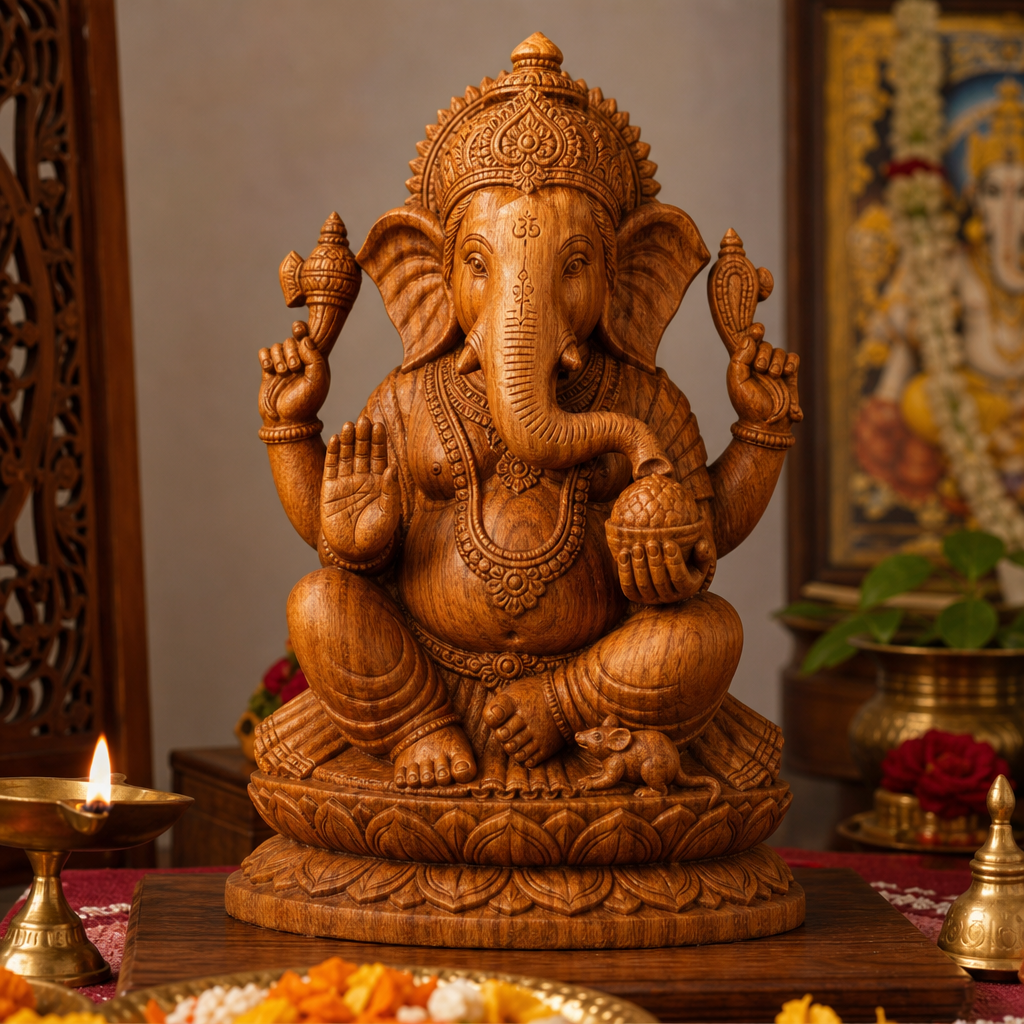
Wood carving has been central to Hindu devotional art across South and Southeast Asia for centuries. The tradition is strongest in India, Bali, Burma, and Nepal, and the results range from intricately gilded panels depicting Krishna to naturalistically carved standalone statues of Ganesha, Lakshmi, and Durga. A well-carved wooden Hindu statue carries a quality of warmth, both visually and literally in the hand, that metal and stone do not replicate.
The Best Woods Used in Asian Religious Sculpture
Teak is the workhorse of Southeast Asian wood carving. It is dense, naturally oily, and resistant to insects and rot, making it well suited to both indoor altars and covered outdoor shrines. Burmese and Thai craftsmen have used teak for religious carvings for centuries, and the golden-brown color it develops with age is visually distinct and beautiful.
Rosewood appears frequently in Chinese Buddhist and Hindu pieces. It is harder and denser than teak, takes very fine surface detail, and polishes to a deep reddish-brown that reads as intrinsically valuable. Jackfruit wood is traditional in South Indian temple carving and produces pieces with a warm golden tone and excellent structural stability.
A common mistake is overlooking lacquered wood as somehow less authentic. In the Burmese tradition in particular, carved and lacquered figures, sometimes with gilded surfaces and inlaid glass details, are among the most sophisticated religious objects produced in the region. The lacquer is not a coating applied to disguise inferior carving. It is part of the tradition and part of the object's sacred identity.
Where Wooden Statues Belong and Where They Do Not
Wooden Hindu statues belong in stable indoor environments. That means away from exterior walls in cold climates, away from air conditioning vents that create dry microclimates, and away from bathrooms or kitchens where humidity swings dramatically. A room that stays between 45% and 60% relative humidity year-round is ideal.
For home altar use specifically, wood is arguably the most appropriate choice across Hindu devotional traditions. The material carries centuries of devotional use in South and Southeast Asian homes, and its warmth makes it feel suited to a space defined by incense, light, and personal prayer practice.
Material Comparison by Use Case
The table below cuts through the general properties to address the specific decisions most collectors and practitioners face. Use it as a direct reference rather than a starting point for further research.
|
Use Case |
Best Material Choice |
Why It Wins for This Use |
|---|---|---|
|
Outdoor garden or courtyard focal point |
Bronze |
Weather-resistant, develops an attractive natural patina, holds position without anchoring at adequate weight |
|
Indoor meditation room centerpiece |
Stone |
Physical permanence and visual weight create a gravitational focal point; no maintenance requirements indoors |
|
Home altar for active daily devotional practice |
Wood |
Warmth and hand-carved character suit intimate ritual use; traditional in Hindu household shrines across Asia |
|
Art collection investment piece |
Bronze or Stone |
Both materials hold value well for museum-quality pieces; bronze allows finer iconographic detail, stone carries archaeological weight |
|
Small-scale desktop or personal altar piece (under 20 cm) |
Bronze |
Lost-wax casting retains fine detail at small scale; stone is often too heavy or too coarse at small sizes; wood can be fragile at thin cross-sections |
|
Gift for a spiritual practitioner |
Wood or Bronze |
Wood feels personal and warm; bronze reads as a serious and lasting gift; both are appropriate for active ritual use without maintenance concerns |
"The material of a sacred image is never neutral. In Buddhist and Hindu traditions, the substance from which a deity is formed participates in the divinity it represents. Bronze, stone, and wood each carry their own symbolic resonance within these traditions." -- Dr. Donald Stadtner, author of "Sacred Sites of Burma: Myth and Folklore in an Evolving Spiritual Realm" (Thames and Hudson)
Caring for Each Material Over Time
Museum-quality Asian sculptures require different maintenance approaches depending on material. Getting this wrong can reduce the visual quality and long-term value of a piece you have paid seriously for.
Bronze Buddha Statue Care
The most important rule for bronze is to leave the patina alone. The patina, whether brown, black, or green, is a stable oxide layer that protects the metal underneath. Polishing it removes that protection and permanently changes the appearance. Dust a bronze Buddha statue with a soft dry cloth or a natural bristle brush. For statues used with liquid offerings, rinse with clean water and dry promptly.
If you notice powdery bright-green spots, this is bronze disease, an unstable chloride corrosion that will spread if untreated. Do not attempt to remove it with household cleaners. Contact a professional conservator. This condition is rare in well-stored pieces but can occur in pieces exposed to salt air or damp storage conditions.
Stone Buddhist Sculpture Care
Stone is the lowest-maintenance material in this group. Dry dusting is sufficient for most indoor stone Buddhist sculptures. Avoid applying any oil, wax, or sealant unless you have specific professional advice for that stone type. Many well-intentioned sealants trap moisture and cause spalling, particularly in sandstone.
For outdoor stone, an annual inspection for biological growth such as lichen or moss is worthwhile. These can be removed with a soft brush and clean water. Do not use pressure washers on carved stone, as the force erodes fine surface detail irreversibly.
Wooden Hindu Statue Care
Wood needs the most active environmental management of the three materials. Keep relative humidity stable between 45% and 60%. In dry winters, a room humidifier near the piece is a practical and effective intervention. In humid summers, ensure adequate ventilation.
For unfinished or oil-finished teak carvings, a very light application of food-grade linseed oil or teak oil once or twice a year maintains the surface without building up a heavy film. Lacquered pieces should only be dusted. Never apply oil or wax to a lacquered surface, as it interferes with the lacquer's own protective properties.
Pro tip: Store any Asian sculpture, regardless of material, away from skylights and south-facing windows with direct afternoon sun. UV radiation fades pigments on painted wood and lacquerware, and thermal cycling from direct sun heats stone and bronze to temperatures that can stress surrounding structures, including wooden furniture and plinth materials.
Frequently Asked Questions
Is a bronze Buddha statue more expensive than stone or wood?
Not necessarily, and the question is less useful than it appears. At museum quality, price tracks workmanship, age, regional origin, and iconographic rarity rather than material alone. A hand-carved Burmese teak Buddha from the Mandalay period can command a higher price than a mass-produced bronze casting. That said, at equivalent quality levels, lost-wax bronze casting is generally more labor-intensive than stone carving at medium scales, which is reflected in pricing for contemporary workshop pieces.
Which material is best for a home altar that receives daily incense and offerings?
Bronze is the most practical choice for altars that see daily ritual use involving incense, water, or flower offerings. It tolerates moisture contact without absorbing it, does not react to incense smoke in a damaging way, and is easy to wipe clean. Wood is appropriate for altars where offerings are kept separate from the statue itself. Stone works well but requires attention to drainage if liquid offerings are placed directly on or near it.
How do I tell whether a bronze Buddha statue is genuinely cast bronze or a resin replica?
Genuine cast bronze is heavy relative to its size, cold to the touch, and produces a clear ringing sound when lightly tapped with a fingernail. The surface will show the slight irregularities of hand-finishing. Resin replicas are noticeably lighter, feel warmer in the hand, and produce a dull thud when tapped. The patina on a resin piece is often applied as paint and may show uniform color distribution without the variation that develops naturally on metal over time. When in doubt, buy from a specialist retailer who provides material provenance rather than a generic marketplace listing.
Can I keep a wooden Hindu statue in a bathroom or kitchen?
This is a very common mistake and the answer is no. Both rooms experience dramatic humidity swings that cause wood to expand and contract repeatedly. In a carved wooden statue, this eventually causes cracking, particularly at joins and at thin cross-sections like the fingers of a Lakshmi figure or the trunk of a Ganesha. A dedicated altar space in a bedroom or living room with stable humidity is far more appropriate for devotional wooden pieces.
What is the difference between a stone Buddhist sculpture from Cambodia and one from India?
The differences are significant in stone type, aesthetic tradition, and iconographic content. Cambodian Khmer sculptures typically use warm-toned sandstone and depict Buddhist or syncretic Hindu-Buddhist figures with distinctive serene facial features, elaborate crowns, and formal frontal poses. South Indian stone sculpture tends toward black granite or schist, favors more dynamic multi-armed poses particularly for Hindu deities, and reflects the Chola or Pallava stylistic canons. Both are formally distinct and visually recognizable once you have spent time with pieces from each region. The stone itself, its color and texture, usually tells you the origin before the iconography does.
Does the material of an Asian sculpture affect its spiritual significance for practice?
Within living Buddhist and Hindu traditions, yes, though in ways that vary by tradition and teacher. In Theravada Buddhism practiced across Burma, Thailand, and Sri Lanka, the consecration ceremony performed over a finished statue, not the material itself, is what activates its spiritual presence. That said, certain materials carry traditional associations: gold and bronze are linked to solar energy and endurance, stone to earth-rooted permanence, and wood to the living quality of natural growth. For most practitioners in Western contexts, the material should feel right for the quality of presence you want to create in your space, guided by your own tradition or teacher where applicable.
Have you already chosen a material for your collection or altar space, and did the decision process feel straightforward or did you find yourself pulled in different directions? Share what finally made up your mind in the comments below.
References
