



Caring for and Preserving Antique Buddhist Artifacts
Caring for and Preserving Antique Buddhist Artifacts
Table of Contents
- Why Antique Buddhist Artifacts Need Museum-Grade Care
- Environmental Factors for Antique Preservation: Humidity, Temperature, and Light
- Safe Cleaning Techniques for Different Materials
- Displaying Antique Buddhist Statues: Home Altar Setup and Placement
- Handling, Storage, and Archival Materials: Best Practices
- Pest Management for Organic Materials and Avoiding Common Damage
- Insurance, Appraisal, and Documentation for Antique Artifacts
- When to Seek Professional Restoration and Conservation Help
- Frequently Asked Questions
Why Antique Buddhist Artifacts Need Museum-Grade Care
Caring for and preserving antique buddhist artifacts is preventative conservation, not occasional dusting. These objects are made from organic and mineral materials that respond to their surroundings over decades, and the wrong environment causes irreversible damage. At HD Asian Art, we handle antique and contemporary Buddhist and Hindu sculptures daily, and the same principles that protect museum collections apply to a home altar.
Most owners damage their pieces through good intentions: too much sunlight, too much handling, the wrong cleaner. A single well-meaning polish can strip a surface finish that took a century to develop.
Below, we break down environmental control, material-specific care, display, storage, and when to call a conservator. The guidance follows standards used by professional conservation bodies, including the American Institute for Conservation, which publishes widely used guidance on the care of cultural objects.
Environmental Factors for Antique Preservation: Humidity, Temperature, and Light
Environmental factors for antique preservation come down to three variables: relative humidity, temperature stability, and light exposure. Get these right and most deterioration slows dramatically.
Managing Humidity and Temperature in Your Space
The target for most antique Buddhist material is a stable relative humidity between 45% and 55%, with temperature held steady rather than cool. Stability matters more than any single number.
Fluctuations cause wood to expand and contract, stone to shed mineral deposits, and gilding to lift. In dry climates, a room humidifier several feet away helps; in humid regions, a dehumidifier or silica gel in an enclosed case creates a micro-climate. Never place a statue near a heating vent, radiator, or exterior door.
Protecting Against UV Exposure and Display Lighting Standards
UV exposure is the fastest cause of irreversible fading and embrittlement. Direct sunlight should never fall on an antique statue, thangka, or textile.
Museum display standards call for LED fixtures, which emit almost no UV radiation and far less heat than halogen or incandescent bulbs. Keep fixtures at least three feet away, aim light from above, and cap daily illumination, a thangka or painted wood surface should be lit only when someone is in the room.
Safe Cleaning Techniques for Different Materials
Safe cleaning starts with the least invasive method: soft-bristle dusting with a dry, clean brush removes most surface soil without touching the patina.
Work from the top down, support the piece with both hands, and never use water on porous or gilded surfaces. Household polish is a common mistake: most commercial compounds are abrasive and strip the patina that gives an antique its historical significance.
- Use a soft, dry brush for loose dust
- Use a microfiber cloth, dry, for flat surfaces
- Never use water, alcohol, or ammonia on gilded or painted areas
- Never submerge any part of an antique piece
Stone, Wood, Bronze, and Thangka: Material-Specific Care
Each material demands a different approach, and treating them alike is the most common error we see.
| Material | Main Risk | Safe Approach | Avoid |
|---|---|---|---|
| Stone | Mineral deposits, staining | Dry soft-bristle dusting | Water, acidic cleaners |
| Wood | Cracking, insect damage | Stable humidity, dry cloth | Direct sun, oils |
| Bronze | Oxidation, patina loss | Dry dusting, leave patina | Polishing compounds |
| Thangka | Fading, textile rot | Low light, flat storage | Folding, hanging in sun |
Bronze oxidation is natural and protective, green or brown patina is not dirt, and removing it destroys value. Wood cracks along the grain when humidity swings. Thangka, being painted textile, is the most fragile category and benefits from flat archival storage when not displayed.
Displaying Antique Buddhist Statues: Home Altar Setup and Placement
Displaying antique buddhist statues well means balancing ritual function with physical protection: keep the piece out of traffic, away from heat sources, and at a height that respects its role in the space.
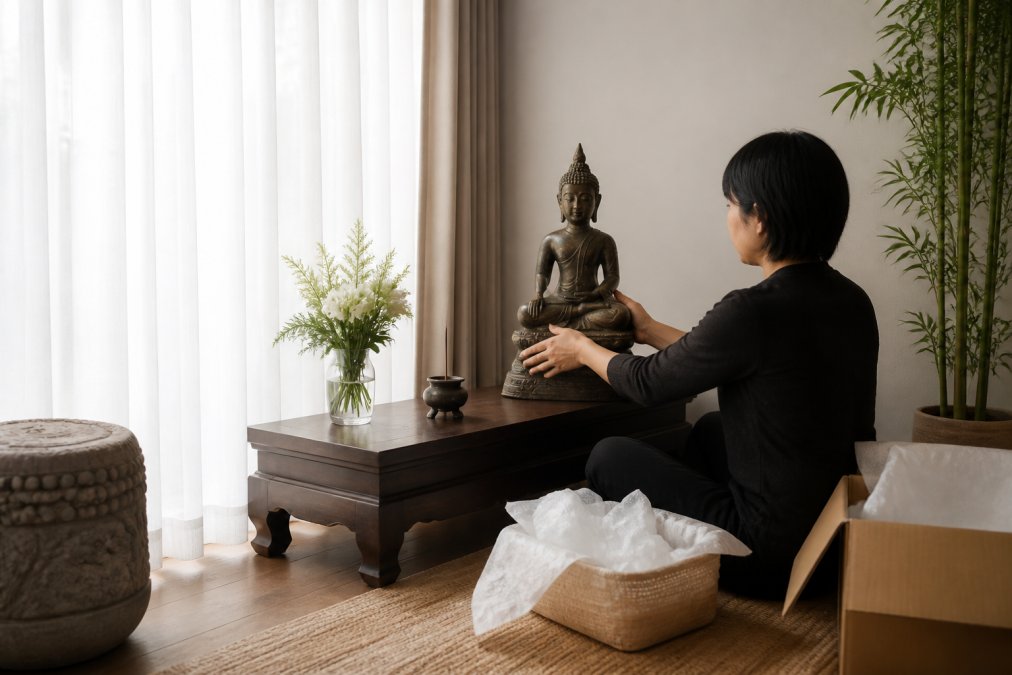
Home Altar Setup for Buddhist Artifacts: Ritual, Respect, and Room Flow
Home altar setup for buddhist artifacts follows a few practical rules. Elevate the central figure above eye level when seated, keep the surface stable and level, and leave clearance on all sides for air movement. Maintaining this environment prevents the accumulation of dust and debris that might otherwise necessitate the delicate process of cleaning found artifacts.
Place the altar away from kitchens, bathrooms, and foot traffic; a small apartment corner works if the shelf is secure and the light indirect. Incense and candles should sit to the side and downwind, since smoke deposits oily residue over time.
Handling, Storage, and Archival Materials: Best Practices
Archival materials are tested to be chemically stable in direct contact with an object: acid-free boxes, unbuffered tissue for protein-based materials, and inert foam padding.
Handle any antique with clean, dry hands or nitrile gloves. Lift from the base, never from an arm, halo, or finial, and clear the path before moving a piece.
For long-term storage:
- Wrap in acid-free tissue, then pad with polyethylene foam
- Store flat where possible, especially thangka and textiles
- Label the box with contents and date
- Keep boxes off concrete floors, which transmit moisture
Reversibility is the guiding principle: every storage choice should be undoable without harming the object. That is why conservators avoid permanent adhesives, and why tape, rubber bands, and newspaper are never acceptable.
Pest Management for Organic Materials and Avoiding Common Damage
Insect infestation and fungal growth are the two threats organic materials face in storage, and both are preventable. Wood, textile, and paper attract pests when humidity runs high and air circulation is poor. The difference between a clean collection and an infested one is not a product but a schedule: inspect on a fixed cadence, catch activity early, and isolate anything suspect.
Identifying the Pests That Target Organic Artifacts
Different materials attract different insects, and identifying the pest tells you how urgent the problem is.
- Wood-boring beetles (powderpost, furniture, deathwatch) leave fine, flour-like frass sifting out of exit holes and a faint ticking sound in quiet rooms. Fresh frass means active infestation; old frass with darkened holes may be historic.
- Silverfish graze on the starch in paper, textile sizing, and the reverse of thangka mounting fabric, leaving irregular scraped patches and tiny dark specks.
- Clothes moths (webbing and casemaking) attack wool, silk, and felt components, cushions, textile mounts, and storage liners, leaving webbing, larval cases, and holes concentrated in folds and dark crevices.
- Carpet beetles feed on protein fibers and are often introduced on cut flowers and wool rugs near an altar.
- Booklice and psocids are a humidity indicator rather than a primary destroyer; a sudden population signals that relative humidity has drifted above the safe band.
Fungal growth shows as a musty odor, a powdery bloom on leather or textile, or foxing (small brown spots) on paper. Mold spores are always present in household air and only colonize when moisture is available, which is why humidity control is the first line of defense.
A Monitoring and Quarantine Routine That Works
Inspect stored pieces every three to four months, and monthly for wool, silk, or unfinished wood. Work in good light with a flashlight and magnifier, and check where damage hides: undersides, hollow bases, the back of a thangka mount, textile folds, and the seam where a statue meets its plinth.
When you find evidence of activity, isolate the piece immediately in a sealed polyethylene bag or dedicated lidded bin kept away from the collection, and note the date. Do not use household insecticide, sprays deposit residues that stain porous surfaces and are harder to remove than the insects. Freezing is a museum method requiring precise control and a trained operator, so it belongs with a conservator. Contact one for active frass, live larvae, or mold on a painted surface.
Prevention is mostly environmental and physical:
- Keep relative humidity in the 45-55% band and keep air moving gently around stored pieces.
- Store organic materials in acid-free boxes with a tight but not airtight lid, and inspect the box interior, not just the object.
- Avoid storing wool, silk, and paper against bare wood shelves; line shelves with inert foam or acid-free board.
- Never store food, dried flowers, or natural-fiber rugs in the same closet as artifacts.
- Vacuum storage areas (not the objects) regularly, and keep the space free of dust and cobwebs.
The Everyday Damage Sources That Outpace Pests
In practice, pests are rarer than the slow damage owners cause themselves:
- Sunlight: fades pigment, yellows paper, and weakens textile fibers; damage is cumulative and irreversible.
- Smoke: incense and candle smoke deposit an oily film that traps dust and darkens gilding and painted surfaces over years.
- Oils from hands: leave an acidic residue that etches stone, dulls gilding, and darkens wood.
- Water: causes staining, tide lines, and mineral deposits on porous surfaces, and can trigger mold within days.
- Heat: accelerates every chemical reaction, from adhesive failure to pigment fading.
A dust cover over an open altar, removed when in use, solves several at once. So does a simple rule: handle less, light less, and keep the environment steady.
Insurance, Appraisal, and Documentation for Antique Artifacts
Documentation and provenance records are the foundation of both insurance and resale value, and the step most private owners skip. Provenance is the recorded history of an object's ownership, and it separates a documented antique from an unattributed piece. Most guides to caring for and preserving antique Buddhist artifacts stop at physical care; the financial and legal side is where the real protection lives.
Building a Health Record for Each Object
Treat every significant piece as if it were on loan to a museum, the standard an insurer or appraiser will eventually apply. A complete file contains:
- Photographs: overall views from at least four angles, plus close-ups of the base, any inscription or mark, and any existing damage or repair. Include a scale reference (a ruler or coin) in at least one shot.
- Written description: dimensions, weight, material, construction method, and a plain-language condition note ("stable hairline crack along the left forearm, not lifting").
- Acquisition records: purchase receipt, date, seller, and any prior owner history. Even a handwritten note from a family member counts.
- Condition log: a dated entry each time you inspect, clean, move, or notice a change. This is the single most useful document if a claim is ever filed, because it shows the object's condition before and after an event.
- Treatment records: any conservation work, with the conservator's name, date, and a copy of the treatment proposal and report.
Update the file yearly and after any move, loan, or treatment. Store digital copies in the cloud separate from the physical file, and keep a second physical copy off-site. If a piece is lost, stolen, or damaged, that documentation makes a claim possible and prevents disputes over its prior condition.
Appraisal: What It Is and When to Get One
An appraisal is a written opinion of value from a qualified appraiser, distinct from a purchase receipt or insurance estimate. For valuable pieces, schedule a professional appraisal and review your policy, since standard policies often cap fine-art coverage and may require a rider or scheduled-property endorsement.
A few practical points most owners miss:
- Appraisals have a shelf life. Insurers and appraisers generally expect a fresh valuation every few years, and sooner after a major market shift or after any conservation treatment.
- Ask what kind of value is being reported. Replacement value (what it would cost to buy a comparable piece) and fair market value (what it would sell for) are different numbers, and insurers want the former.
- Keep the appraisal with the object's file, not in a separate folder, so the condition log and the valuation travel together.
- Photograph the piece before and after any move or treatment, and note the date on the image file.
Provenance: The Record That Compounds in Value
Provenance is not just a paper trail for insurance; it is part of the object's historical significance. A documented chain of ownership, even a short one, supports both the piece's story and its market position. Build it deliberately:
- Record where and when you acquired the piece, and from whom.
- Ask sellers for any prior documentation, photographs, or exhibition history, and keep copies even if they are informal.
- Note any published references, auction records, or family histories connected to the object.
- Store provenance documents with the same care as the object itself: acid-free folders, cool and dry, away from light.
For guidance on finding a qualified appraiser or conservator, the American Institute for Conservation's find-a-conservator directory lists professionals by specialty and region, and the National Park Service's conservation guidance publishes free technical bulletins on caring for cultural objects.
When to Seek Professional Restoration and Conservation Help
Call a conservator when damage is structural, a surface is actively flaking, or a repair requires matching original materials. Restoration ethics favor minimal intervention, so a professional will often stabilize rather than restore.
Signs it is time to get help:
- Active flaking, lifting gilding, or powdering surfaces
- Cracks that have widened since purchase
- Old repairs that are failing or discoloring
- Any object you suspect has been previously restored
Ask for a written treatment proposal that explains what will be done, what materials will be used, and whether the work is reversible. A qualified conservator will always offer reversibility as a goal. For guidance on finding one, the American Institute for Conservation's find-a-conservator directory lists professionals by specialty and region, and the National Park Service's conservation guidance publishes free technical bulletins on caring for cultural objects.
Curatorial standards exist for a reason: they work. A stable environment, minimal handling, and honest documentation will preserve an antique Buddhist artifact for the next generation far better than any cleaning product.
Frequently Asked Questions
Is it okay to keep a Buddha statue at home?
Yes, keeping a Buddha statue at home is common for both spiritual practice and appreciation of Asian art. Placement matters: choose a clean, elevated spot such as a dedicated altar or shelf, avoid bathrooms, kitchens, and floors where the statue might be disrespected. For antique Buddhist artifacts, ensure the location has stable temperature and low humidity to prevent deterioration. Many collectors treat the statue as a focal point for meditation, which aligns with traditional reverence. If you are unsure about a piece's history, consult a reputable dealer like HD Asian Art for guidance.
How do you protect antique sculptures from environmental damage?
Protect antique sculptures by controlling humidity (aim for 45-55% relative humidity), keeping temperatures stable between 65-72°F, and blocking direct sunlight and UV exposure. Use dehumidification in damp climates and avoid placing pieces near heating vents or fireplaces. For organic materials like wood or thangka, pest management is also key: inspect regularly for insect infestation and store with acid-free materials. A micro-climate display case can buffer fluctuations. These steps preserve patina, structural integrity, and surface finish over time.
What is the best way to display antique Buddhist art in a home sanctuary?
Display antique Buddhist statues on a stable, elevated surface away from high-traffic areas. Use soft, diffused lighting with UV filters, and avoid direct sun. For thangkas, hang them on interior walls away from humidity sources. Group pieces with complementary materials, but leave space for each to breathe. Incorporate ritual offerings like fresh flowers or a small water bowl if it suits your practice. Rotate pieces periodically to limit light exposure. A conservator can advise on mounts that do not stress the object.
How can I tell if my antique Buddhist artifact is authentic?
Authenticating antique Buddhist artifacts requires examining material composition, patina, tool marks, and provenance records. Look for signs of age such as oxidation on bronze, stable cracking in wood, or mineral deposits on stone. Documentation like old photographs, bills of sale, or exhibition labels strengthens provenance. Reputable dealers provide detailed condition reports and provenance. If you are uncertain, consult a qualified appraiser or conservationist. HD Asian Art offers handpicked pieces with verifiable histories, giving collectors confidence in authenticity.
Antique Buddhist artifacts reward patience more than effort, and the biggest risk is doing too much rather than too little.
HD Asian Art curates handpicked antique and contemporary Buddhist and Hindu statues, including Khmer and Southeast Asian sculptures, with free shipping and pieces selected for temple-inspired home interiors and meditation spaces. Browse the HD Asian Art collection to find a piece worth preserving well.
