



What Coverage Should You Buy to Insure Art in Transit?
What Coverage Should You Buy to Insure Art in Transit?
Buy ad valorem (according to value), nail-to-nail (all risk) transit insurance for any high-value work you ship. Expect a premium of 0.3% to 1.5% of the item’s declared value, often with a minimum fee per shipment regardless of how small the piece is. The single most important action before anything gets crated: a written condition report and proof of value done before the packing tape ever touches the object.
- Request nail-to-nail (also called wall-to-wall) coverage, not standard carrier liability.
- Budget 0.3%–1.5% of declared value, plus watch for minimum premiums.
- Get a condition report and appraisal or bill of sale on file before packing begins.
Key Takeaways
Nail-to-nail, ad valorem transit insurance backed by a condition report and proof of value is the coverage that actually pays out when a shipped artwork is damaged.
| Point | Details |
|---|---|
| Buy nail-to-nail coverage | Confirm the policy covers packing, transit, and unpacking continuously, not just the truck or plane leg. |
| Budget 0.3%–1.5% of value | Expect this premium band for ad valorem transit insurance, plus a possible minimum fee per shipment. |
| Document before you pack | Secure a condition report, appraisal, or bill of sale, and provenance records before crating begins. |
| Check sub-limits and tiers | Ask whether restoration costs and loss-of-value are included or capped separately from the main coverage. |
| Preserve evidence after damage | Keep the crate, photograph everything unopened, and report the claim within the policy’s window. |
Table of Contents
Art Shipping Insurance vs. Carrier Liability: What’s the Difference?
Standard carrier liability is not art shipping insurance, and confusing the two is the most expensive mistake a collector can make. A courier’s default protection is usually weight-based or capped at a flat sum per package, calculated for a box of electronics, not a 19th-century bronze. Many carriers only offer Total Loss Only protection, meaning a cracked base or a chipped hand pays nothing at all.
Nail-to-nail coverage is the industry standard for a reason: it protects the piece continuously from the moment it’s removed from the wall or pedestal until it’s reinstalled at the destination, including the packing and unpacking stages where damage most often happens.
A solid policy typically covers:
- Breakage, drops, and impact during handling or transit.
- Water damage, fire, and theft.
- Loss or damage during customs inspection.
Common exclusions include normal wear and tear, inherent vice (a material flaw the object already had), and damage traced to improper packing done by the owner rather than a professional.
How Much Does Art Shipping Insurance Cost?
Ad valorem pricing means the premium scales directly with the piece’s declared value, and insurers typically charge between 0.3% and 1.5% of that value for a single transit. Most carriers also apply a minimum premium per shipment, so a $500 object might still cost as much to insure as one worth $3,000.
Run the math on two common scenarios:
- A $5,000 sculpture at a 0.8% rate costs roughly $40 to insure for that single shipment.
- A $20,000 statue at the same 0.8% rate runs about $160, though the rate itself often drops slightly as declared value rises.
Several variables move that percentage up or down:
- Route and destination. International shipments crossing multiple customs zones carry more risk than a domestic move.
- Crate quality. Museum-grade crating tends to lower the rate; a cardboard box raises it, if it’s even insurable.
- Security measures. GPS tracking, signature-required delivery, and bonded carriers all factor into underwriting.
- Transit duration and mode. Air freight is faster and generally cheaper to insure than a multi-week ocean crossing.
What Documents Do You Need to Insure a Shipped Artwork?
Insurers won’t write a full-value policy on a handshake. A recent appraisal or a verifiable bill of sale is the baseline requirement, and owners who skip this step often find themselves limited to Total Loss Only coverage, the exact gap that leaves a chipped or cracked piece uncompensated.
You’ll typically need:
- A recent appraisal or bill of sale establishing declared value.
- Provenance records supporting authenticity and history.
- A dated condition report with photographs, measurements, and a signature.
Condition reports are non-negotiable: insurers routinely deny or reduce claims when there’s no documented proof of the object’s state before it shipped. Appraisals prepared to USPAP standards carry more weight with underwriters than an informal estimate, and under-declaring value to save a few dollars on premium is one of the fastest ways to get a claim denied outright. For sculptures and statues specifically, a museum-grade photo checklist makes the condition report far more defensible if damage occurs.
Pro Tip: Photograph every angle, including the base and any existing chips or repairs, with a ruler or coin in frame for scale. Insurers move faster on claims when the pre-shipment photos leave nothing to interpretation.

What Packing Standards Do Insurers Expect?
Insurers care less about paying claims than preventing them, and professional packing is the biggest lever collectors control. Museum-grade practice generally means double-crating, Ethafoam padding, Tyvek moisture barriers, and climate-controlled sealed crates for humidity-sensitive materials like wood or lacquer.
International shipments carry one more requirement: ISPM-15 heat-treated wooden crates are mandatory in most countries to prevent pest contamination, and a crate without the ISPM-15 stamp can be held or destroyed at customs, insured or not.
- Double-crate fragile stone or bronze pieces with rigid outer shells.
- Use Ethafoam or acid-free padding, never loose newspaper or bubble wrap alone.
- Confirm ISPM-15 certification on any wooden crate crossing a border.
- Hire a fine-art shipper for anything self-packing can’t properly secure.
Self-packing a valuable statue is often the fastest way to void full coverage, since many insurers reserve their best terms for professionally crated shipments. Guides on shipping other high-value, fragile objects show the same pattern: chain of custody and packing quality matter more to underwriters than the object category itself.
How Do You Choose the Right Art Shipping Insurance Policy?
Not every policy that calls itself “art coverage” actually behaves like one. Run every quote through the same checklist before you sign anything.
- Coverage scope. Confirm it’s genuinely nail-to-nail, not a limited transit rider dressed up to sound comprehensive.
- Policy limits and sub-limits. Ask what the ceiling is per item and whether certain risks (mold, inherent vice) carry a lower sub-limit.
- Deductible. A low premium with a high deductible can cost more on a real claim than a slightly pricier policy with none.
- Documentation requirements. Know exactly what you must submit before shipping to keep the policy valid.
- Claims process and turnaround. Ask who inspects damage and how long settlement typically takes.
- Transit security. Verify whether GPS tracking or signature confirmation is required or just optional.
Ask any shipper or insurer directly: Do you offer true nail-to-nail terms? What’s your minimum premium? Who writes the condition report, and is that person independent of the shipper?
Pro Tip: A third-party fine art insurer almost always outperforms a carrier’s declared-value option for anything over a few thousand dollars. The premium difference is small; the coverage gap is not.
How Do You File a Claim for Damaged Artwork?
Speed and documentation decide most claim outcomes. The moment damage is suspected, preserve the crate and every scrap of packing material rather than discarding it, and photograph the crate unopened if you can before breaking the seal.
- Photograph the damage and the packaging immediately, before moving the piece.
- Notify the insurer within the policy’s reporting window, not after the fact.
- Collect any witness statements from the delivery crew.
- Request an insurer inspection before disposing of anything.
Claims commonly get denied or reduced for a short list of predictable reasons: improper packing, a missing pre-shipment condition report, late reporting past the policy deadline, or an insurer arguing the damage was pre-existing. Working with a conservator or registrar to document the loss, and keeping digital copies of every report, tends to move resolution along far faster than a phone call alone.
How HDAsianArt Handles Insured Shipping for Buyers
Every piece HDAsianArt ships internationally moves under worldwide insured DHL shipping, backed by the same documentation standard this article recommends: pre-shipment photographs, a written condition assessment, and provenance records buyers can hand directly to their own insurer or appraiser if needed.
- Pre-shipment photos of the piece from every angle, including the base.
- A condition note describing existing wear, repairs, or material characteristics.
- Provenance documentation supporting the piece’s origin and history.
- Direct contact for coordinating insured transit and any claims paperwork.
Pro Tip: Keep the gallery’s documentation with your own appraisal file. If you ever need to insure the piece for a loan or a later resale shipment, that paper trail is what gets you full nail-to-nail terms instead of a Total Loss Only fallback.
Buyers researching a specific piece, like this antique Indonesian Bodhisattva statue, receive this documentation as a standard part of the purchase, not an upsell.
What Coverage Limits and Tiers Are Typically Available?
Most fine art transit policies aren’t sold as a single flat number. Insurers structure them in tiers, and understanding the tier you’re buying matters as much as the headline premium rate.
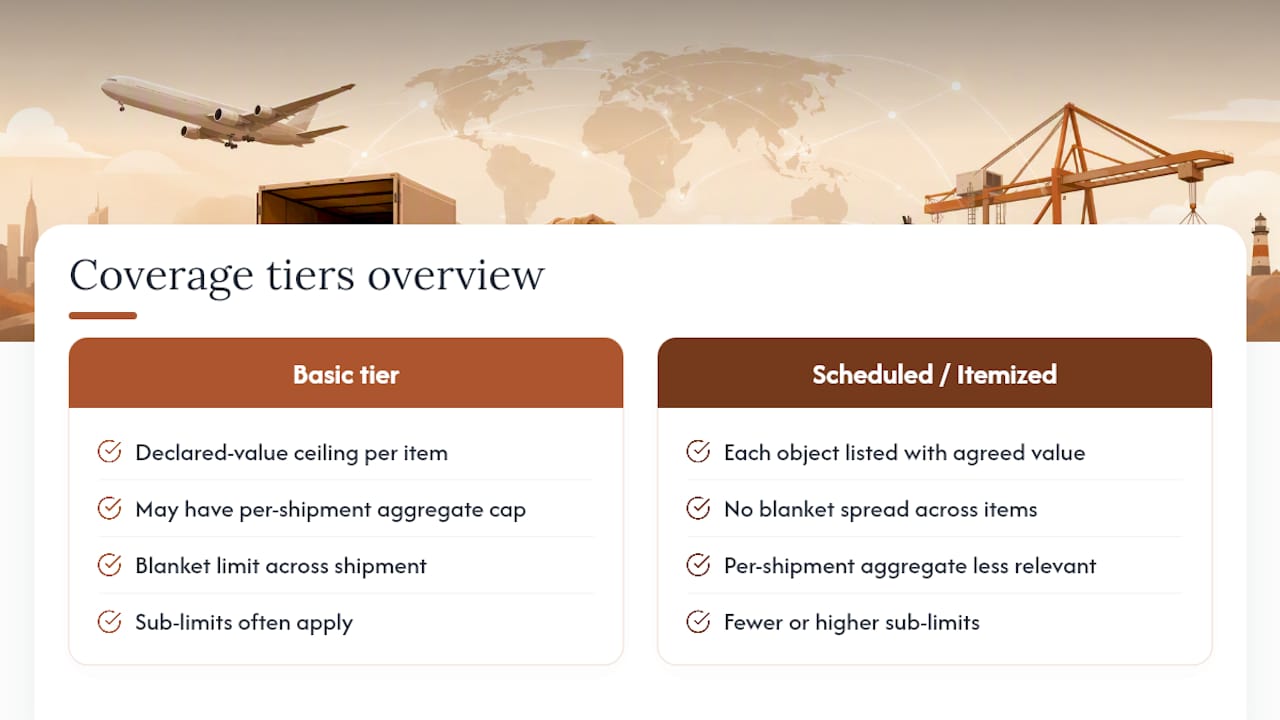
A basic tier usually covers the declared value up to a set ceiling per item, often with a per-shipment aggregate cap if you’re moving multiple pieces at once. Above that ceiling, you typically need a scheduled or itemized policy that lists each object individually with its own agreed value, rather than relying on a blanket limit spread across everything in the shipment.
Sub-limits are where collectors get caught off guard. A policy might advertise full-value coverage but quietly cap payouts for specific risks, mold and humidity damage, restoration costs, or loss of market value after a repair, at a fraction of the item’s insured amount. Restoration cost coverage and loss-of-value provisions aren’t automatic in every policy; some insurers offer them as an add-on, others bundle them into nail-to-nail terms by default.
For a $20,000 bronze, that distinction can mean the difference between a policy that pays for a professional restoration and one that pays only the depreciated resale value after damage. Before accepting a quote, ask specifically whether restoration and loss-of-value are included or excluded, and whether any sub-limit applies to categories like water damage, pest infestation, or damage during customs inspection. A policy that looks identical to a competitor’s on price can have a materially different payout structure once you read the sub-limits.
Does Art Shipping Insurance Work the Same Way Internationally?
Coverage that works flawlessly for a shipment within one country doesn’t automatically extend the same way across a border. Many policies carry geographic restrictions, some exclude certain high-risk countries entirely, others require a separate rider or an increased premium once a shipment leaves domestic territory.
Customs handling is where international coverage gets tested most. A piece held at a border for inspection, repacked by customs officials, or delayed for weeks in storage introduces risk that a purely domestic policy was never underwritten to handle. Confirm before shipping whether your policy treats customs delay and customs-related repacking as a covered event or as an exclusion.
Loan and exhibition shipments raise a related question collectors often overlook: liability at each leg of the journey. When international loans change hands between institutions, the parties should confirm in writing exactly where liability shifts, because a receiving museum’s policy might not pick up coverage until the crate is physically inside their building, leaving a gap during the final leg of transit. That gap is exactly where uninsured damage tends to happen.
If you’re shipping across multiple countries or through a freight forwarder, ask directly whether the policy is valid in every jurisdiction the piece will pass through, not just the origin and destination. A policy silent on transit countries isn’t necessarily covering them.
How Long Does Coverage Last, and When Does It Start?
Nail-to-nail coverage has a defined start and end point, and knowing exactly where those boundaries sit matters more than most collectors realize. Coverage typically begins the moment the piece is removed from its current wall, pedestal, or storage location for packing, not when it physically leaves the building. It ends when the piece is unpacked and installed at its destination, not when the truck pulls away.
That distinction covers the two riskiest moments in the entire process: the initial packing, when a piece is most exposed to handling damage, and the final unpacking, when fatigue and rushed installation often cause the mishaps that never make it into a shipping report. A policy that only covers “transit” in the narrow sense, wheels turning, plane in the air, leaves both of those windows exposed.
For a single shipment, the coverage window is usually measured in days to a few weeks depending on route and mode. Multi-leg exhibition loans are different: coverage may need to span months, with renewal or extension clauses built in if the piece is on display longer than originally planned. Always confirm whether a policy auto-extends if a delay pushes the return shipment past the original coverage window, since a lapsed policy during an extended loan is a common and entirely avoidable gap.
What Extra Services Do Art Insurers Typically Offer?
Beyond the core payout promise, many specialist art insurers bundle in services that reduce the odds you’ll ever need to file a claim in the first place. Pre-shipment risk assessment is common: an underwriter or affiliated conservator reviews the crating plan, route, and handling protocol before the piece ships, flagging weak points while there’s still time to fix them.
Transport tracking support has become a standard feature with higher-tier policies, real-time GPS visibility on the crate’s location, temperature and humidity logging inside climate-controlled containers, and alerts if a shipment deviates from its planned route or sits stationary longer than expected. For a piece crossing oceans or multiple customs checkpoints, that visibility can be the difference between catching a problem in transit and discovering it only after delivery.
Some insurers also offer access to a network of approved conservators for post-damage restoration, which speeds claims resolution because the insurer already trusts the assessment coming back. A smaller number provide advisory support on export licensing and customs documentation for culturally significant or antique pieces, an area where a wrong form can delay a shipment for weeks regardless of how good the insurance is. None of these services replace the core coverage, but they meaningfully change how smoothly a shipment or a claim actually goes.
How Should You Insure High-Value or Fragile Pieces Differently?
A $2,000 print and a $50,000 antique bronze statue should never be insured the same way, and treating them identically is where collectors leave real money exposed. Above a certain declared value, most specialist insurers move from a standard blanket policy to a scheduled, itemized approach: each high-value piece gets its own agreed value, its own line in the policy, and often its own inspection requirement before coverage is bound.
Anything above roughly $5,000 in declared value generally warrants a specialist fine-art shipper rather than a standard courier, and the incremental shipping cost is typically small next to the risk of relying on carrier liability. For fragile stone or ceramic pieces, that often means a pre-shipment engineering assessment of the crate design itself, since a standard crate built for a bronze may not distribute weight correctly for something brittle.
Material matters as much as value. Lacquerware and wood pieces face humidity risk that stone and bronze don’t, and a policy or crating plan built for a bronze Buddha won’t necessarily protect a lacquered piece the same way. Storage and handling guidance for stone sculpture applies directly to how these pieces should be packed and transported, since the same climate sensitivities that matter in storage matter in transit. For genuinely irreplaceable or one-of-a-kind pieces, ask insurers specifically about agreed-value clauses, which lock in the payout amount at the time of loss rather than leaving it to a post-damage appraisal debate.
All-Risk vs. Named-Perils: Which Art Insurance Type Fits?
Every art insurance policy falls into one of two broad structures, and the difference determines what you’re actually protected against, not just how much you pay.
All-risk policies cover any cause of loss except what’s specifically excluded in the contract. This is the broader, more collector-friendly structure: if the policy doesn’t name an exclusion for it, you’re generally covered, whether that’s an obscure handling accident or an unusual transit mishap nobody thought to write into a specific-perils list.
Named-perils policies work in reverse: they only cover the specific causes of loss listed in the contract, fire, theft, collision, water damage, for instance, and anything not explicitly named is excluded by default. These policies tend to cost less, which makes them tempting, but they leave gaps for unusual damage scenarios that don’t fit neatly into a named category.
For shipping specifically, all-risk with nail-to-nail terms is the combination most fine art insurers and this article recommend as the baseline, because shipping introduces so many unpredictable variables (customs handling, multiple carriers, transfer points) that a named-perils list almost always misses something. Named-perils coverage can make sense for long-term storage or display, where the risk profile is narrower and more predictable, but it’s a weaker fit for the chaos of actual transit. When comparing quotes, always ask which structure you’re being offered; a cheaper named-perils policy that looks like a bargain can turn into an uninsured loss the moment damage falls outside its named list.
What Most Collectors Get Wrong About Art Shipping Insurance
The conventional advice treats insurance as the safety net and packing as an afterthought. That’s backward. The research on this is consistent: insurers underwrite risk, they don’t eliminate it, and a policy is only as good as the documentation and crating behind it. A collector who spends $150 on a proper crate and a fifteen-minute condition report will get a cleaner claim outcome than one who buys the most expensive policy available and skips both.
The decision that matters is whether you can prove the piece’s condition before it left your hands. Most disputes come down to exactly that question, and most collectors only think about it after something breaks.
If you’re shipping a single valuable piece or coordinating a multi-leg loan, prioritize the paper trail first, then shop premium rates. A cheap policy with airtight documentation beats an expensive one with none.
— James, HDAsianArt.com
This article is general information, not a substitute for advice from a qualified financial advisor. Consult a qualified financial professional about your own circumstances before acting on anything here.
Sources
- 7 things you need to know about art transport insurance | Conserv
- Art condition reports demystified | ACDR Conservation
Recommended
- Photographing Sculptures: Museum-Grade Checklist for Collectors – HD Asian Art
- How to Store Antique Stone Buddhist Sculpture Safely – HD Asian Art
- Provenance Documents for Art: A Collector’s Verification Guide – HD Asian Art
- Balinese and Indonesian Temple Art: A Collector’s Buying Guide – HD Asian Art
