



Die Rolle der Mandorla in der buddhistischen Kunst: Ein Leitfaden für Gelehrte
Die Rolle der Mandorla in der buddhistischen Kunst: Ein Leitfaden für Gelehrte
Die Mandorla wird als mandelförmiger leuchtender Rahmen definiert, der eine heilige Figur vollständig umhüllt und eher göttliche Transzendenz als bloße Heiligkeit signalisiert. Im Gegensatz zum Heiligenschein, der nur den Kopf markiert, ist der Mandorla umgibt die gesamte Figur, wobei die ganzheitliche Heiligkeit und die vollständige Transformation eines Wesens in einen erleuchteten Zustand betont werden. Die Rolle der Mandorla in der buddhistischen Kunst besteht darin, das Unsichtbare sichtbar zu machen: Sie übersetzt die transzendentale Präsenz Buddhas in eine Form, der das Auge folgen kann.
Kunsthistoriker erkennen die Mandorla, auch Mandorla genannt prabhavali in südasiatischen ikonografischen Traditionen als eines der strukturell bedeutsamsten Mittel der buddhistischen visuellen Kultur. Seine spitze ovale Form erscheint überall in Gandhara, Japan, Tibet, Kambodscha, und Java, was es zu einem wirklich panbuddhistischen Symbol macht.
Welche Rolle spielt Mandorla in der buddhistischen Kunst?
Die Mandorla fungiert zugleich als kompositorische und theologische Aussage. Es ist spitzer ovaler Rahmen ist höher als breit, lenkt den Blick des Betrachters nach oben und verstärkt die spirituelle Erhebung der Figur über die irdische Ebene. Dies ist keine zufällige Designentscheidung. Die Form trennt die heilige Figur physisch vom Bildhintergrund und schafft so eine Zone göttlichen Lichts, in die die umgebende Welt nicht eindringen kann.
Die Mandorla fungiert auch als symbolische Kurzschrift. In allen buddhistischen Traditionen unterscheiden sich göttliche Figuren von weltlichen Motiven durch diesen einzigartigen mandelförmigen Rahmen, der es sogar einem ungebildeten Betrachter ermöglicht, eine Figur sofort als erleuchtet zu identifizieren. Die Form kommuniziert, bevor die ikonografischen Details, die Mudras oder der Thron überhaupt verarbeitet werden.
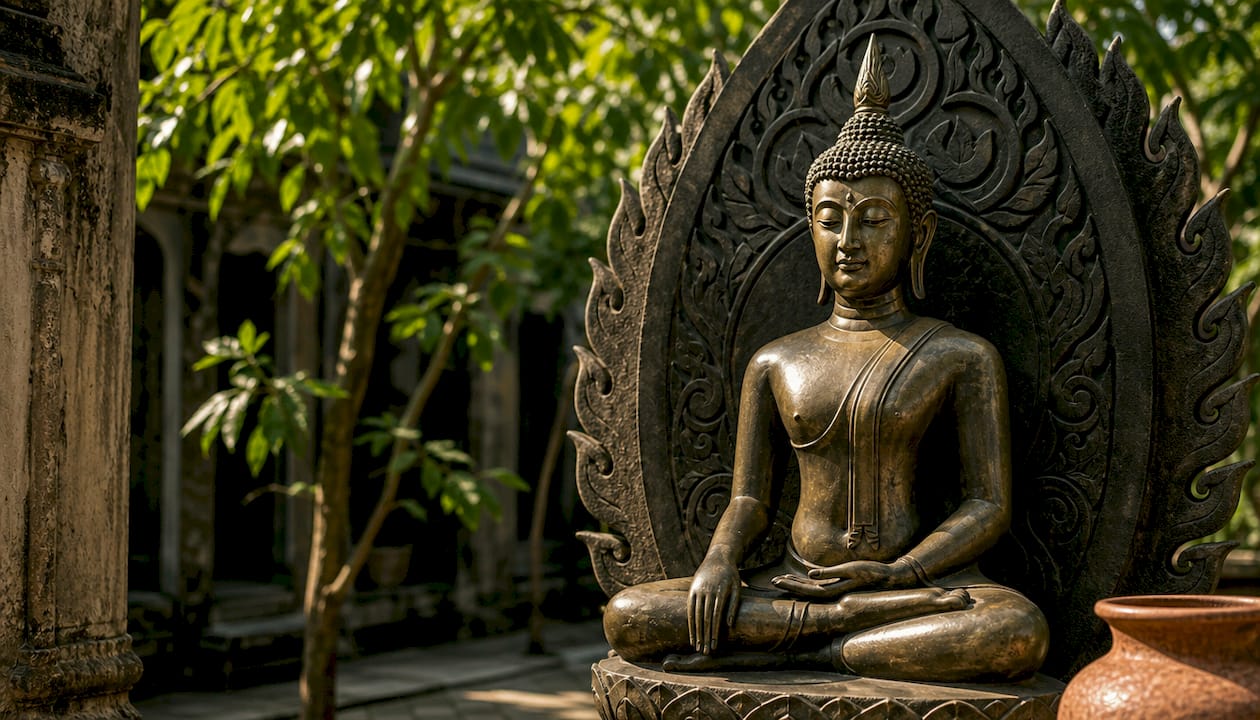
Profi-Tipp: Wenn Sie zum ersten Mal eine buddhistische Skulptur oder ein buddhistisches Gemälde studieren, stellen Sie fest, ob die Figur einen Heiligenschein, eine Mandorla oder beides trägt. Eine Mandorla signalisiert ein völlig transzendentes Wesen. Ein Heiligenschein allein markiert die Heiligkeit, aber keine vollständige göttliche Verkörperung.
Wie ist die Mandorla entstanden und was sind ihre interkulturellen Wurzeln?
Der Name Mandorla leitet sich vom italienischen Wort für Mandel ab. Der Mandelbaum blüht früher als jeder andere Baum im Mittelmeerraum, und alte Kulturen lesen diese frühe Blüte als Zeichen der Erneuerung und des neuen Lebens. Biblische Hinweise, darunter Aarons blühender Stab im Buch Numeri, untermauerten dies Mandel symbolisiert die Erneuerung in den Traditionen des Nahen Ostens und später Europas.
Geometrisch ist die Mandorla identisch mit der Vesica piscis, eine Form, die durch die Überlappung zweier gleicher Kreise entsteht. Jeder Kreis repräsentiert einen bestimmten Bereich: den göttlichen und den menschlichen. Ihre Kreuzung ergibt die Mandorla, eine Form, die zu beiden Welten gehört, aber zu keiner von beiden vollständig. Diese Geometrie verlieh der Form ihre theologische Kraft, lange bevor sie in einer einzelnen religiösen Tradition kodifiziert wurde.
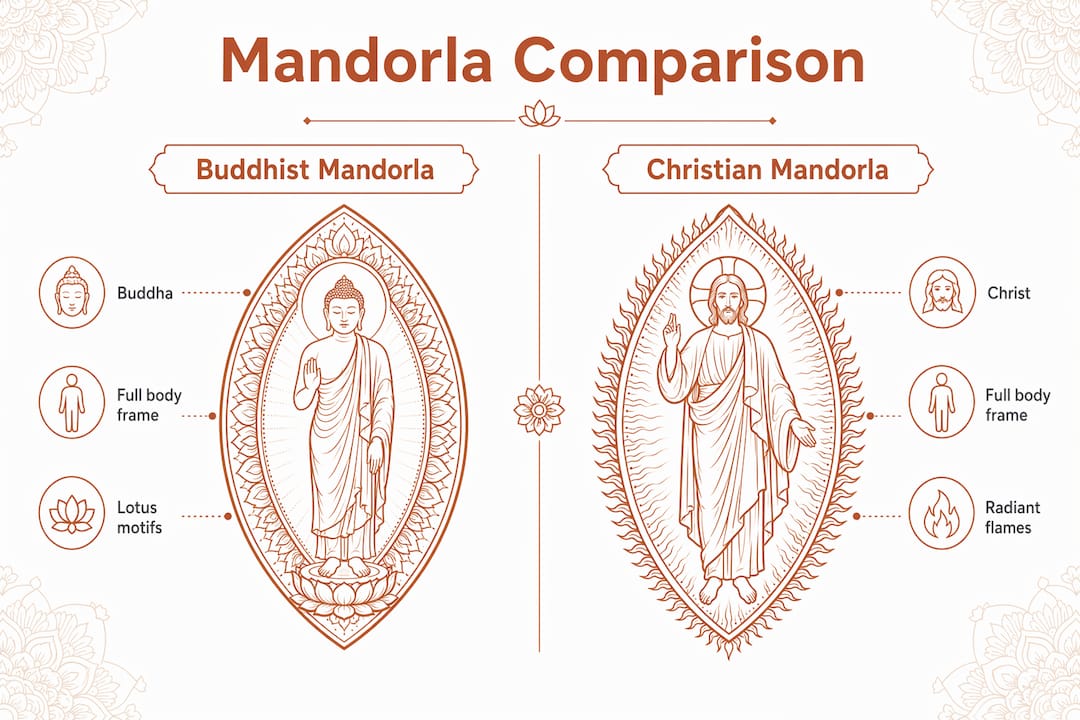
Die buddhistische Kunst übernahm die Mandorla-Form in den ersten Jahrhunderten unserer Zeitrechnung, insbesondere in der Gandhara-Schule im Nordwesten Südasiens, wo der hellenistische Einfluss stark war. Die christliche Ikonographie entwickelte eine parallele Tradition, am bekanntesten in der Christus in Majestät Kompositionen romanischer Kirchen, in denen Christus in einem identischen Mandelrahmen thront. Die Parallele ist kein Zufall. Beide Traditionen stützten sich auf das gleiche antike visuelle Vokabular des Mittelmeerraums und des Nahen Ostens.
| Funktion | Buddhistische Mandorla | Christliche Mandorla |
|---|---|---|
| Primärfigur | Buddha, Bodhisattva | Christus, Jungfrau Maria |
| Kernsymbolik | Aufklärung, Transzendenz | Göttliche Majestät, Herrlichkeit |
| Gemeinsame Motive | Lotusblütenblätter, strahlende Flammen | Sterne, Engel, Evangelisten |
| Wichtige regionale Beispiele | Gandhara, Japan, Tibet | Byzantinisches, romanisches Europa |
Der Vergleich offenbart einen gemeinsamen menschlichen Instinkt: Wenn eine Kultur zeigen muss, dass eine Figur über das Gewöhnliche hinausgegangen ist, greift sie nach derselben geometrischen Lösung.
Welche stilistische und ikonografische Rolle spielen Mandorla-Formen in der buddhistischen Kunst?
Das visuelle Vokabular der Mandorla in der buddhistischen Kunst ist weitaus reicher als ein einfacher ovaler Umriss. Traditionsübergreifend füllten Künstler den Innenraum mit vielschichtigen Motiven, von denen jedes eine unterschiedliche Bedeutung hatte.
- Ränder aus Lotusblütenblättern: Der Lotus symbolisiert Reinheit und spirituelles Erwachen. Reihen von Blütenblättern, die strahlenförmig vom Körper der Figur ausgehen, verstärken die Vorstellung, dass der Buddha aus der Unreinheit der Welt hervorgeht, ohne von ihr berührt zu werden.
- Strahlende Speichen und Flammen: Lotusblütenblätter und strahlende Speichen in Mandorlas repräsentieren göttliches Licht. Flammenmandorlas, genannt kakkoku Umgeben Sie in der japanischen buddhistischen Kunst Figuren wie Fudo Myoo mit Feuer, das eher reinigt als zerstört.
- Konzentrische Farbbänder: Tibetisch-buddhistische Thangka-Gemälde verwenden konzentrische Farbringe innerhalb der Mandorla, um die fortschreitenden Stufen der Erleuchtung darzustellen, die sich von der äußeren Dunkelheit zur inneren Leuchtkraft bewegen.
- Figurale Integration: Bei Gandhara-Steinreliefs ist die Mandorla direkt in den architektonischen Hintergrund eingraviert, wodurch die Figur und ihr heiliger Rahmen eine einzige skulpturale Einheit bilden.
Die japanische buddhistische Kunst bietet einige der technisch raffiniertesten Mandorla-Designs. Die Halo- und Mandorla-Systeme in der japanischen Tempelskulptur wurden während der Nara-Zeit (710–794 n. Chr.) standardisiert, wobei Werkstätten vergoldete hölzerne Mandorlas von außergewöhnlicher Komplexität herstellten. Die tibetische Ikonographie ordnete bestimmten Buddhas bestimmte Mandorla-Farben zu: Amitabhas Mandorla erscheint in Rot, während die von Vairocana weiß ist, wodurch kosmologische Informationen direkt in den Rahmen übertragen werden.
Südostasiatische buddhistische Kunst, insbesondere aus Kambodscha und Java, integriert die Mandorla in steinerne Tempelreliefs, wo der Rahmen mit architektonischen Elementen verschmilzt. Die Theravada-buddhistische Skulptur Die Tradition des südostasiatischen Festlandes bevorzugte flachere, linearere Mandorla-Formen im Vergleich zu den volumetrischen vergoldeten Versionen Ostasiens.
Die Mandorla löst auch ein kompositorisches Problem. Eine stehende oder sitzende Figur vor einem schlichten Hintergrund kann sich optisch instabil anfühlen. Die Mandorla dient als vertikaler Anker und umrahmt Figuren mit einer Form, die optisch leichter als ein Rechteck ist und dennoch die Bildebene beherrscht.
Wie wurde die Mandorla in der modernen und zeitgenössischen buddhistischen Kunst neu interpretiert?
Die moderne buddhistische Kunst entstand Mitte des 20. Jahrhunderts, indem sie traditionelle Ikonographie mit modernistischen Bildsprachen verbindet, um spirituelle Zustände auf neue Weise auszudrücken. Die Mandorla wurde in dieser Schicht nicht aufgegeben. Künstler gegenüber Japan, Thailand, und Indien fand die Form flexibel genug, um Abstraktionen zu absorbieren, ohne ihre Kernbedeutung zu verlieren.
Zeitgenössische Neuinterpretationen der Mandorla nehmen verschiedene Formen an:
- Abstrakte Farbfelder: Künstler ersetzen den detaillierten Lotusblütenrand durch breite Farbtupfer und nutzen den Mandelumriss eher als Behälter für meditative Farberlebnisse als für narrative Ikonographie.
- Mixed-Media-Installationen: Einige zeitgenössische buddhistische Künstler betten Mandorla-Formen in Lichtinstallationen ein und projizieren die Form auf Wände oder Böden, um immersive heilige Räume ohne eine zentrale Figur zu schaffen.
- Minimalistische Skulptur: Bildhauer reduzieren die Mandorla auf ihre wesentliche Geometrie, einen klaren Mandelumriss in Bronze oder Stein, und laden den Betrachter ein, den spirituellen Inhalt durch Kontemplation zu vermitteln.
- Digital- und Printmedien: Die Mandorla erscheint in zeitgenössischem buddhistischem Grafikdesign, Meditations-Apps und Galeriedrucken, wo ihre Silhouette auch ohne traditionellen ikonografischen Inhalt als unmittelbares kulturelles Signal fungiert.
Zeitgenössische buddhistische Künstler überall Japan, Thailand, und Indien Interpretieren Sie traditionelle Mandorla-Motive mit klassischen und abstrakten Formen neu, um Erleuchtung und Mitgefühl hervorzurufen. Diese Flexibilität ist die größte Stärke der Mandorla als lebendiges Symbol. Es hat genug historisches Gewicht, um Tradition zu signalisieren, bleibt aber gleichzeitig offen genug, um neue Bedeutungen aufzunehmen.
Profi-Tipp: Wenn Sie ein zeitgenössisches buddhistisches Kunstwerk bewerten, das eine Mandorla verwendet, fragen Sie, ob der Künstler die figurenumschließende Funktion beibehält oder die Form rein dekorativ nutzt. Diese Unterscheidung trennt ikonografisch informierte Arbeiten von oberflächlichen kulturellen Anleihen.
Für Sammler, die daran interessiert sind, wie traditionelle Motive umgesetzt werden zeitgenössische buddhistische künstlerische SymbolikModerne Interpretationen der Mandorla bieten eine direkte Verbindung zwischen antiker Ikonographie und heutiger visueller Kultur.
Welche kulturelle und spirituelle Bedeutung hat die Mandorla in der buddhistischen Praxis?
Die wichtigste Funktion der Mandorla besteht darin, den erleuchteten Zustand Buddhas als physische Realität und nicht als Metapher darzustellen. Mandorlas dienen in der buddhistischen Kunst als visuelle Metaphern für erleuchtete Präsenz und umschließen Buddha-Figuren mit symbolisch strahlendem Licht und kosmischer Ordnung. Der Rahmen schmückt die Figur nicht. Es beschreibt, was die Figur eigentlich ist: ein Wesen, dessen Körper Licht in alle Richtungen ausstrahlt.
Dieses Verständnis verbindet sich mit mehreren Ebenen der buddhistischen Lehre und Praxis:
- Schützende Aura: Die Mandorla repräsentiert Buddhas prabha, die leuchtende Aura, die in buddhistischen Texten als von einem erleuchteten Körper ausgehend beschrieben wird. Der Rahmen macht diesen Textanspruch sichtbar.
- Heiliger Raum: Die Mandorla definiert eine Grenze zwischen dem Heiligen und dem Gewöhnlichen. Gläubige, die sich einem mit einer Mandorla gerahmten Bild nähern, überschreiten eine visuelle Schwelle, die sie auf ein rituelles Engagement vorbereitet.
- Kosmische Ordnung: Die strahlenden Elemente in Mandorlas bilden den Einfluss Buddhas im gesamten Kosmos ab. In Mahayana-Traditionen hängt dies mit dem Konzept des zusammen Mahayana-buddhistische Kunsttradition von Buddha-Feldern, Bereichen gereinigter Realität, die durch die Verdienste eines Buddha erzeugt wurden.
- Meditativer Schwerpunkt: Praktizierende verwenden Mandorla-gerahmte Bilder als Objekte der Visualisierungspraxis. Die Form lenkt die Aufmerksamkeit gleichzeitig nach innen und oben und unterstützt so die mentale Haltung der Meditation.
Die Farbdynamik innerhalb der Mandorlas hat zusätzliches theologisches Gewicht. In der byzantinischen christlichen Kunst werden Mandorlas zur Mitte hin dunkler, um das göttliche Geheimnis durch apophatische Theologie auszudrücken. Eine parallele Logik taucht in einigen buddhistischen Traditionen auf, in denen die innerste Zone der Mandorla am intensivsten ist und eher den konzentrierten Kern des erleuchteten Bewusstseins als dessen äußere Ausstrahlung darstellt.
Die Mandorla umrahmt den Buddha nicht nur. Es definiert den Raum, in dem sich das Erleuchtete und das Gewöhnliche treffen, und macht die Grenze zwischen den Welten für das menschliche Auge sichtbar.
Die Mandorla erfüllt auch eine gemeinschaftliche Funktion. In Tempeln wird ein großes Buddha-Bild mit Mandorla-Rahmen zum Mittelpunkt der gemeinsamen Anbetung. Der gemeinsame Akt der Orientierung an diesem Rahmen schafft einen einheitlichen heiligen Raum für die Gemeinde. Die sSymbolik des Mandalas im Buddhismus funktioniert nach einem ähnlichen Prinzip: Geometrische Formen organisieren spirituelle Erfahrungen für eine Gemeinschaft.
Was mich das 20-jährige Studium der Mandorlas gelehrt hat
Die Mandorla ist das am wenigsten analysierte Hauptsymbol in der buddhistischen Kunstgeschichte. Wissenschaftler investieren enorme Energie in Mudras, Throntypen und ikonometrische Systeme, aber die Mandorla wird oft als Hintergrunddekoration behandelt. Das ist eine schwerwiegende Fehlinterpretation.
Bei der Arbeit mit Sammlungen von kambodschanischen Khmer-Bronzen bis hin zu japanischen vergoldeten Holzskulpturen habe ich herausgefunden, dass die Mandorla häufig das kulturell spezifischste Element in einem Stück ist. Die Körperhaltung und die Handgesten der Figur mögen panbuddhistischen Konventionen folgen, doch die Motive der Mandorla, die Anzahl der Blütenblätter, der Flammenstil und die Farbfolge kodieren präzise die regionale Werkstatttradition. Ein geschultes Auge kann oft nur ein Stück der Mandorla datieren und lokalisieren, bevor es etwas anderes untersucht.
Die heutige Herausforderung besteht darin, dass die Mandorla zu einem dekorativen Motiv in der Populärkultur geworden ist, das ihrer ikonografischen Besonderheit beraubt ist. Kunsthistoriker, die sich mit der buddhistischen Kunst des 21. Jahrhunderts befassen, müssen zwischen Werken unterscheiden, bei denen die Mandorla ihre strukturelle und theologische Funktion behält, und Werken, bei denen sie lediglich eine gefällige Form aufweist. Für diesen Unterschied ist es erforderlich, die Tradition tief genug zu kennen, um zu erkennen, wann sie gewürdigt wird und wann sie ohne Verständnis übernommen wird.
Mein Rat: Verbringen Sie Zeit mit den Mandorla-Designs der Nara-Zeit Japan und Gandhara-Steinreliefs, bevor er sich zeitgenössischen Werken zuwandte. Die historische Ausgangslage macht die Neuerungen lesbar und die Verluste sichtbar.
— James, HDAsianArt.com
Authentische buddhistische Statuen mit Mandorla-Ikonographie bei HDAsianArt
HDAsianArt bietet eine kuratierte Auswahl antiker und traditioneller buddhistischer Statuen, bei denen die Mandorla-Ikonographie für die spirituelle und künstlerische Identität des Stücks von zentraler Bedeutung ist.
Die Javanische Avalokiteshvara Bodhisattva-Statue in der HDAsianArt-Sammlung veranschaulicht, wie südostasiatische Werkstätten die Mandorla in den Bronzeguss integriert haben und den Bodhisattva in ein leuchtendes Feld einrahmen, das sowohl die Mahayana-Lehre als auch die javanische ästhetische Raffinesse widerspiegelt. Jedes Stück der HDAsianArt-Sammlung wird individuell von Spezialisten recherchiert und beschrieben, mit weltweitem versichertem DHL-Versand. Für Kunsthistoriker und Sammler, die die Mandorla-Ikonographie anhand von Primärobjekten und nicht anhand von Fotografien studieren möchten, bietet die HDAsianArt-Sammlung direkten Zugang zu Werken in Museumsqualität.
FAQ
Was ist eine Mandorla in der buddhistischen Kunst?
Eine Mandorla ist ein mandelförmiger Rahmen, der eine ganze heilige Figur umgibt und sie von einem Heiligenschein unterscheidet, der nur den Kopf markiert. In der buddhistischen Kunst signalisiert es den völlig erleuchteten und transzendenten Zustand der Figur.
Wie unterscheidet sich die Mandorla von einem Heiligenschein?
Der Heiligenschein umgibt nur den Kopf und symbolisiert die Heiligkeit. Die Mandorla umschließt den gesamten Körper und stellt eine vollständige Verwandlung in ein erleuchtetes oder göttliches Wesen dar.
Welche Motive erscheinen in buddhistischen Mandorlas?
Buddhistische Mandorlas weisen häufig Lotusblütenränder, strahlende Flammen und konzentrische Farbbänder auf. Jedes Motiv hat eine spezifische Bedeutung: Lotusblüten stehen für Reinheit und strahlende Speichen stehen für göttliches Licht.
Ist die Mandorla einzigartig in der buddhistischen Kunst?
Die Mandorla kommt sowohl in der buddhistischen und christlichen Ikonographie als auch in den visuellen Traditionen des Alten Orients vor. Seine geometrische Grundlage, die Vesica piscis, stammt aus der Zeit vor beiden Religionen und hat kulturübergreifende symbolische Bedeutung.
Wie nutzen zeitgenössische Künstler die Mandorla?
Zeitgenössische buddhistische Künstler überall Japan, Thailand, und Indien Interpretieren Sie die Mandorla durch abstrakte Farbfelder, Lichtinstallationen und minimalistische Skulpturen neu und bewahren Sie dabei die spirituelle Resonanz der Form, während Sie ihre visuelle Sprache an moderne Kontexte anpassen.
Wichtige Erkenntnisse
Die Mandorla ist in der buddhistischen Kunst das primäre visuelle Mittel zur Markierung der vollständigen Erleuchtung, und ihre Motive, Geometrie und Farben verschlüsseln theologische, regionale und doktrinäre Informationen, die kein anderes ikonografisches Element reproduziert.
| Punkt | Details |
|---|---|
| Mandorla vs. Halo | Die Mandorla umgibt die gesamte Figur; Der Heiligenschein markiert nur den Kopf und signalisiert eine höhere Stufe der Heiligkeit. |
| Geometrischer Ursprung | Die aus zwei sich überschneidenden Kreisen gebildete Vesica piscis gibt der Mandorla ihre Form und ihre Bedeutung als Vereinigung göttlicher und menschlicher Bereiche. |
| Regionale Motivvariation | Lotusblütenblätter, strahlende Flammen und Farbbänder innerhalb von Mandorlas kodieren Werkstatttradition, Datum und Lehrzugehörigkeit. |
| Interkulturelle Parallele | Die buddhistische und christliche Kunst entwickelte die Mandorla unabhängig voneinander aus einem gemeinsamen alten visuellen Vokabular und nicht durch direkte Anleihen. |
| Lebendiges Symbol | Zeitgenössische Künstler überall Japan, Thailand, und Indien interpretieren die Mandorla weiterhin in abstrakten und gemischten Formen neu. |
Empfohlen
- Die Rolle des Bodhisattva Avalokiteshvara in der buddhistischen Kunst – HD Asian Art
- Das Mandala im Buddhismus: Symbolik und spirituelle Bedeutung – HD Asian Art
- Theravada-buddhistische Skulptur für Kunstwissenschaftler erklärt – HD Asian Art
- Das Mandala in den Händen von Khmer Ganesha: Symbolik und Bedeutung – HD Asian Art
