


Thai Buddhist Symbols and Meanings: A Visual Guide
Thai Buddhist Symbols and Meanings: A Visual Guide
What if the raised hand on a Thai Buddha doesn't mean just one thing? Most quick guides give you a single label, such as protection or peace, and move on. That's tidy, but it flattens how Thai Buddhist symbols and meanings function. A gesture, a pedestal, a crown and a temple setting can point in different directions at once, and you'll read the image better when you hold those layers together rather than picking the simplest one.
Table of Contents
- Thai Buddhist Symbols at a Glance
- How Mudras Carry Meaning in Thai Buddha Images
- Lotus, Dharma Wheel and Triple Gem Emblems
- Naga, Garuda and Hindu-Derived Guardians
- Regional Styles From Dvaravati to Ayutthaya
- Monastic Symbols, Robes and Temple Motifs
- Interpreting Symbols Across Thai and UK Contexts
- Choose a Respectful Placement for Your Thai Buddha
Thai Buddhist Symbols at a Glance
| Symbol | Core meaning | Where readers usually see it |
|---|---|---|
| Buddha image | Awakened teacher and the central object of worship | Temple altars, shrines and home altars |
| Lotus pedestal | Purity of the Buddha and his teaching | Beneath standing and seated Buddha figures |
| Dharma wheel | The teaching, with eight or twelve spokes | Temple gables, flags and sermon scenes |
| Naga | Serpent protector linked with water and shelter | Staircase balustrades and beneath Buddha images |
| Chatra (parasol) | Sovereignty, spiritual and royal | Above Buddha images and in processions |
| Bodhi tree | Site of the Buddha's awakening | Behind seated Buddhas and in mural backgrounds |
| Triple Gem | The three refuges, Buddha, Dharma and Sangha | Frames, plaques and temple entrances |
| Alms bowl | Humility and monastic discipline | Monk sculptures and temple grounds |
| Saffron robe | Renunciation and the monastic life | Monk statues and ordination scenes |
Use this table as your first pass, not your final answer. Find the symbol you've noticed, note its core meaning, then check what sits next to it. A Buddha on a lotus pedestal with one hand raised is telling you more than either element says alone.
That's the central habit to build. Thai images combine gesture, posture, pedestal and surrounding emblems, and each part narrows the reading. Posture tells you whether the figure is seated in meditation, standing to teach or reassure, or walking among people. Emblems behind or beneath the figure add a place, a teaching or a community.
How to use the quick guide
Start with the largest feature, usually the Buddha image itself. Then move outwards to the base, the backdrop and any guardian figures at the edges. If you spot a wheel, count its spokes before you name its meaning. If you spot a serpent, check whether it's forming a seat, a hood or a staircase rail, because position changes the story.
The families that follow build in a practical order. Gestures come first because they're the easiest feature to check by eye, then flora and emblems, guardians, regional styles, monastic items and finally display. You don't need to memorise every row now. Return to the table when a new image puzzles you, identify its neighbours, and then read the matching section for the fuller context.
Reading rule: Never name a symbol from one detail alone. Note at least two features, such as hand plus base, before you decide what the image emphasises.
How Mudras Carry Meaning in Thai Buddha Images
Mudras are hand gestures built into the sculpture, so they're the most reliable first read you have. You can check them without specialist equipment, and they usually identify an episode or a quality linked to the Buddha. Start there, then let posture and costume confirm or adjust what the hands suggest.
Follow a simple three step routine. First, identify which hand is active and where the palm faces. Second, check whether the figure is seated, standing or walking. Third, look for narrative details, such as fingertips reaching to the ground, that tie the pose to a specific moment.
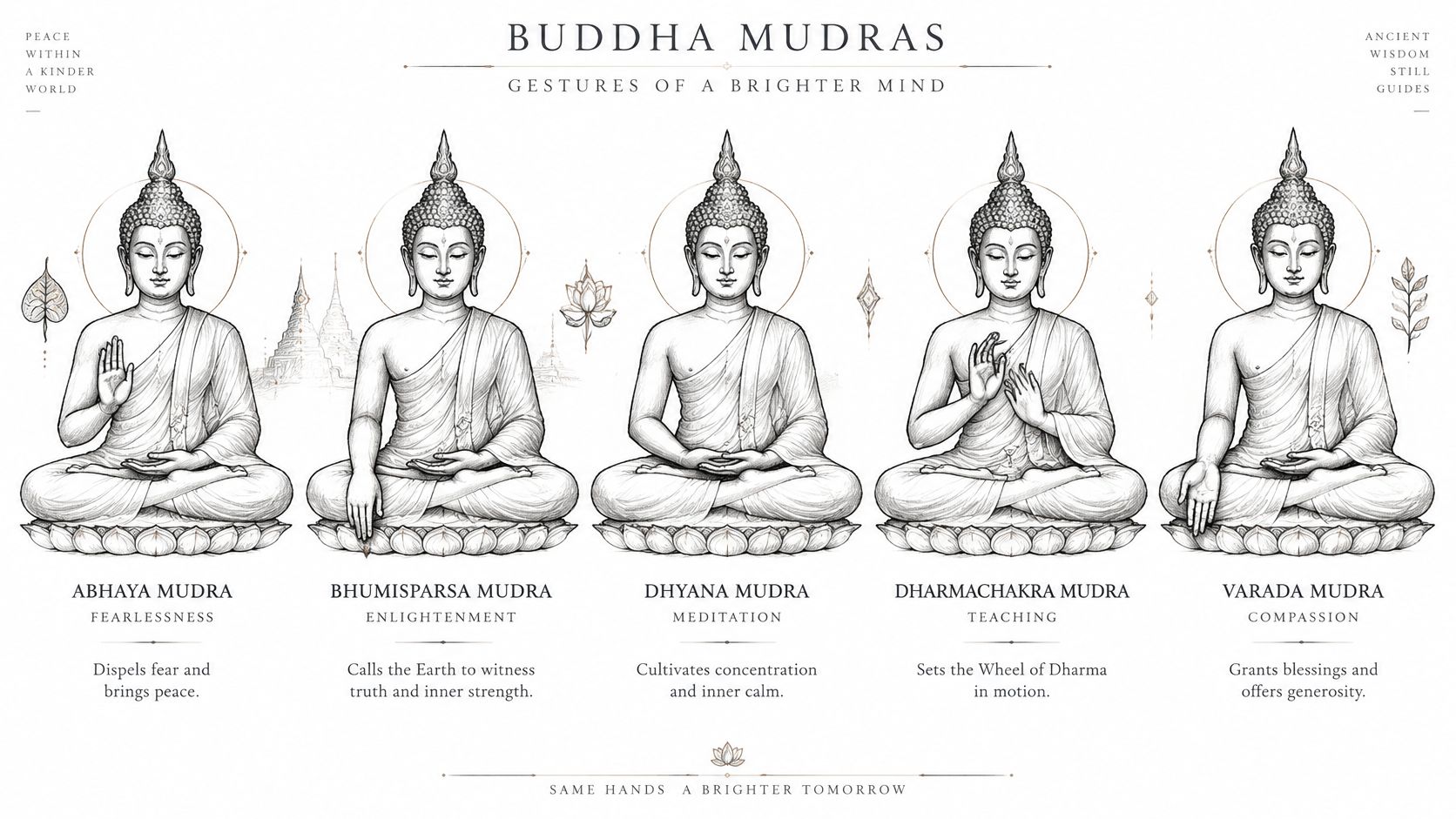
| Gesture | Hand position | Core meaning | Episode or quality |
|---|---|---|---|
| Abhaya mudra | Right hand raised, palm facing out | Reassurance and fearlessness | The Buddha halting a dispute over river water |
| Bhumisparsha mudra | Right hand touches the earth, seated | Enlightenment and triumph | Calling the Earth Goddess to witness awakening, victory over Mara |
| Dhyana mudra | Hands resting in the lap, palms up, seated | Meditation and concentration | The Buddha in deep meditation |
| Vitarka mudra | Thumb and index finger touching, other fingers extended | Teaching and discourse | The Buddha expounding the Dharma |
| Varada mudra | Right hand lowered, palm facing out | Generosity and granting wishes | Blessing those who approach |
One gesture, two readings
The raised right hand shows why a single label isn't enough. The British Museum object record identifies the raised right hand, palm facing outward, as the abhaya mudra, commonly translated as the gesture of reassurance or fearlessness. In Thailand, the same pose is also called ham yat, meaning "forbidding" or "stopping," because it recalls the Buddha preventing a violent dispute between the Sakya and Koliya clans over water from the Rohini River.
Both readings are correct, and they do different work. The first gives you a universal Buddhist ideal, calm protection and freedom from fear. The second gives you a Thai narrative association with preventing conflict. If you only learn "protection," you'll miss the episode that Thai viewers may bring to the same image.
The earth touching gesture needs the same care. It's often sold as "meditation," but the right hand reaching toward the ground while the Buddha stays seated points to enlightenment, when he calls the Earth Goddess to witness his attainment and defeats Mara, the personification of distraction and obstruction. That posture can also be called maravijaya, meaning victory over Mara, and the fuller account is set out in this study resource on Buddhist practices.
Costume can shift the emphasis again. A crowned and ornamented Buddha doesn't stop being a Buddha, but the jewellery adds royal symbolism and universal sovereignty alongside spiritual authority. For a closer comparison of the main forms, our guide to Buddha statue mudras including bhumisparsha, abhaya and dhyana works through each hand position in turn.
Your takeaway is modest but useful. A gesture gives you a first reading, and the rest of the image confirms it. If the hand, posture and narrative details don't agree, slow down rather than forcing a label.
Lotus, Dharma Wheel and Triple Gem Emblems
Emblems around a Buddha image add meaning to its posture and gesture. A lotus may suggest purity, a wheel may point to the teaching, and a tree may recall awakening. Read each sign in its setting, then consider how the signs work together.
The lotus pedestal
A lotus can serve as both a doctrinal symbol and a clue to how an image is composed. The V&A record for an Ayutthaya standing Buddha interprets the lotus beneath the figure as representing the purity of the Buddha and his teachings. The object is attributed to north-central Thailand's Ayutthaya period, broadly the fifteenth to sixteenth centuries, showing how a widely shared symbol appears in a distinct historical form.
Notice where the lotus sits. The Buddha stands above the ground on stylised petals, separating the figure visually from ordinary space while retaining a stable, frontal format for devotion. Record the pedestal separately from the stance, robe and hand gesture. A standing figure on a lotus with one hand raised may bring together ideas of purity and reassurance, but the lotus alone cannot identify a precise date or school.
Counting the wheel
The dharma wheel, or dharmacakra, represents the Buddha's teaching and is especially associated with his first sermon at Sarnath. Its familiar eight-spoked form refers to the Noble Eightfold Path: right view, intention, speech, action, livelihood, effort, mindfulness and concentration.
A twelve-spoke wheel is associated with the Four Noble Truths in their threefold structure of truth, practice and realisation. Spoke counts can therefore point to different teachings, but they are not a firm identification rule on their own. Consider the wheel's context and other features before settling on a reading.
Framing emblems behind the figure
The Bodhi tree evokes the Buddha's awakening. The Triple Gem represents the three refuges: Buddha, Dharma and Sangha. A flaming pillar or radiance behind the Buddha can suggest Shakyamuni's spiritual brilliance. These distinctions are discussed in an Oxford academic chapter on Buddhist emblems.
Together, these signs form a visual vocabulary. A tree may evoke awakening, a wheel the teaching, and the Triple Gem the community of Buddhist practice. Radiance adds another layer. As with a sentence, each element contributes to the whole, and its meaning depends partly on where it appears.
Use this checklist before deciding what an image emphasises:
- Count the spokes: Eight refer to the Noble Eightfold Path; twelve are associated with the Four Noble Truths in their threefold structure.
- Note the pedestal: A lotus suggests purity and elevation, but does not date the piece by itself.
- Name the frame: A tree, wheel, radiance or Triple Gem points to a different aspect of Buddhist tradition.
- Combine the clues: Describe what the arrangement suggests as a whole, rather than treating one emblem as a complete explanation.
Naga, Garuda and Hindu-Derived Guardians
Say you're climbing the steps to a Thai temple hall and a long serpent runs down each side as a balustrade. That's a naga, shown as a serpent, dragon or cobra, and it's doing more than decorating the stair. You're crossing a threshold, moving from ordinary ground into sacred space under a guardian's watch.
The naga is a protector linked with water and shelter. In the best known episode, the naga king Mucalinda coils beneath the meditating Buddha during a storm and spreads his hood above him, which is why you'll see Buddha figures seated on coils with a multi headed hood behind them. The same guardian appears on staircases, bridges and roof edges, where its body marks a boundary you pass through.
Other figures frame Thai temple art in a similar way. Garuda appears as a human-bird hybrid, Vishnu is commonly represented with four arms, Shiva is represented in some Thai contexts with eight arms, and Ganesha is identified by his elephant head, as listed in this overview of Thai temple art and architecture. You'll often meet them on gables, pediments and shrine surrounds rather than at the centre of the altar.
Don't classify these figures as alternative Buddha identities. They occupy distinct religious roles alongside Buddha images, reflecting the long interaction between Theravada Buddhism and Hindu derived traditions in Thai religious culture. Their presence shows that Thai Buddhist iconography isn't limited to symbols that began inside Buddhism.
A guardian at the edge of an image is usually framing the Buddha, not replacing him. Check who sits at the centre before you name the subject.
A quick identification routine helps when figures crowd a doorway or mural. Count the arms, note the head or body form, and check where the figure sits in relation to the Buddha. An elephant head settles Ganesha at once, while a bird body with human features points to Garuda.
Position gives you the final clue. A serpent forming a seat supports the Buddha, a serpent along a stair guards your approach, and a deity on a gable watches over the building. Our guide to the meaning and importance of the naga in Thailand follows that guardian through its protective, watery and spiritual associations in more depth.
Regional Styles From Dvaravati to Ayutthaya
How can a Buddha's style help you read its symbols? Begin with the period and region: a raised hand, for example, may be shaped differently across eras, even when its gesture carries a familiar meaning. Style gives context, rather than a single definitive label.
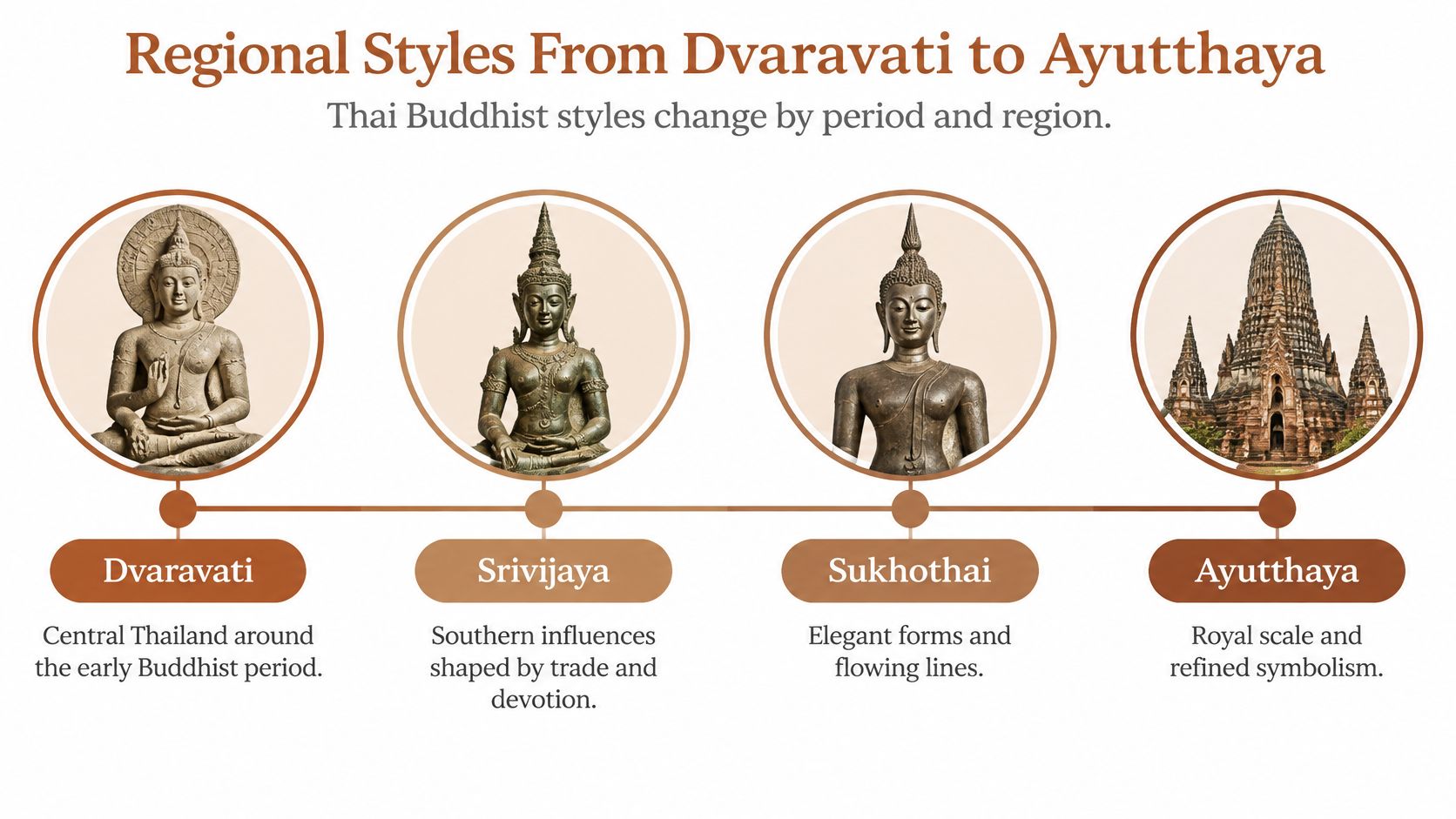
| Period | Approximate dates | Region | Recognisable features |
|---|---|---|---|
| Dvaravati | Around the eighth century | Central Thailand | Early Buddhist imagery of the central plains |
| Lopburi | Twelfth to thirteenth centuries | Central Thailand | Khmer-Angkorian influence |
| Sukhothai | From the thirteenth century | Northern central Thailand | Flame-like ushnisha, walking Buddha, Sri Lankan influence |
| Ayutthaya | Fifteenth to sixteenth centuries, V&A attribution | North-central Thailand | Lotus pedestals and elevated standing figures |
| Rattanakosin | From 1782 | Bangkok | Court styles of the Chakri dynasty |
The walking Buddha as a period marker
The walking Buddha is especially associated with Thai art. Khan Academy's account of the Sukhothai walking Buddha describes the form as distinctive in the thirteenth century and notes its raised right hand, commonly shown in abhayamudra, the gesture of reassurance. The Sukhothai style also features a flame-like ushnisha, the cranial protuberance on the Buddha's head, reflecting Sri Lankan influence.
The walking posture gives the image a sense of presence and movement. It can suggest the Buddha among people, teaching and engaging with the world. A calm expression here belongs to a figure in motion, not only to one seated in meditation.
Some readings also connect the walking form with ideals of kingship. Treat that as an interpretation, not a fixed meaning: the posture alone cannot establish a political message. Gesture, setting and the tradition in which an image was made all shape how it may be understood.
Using the timeline without overclaiming
Read visible features together. Check the ushnisha, then the body's posture and stance, and then the base and robe treatment. When several features point to the same period, they support a reasonable stylistic reading. If they differ, describe what you can see without forcing a precise attribution.
Regional influence can account for those differences. Lopburi works show Khmer-Angkorian influence, while Dvaravati images belong to an earlier central Thai tradition. A single emblem, then, rarely settles an image's date or origin. For a closer comparison, see this guide to Sukhothai and Ayutthaya Buddha sculpture styles.
Thai Buddha images are also venerated in Thai temples in Britain, including Buddhapadipa in London. Their presence in a new setting does not erase their regional style or devotional role. For UK viewers, both can matter at once: an image may be encountered as sacred, as art, or as both, depending on where it stands and who is looking.
Monastic Symbols, Robes and Temple Motifs
Walk into a temple compound slowly and the monastic symbols appear before the main Buddha does. You notice saffron cloth, a monk carrying a bowl, boundary stones set into the ground and a bell shaped monument rising behind the hall. Each item tells you whether you're in a working religious place or looking at a decorative copy.
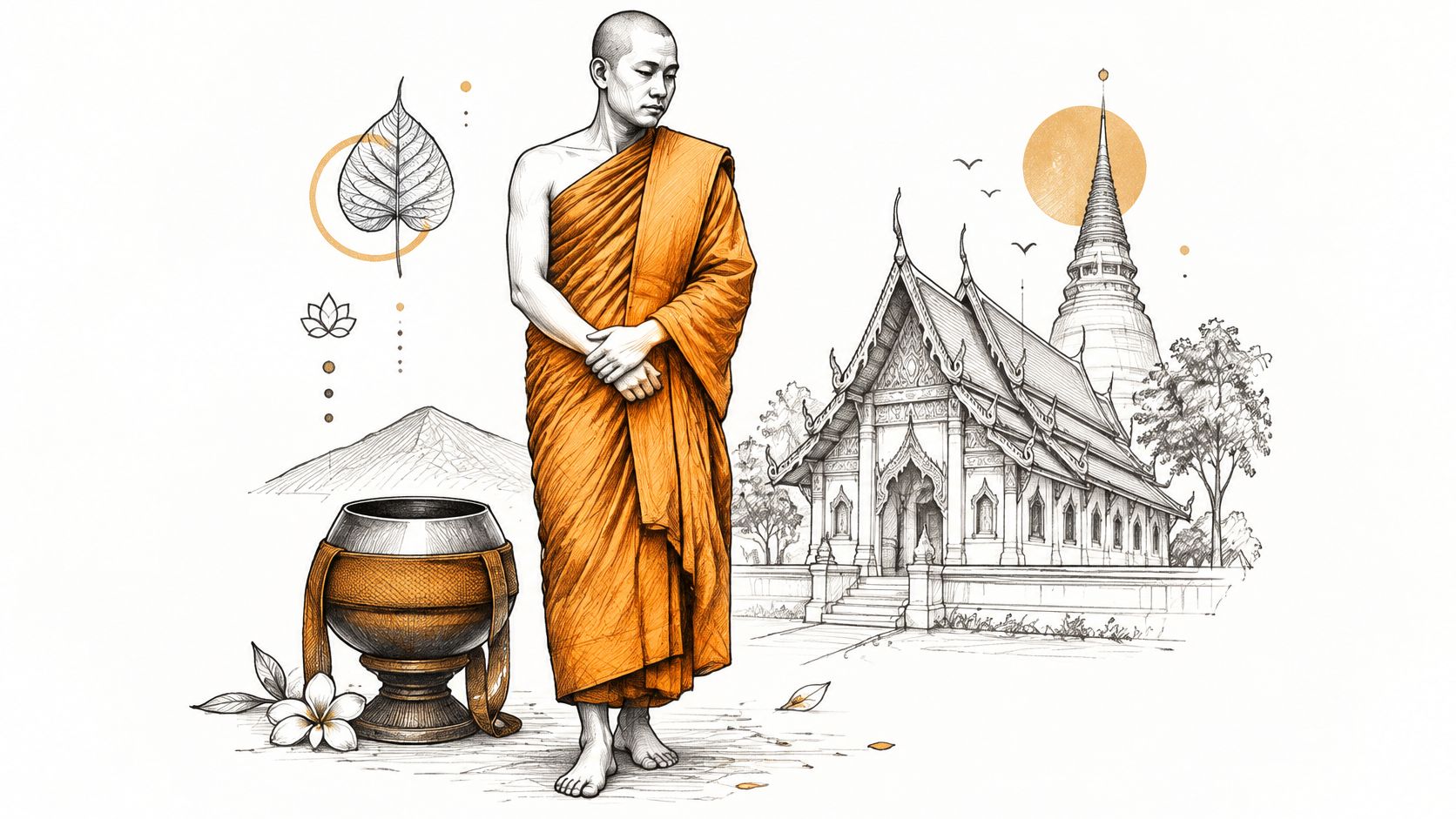
The saffron robe signals renunciation and the monastic life. In sculpture, watch how the cloth is draped over one shoulder or both, and whether the folds are plain or highly patterned, because sculptors use that treatment to show simplicity rather than status. A monk figure doesn't depict just one person. It evokes the Sangha, the community that preserves and transmits the teaching.
The alms bowl signals humility and monastic discipline. Monks depend on daily almsgiving, receiving food from laypeople who gain merit by giving, so the bowl captures an exchange rather than a possession. When a sculpture cradles the bowl in both hands with downcast eyes, it's recalling the quiet morning alms round, not holding a container.
Moving through the temple grounds
The chedi, or stupa, can hold relics and marks the Buddhist presence of a site. You'll usually see it as a prominent, often bell shaped monument that visitors walk around rather than enter. Treat it as a sacred focal point, not as a backdrop for photographs of people climbing or leaning.
The mondop is a square hall, often with a tiered roof, that can house a principal image or sacred object. Its compact, centred plan sets it apart from the longer ordination and assembly halls around it. If a building looks like a shrine pavilion rather than a gathering space, you're probably looking at a mondop.
Bai sema are boundary stones that mark the sacred ground of an ordination hall. They sit at ground level around the building, easy to overlook, but they define where valid monastic acts take place. Naga balustrades and gable ornaments then frame your approach to the entrance, combining protection with a clear visual threshold.
- Sacred and functional: Chedi, bai sema and the principal image inside a mondop.
- Protective and framing: Naga balustrades and gable ornaments at entrances and rooflines.
- Monastic and everyday: Robes and alms bowls, which connect sculpture to daily discipline.
Once you can name these items, you can ask better questions about any object you're studying. Is that bowl a ritual item, a sculptural attribute or a later addition? Does the setting suggest a working temple, a museum display or a garden reproduction? Those distinctions protect you from treating every Thai looking motif as interchangeable ornament.
Interpreting Symbols Across Thai and UK Contexts
A common assumption causes most misreadings. Readers expect a lotus, a gesture or a wheel to hold one stable meaning wherever it appears, but Thai Buddhist symbols aren't universally interchangeable across communities or contexts. Meaning shifts with lineage, ritual setting, object type and the person standing in front of the image.
Separate four layers before you decide what you're seeing:
- Doctrinal meaning: What the gesture, lotus or wheel signals within Theravada teaching, such as reassurance or the Noble Eightfold Path.
- Thai cultural usage: How the image functions in Thai life, such as the Rohini River episode behind the name ham yat.
- Temple etiquette: How the image is treated in an ordination hall or shrine, including who may touch it and how it is faced.
- Secular decorative reading: How a buyer or designer sees the same figure as an interior accent.
Now apply all four to one standing Buddha with abhaya mudra on a lotus pedestal. Doctrinally, you're reading reassurance joined with purity. In Thai cultural usage, you may also be reading the stopping of a clan dispute over river water. In a temple, that same figure is an object of veneration with rules about proximity and handling. In a living room catalogue, it may be presented only as a calm focal point, which is the thinnest of the four readings.
Why the UK audience isn't one audience
UK figures need careful handling. The ONS Census 2021 release on religion in England and Wales records that 272,508 people identified as Buddhist in the 2021 Census in England and Wales, while 55.7% were female. Those figures describe identity, not a uniform level of familiarity with Thai Buddhist iconography, because census data records religious identification rather than belief, practice or active affiliation.
That distinction changes how you should write or buy. A Thai temple community, a Western convert, a meditation practitioner and a collector may all value the same image, but they won't bring the same knowledge or obligations to it. Census affiliation also doesn't necessarily correspond to lived experience, practice or group membership, so you can't infer ritual understanding from a ticked box.
Better question: Don't ask only what a symbol means. Ask whose meaning you're reading, and in what setting.
Simplifying symbols can make them more accessible, and there's a place for a short label in a shop or museum. The risk is that simplification erases the difference between Theravada ritual meanings and generalised Western readings of Buddha imagery as mindfulness decoration. If you're creating a home altar, you need the cultural context, not a one line symbolism tag.
Choose a Respectful Placement for Your Thai Buddha
Placement starts with purpose, not with a shelf. Decide whether the image is for a devotional altar, a meditation space, or a collection and interior, because each purpose changes what respectful treatment looks like. There's no single universal checklist that fits a temple image, a family altar and a collector's cabinet in the same way.
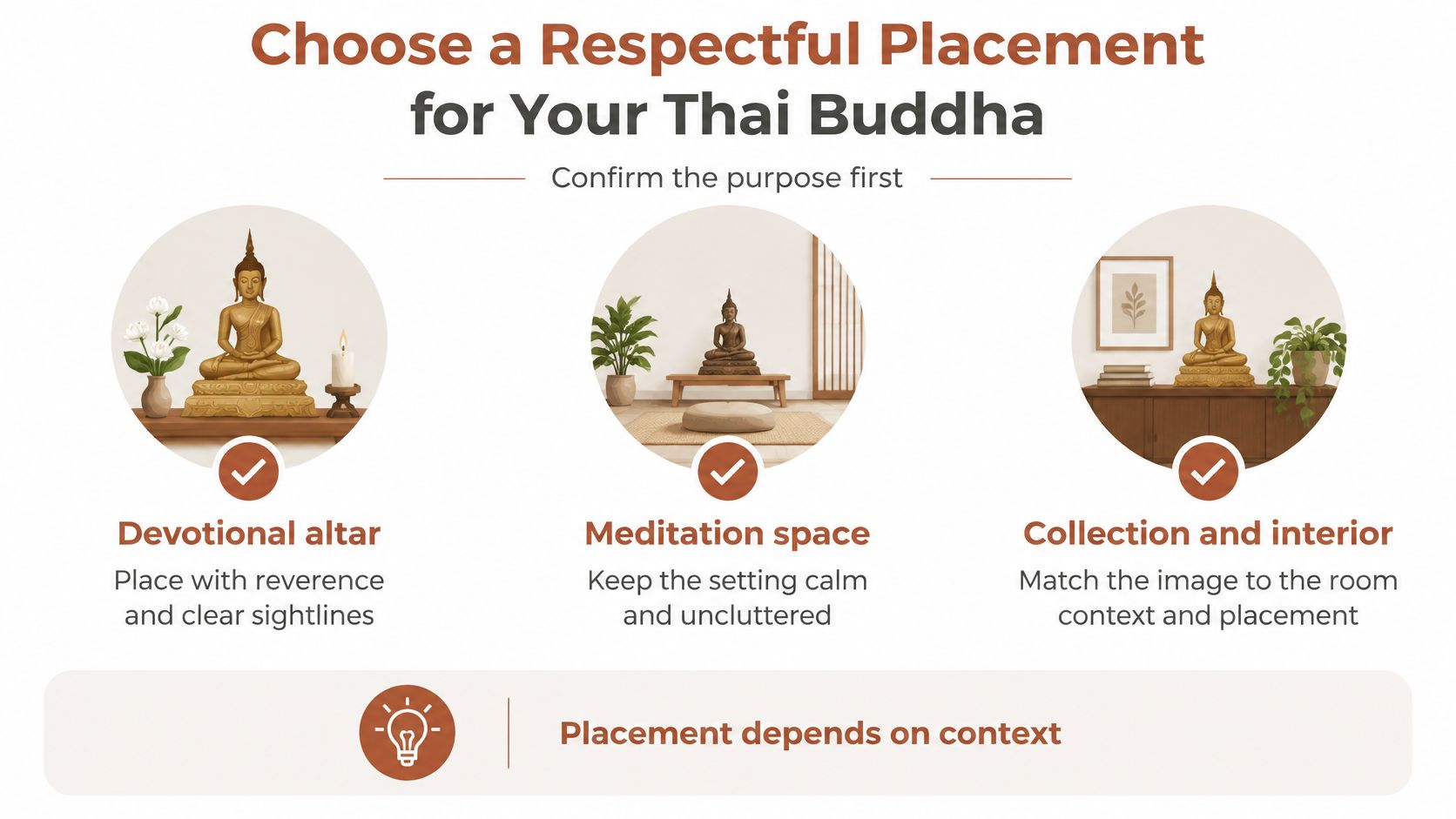
A four step placement routine
1. Read the image before you buy. Identify the mudra and check the period features, such as a flame-like ushnisha or a lotus pedestal, so you know whether you're choosing a teaching, protection, meditation or blessing figure. We explain the meaning of Buddha postures and hand gestures, such as meditation, teaching, protection or blessing, in our listings and guides so you can match the form to your purpose.
2. Check condition and status. Note cracks, missing parts and repainting, and ask whether an antique piece is damaged or deconsecrated, since that affects how it should be handled. A fragile or repaired image may suit a protected cabinet better than a busy altar where it's moved often. Don't hide damage with casual restoration before you've taken advice.
3. Choose a calm, raised position. We recommend that a Buddha statue be kept clean, raised from the floor, and away from bathrooms, cluttered areas or places where it may be treated casually. Give the figure clear sightlines and enough space that it isn't used as a bookend, a doorstop or a surface for keys and post.
4. Consult a temple where possible. An Oxford study hosted in the Oxford Research Archive identifies 31 Thai Buddhist temples in the UK, so Thai Buddhist practice has an established institutional presence here rather than being only an imported aesthetic category. A local temple can advise how an image should be treated, especially if it's antique or if you intend devotional use.
Keep the audiences distinct as you decide. The same image may serve an established Thai community, another Buddhist practitioner, a culturally interested collector and an interior buyer, but those groups bring different expectations to it. Devotional altar use calls for offerings, cleanliness and careful facing, while non ritual display still calls for elevation, stability and an uncluttered setting.
Match the symbol to the purpose first, then choose the placement that fits it. A meditation figure belongs in the calmest part of the room, a protective standing figure suits a clear and visible position, and a fragile antique needs protection from handling. When you're unsure, choose the more reverent option and ask for advice rather than treating a sacred image as generic décor.
If you're now reading gestures, pedestals and styles with more confidence, browse our Thai Buddha sculptures and use the detailed symbolism notes on each listing to match a mudra and period style to your altar, meditation space or collection. Visit HD Asian Art to compare antique and contemporary pieces and choose an image you can place with knowledge rather than guesswork.
