



Symbolism and Meaning in Buddhism: Reading Sculpture
Symbolism and Meaning in Buddhism: Reading Sculpture
You've found a seated figure you like. The seller calls it a Buddha, the price is reasonable, and the bronze has a weight that feels right in the hand. Then you notice the right palm is raised, the left hand sits open in the lap, and there's a lotus carved into the base. Three details, no explanation, and a quiet worry that you're about to buy something you can't describe to anyone who asks.
That uncertainty is worth taking seriously. A Buddhist sculpture isn't a single symbol with a single caption. It's a set of clues, and the meaning only emerges when you read them together. The same raised hand can signal reassurance in one tradition and a specific miracle story in another. A lotus base isn't background decoration. It's a doctrinal statement about where awakening comes from.
Read any image in three layers. The first is formal iconography, what the figure shows through hands, posture and attributes. The second is regional or sectarian interpretation, how Theravada, Mahayana or Vajrayana traditions emphasise that same feature. The third is present-day use, whether the object sits on a temple shrine, in a museum case, on a home altar or in a designed interior.
Think of a road sign. A red octagon reads as "stop" only to someone who knows the code. The shape carries no inherent meaning. Buddhist symbols work the same way, which is why they function as signposts to the Buddha's life, teachings or presence rather than as fixed dictionary entries you can memorise once.
This isn't an antiquarian concern. The 2021 Census recorded 272,508 people identifying as Buddhist in England and Wales, approximately 0.5% of the population, a figure reported in a 2024 academic study of British Buddhism. These images serve a living community as well as museum collections, and that raises the stakes on getting the reading right.
What follows is a lookup guide, not a lecture. Each entry comes with the conditions that change it, so you can establish what an image says before deciding whether to buy it, display it or interpret it for someone else.
Table of Contents
- How Buddhist Sculpture Carries Meaning
- Hand Gestures (Mudras) and What They Signal
- Postures That Separate Buddhas From Bodhisattvas
- Attributes and Implements That Identify Each Figure
- Recurring Motifs From Lotus to Empty Throne
- How Meaning Shifts Across Traditions and Settings
- How to Read a Sculpture Step by Step
- Confirm the Iconography Before You Buy or Display
How Buddhist Sculpture Carries Meaning
The three-layer framework does most of the work, but each layer answers a different question. Formal iconography tells you what the sculptor depicted. Regional interpretation tells you what a particular community understood by it. Present use tells you what the object is doing now.
Most confusion comes from collapsing these into one. A collector reads the gesture and stops. A curator reads the region and stops. A practitioner reads the setting and finds the first two readings incomplete.
Take a seated figure with the right hand touching the ground. Formally, that's the earth-touching gesture. In Theravada contexts across Southeast Asia, it's the defining image of the enlightenment moment, so common that it almost becomes the default. In a Tibetan Vajrayana setting, the same gesture appears within a far more elaborate visual system where the surrounding figures and colours carry equal weight.
None of those readings contradicts the others. They're emphases, and knowing which one an object assumes is what separates a confident description from a guess.
The practical consequence: an image carries a message whether or not you can name it. Learning the code is what lets you describe an object accurately, price it fairly and place it respectfully.
Hand Gestures (Mudras) and What They Signal
Start with the hands. A mudra is a ritual hand gesture, and it's usually the fastest clue to what a figure is doing, because the sculptor had to make a deliberate choice about every finger.
The most recognisable is the abhaya mudra, with the right palm raised outward and the fingers up. The British Museum's catalogue record describes it as communicating reassurance, protection or the dispelling of fear. It's the gesture that greets you at temple entrances and appears on standing and seated Buddhas across many regions.
Its counterpart is the bhumisparsha mudra, where the right hand reaches down to touch the earth while the left rests in the lap. This marks the moment of enlightenment, when the Buddha called the earth to witness. It's a narrative gesture, not a mood. The figure isn't sitting calmly. It's doing something specific in a story.
Here's where careful reading matters. The British Museum notes that Thai images with both hands raised can signify ham samut, the Buddha's miraculous stopping of a flood, rather than the standard single-hand meaning. Identical-looking raised palms encode different episodes depending on how many hands are up and where the object was made.
Identification rule: read the gesture first, then test it against the posture and attributes. A single hand never settles the question on its own.
| Mudra | Hand position | Meaning | Typical figures |
|---|---|---|---|
| Abhaya (fearlessness) | Right palm raised, fingers up, palm facing outward | Protection, reassurance, dispelling fear | Standing and seated Buddhas across many regions |
| Bhumisparsha (earth-touching) | Right hand reaches down to touch the earth, left hand resting in the lap | Enlightenment; the earth called to witness | Shakyamuni at the moment of awakening, common in Southeast Asian images |
| Dhyana (meditation) | Hands resting in the lap, right over left, palms up | Meditation, equanimity, concentrated calm | Meditating Buddhas, including Amitabha in East Asian forms |
| Vitarka (teaching) | Thumb and index finger touching, other fingers extended, hand raised at the chest | Exposition of the Dharma, teaching | Teaching Buddhas, especially Shakyamuni preaching |
| Varada (giving) | Right arm hanging down, palm outward, fingers pointing down | Generosity, granting wishes | Bodhisattvas and Tara |
A reference table is useful until the object doesn't cooperate. Antique pieces present three common problems: hands worn smooth, fingers broken and replaced, and restorations that rebuild a gesture from insufficient evidence.
A missing thumb on a vitarka hand can turn a teaching Buddha into a misdescribed figure in a catalogue. If a fingertip looks cleaner than the rest of the surface, or the patina breaks sharply at a knuckle, treat the gesture as uncertain and check the documented record before you repeat the description. Our own catalogue entries walk through the Buddha statue mudras explained, including bhumisparsha, abhaya, dhyana and dharmachakra, which is a sensible cross-check against what you see in front of you.
Postures That Separate Buddhas From Bodhisattvas
Posture is the shape of the whole body, and it often settles identity faster than the hands do. The key distinction in most collections is between a Buddha and a bodhisattva, and the difference is legible from across a room before you can make out a single finger.
A Buddha typically wears plain monk's robes, carries no jewellery, and has a cranial protuberance (ushnisha) on top of the head. A bodhisattva wears a jewelled crown, necklaces and silk scarves, and is posed with more fluidity and elegance.
That ornamentation isn't vanity. A bodhisattva remains engaged with the world and is depicted in its finery. The Buddha renounced it, and the plain robe records that choice.
| Posture | Body position | Meaning | Common figures |
|---|---|---|---|
| Padmasana (lotus position) | Legs crossed, each foot resting on the opposite thigh | Meditation, purity, awakening | Seated Buddhas, especially Shakyamuni |
| Lalitasana (royal ease) | One leg folded, the other hanging down from the seat | Relaxed kingship, compassionate readiness | Bodhisattvas, often Avalokiteshvara and Maitreya |
| Samabhanga (upright stance) | Body balanced, weight evenly shared, feet together | Stability, dignity, a teaching presence | Standing Buddhas, common in early Indian sculpture |
| Tribhanga (three bends) | Body bent at hip and shoulder in a gentle S-curve | Grace, tenderness, bodhisattva elegance | Standing bodhisattvas and some female deities |
| Parinirvana (reclining) | Lying on the right side, head resting on the right hand | The Buddha's passing into final nirvana | Reclining Buddhas in temples and monasteries |
The reclining figure deserves special attention because it's the clearest case of posture becoming story. A figure lying on its right side with the head propped on the right hand isn't resting or sleeping. It depicts the Buddha's passing into final nirvana, and the position of the body is the narrative.
Where collectors most often slip is treating these categories as mutually exclusive. A jewelled figure in a relaxed pose is likely a bodhisattva, but some traditions depict crowned Buddhas, and Southeast Asian regalia occasionally dresses a Buddha as a king. The clearer distinction, and the one our guide to the key differences between bodhisattva and Buddha figures sets out, rests on combining ornament, posture and gesture rather than trusting any one of them.
Cross-check the two tables. A lotus posture with plain robes, an ushnisha and a raised right palm is a strong Buddha reading. Add a crown and swap to royal ease, and the same figure shifts to bodhisattva.
Attributes and Implements That Identify Each Figure
Attributes are the name badges. These are the objects a figure holds, rests a foot on or sits upon, and they matter most when an inscription is missing or worn past legibility.
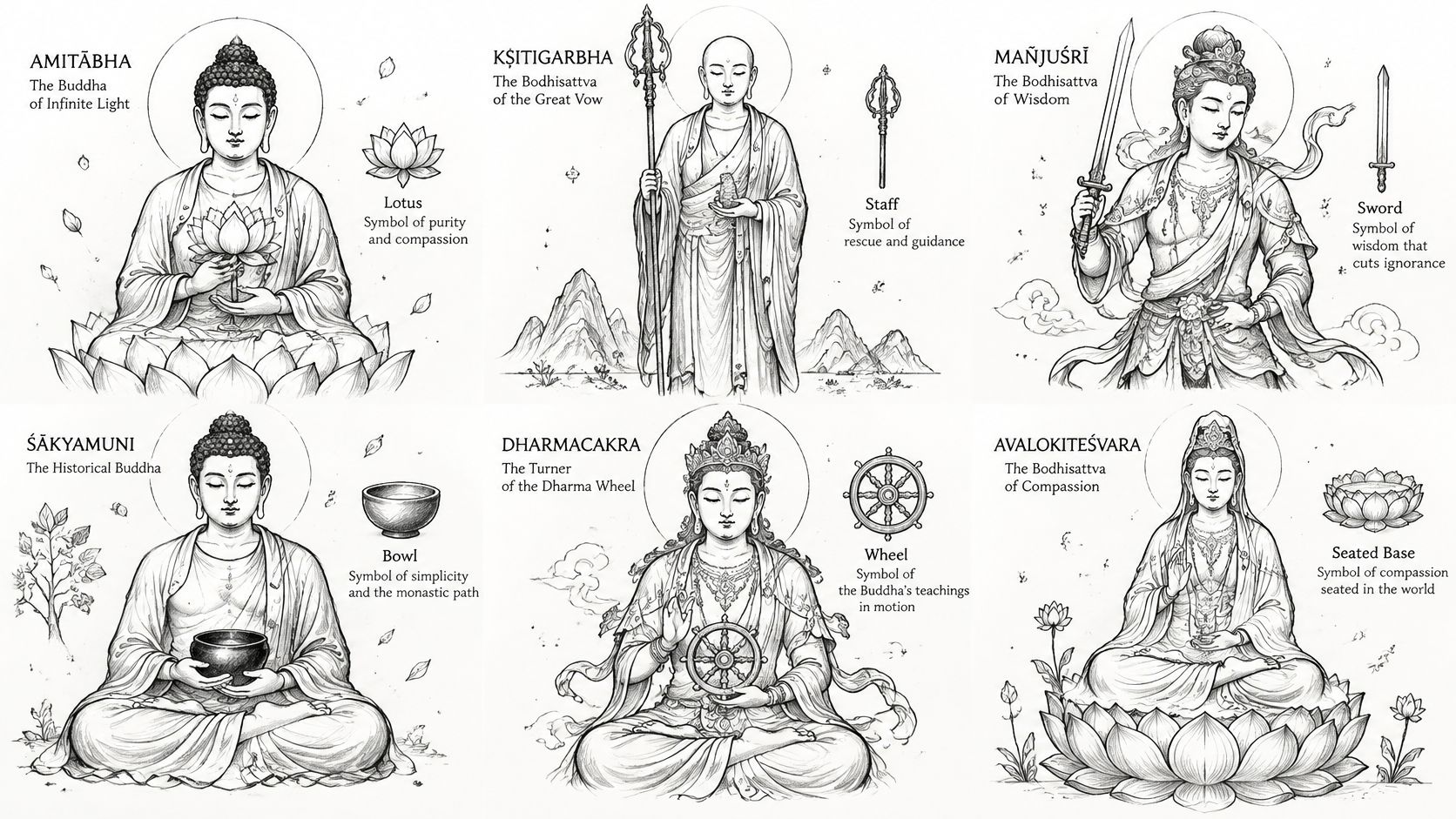
| Attribute | Usually held by | Meaning |
|---|---|---|
| Lotus (padma) | Avalokiteshvara and Tara | Purity rising from mud, awakening |
| Alms bowl | Shakyamuni; the Medicine Buddha holds a bowl of healing medicine | Renunciation and monastic life; healing |
| Vajra (thunderbolt sceptre) | Vajrapani and many Vajrayana deities | Indestructibility, skilful means, cutting through illusion |
| Flaming sword | Manjushri | Cutting away ignorance with wisdom |
| Book or scripture (pustaka) | Manjushri | Wisdom and the Prajnaparamita texts |
| Wish-fulfilling jewel (chintamani) | Avalokiteshvara in some forms | Fulfilment of wishes and compassion |
One attribute rarely decides anything. A lotus is held by Avalokiteshvara and by Tara, so the flower narrows the field without naming the figure. Pair it with the mudra and the posture and the options collapse quickly.
The alms bowl shows why context beats object. In Shakyamuni's hands it signals renunciation and the monastic life. In the Medicine Buddha's hands the same bowl holds healing medicine, and the distinction usually comes from the figure's colour and the surrounding composition rather than the bowl itself.
Antique pieces complicate all of this. Attributes get lost, replaced or added by a later restorer, and a rebuilt hand may hold something the original sculptor never carved.
If a hand looks newer than the wrist it joins, treat whatever it holds as evidence of restoration, not evidence of identity.
Check the catalogue or museum record before committing to a firm identification. A jewelled figure holding a sword and a book is Manjushri with reasonable confidence. The same figure with a replaced right hand and no documented attribute is a bodhisattva with a question mark, and saying so is more honest than guessing.
Recurring Motifs From Lotus to Empty Throne
The most surprising thing about early Buddhist art is what it leaves out. At Amaravati, the Buddha was initially represented without a human figure at all, through an empty throne, footprints, a sacred tree and a parasol. The British Museum's guide to the Ancient India galleries dates that symbolic carving to approximately 50–1 BC, while a later side of the same slab, carved around AD 250, shows the Buddha in human form.
That shift changed what a devotional image could do. Symbols referred to the Buddha's presence indirectly. Anthropomorphic images made doctrinal narrative and direct encounter possible.
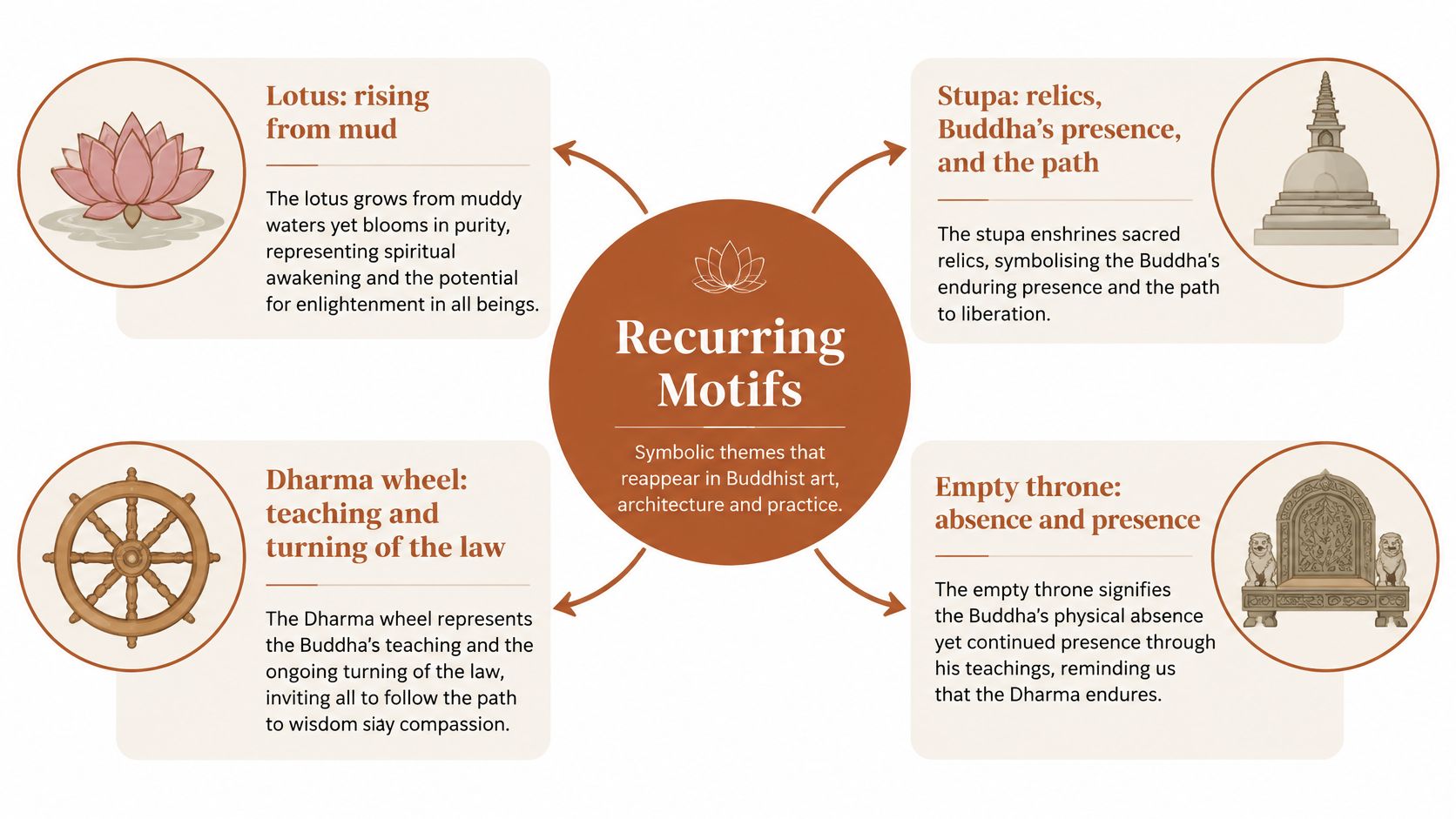
| Motif | Meaning | Where it appears |
|---|---|---|
| Lotus (padma) | Purity rising from mud, awakening | Base or seat beneath the figure |
| Stupa | Relics, the Buddha's presence and the path | Free-standing or behind the figure |
| Dharma wheel | The first teaching at Sarnath | Pedestal, palms or flanking the throne |
| Bodhi tree | The place of awakening | Background or beside a seated Buddha |
| Parasol (chattra) | Honour and sovereignty | Above the figure or a standing image |
| Empty throne and footprints (Buddhapada) | The Buddha's presence without a human form | Early reliefs such as Amaravati |
Buyers often make their most costly error here. An empty throne or a pair of footprints are catalogued as incomplete statues, fragments missing their main figure, and priced accordingly. They are not.
An empty throne is a complete theological statement. The absence is the point.
When a motif stands alone on a relief, read it as a sign of presence rather than a missing piece. The stupa holds relics and represents the Buddha's presence and the structure of the path. The wheel recalls the first teaching. The parasol signals honour. Each one works without a body at the centre.
How Meaning Shifts Across Traditions and Settings
The most attractive simplification in Buddhist art is that a gesture, lotus or crown has one stable meaning across all traditions. Museum scholarship pushes back on it, and so should anyone writing a catalogue entry.
Three broad traditions carry different emphases. Theravada, practised across Sri Lanka, Thailand, Burma, Cambodia and Laos, tends toward restrained Buddha imagery with strong narrative clarity. Mahayana, across China, Korea, Japan and Vietnam, brings in a wider cast of bodhisattvas and celestial figures. Vajrayana, across Tibet, Nepal, Bhutan and Mongolia, gives greater weight to the vajra, mandala-based deities and wrathful protective forms.
The same visual feature can shift emphasis between them. A crown on a Buddha is unusual in one setting and doctrinally meaningful in another.
Setting matters just as much as tradition. A temple shrine treats the image as a locus of worship. A museum case presents it as art, and displays have historically prioritised material and aesthetic qualities over sacred context. A home altar supports daily practice. A designed interior may read the figure only as calm.
The redisplay of the Buddhist collection at Chiddingstone Castle shows what changes when interpretation widens. UK Buddhist and Tibetan communities contributed to the reading and helped uncover meanings that earlier collector-centred displays had obscured.
That's a working model for anyone describing an object. Record which tradition and which setting the reading assumes. Say where provenance is incomplete. Our guide to regional Buddha statue styles across Thai, Burmese, Chinese, Tibetan and Gandharan work is useful for pinning down which regional convention a piece follows before you assign meaning.
How to Read a Sculpture Step by Step
A reliable reading follows a fixed order so that no single clue gets over-weighted. Work through it every time, even when the answer seems obvious at a glance.
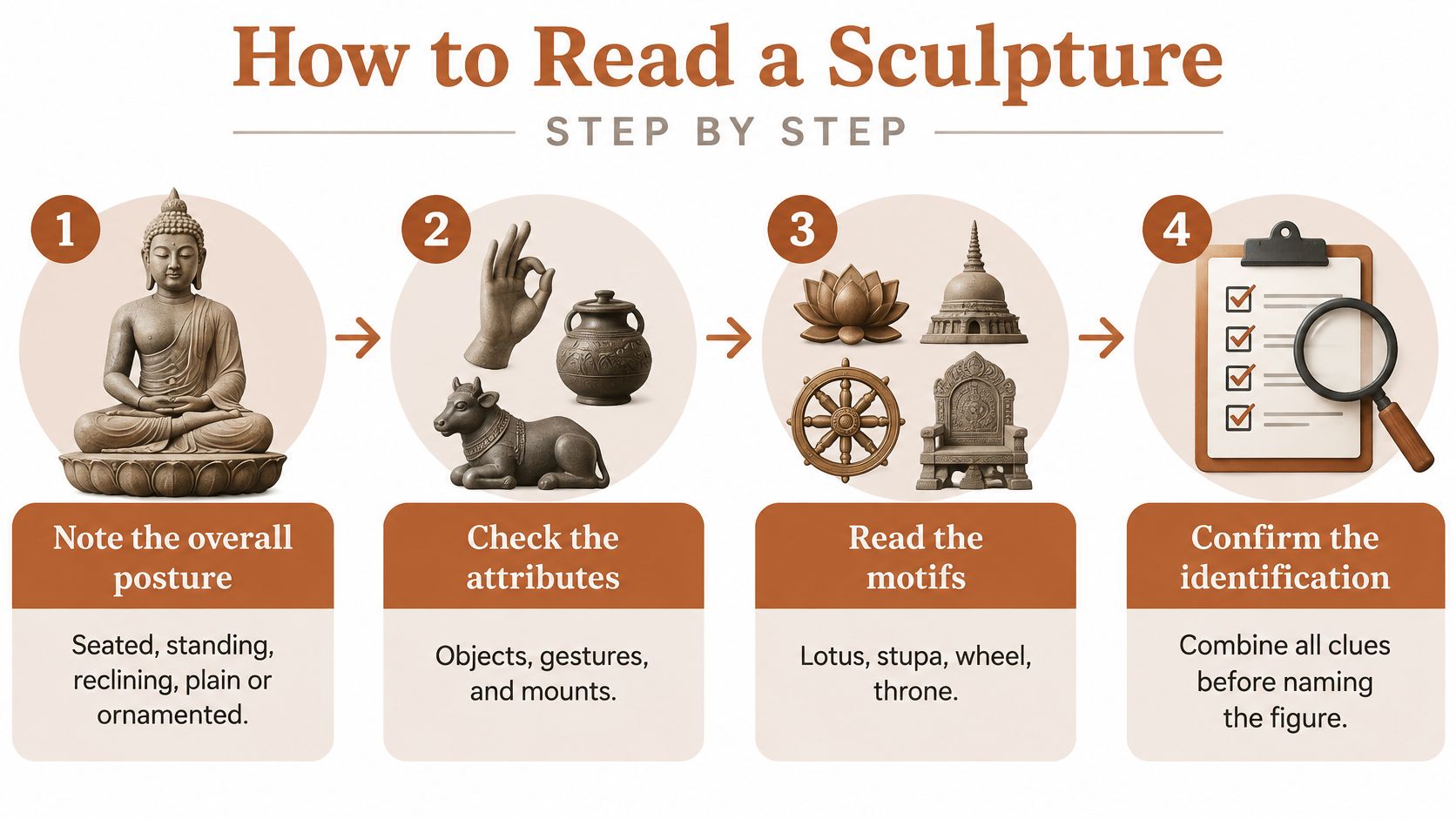
1. Note the overall posture. Seated, standing or reclining, and whether the figure is plain or ornamented. Do this before anything else because posture sets the category: a jewelled, relaxed figure points away from a Buddha before you've looked at a hand.
2. Check both hands. Not just the visible one. The most common error in the whole process is reading a single raised palm and stopping there, when the second hand is what tells you whether it's abhaya or ham samut.
3. Identify the attributes. What the figure holds, sits on or has beside it. Compare against the attribute table, then ask whether that object is original. A restored hand can carry a later addition.
4. Read the motifs. The lotus base, stupa, wheel or parasol. Decide whether each one signals the Buddha's presence or identifies the scene. A lotus base is usually a statement about awakening, not a decorative plinth.
5. Note the regional style and any inscription. Compare the carving with the tradition it appears to follow. Face shape, robe treatment and jewellery conventions do a lot of the work here.
6. Check provenance and age. Antique, vintage or a contemporary piece inspired by historic temple art. This step comes late because it doesn't change what the image depicts, only how much confidence you place in the physical evidence.
7. State the reading with its level of certainty. Mark which layer is firm and which is open. This is the step most descriptions skip, and the one that makes a description trustworthy.
Phone checklist: posture, both hands, attributes, motifs, style, provenance, certainty.
Here's the method applied. A seated figure in plain robes with an ushnisha, the right palm raised outward and nothing in either hand reads as a Buddha in abhaya mudra, with reasonable confidence. Add a jewelled crown and a relaxed pose and the reading shifts toward a bodhisattva. Put a lotus in the hand and you're checking Avalokiteshvara or Tara against the gesture before you commit.
Confirm the Iconography Before You Buy or Display
Everything above converges on one decision, and it's worth making it explicitly rather than hoping the description is right.
Before you buy or place a sculpture, check that the listing names the mudra, the posture and the attributes, gives the stylistic origin (Khmer, Thai, Indian school and so on), and states whether the piece is antique, vintage or a contemporary work inspired by historic temple art. Then ask whether the hands and attributes are original or restored, and whether any restoration is disclosed.
That's a reasonable bar, and it's the one our catalogue entries are built to meet. Each product description explains the statue's stylistic origin, such as Khmer, Thai or Indian school, and whether it is antique, vintage, or a high-quality contemporary piece inspired by historic temple art. Descriptions also set out the symbolism of each pose and mudra, so the iconography is legible before purchase rather than after delivery.
Decision rule: if the hands, posture and attributes in the description match the tables here, the iconography is confirmed. If they conflict, ask for the provenance and the regional reading before you commit.
Match purpose to setting as well. A meditation Buddha suits a calm room or a practice altar. A museum-style piece suits a considered interior where it can be looked at properly. Keep the figure clean, raised from the floor, and away from bathrooms, cluttered areas or anywhere it might be treated casually.
The next step is small and concrete. Compare the image in front of you against the three tables, write down the reading in three layers (iconography, tradition, present use), and keep that note with the object record. It'll serve you better than memory when someone asks what you've bought.
At HD Asian Art we publish the iconography alongside the object, so every Buddha statue listing explains its pose, mudra and stylistic origin before you decide. Browse the HD Asian Art collection by region, from Burmese and Thai pieces to Khmer and Indian schools, and compare the descriptions against the tables in this guide. If a gesture or attribute isn't clear, ask us directly and we'll tell you what the evidence supports.
