



Surya Statue and Javanese Hindu-Buddhist Sculpture Guide
Surya Statue and Javanese Hindu-Buddhist Sculpture Guide
A Surya statue is one of the most rewarding pieces a collector can bring home from Asia, and one of the easiest to misread. The Hindu sun god appears across South Asian art for centuries, but his image in Indonesia developed under its own conditions, shaped by the Singhasari and Majapahit courts and by the East Javanese workshops that followed. If you have ever held a stone figure from Java and wondered whether it was Hindu, Buddhist, or a blend of both, you are not alone. This guide explains how to read these sculptures, where Surya fits into the Javanese tradition, and what to check before you buy.
Table of Contents
- Quick Takeaways
- Historical Context: Singhasari, Majapahit and East Java
- Javanese Iconography and Religious Syncretism
- Surya Iconography and Worship Evolution
- Surya Statues and the Indian Temple Sculpture Connection
- Comparing Singhasari, Majapahit and East Javanese Styles
- Buying and Authenticating a Javanese Surya Statue
- Displaying a Surya or Javanese Piece on a Home Altar
- Frequently Asked Questions
- References
Quick Takeaways
|
Key Insight |
Explanation |
|---|---|
|
Identify Surya by his solar attributes first |
Look for a lotus, a crown and a chariot before you read anything into the period or the religious setting. |
|
"Javanese" does not mean one style |
Singhasari, Majapahit and later East Javanese work differ in proportion, ornament and surface finish. |
|
Religious blending is normal |
Shiva-Buddhist ideas appear in Singhasari and Majapahit art, so a mixed reading does not automatically mean a fake. |
|
Majapahit continued Singhasari |
Dating by period alone is risky, so weigh regional style and stylistic detail together. |
|
Provenance matters more than polish |
Ask for documented origin and prior ownership before paying a premium for a sharp, clean surface. |
|
Wear should tell a consistent story |
Weathering, edge rounding and old repairs should match the age and use a seller claims for the piece. |
Historical Context: Singhasari, Majapahit and East Java
Indonesia's Hindu-Buddhist sculpture grew out of a long exchange with India. Indian religious ideas shaped local artists heavily, but those artists kept adapting forms to island materials and local tastes.
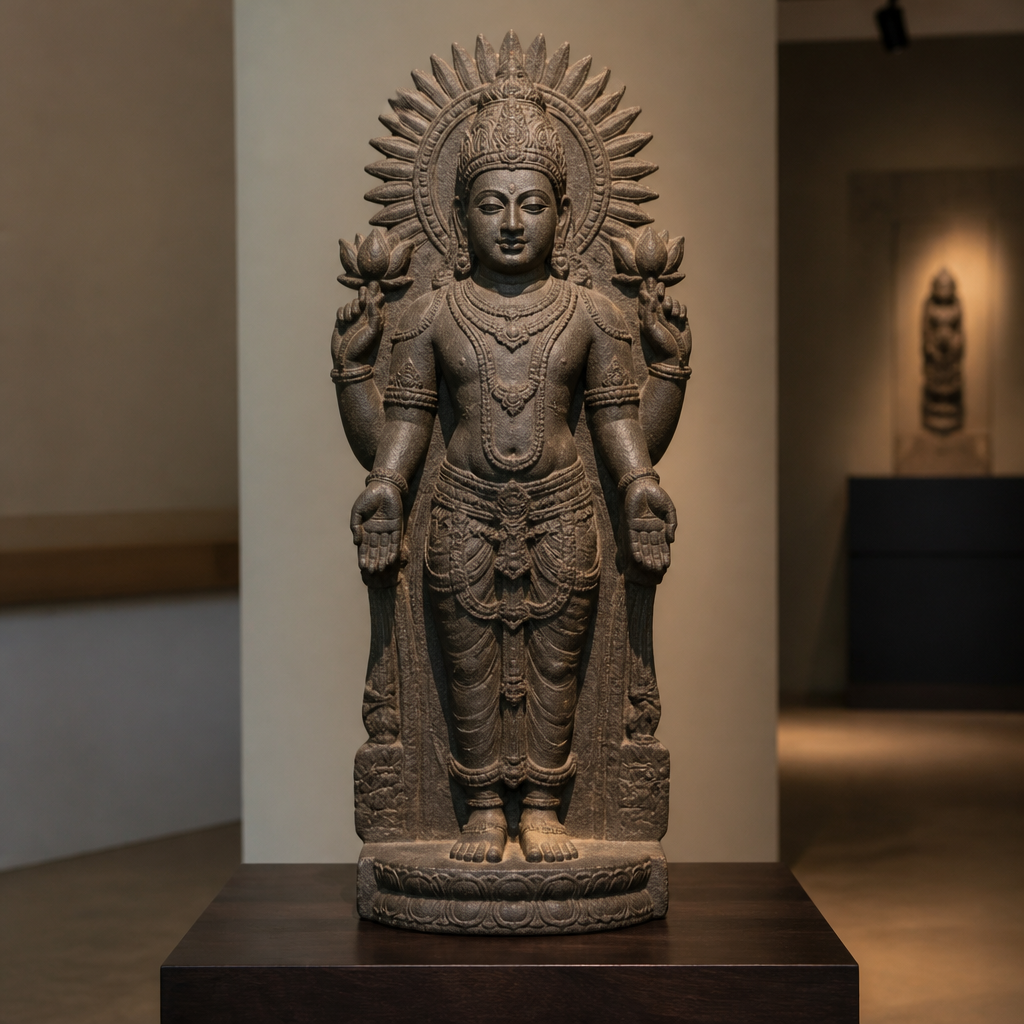
The Singhasari kingdom in East Java produced some of the most important sculpture of the thirteenth century. Its statues established a stylistic vocabulary that later artists drew on for generations. When you see a figure with a compact, carefully modeled form, you are often looking at a tradition that had already matured before the Majapahit court rose to power.
Singhasari as the Anchor Style
Singhasari sculpture is the reference point for almost every serious Javanese attribution. Collectors often start with a stone figure they like, then look for the features that connect it back to this period. In practice, the most useful evidence is the combination of face, posture and ornament rather than any one detail.
A common mistake is to call any old East Javanese stone figure Singhasari because it looks heavy and weathered. Weathering can be produced quickly by a buyer or a seller, and it tells you little about the workshop that carved the piece. Treat Singhasari as a hypothesis to test, not a conclusion to start from.
Majapahit as Continuation, Not Break
Majapahit art carried this inheritance forward. Its statues of Hindu gods and Buddhist deities continued the forms of earlier Singhasari work, which is why the two periods can look alike to a buyer without a trained eye. The differences usually appear in finer ornament and overall proportion rather than in a single signature feature.
This continuity has a practical consequence for buyers. A piece described as Majapahit may carry clear Singhasari traits, and that is not a contradiction. What you should expect is a coherent set of stylistic choices that fits the claimed period and region.
Javanese Iconography and Religious Syncretism
Many Javanese sculptures resist a simple label of Hindu or Buddhist. Research on Singhasari and Majapahit temples discusses a Shiva-Buddhist concept, which points to a worldview where the two traditions were combined in worship rather than kept strictly apart. For a buyer, this means the religious identity of a piece is often a matter of emphasis, not a clean binary.
The safest approach is to read the whole object. Consider the deity or figure, the seat or pedestal, the hand positions and any surrounding motifs. A single attribute can mislead you, but the full set is usually telling.
The Shiva-Buddhist Concept in Practice
When Hindu and Buddhist elements appear together, the question is not whether the object is "pure" but what the maker intended. A Shiva-Buddhist reading helps explain figures that do not fit a single textbook category. It also prevents you from dismissing a genuine piece simply because it does not match a narrow catalogue description.
A Javanese sculpture rarely announces its religion in one feature. Read the set of attributes, the seat, the hands and the setting together before you decide what you are looking at.
Pro tip: Photograph the back and sides of a piece as well as the front. Many iconographic clues, including secondary figures and supporting motifs, sit on the reverse or along the base.
Reading Attributes Before Labels
Start with what the figure holds, wears and stands on. These details are more reliable than the name a seller gives the piece, and they are what you will compare against reference material. Write them down before you look at the price.
Be cautious with photo-based identifications posted online. Community discussions often suggest a period or style from a single image, and that suggestion is a starting point for research, not evidence. Verify with stylistic comparison and documentation.
Surya Iconography and Worship Evolution
Surya is the Hindu sun god, and his iconography is built around solar identity. A Surya figure is usually recognized by a set of attributes rather than by an inscription, which makes careful visual reading essential. The development of his images shows how worship and representation changed over time.
Scholarly overviews of Surya iconography trace how his worship and representation evolved across regions. For collectors, the lesson is that a Surya figure from one period or place will not always match another. Expecting one fixed template leads to wrong conclusions.
Early Worship and Changing Forms
Early worship of Surya shaped the forms that later artists inherited and reinterpreted. As images spread, sculptors adjusted pose, dress and attendant figures to suit local customs and materials. This is why two Surya statues can share core attributes and still look very different.
For a buyer, the practical question is whether the piece's form matches the claimed region and period. A figure that belongs to a regional tradition should show that tradition's habits, not a generic idea of Surya assembled from photographs.
Attributes to Check on a Surya Figure
In many classical depictions, Surya holds lotus flowers and wears a crown. He is often shown in a chariot drawn by horses, commonly described as seven. Some northern depictions also show him in long boots, which is a detail worth checking when a seller makes a northern attribution.
Pro tip: Missing attributes are not automatically a sign of a fake. Damage, re-carving and losses are common on stone figures, so compare the surviving elements to the surface and the style before you decide what is missing.
Surya Statues and the Indian Temple Sculpture Connection
Indian temple sculpture is the foundation on which much Southeast Asian religious art was built. Indonesia's Hindu-Buddhist tradition has a strong Indian connection, and Surya images reflect that lineage. Understanding the Indian canon helps you see where Javanese carvers kept the rules and where they departed from them.
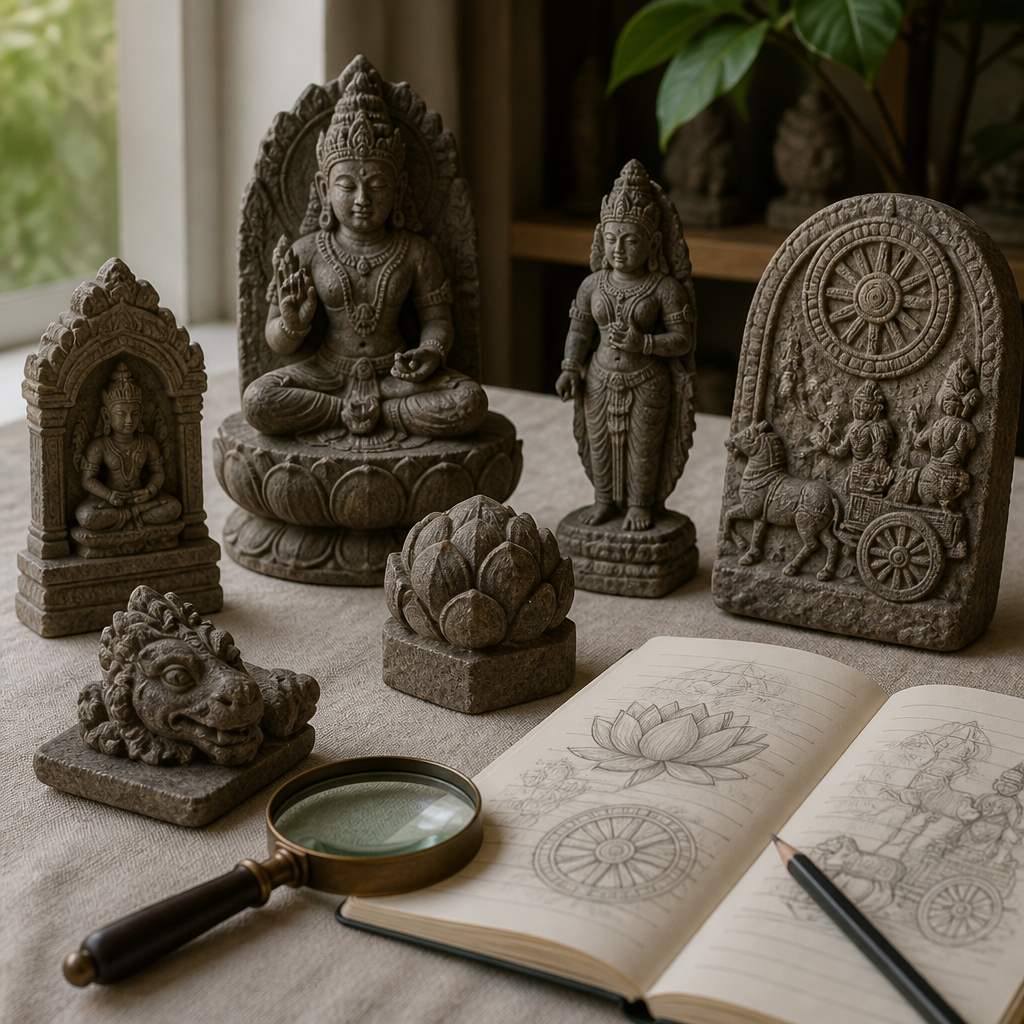
Indian models set the basic vocabulary of deities and attributes. Javanese sculptors worked within that vocabulary but applied their own sense of proportion, facial modeling and decorative detail. The result is a family resemblance rather than a copy.
Where the Indian Canon and Javanese Style Diverge
A useful test is to compare the proportions of the head, torso and limbs against Indian examples, then compare the ornament. Javanese work often shows a distinct treatment of the face and the way garments fall. These differences are subtle, so take your time and look at several reference images rather than one.
A common error is to assume that any Indian-looking figure must be an Indian import. Indonesian artists produced their own Hindu deities, and a Javanese piece can look Indian in its basic iconography while still being local in style and workmanship.
Why Indian Temple Sculpture Matters to Buyers
Knowing the Indian temple tradition helps you avoid two mistakes. The first is dismissing an authentic Javanese figure because it does not match an Indian standard. The second is accepting a piece as Javanese when its features are closer to a later, mass-produced Indian reproduction.
Use Indian temple sculpture as a comparison set, not as a verdict. The question to ask is whether the piece makes sense as a regional object within its own tradition.
Comparing Singhasari, Majapahit and East Javanese Styles
Buyers often use "East Javanese" as a catch-all, but the category covers distinct moments and workshops. The table below separates the three groups most often encountered in the trade. Use it as a checklist when a seller offers a period attribution.
|
Style |
Defining Traits to Look For |
Common Buyer Mistake |
|---|---|---|
|
Singhasari (thirteenth century) |
Foundational forms that later artists copied, with strong, carefully modeled figures in the Javanese manner |
Dating any East Javanese stone figure to this period because it looks old and weathered |
|
Majapahit (fourteenth to fifteenth century) |
Continuation of Singhasari forms with refined ornament, and Hindu deities and Buddhist figures sharing the same artistic language |
Treating Majapahit as a clean break and missing its Singhasari inheritance |
|
Later East Javanese provincial work |
Varied quality, simpler ornament and regional habits in local stone |
Paying an early-period price for a later or copied piece |
How to Use the Comparison in Practice
Compare the piece against all three categories before you settle on one. A figure that fits Singhasari in face and posture but has simpler ornament may be a later work that follows the older model. That profile is common, and it is a perfectly good piece if it is priced accordingly.
Keep in mind that style categories are working tools, not legal labels. They help you ask better questions, but they do not replace documentation or expert examination.
Where Regional Workshops Fit
Provincial workshops often reworked established forms for local patrons. Their output can be excellent, but it is harder to date and easier to overstate. When a seller describes a regional piece as a court work, ask what specific features support that claim.
Buying and Authenticating a Javanese Surya Statue
Authentication is less about a single test and more about a chain of evidence. Documentation, physical condition and stylistic consistency each carry weight, and a weakness in one area should make you look harder at the others. Good sellers expect these questions and answer them without defensiveness.
Questions to Ask a Seller
Ask where the piece came from, how long it has been held, and whether there are any export or import records. Ask what the seller believes the piece depicts, and which attributes support that reading. A reputable seller can explain the basis for a claim in plain language.
Ask about repairs, restoration and any re-carving. Some restoration is normal and even expected on old stone, but it should be disclosed so you can judge the piece accurately.
Patina, Wear and Repairs
Wear should match the story. Edges that have rounded over time, soft recesses and consistent weathering suggest age. Sharp, uniform surfaces, or wear that appears only on high points in an unnatural pattern, deserve closer inspection.
Look closely at joins, losses and filled areas. Modern fills and adhesives often look different under raking light, so ask to see the piece in good light from several angles before committing.
Pro tip: Ask for the piece to be photographed under raking light, with the light source at a low angle. Surface detail, tool marks and repairs are far easier to judge this way than in flat studio photos.
Red Flags Worth Walking Away From
Walk away when a seller cannot describe the origin, when the price is far below comparable pieces without explanation, or when the story changes between conversations. Pressure to decide quickly is another warning sign, since well-documented pieces can usually wait for due diligence.
A practical rule is to accept a period attribution only when the documentation, the form and the condition all point the same way. If one of the three is weak, the attribution should be treated as provisional. You can explore the full range of Buddha and Hindu deity statues at HD Asian Art, where each listing is a starting point for your own checks.
Displaying a Surya or Javanese Piece on a Home Altar
Many people bring a Surya or other Hindu-Buddhist figure into the home as a devotional object rather than a museum piece. The aims are different, but the care is similar. Stone is heavy, porous and sensitive to moisture, so the setting matters as much as the choice of figure.
Placement and Light
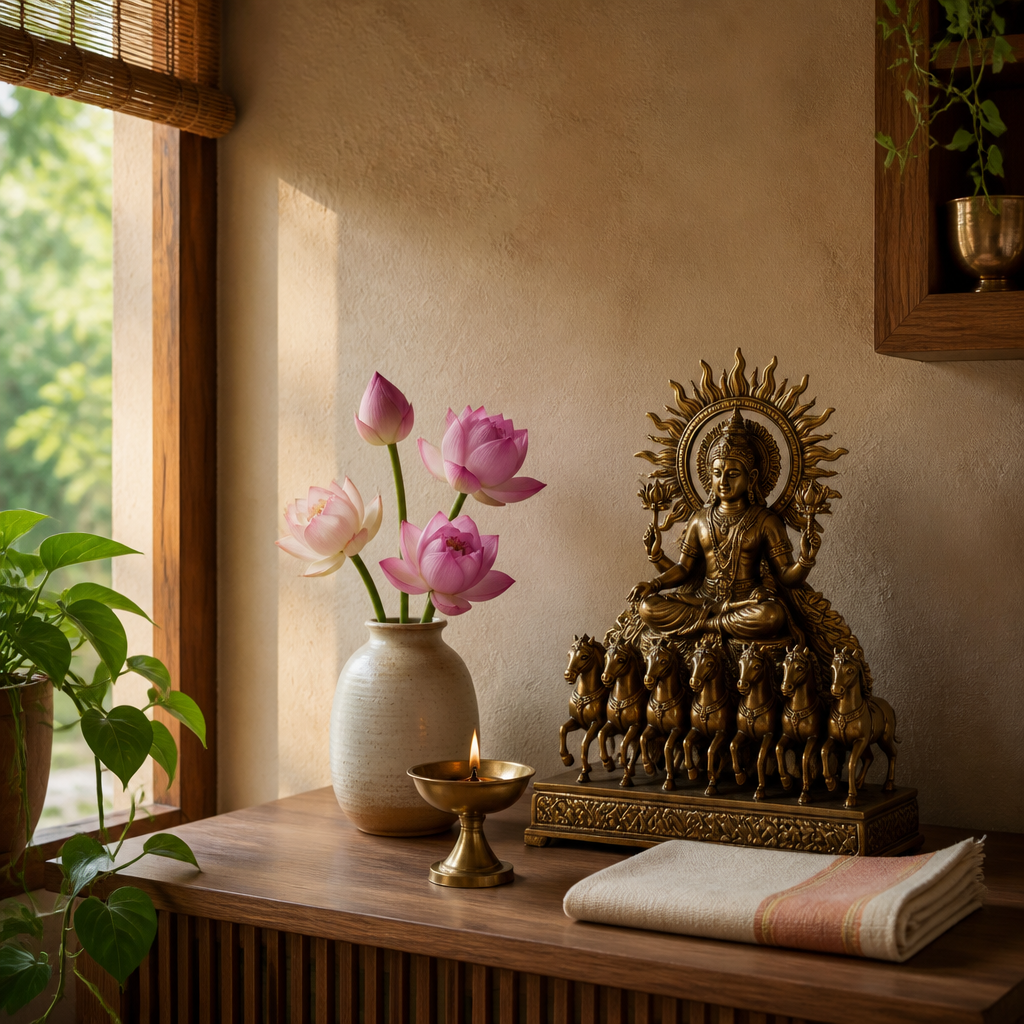
Choose a stable, dry surface at a comfortable height, away from radiators, direct sun and damp areas. Indirect light shows the carving best and protects the surface from fading or stress over time. Avoid placing the statue where it will be knocked or where small children can move it easily.
If you use the figure for daily practice, keep the area clean and dust-free. Dust settles into fine carving and can make later cleaning harder without damage.
Respectful Handling
Lift the statue with both hands, supporting the base rather than projecting elements such as hands, crowns or attendant figures. These are the parts most likely to break. Wash your hands before handling if the figure is part of a ritual setting.
Keep a record of the piece's condition when it arrives. If you later notice new damage, you will have a reference point for insurance or for consulting a conservator.
Frequently Asked Questions
What is a Surya statue?
A Surya statue depicts Surya, the Hindu sun god. He is recognized by solar attributes such as lotus flowers, a crown and a chariot, and these attributes matter more than any single inscription when you identify a figure.
How can I tell whether a Javanese statue is Hindu or Buddhist?
Read the whole object, including the deity, seat, hand positions and surrounding motifs. Many Javanese works blend Hindu and Buddhist elements, so a mixed reading is often accurate rather than a sign of a problem.
Is a Javanese Surya statue the same as an Indian one?
No. Javanese and Indian Surya figures share core iconography, but Javanese carvers worked with their own proportions, facial modeling and ornament. Comparing several reference examples from each tradition will show the difference.
Does a Singhasari attribution guarantee that a statue is old?
No. A Singhasari attribution should rest on stylistic evidence, documentation and consistent condition. Weathering alone does not prove the period, and it can be produced artificially.
What should I ask before buying a Javanese stone figure?
Ask about the origin, prior ownership, any export records and every repair or restoration. Request photographs under raking light so you can check the surface, joins and any filled areas for yourself.
Can a Surya statue be used on a home altar?
Yes, many people use Surya and other Hindu-Buddhist figures as devotional objects at home. Place the statue on a stable, dry surface away from direct sun and damp, and handle it by the base to protect fragile parts.
Tell us about your own experience identifying or owning a Javanese Hindu-Buddhist figure, especially whether the attributes or the seller's documentation changed your view of it.
References
-
Overview of Indonesian art and its Indian-influenced Hindu-Buddhist sculpture
-
Overview of the Majapahit kingdom and its continuation of Singhasari sculpture
-
Study of Shiva-Buddhist concepts in Singhasari and Majapahit temples
-
Document tracing the iconography and worship evolution of the Hindu sun god Surya
