



Choosing a Small Bronze Ganesh Statue: A Buyer's Guide
Choosing a Small Bronze Ganesh Statue: A Buyer's Guide
You're standing in front of two small bronze Ganesh statues that look almost the same at first glance. Both are dark, both feel substantial in the hand, and both seem right for a shelf, altar, or console table. Then you notice one is priced very differently, and the key question appears: what are you looking at?
The answer is rarely about shine alone. A good small bronze Ganesh statue asks you to look at casting, surface, scale, and care, then decide whether the piece is meant for daily worship, a quiet room, or a collection that values age and finish. In the right setting, bronze can read as devotional, decorative, or museum-like, but only if you know how to read the clues properly.
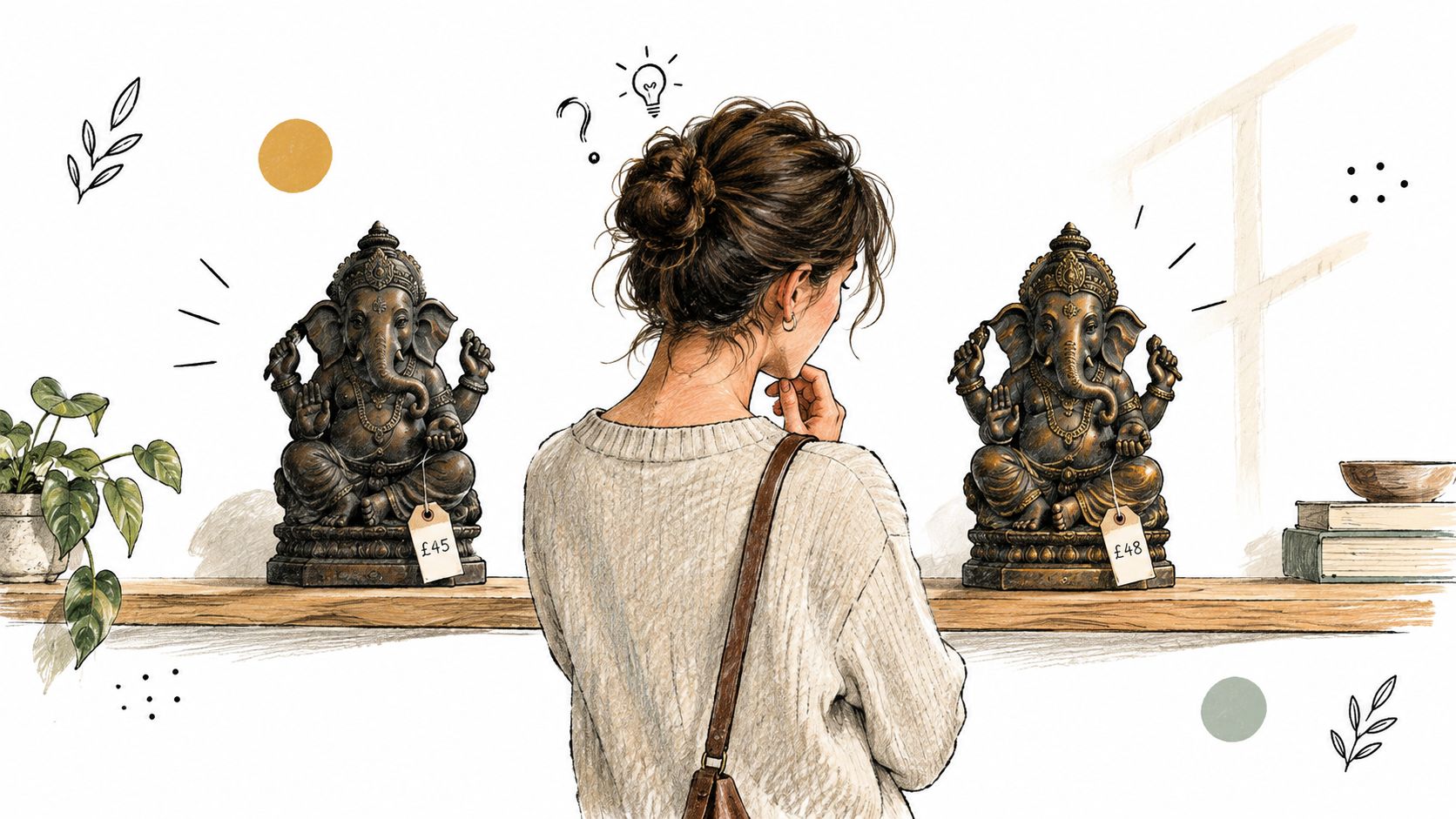
If you're arranging the figure on a shelf, it helps to think like a room stylist as well as a buyer. A practical guide such as how to decorate shelves can help you see why surrounding objects, height, and spacing matter almost as much as the statue itself.
Table of Contents
- Two Statues on the Same Shelf
- How Small Bronze Ganesh Statues Are Made
- Reading the Patina and Finish
- Ganesha Among Other Bronze Subjects
- Sizing Small Bronze Statues for Interiors and Altars
- What Drives the Price of a Small Bronze Ganesh Statue
- Caring for a Small Bronze Ganesh Statue in a UK Home
- Bringing It All Together Before You Buy
Two Statues on the Same Shelf
The easiest mistake is to compare two pieces only by height. A taller statue can still feel lighter, less refined, or less stable than a shorter one, because the eye is responding to casting quality, base design, and surface character rather than size alone. That's why a first look is often misleading.
A buyer stands in front of two figures and assumes the darker, shinier, or heavier one must be "better". In practice, one may have a cleaner cast, a more stable base, or a finish that has been cared for more thoughtfully. The other may have been polished harder, which can make it look newer without making it more desirable.
Four things to check before price
Start with the object's manufacture, then move to its surface, then to its placement, and finally to its care. Those are the four decisions that separate a decorative impulse buy from a piece you can live with. The same bronze can suit a prayer corner, a bookcase, or a collector's cabinet for very different reasons.
Practical rule: if two pieces look similar but one has sharper detail around the trunk, fingers, crown, or ornaments, that sharper piece usually tells you more about the casting and less about the seller's photography.
A useful frame is to treat the statue as a small architectural object. It needs a good silhouette, a stable footing, and a surface that can survive being touched, dusted, and moved without losing its character. Once you see it that way, price differences become easier to understand.
How Small Bronze Ganesh Statues Are Made
A buyer usually meets two broad casting routes. The first is lost-wax casting, where the artist makes a wax model, builds a shell around it, then melts the wax away before pouring in bronze. Our guide to the art of lost-wax casting and how it creates timeless statues shows why this method is prized for bronze figures. The second is sand casting, where a mould is packed from sand and used to form the cavity for the metal. The simplest analogy is a wine bottle. One method makes a unique bottle that is sacrificed to get the final shape. The other makes repeated copies from a more reusable mould.
The craft matters because it affects detail. Lost-wax usually allows finer modelling in places like the eyes, crown, tusk, hands, and the folds of clothing. Sand casting can still produce a useful and attractive figure, but it often reads more plainly in the smaller features. If you are choosing between two similar statues, the crispness of those small details usually tells you more than the seller's wording.
Why construction affects the buyer's experience
Solid and hollow construction feel different in the hand. A solid piece usually feels dense and reassuring, while a hollow one may be easier to place on a shelf or altar and may ring differently when tapped lightly. Neither is automatically better. Each carries a different balance of weight, transport risk, and repair complexity.
The Victoria and Albert Museum's bronze Ganesha dated 1650–1750 shows that cast bronze Ganesha figures have a documented historical lineage in the UK collection context, not just a contemporary décor role. That gives you a reference point for what established bronze workmanship can look like in a catalogued object. Museum examples also help show why a small figure can still carry serious craftsmanship.
If a seller cannot tell you whether the piece was cast by lost-wax or sand casting, ask again before you buy. The answer will not solve everything, but it tells you how much the seller understands the object.
Before purchase, ask about alloy, joins, and whether any separately made elements were attached after casting. A clear answer is often more useful than a polished sales line.
Reading the Patina and Finish
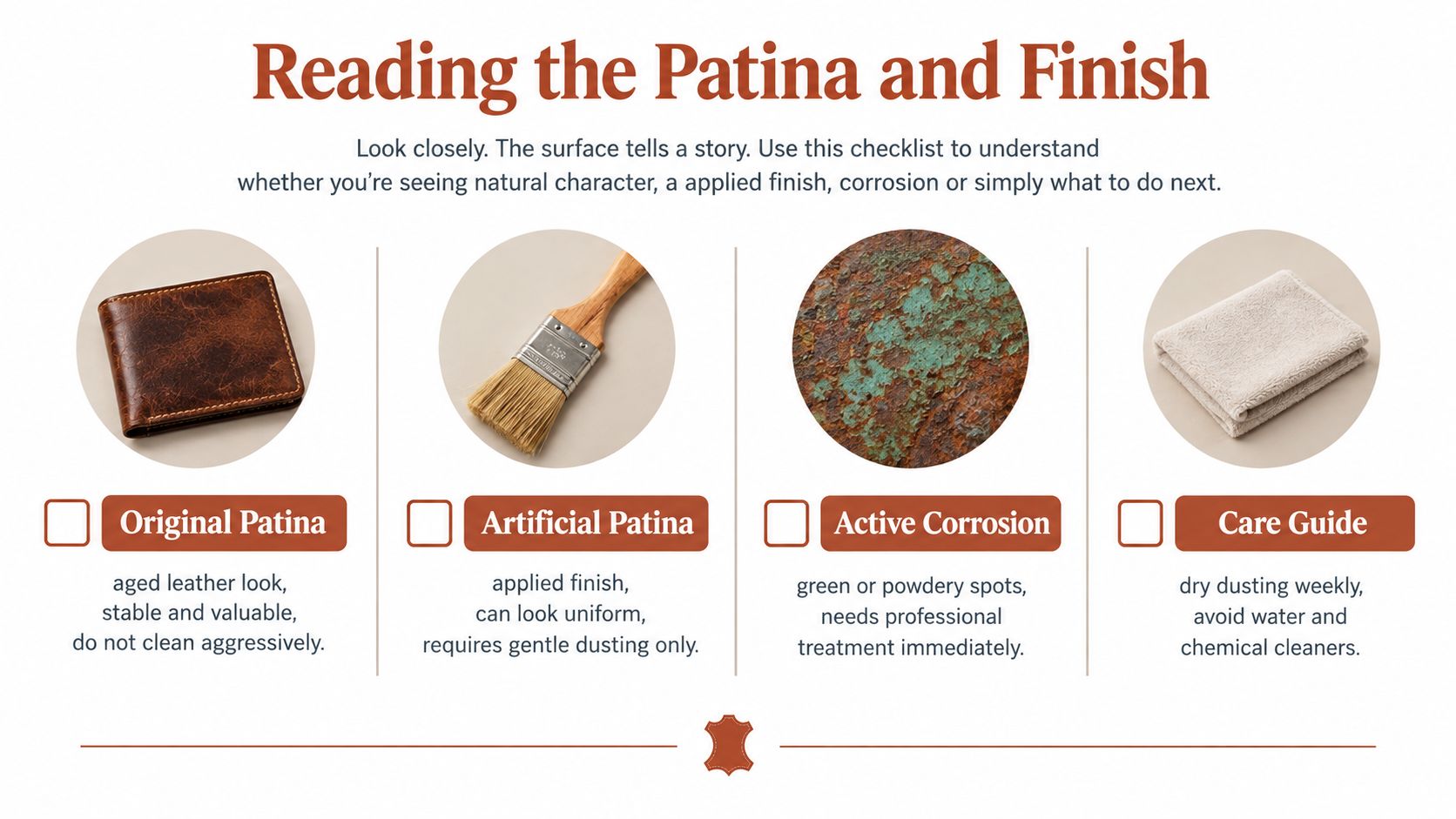
Patina is easiest to understand if you think of aged leather rather than fresh paint. Good leather has depth, variation, and wear that feels natural. Patina works the same way on bronze, because it can be original, intentionally applied, or the result of age and handling. The trick is knowing which of those you're seeing.
A dark surface is not automatically dirt. UK conservation guidance notes that bronze is comparatively durable, but protective waxes or lacquers need periodic renewal and should not be stripped casually. The British Museum's conservation policy also warns that wax coatings need regular maintenance, and that you should be careful before removing patina, lacquer, gilding, or painted details from bronze surfaces. See the British Museum conservation policy on bronze care for that broader approach.
What your eyes should pick up
Look for colour depth first. A stable patina often changes gently across raised areas and recesses, while a newer or heavily cleaned finish can look flatter and less nuanced. If the surface flashes unnaturally in the light, it may be coated rather than naturally aged.
Then check the vulnerable spots. Bright-green patches, pitting, pustules, powdering, or holes can point to active corrosion rather than a harmless old finish. That's where the difference between “old looking” and “stable” really matters, because aggressive polishing can remove chased detail as well as the protective surface.
A quick rule helps here:
Stable patina usually looks even but not identical, lacquered or waxed finish often looks more uniform and can show a sheen, and active corrosion often shows bright-green powder or rough, breaking surfaces.
For a small bronze Ganesh statue, that distinction is practical, not academic. The trunk, hands, crown, and jewellery need surface clarity to hold their visual language, so over-cleaning can make the figure less readable, not more attractive.
Ganesha Among Other Bronze Subjects
A small bronze Ganesh statue has a different visual logic from a seated Buddha or a Shiva figure. Buddha images usually prioritise calm symmetry and meditative stillness, while Ganesha is read through specific attributes, including the broken tusk, the trunk's direction, and the objects held in the hands. Those details tell you whether the figure is following a familiar devotional convention or borrowing the general shape of a Hindu bronze.
The Victoria and Albert Museum's second example, dated 1800–1875, is described as a three-piece cast-bronze seated Ganesha with a base and arch. It also records the axe, noose, sweets, and tusk, notes that the trunk turns to the left, and says the rat vehicle is absent. That catalogue-style description shows how much meaning sits in the details, even when the statue is small.
Choosing Ganesha on purpose
If you're comparing Ganesha with other bronze subjects, think about what the figure is meant to do in the room. A seated Ganesha usually reads as settled and devotional, while a standing or more dynamic figure changes the mood of the space. The choice is not only visual, it's also about the kind of attention the object asks for.
For buyers who enjoy comparing iconographic precision, even a museum-quality malachite lion such as this example from Astro West can sharpen the eye for proportion, base treatment, and the relationship between subject and support. Once you start reading those things in one object, you notice them everywhere.
A small household shrine often benefits from a figure that feels clear and settled rather than crowded with unnecessary flourish. A collector may want more complexity, but a worshipper often wants the iconography to read cleanly from a seated position. Those aren't the same requirement.
Sizing Small Bronze Statues for Interiors and Altars
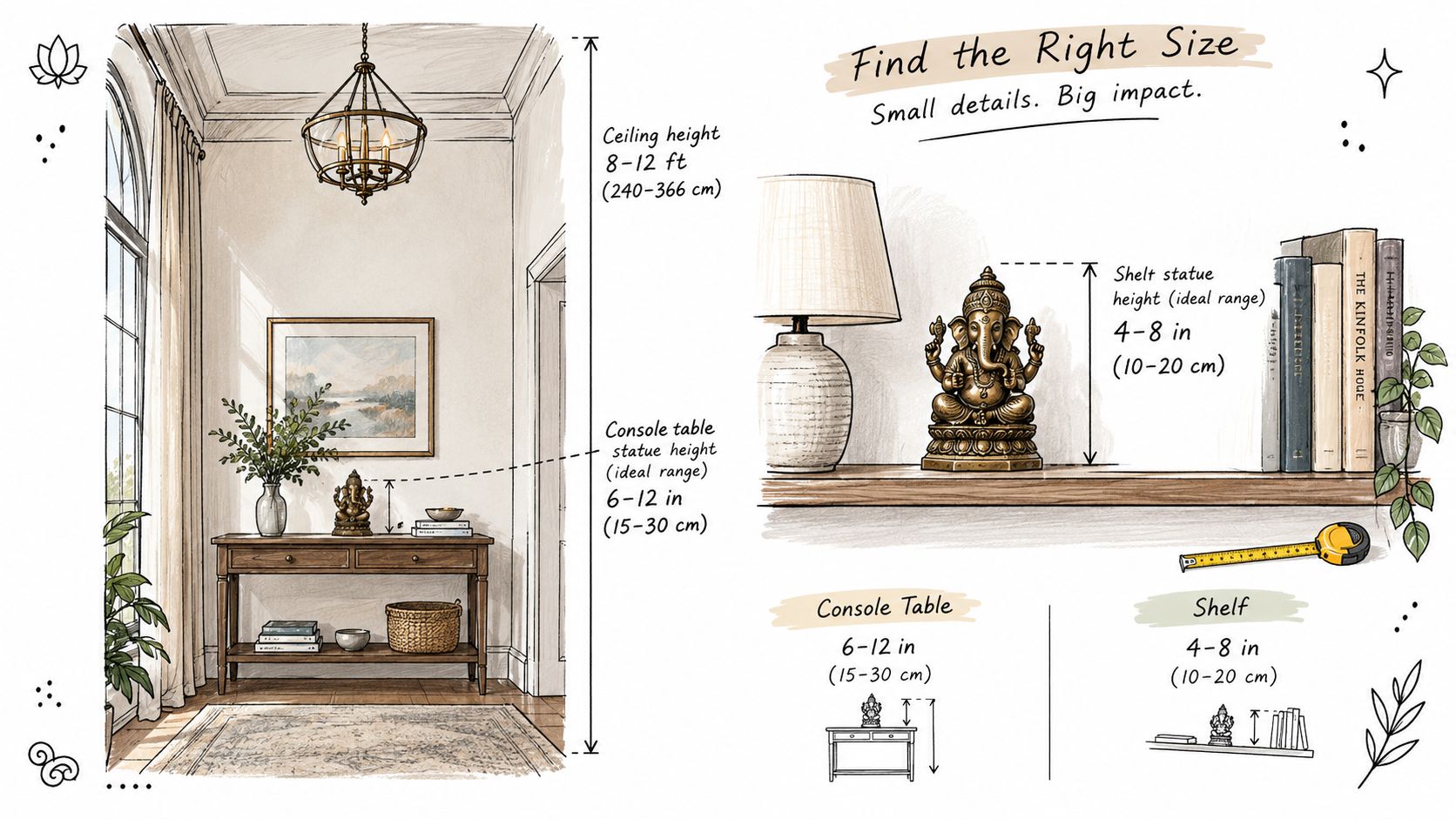
Scale is not just a measurement, it is a relationship. A small bronze Ganesh statue can look ideal in a product photo and still feel cramped on a console table, lost on a deep shelf, or too high if it sits above seated eye level. The size on paper matters, but the room decides how the piece reads.
For a desk or meditation corner, smaller figures in the 10–20 cm range usually stay visually calm and easy to place. For a domestic shrine or pooja shelf, 20–30 cm pieces often become the main focus without crowding nearby objects. These are guides rather than rules, because shelf width, surrounding objects, and viewing distance all change the effect.
Where the figure sits changes how it reads
A sacred figure usually sits most comfortably slightly below or roughly level with seated eye-line. Place it too high and it can feel detached, almost like a museum object on a distant plinth. Set it too low and it disappears into clutter. For a fuller treatment of placement, see our guide on where a Ganesh statue should be placed.
Stability matters as much as sightline. A narrow shelf needs a broader base than a deep console table, and any spot with vibration, children, or pets deserves extra care. A solid-cast bronze statue can still topple if it is perched poorly, and the first parts to suffer are often the base, the trunk, or another projecting detail.
A home altar asks for calm visibility, not height for its own sake. That is where museum habits help a private buyer. Conservators look for balance, secure support, and surfaces that can be read clearly without strain, and the same logic works on a shelf at home. The goal is a figure that feels settled, like a well-placed icon rather than an object waiting to slip.
What Drives the Price of a Small Bronze Ganesh Statue
Price is driven by more than size, and size is often the least interesting part of the story. The first variable is casting method, because finer work and more labour usually take more time. The second is alloy and origin, because a bronze from a known tradition or workshop context can be more valued than a generic decorative cast. The third is condition and provenance, because a clean history and intact surface matter to both collectors and institutions.
The UK market also has practical paperwork realities. GOV.UK states that there are no licensing requirements for importing objects of cultural interest into Great Britain, while export rules in the country of origin still apply. In other words, a buyer may not need a British import licence, but they still need to know whether the exporting country requires documentation for the object's departure.
Indicative price bands for small bronze Ganesh statues in the UK
| Price band | Typical profile | Best suited for |
|---|---|---|
| Under £150 | Contemporary decorative piece, often simpler casting and finish | Gifts, first altar, casual interior display |
| Mid-range collector level | Better casting, cleaner finish, stronger iconographic detail | Regular home use, collectors, thoughtful presentation |
| Higher-end museum-style work | Older, more refined, or provenance-sensitive piece with stronger surface and form | Serious collectors, institutions, long-term display |
Those bands are only a starting point. A visually similar pair can sit in very different places because one has more convincing casting, a more stable surface, or better documented origin. The most expensive object isn't always the one you should buy, but the cheapest one often tells you why it costs less once you inspect it closely.
For a broader view of value, insights from William Tucker Art are useful because they frame worth as a mix of material, workmanship, and context rather than price alone. That's the right way to think about bronze too.
Caring for a Small Bronze Ganesh Statue in a UK Home
A small bronze Ganesh statue stays in better condition when care is restrained. Cleaners can strip away patina, weaken the surface protection it provides, and blur chased detail around the face, hands, and ornaments. That surface is part of the object, not dirt sitting on top of it.
For preventive care, humidity matters more than polish. Conservation guidance for copper-alloy objects treats relative humidity as the main variable to watch, and a museum conservation source notes below 35% RH as a level that can help reduce the risk of bronze disease, the chloride-driven corrosion that can appear when moisture is present. That is why bathrooms, kitchens, window sills, and damp cellars are poor places for a small bronze Ganesh statue.
A routine that protects the surface
Dust the statue with a soft dry brush or a lint-free cloth. Keep it on a dry, inert support, and use a hygrometer if the piece has collection value or sits in a room that feels damp. If pale-green powdery spots appear, do not brush them away or polish harder, because that can spread corrosion rather than treat it.
Home altar use changes the cleaning question. Incense smoke, oil lamps, water offerings, and fingerprints can leave residue on bronze, but they call for light, careful cleaning rather than forceful restoration. If the statue has wax or lacquer, Historic England's bronze care guidance recommends periodic renewal, with annual reapplication as a practical guide, once the object is clean, dry, and properly assessed. Historic England's bronze care guidance sets out that approach in a way a private owner can follow.
A trained conservator is the right choice if you see active corrosion, lifting coating, cracks, or loose parts. The aim is not a shiny new finish. It is a surface that remains legible, stable, and safe to keep on display.
For a practical care reference, the HD Asian Art guide on cleaning bronze statues is useful because it keeps the focus on gentle maintenance rather than aggressive polishing.
Bringing It All Together Before You Buy
A good buying decision is simple when you reduce it to the right questions. First, ask where the piece comes from and whether its date is known or approximate. Then look at the casting method, the weight and base stability, the finish, and any sign of repair or reworking. Finally, ask how it will be packed and shipped, because fragile bronze can still suffer in transit if it's not secured properly.
The point is not to find a perfect statue. The point is to find one whose making, surface, and scale fit the job you want it to do. A private altar, a meditation room, a gift, and a collector's shelf all ask for slightly different answers.
Buying shortcut: choose the piece whose form is easiest to read from the distance you'll actually see it at, then check whether its surface condition and base are stable enough for that setting.
If you want a small bronze Ganesh statue that feels right in a home, collection, or gift setting, HD Asian Art offers curated Buddhist and Hindu sculpture with UK-based service and worldwide shipping. Visit HD Asian Art to compare pieces by subject, size, and finish, then choose the one that fits your room and your use.
