



Collectors: Stabilize First Before Choosing Restoration vs Conservation
Collectors: Stabilize First Before Choosing Restoration vs Conservation
Conservation stabilizes an object and slows further decay; restoration goes further, returning a piece to a known earlier appearance once it’s already stable. The rule of thumb: stabilize before you restore, favor conservation for long-term care, and reach for restoration only when the object’s condition and significance justify it.
Reversibility, whenever possible, is what separates responsible work from a quick cosmetic fix.
Key Features:
- Restorations should only be performed on objects that are stable and have been rigorously documented, as irreversible steps may compromise future conservation.
- Techniques vary significantly across materials, with paintings requiring surface cleaning and inpainting, while sculptures often involve reassembly and corrosion treatment.
- Proper qualification includes asking for written condition reports, clear explanations of proposed interventions, and confirmation of reversibility before treatment begins.
- Cost and duration depend on material rarity, damage complexity, and research involved, with phased treatments recommended to keep options flexible.
- Collectors should focus on preventive measures like stable storage and humidity control beforehand, avoiding household cleaners and seeking professional advice for any restoration decisions.
Table of Contents
- What Is the Difference Between Restoration and Conservation?
- Preventive Conservation, Remedial Conservation, and Restoration Explained
- When Should You Choose Restoration Over Conservation?
- How Do Techniques Differ Across Painting, Sculpture, and Architecture?
- Who Should You Hire, and What Should You Ask Them?
- What Drives the Cost and Timeline of a Restoration Project?
- What Practical Steps Can Collectors Take Before Hiring a Conservator?
- A Collector’s Take on Preservation and Presentation
- Where to Read More on Conservation and Restoration Standards
- Sources
- FAQ
What Is the Difference Between Restoration and Conservation?
The International Council of Museums Committee for Conservation treats conservation as an umbrella term. It covers preventive measures, remedial treatment, and restoration itself, all aimed at keeping a piece accessible to future generations. Restoration sits underneath that umbrella as a narrower, more invasive action, applied only once an object is already stable.
Smarthistory frames the distinction in plainer terms: conservation preserves a work from destructive forces, while restoration changes it so it resembles an earlier, chosen state. A cracked bronze that gets cleaned, humidity controlled, and monitored has been conserved. That same bronze, with a missing arm recast and reattached to match the original pose, has been restored.
A related term, preservation, often gets confused with both. Preservation focuses on preventing damage before it starts, through rehousing, enclosures, and climate monitoring, rather than treating existing damage.
- Conservation: stabilizes, slows deterioration, keeps future options open.
- Restoration: modifies appearance, often permanently, to recover lost form or function.
- Preservation: stops damage before it begins, through storage and environment control.
Preventive Conservation, Remedial Conservation, and Restoration Explained
Conservation work splits into two practical categories before restoration ever enters the picture, according to ICOM-CC’s own terminology.
- Preventive conservation addresses risk before damage occurs. Climate control in a display case, UV-filtering glass, and acid-free storage enclosures all fall here. None of it touches the object directly.
- Remedial conservation treats damage that has already started but stops short of changing appearance. Desalinating a waterlogged stone carving, consolidating flaking paint, or stabilizing a splitting wood joint are typical examples.
- Restoration goes beyond stabilization. Inpainting a lost section of a mural, filling a chip in marble, or reassembling broken ceramic fragments into a coherent whole all count. These actions modify how the object looks or reads, sometimes irreversibly.
The categories overlap in practice. A conserved and stabilized statue might later undergo restoration if a museum decides its exhibition value depends on visual completeness.
When Should You Choose Restoration Over Conservation?
Condition comes first. If a piece is actively deteriorating, remedial conservation takes priority, full stop. Restoration on an unstable object is like painting over rust: it hides a problem that keeps spreading underneath.
Significance matters just as much as physical state. A temple carving with rare inscriptions may be worth more to researchers in its damaged, historically honest condition than it would be with losses filled in. A decorative piece intended purely for display carries a different calculation, where visual completeness might matter more than archaeological purity.
Owner goals shape the decision too. A collector planning to loan a piece to a museum needs different documentation than someone restoring a statue for a private shrine room. Whatever the goal, write it down before work starts.
Reversibility and documentation aren’t optional extras. They’re the foundation of professional practice: every treatment should be undoable, or at minimum thoroughly recorded, so future conservators understand exactly what changed and why.
- Is the object currently stable, or actively deteriorating?
- Does its historical value depend on visible age and wear?
- What’s the intended use: display, sale, loan, or personal devotion?
- Has every proposed step been documented before work begins?
Pro Tip: If you’re unsure whether a crack is cosmetic or structural, stop and consult a conservator before touching it. What looks like surface damage on stone or bronze sometimes signals deeper internal stress that DIY cleaning can make worse.
How Do Techniques Differ Across Painting, Sculpture, and Architecture?
Material dictates method, and what’s routine for one medium can be destructive for another.
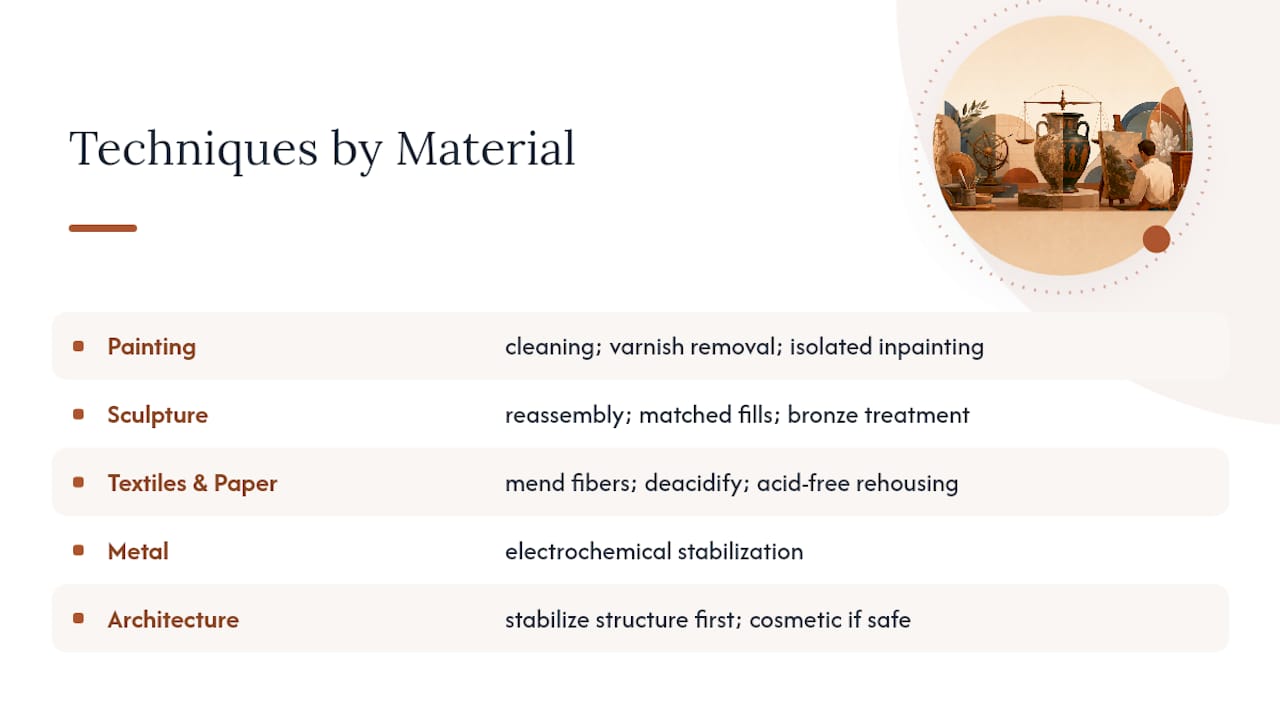
Paintings typically involve surface cleaning, varnish removal, and inpainting of losses. Varnish removal is reversible if done with the right solvents; inpainting over original paint is not, which is why conservators isolate it with a barrier layer first.
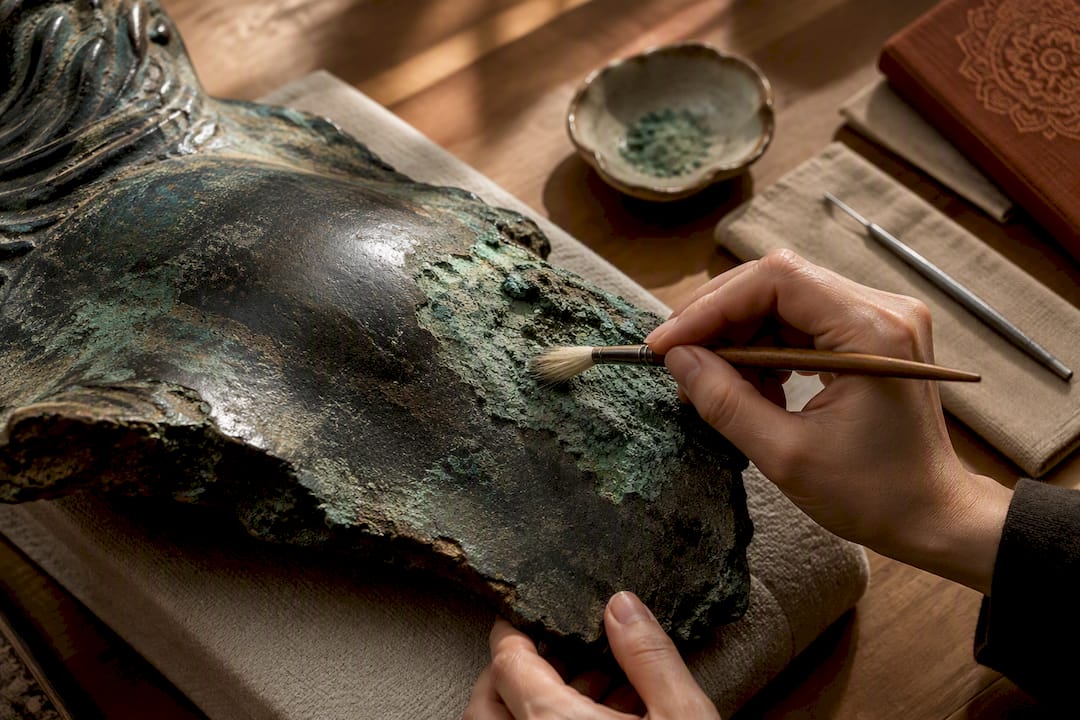
Sculpture work often means reassembly of broken pieces, fill materials matched to the original stone or metal, and, for bronze, active treatment of bronze disease, a corrosion process that spreads if left unchecked. HD Asian Art’s own guidance on sculpture materials explains why stone, bronze, and wood each age on different timelines and demand different handling.
Textiles and paper call for mending torn fibers, deacidification of paper pulp, and rehousing in acid-free enclosures.
Metal objects sometimes need electrochemical stabilization for active corrosion, a technique that requires specialist equipment and training.
Architecture follows a strict order: stabilize the structural fabric first, then consider cosmetic restoration only where it won’t compromise the building’s integrity.
Who Should You Hire, and What Should You Ask Them?
Qualified conservator-restorers typically train through graduate conservation programs or long-term apprenticeships tied to museum labs, and many follow the ethics guidance published by bodies like ICON in the UK. Credentials alone don’t tell the whole story, though. What matters more is how a professional talks through their process.
- Ask for a written condition report before any treatment begins.
- Ask exactly which interventions they’re proposing, and why each one is necessary.
- Ask whether each step is reversible, and how it will be documented if it isn’t.
- Ask about insurance coverage for the piece while it’s in their care.
- Ask for references from past clients with comparable objects.
Treat one answer as a warning sign: a promise that a piece will look “like new” with no mention of documentation or reversibility. That’s a sales pitch, not a professional treatment plan.
What Drives the Cost and Timeline of a Restoration Project?
Price and duration hinge on material rarity, the complexity of the damage, how much research the object requires, and the specialist labor involved. A stabilization job on a stable, minor object might run days; a full restoration involving research, sourcing matched materials, and phased treatment can stretch into months.
- Start with a condition report before agreeing to any scope of work.
- Plan treatment in phases rather than one irreversible push.
- Budget contingency for unexpected discoveries once cleaning begins.
- Ask for a written estimate that separates conservation steps from restoration steps.
Pro Tip: Phased treatment plans protect both your budget and the object. Stabilizing now and deciding on restoration later keeps your options open without locking in an irreversible choice under time pressure.
What Practical Steps Can Collectors Take Before Hiring a Conservator?
Collectors don’t need to wait for a crisis to protect what they own. HD Asian Art publishes conservator-backed guidance on stone cleaning and on halting bronze disease early, along with notes on identifying genuine patina versus damage. The underlying advice is consistent: stable storage, humidity control, and avoiding household solvents meaningfully extend an object’s life before any professional ever touches it.
- Photograph the object from multiple angles before doing anything else.
- Store it away from direct sunlight and fluctuating humidity, following guidance on storing antique stone sculpture.
- Never apply household cleaners, oils, or solvents to bronze, stone, or wood.
- Research the piece’s provenance before deciding whether restoration would reduce its historical value.
A Collector’s Take on Preservation and Presentation
Every collector feels the pull between an object that looks impressive on a shelf and one that stays historically honest. That tension is real, and pretending otherwise does a disservice to both the market and the object’s history.
My position is straightforward: choose the least invasive treatment that meets your actual goal, document every step, and bring in a professional before any irreversible decision. A piece that’s stable and honestly worn will always outlast one that’s been over-restored to satisfy a moment’s aesthetic preference.
— James, HDAsianArt.com
Where to Read More on Conservation and Restoration Standards
For deeper definitions and professional standards, consult ICOM-CC’s conservation terminology, Smarthistory’s overview of conservation and restoration, ICON’s practical guidance, and the UNT Special Collections blog on preservation versus restoration versus conservation.
If you’re considering a piece for your own collection, HD Asian Art’s curated Buddha statues and Hindu statues come with detailed condition notes and provenance research from the start, and the Masterpieces collection features museum-quality bronze, stone, and wood pieces vetted for long-term collectability.
Sources
- ICOM-CC terminology for conservation
- Conservation and restoration | Smarthistory
- Preservation vs. Restoration vs. Conservation | UNT
FAQ
What Are the Four Types of Historical Preservation?
Preservation practice generally groups into preventive care, remedial conservation, restoration, and reconstruction, though terminology varies by institution and country. ICOM-CC’s framework treats preventive conservation, remedial conservation, and restoration as the three core categories under its conservation umbrella, with reconstruction sometimes treated separately when an object is rebuilt largely from new material.
What Is the Difference Between a Conservator and a Restoration Professional?
A conservator focuses on stabilizing an object and preventing further damage, often prioritizing reversibility and documentation over appearance. A restoration professional works on already-stable objects to recover a specific earlier look, which often modifies the object’s appearance and can be difficult to reverse.
What Qualifications Do You Need to Be an Art Restorer?
Most professional restorers complete graduate-level conservation training or extended apprenticeships in museum or private conservation labs, often alongside coursework in chemistry and art history. Reputable practitioners also follow the ethics and documentation standards outlined by bodies like ICON.
What Does Restoration Mean in Architecture?
In architecture, restoration means returning a building or structural element to a known earlier appearance, but only after the underlying fabric has been stabilized. Structural stabilization always comes first, since cosmetic work on an unsound structure creates a false sense of safety.
